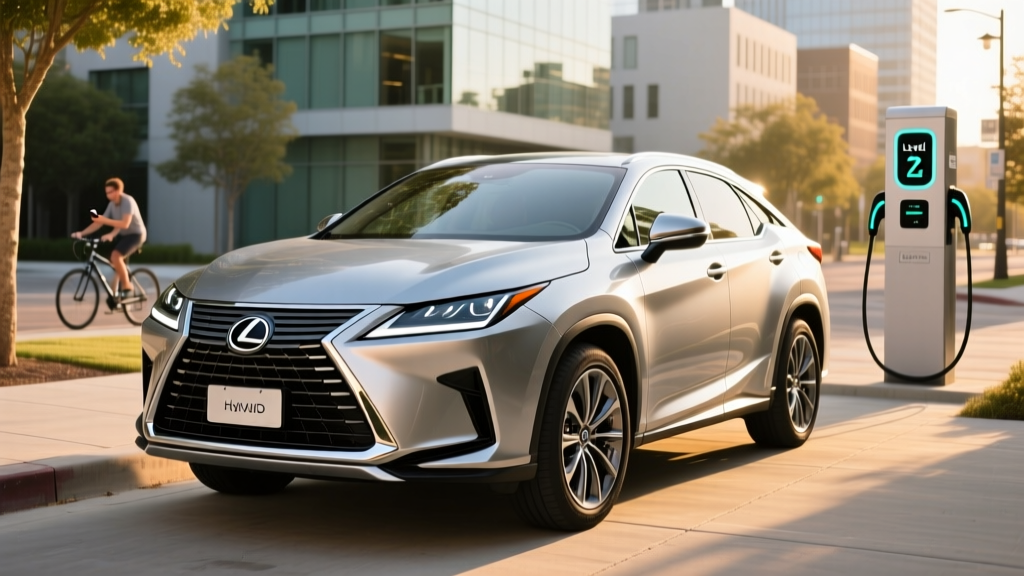
The Lexus RX has anchored the luxury midsize SUV segment for over two decades, and the current-generation RX 350h hybrid remains one of the most compelling options for buyers who want premium comfort without the fuel bills of a traditional V6. For 2026, the RX 350h continues with its proven four-cylinder hybrid powertrain, delivering strong city efficiency, standard all-wheel drive, and the build quality Lexus is known for. But with the RX 450h+ plug-in hybrid and a growing field of electric SUVs also available, where does the conventional RX 350h fit?
This guide breaks down the 2026 Lexus RX 350h hybrid's real-world fuel economy, powertrain specs, pricing, battery longevity, and how it compares to the plug-in variant and full EVs.
2026 Lexus RX 350h: HEV vs. PHEV — Understanding the Difference
Before examining the numbers, it is critical to distinguish between the two electrified RX models Lexus offers. The RX 350h is a conventional hybrid electric vehicle (HEV). It does not plug in. It recovers energy through regenerative braking and uses its gasoline engine to charge a small battery. You simply fuel it like any other car and benefit from improved efficiency.
The RX 450h+ is a plug-in hybrid electric vehicle (PHEV). It has a larger battery that you can charge from a wall outlet or public charger, giving it an electric-only driving range before the gas engine engages. This distinction matters enormously for daily driving, fuel costs, and tax credit eligibility.
| Feature | RX 350h (HEV) | RX 450h+ (PHEV) |
|---|---|---|
| Plugs in? | No | Yes |
| Electric-only range | ~1 mile at low speed | 37 miles (EPA) |
| Battery capacity | ~1.6 kWh (NiMH) | 18.1 kWh (lithium-ion) |
| DC fast charging | N/A | No (Level 2 AC only) |
| Level 2 charge time (0–100%) | N/A | ~2.5 hours at 6.6 kW |
| Combined horsepower | 246 hp | 302 hp |
| Federal tax credit (§30D) | Not eligible | Up to $7,500* |
| Base MSRP (2026) | $52,710 | $64,510 |
*RX 450h+ §30D eligibility depends on buyer income, battery sourcing, and MSRP caps per IRS rules. Consult a tax professional.
Fuel Economy: EPA Ratings and Real-World MPG
The 2026 Lexus RX 350h carries EPA ratings of 37 MPG city, 34 MPG highway, and 36 MPG combined, according to fueleconomy.gov. All-wheel drive is standard across every trim, so these figures apply regardless of configuration.
| Driving Condition | EPA Estimate | Real-World Expectation |
|---|---|---|
| City | 37 MPG | 36–40 MPG (hybrids excel in stop-and-go) |
| Highway | 34 MPG | 31–34 MPG (aerodynamic drag reduces hybrid advantage) |
| Combined | 36 MPG | 34–37 MPG |
| Cold weather (below 32°F) | — | 30–33 MPG (engine runs more for cabin heat) |
Hybrids typically exceed their EPA city ratings in real-world driving because regenerative braking recovers more energy in stop-and-go traffic. Highway driving is where the RX 350h's efficiency narrows closer to a conventional turbocharged four-cylinder SUV, since the electric motor provides less assistance at sustained high speeds. In mixed suburban commuting with moderate temperatures, owners regularly report 35–38 MPG. During winter months, expect a 3–5 MPG drop as the engine runs longer to warm the cabin and the battery operates less efficiently in cold conditions.
Powertrain and Performance Specs
The RX 350h pairs a 2.5-liter naturally aspirated four-cylinder engine with two electric motor-generators and Lexus's electronic all-wheel-drive system (e-AWD), which adds a rear-mounted electric motor. The combined system output is 246 horsepower.
| Specification | 2026 RX 350h |
|---|---|
| Engine | 2.5L inline-4 + 2 motor-generators |
| Combined horsepower | 246 hp |
| Combined torque | 233 lb-ft |
| 0–60 mph | 7.4 seconds |
| Drivetrain | e-AWD (standard) |
| Transmission | eCVT (electronically controlled) |
| Towing capacity | 3,500 lbs |
| Cargo volume (behind 2nd row) | 29.6 cu ft |
| Fuel tank | 17.2 gallons |
| Total driving range | ~619 miles |
The 7.4-second 0–60 time is adequate for highway merging and daily driving but trails the RX 500h F Sport Performance (366 hp, 5.9 seconds) and the RX 450h+ PHEV (302 hp, 6.2 seconds). The eCVT operates smoothly without the gear-hunting of a traditional automatic, though some drivers note a droning quality under hard acceleration — a characteristic of the planetary-gear eCVT design, not a defect.
Pricing, Trims, and Tax Credit Eligibility
The 2026 Lexus RX 350h starts at $52,710 (including destination) for the base trim and climbs to approximately $61,000 for the Luxury grade. Key trims include:
- Base: $52,710 — 9-inch touchscreen, wireless Apple CarPlay/Android Auto, heated front seats
- Premium: $54,910 — adds panoramic moonroof, power-folding rear seats
- Premium+: $57,410 — 14-inch touchscreen, ventilated front seats, 21-inch wheels
- Luxury: $60,910 — semi-aniline leather, heated/ventilated rear seats, head-up display
Federal tax credit: The RX 350h, as a conventional hybrid (HEV), does not qualify for the §30D federal clean vehicle credit. That credit is reserved for plug-in electric vehicles and fuel-cell vehicles. The RX 450h+ PHEV variant may qualify for up to $7,500, subject to the buyer's modified adjusted gross income limits ($150,000 single / $300,000 joint), the $80,000 MSRP cap for SUVs, and critical-mineral and battery-component sourcing requirements outlined by the IRS. Rules are subject to change; verify current-year eligibility with a tax professional.
Some states and utilities offer rebates for conventional hybrids, though these are far less common than EV/PHEV incentives. Check your state energy office or utility provider for local programs.
Battery Longevity, Warranty, and Replacement Cost
2026 Lexus RX 350h Hybrid Battery Warranty:
- Hybrid battery: 10 years / 150,000 miles (whichever comes first) in all 50 states
- Hybrid system components: 8 years / 100,000 miles
- Basic vehicle warranty: 4 years / 50,000 miles
- Powertrain warranty: 6 years / 70,000 miles
Lexus uses a nickel-metal hydride (NiMH) battery pack in the RX 350h — a mature, well-proven chemistry that has demonstrated exceptional longevity across Toyota and Lexus hybrids. Data from fleet and owner reports show these packs routinely lasting 150,000–200,000+ miles with minimal degradation. Unlike lithium-ion packs in EVs, NiMH hybrid batteries experience far fewer charge cycles (they operate in a narrow state-of-charge window, typically 40–80%) and generate less heat, both of which extend lifespan.
If replacement is needed out of warranty, a new OEM hybrid battery for the RX 350h typically costs between $3,000 and $5,000 including labor. Refurbished and aftermarket options are available for $1,500–$2,500. Individual module replacement (only the degraded cells) can reduce cost further. This is a fraction of the $10,000–$20,000+ replacement cost associated with large EV traction batteries.
For comparison, the RX 450h+ PHEV uses a larger 18.1 kWh lithium-ion pack with the same 10-year/150,000-mile hybrid battery warranty. PHEV batteries see deeper discharge cycles than HEV batteries, making the robust warranty especially valuable.
Who Should Choose the RX 350h Hybrid vs. PHEV or EV?
Choose the RX 350h (HEV) if:
- You cannot install a home charger (apartment, street parking, no garage)
- You want luxury SUV comfort with 36 MPG and zero behavior change
- You drive 12,000–15,000 miles/year and want low total cost without plug-in complexity
- You prioritize proven reliability and low battery replacement risk
Choose the RX 450h+ (PHEV) if:
- You have home Level 2 charging and a commute under 37 miles round-trip
- You want to drive mostly on electricity weekdays but take gas-powered road trips
- You may qualify for the $7,500 federal tax credit, narrowing the price gap
- You want 302 hp and a 6.2-second 0–60 time
Choose a full EV (e.g., Tesla Model X, BMW iX, Genesis GV60) if:
- You have reliable home charging and access to DC fast charging for road trips
- You want zero tailpipe emissions and the lowest per-mile fuel cost
- You are ready for EV ownership logistics (charging planning, cold-weather range management)
The RX 350h occupies a specific niche: buyers who want the refinement and efficiency gains of electrification without any change to their fueling routine. If you live in a region with reliable gas stations but limited charging infrastructure, or if your housing situation makes home charging impractical, the HEV is the rational choice. The $12,000 price gap between the 350h and 450h+ is substantial — even with a potential $7,500 tax credit on the PHEV, the HEV remains the more affordable entry point, and its fuel cost advantage over a gas-only RX 350 (24 MPG combined) saves roughly $600–$800 per year at current fuel prices.
Pros and Cons at a Glance
Pros
- 36 MPG combined — best-in-class for luxury midsize SUVs
- Standard AWD with no efficiency penalty vs. FWD
- 10-year/150,000-mile hybrid battery warranty across all states
- No plug-in charging required — zero lifestyle adjustment
- 619-mile total range eliminates range anxiety entirely
- Strong resale value; Lexus reliability reputation
Cons
- 246 hp feels modest for the price point; 7.4s 0–60
- No federal tax credit eligibility (HEV)
- eCVT drone under hard acceleration
- Base price above $52K — premium over non-hybrid RX 350
- Infotainment learning curve; no physical knobs for climate
- Rear cargo slightly reduced vs. gas-only RX due to battery placement
Frequently Asked Questions
How many MPG does the 2026 Lexus RX 350h hybrid get?
The EPA rates the 2026 RX 350h at 37 MPG city, 34 MPG highway, and 36 MPG combined. In real-world suburban driving, owners commonly achieve 35–38 MPG. Cold weather and sustained highway driving can reduce efficiency to 30–33 MPG.
Does the RX 350h need to be plugged in?
No. The RX 350h is a conventional hybrid (HEV). It charges its battery through regenerative braking and the gasoline engine. You fuel it at any gas station like a standard vehicle. If you want plug-in capability, look at the RX 450h+ PHEV.
How far can the RX 450h+ PHEV go on electric only?
The 2026 RX 450h+ has an EPA-rated electric-only range of 37 miles on its 18.1 kWh battery. This covers most daily commutes. After the battery depletes, it operates as a conventional hybrid with an estimated 35 MPG combined.
Is the Lexus RX hybrid reliable, and what does battery replacement cost?
Lexus and Toyota hybrids have an exceptional reliability record. The NiMH battery in the RX 350h commonly lasts 150,000–200,000+ miles. Replacement, if needed out of warranty, costs $3,000–$5,000 for a new OEM pack. The battery is covered by a 10-year/150,000-mile warranty.
Does the 2026 RX 350h qualify for any federal tax credit?
No. The §30D federal clean vehicle credit applies only to plug-in electric vehicles (BEVs and PHEVs) and fuel-cell vehicles. The RX 350h, as a conventional hybrid, is not eligible. The RX 450h+ PHEV may qualify for up to $7,500, subject to income, MSRP, and battery-sourcing requirements. Verify current eligibility at irs.gov.
How does the RX 350h compare to the non-hybrid RX 350?
The gas-only RX 350 (turbocharged 2.4L, 275 hp) gets an EPA-estimated 24 MPG combined and starts around $49,000. The RX 350h costs roughly $3,700 more but delivers 12 additional MPG combined, standard AWD (a $1,600 option on the gas model), and a smoother powertrain. Fuel savings of $600–$800 per year recoup the premium in approximately 5–6 years for an average driver.
Can the RX 350h tow?
Yes. The 2026 RX 350h is rated to tow up to 3,500 pounds when properly equipped — sufficient for a small boat trailer, utility trailer, or a pair of personal watercraft.