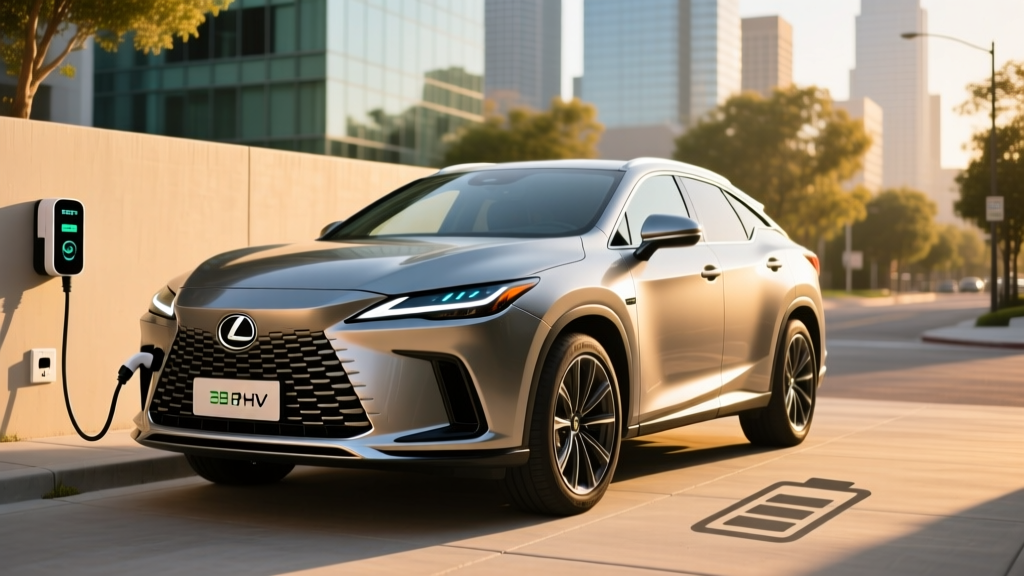
The Lexus RX has been America's best-selling luxury SUV for years, and its plug-in hybrid variant — the RX 450h+ — tries to offer the best of both worlds: daily electric commuting without any range anxiety on longer trips. For 2026, the RX PHEV continues to target buyers who want luxury and efficiency but aren't ready to commit to a full battery-electric vehicle. Here's a thorough, numbers-driven look at what the 2026 Lexus RX PHEV actually delivers.
HEV vs. PHEV: Which Lexus RX Are You Actually Buying?
Lexus sells the RX with two electrified powertrains, and confusing them is a common mistake. Here's the critical distinction:
RX 350h (Conventional Hybrid / HEV): Uses a small battery (~1.6 kWh) charged entirely by the engine and regenerative braking. You never plug it in. It achieves higher MPG than a gas-only RX but offers no meaningful electric-only driving.
RX 450h+ (Plug-in Hybrid / PHEV): Carries an 18.1 kWh lithium-ion battery that you plug in to recharge. It provides an EPA-rated 37 miles of electric-only range before the gasoline engine engages. Once the battery is depleted, it operates as a conventional hybrid.
This review focuses on the RX 450h+ PHEV. If your commute is under 35 miles round-trip and you can charge at home, the PHEV can run on electricity alone most weekdays while still handling 400-mile road trips without a second thought.
Powertrain, Horsepower, and Performance Specs
| Specification | 2026 Lexus RX 450h+ PHEV |
|---|---|
| Engine | 2.5L inline-4 Atkinson-cycle |
| Combined System Output | 302 hp |
| Electric Motors | Front + rear (eAWD standard) |
| 0–60 mph | 6.2 seconds |
| Drivetrain | Electronic AWD (eAWD) |
| Transmission | eCVT (planetary gearset) |
| Battery (Usable) | 18.1 kWh lithium-ion |
| EPA Electric-Only Range | 37 miles |
| Total Combined Range | ~420 miles (electric + gas) |
| Towing Capacity | 3,500 lbs |
| Cargo Volume (behind 2nd row) | 29.6 cu ft |
The 302-hp combined output comes from the 2.5L four-cylinder engine paired with front and rear electric motors. Unlike turbocharged competitors, the Atkinson-cycle engine prioritizes thermal efficiency over peak power, but the electric motors fill in torque instantly off the line. The 6.2-second 0–60 time is brisk enough for confident highway merging and passing.
Fuel Economy: EPA Ratings and Real-World MPG
| Driving Mode | City | Highway | Combined |
|---|---|---|---|
| Charge-depleting (EV mode) | 84 MPGe combined | ||
| Charge-sustaining (hybrid mode) | 37 MPG | 34 MPG | 36 MPG |
Source: fueleconomy.gov
Real-World MPG Expectations: Lexus hybrids historically match or exceed EPA city estimates in stop-and-go driving thanks to aggressive regenerative braking and frequent engine shut-off. Expect 38–40 MPG in city driving once the battery is depleted. Highway driving at 75+ mph will drop to roughly 31–33 MPG, as the engine runs more continuously and aerodynamic drag dominates. In cold weather (below 30°F), the engine starts more frequently to provide cabin heat, reducing electric-only range to roughly 28–30 miles and dropping hybrid-mode economy by 2–4 MPG.
The 37-mile electric-only range is the headline figure. Most Americans drive fewer than 40 miles per day, according to FHWA data, meaning many RX 450h+ owners will complete the vast majority of weekday driving on electricity alone — as long as they plug in each evening.
Battery, Charging Time, and DC Fast-Charge Capability
The RX 450h+ uses an 18.1 kWh lithium-ion pack (NMC chemistry) mounted beneath the rear floor. Here's what charging looks like in practice:
| Charge Method | Power | 0–100% Time | Notes |
|---|---|---|---|
| Level 1 (120V household outlet) | ~1.4 kW | ~13 hours | Overnight top-up only |
| Level 2 (240V home charger, 16A) | ~3.3 kW | ~5.5 hours | Standard onboard charger limit |
| DC Fast Charging | Not supported — no DC fast-charge port | ||
This is a critical limitation: the RX 450h+ cannot DC fast charge. The onboard charger maxes out at 3.3 kW, meaning even a 50 kW public fast charger won't help. A full Level 2 charge takes about 5.5 hours — fine for overnight charging, but it means you can't quickly top up the battery during a road trip stop. On long drives, the vehicle simply operates in hybrid mode at 36 MPG combined, which is still excellent for a 4,600-lb luxury SUV.
Preconditioning note: The RX 450h+ can precondition its battery while plugged in, warming it for better efficiency on cold mornings. Use the Lexus app to schedule preconditioning while the car is still on your Level 2 charger — this preserves electric-only range that would otherwise be consumed heating the cabin and battery.
Pricing, Trims, and Tax Credit Eligibility
| Trim | 2026 MSRP |
|---|---|
| RX 450h+ Premium | $63,350 |
| RX 450h+ Premium+ | $66,850 |
| RX 450h+ Luxury | $70,750 |
Prices include destination charge. Source: Lexus USA
Does the Lexus RX PHEV Qualify for the Federal Tax Credit?
Under IRS §30D rules (current for 2026), the RX 450h+ does not qualify for the full $7,500 federal EV tax credit. Here's why:
- Battery sourcing requirements: The §30D credit requires that a percentage of critical minerals and battery components be sourced from the U.S. or free-trade-agreement partners. Toyota/Lexus battery supply chains have not met these thresholds for the RX 450h+.
- MSRP cap: SUVs must be priced under $80,000 — all RX 450h+ trims clear this.
- Buyer income cap: AGI must be under $150,000 (single) or $300,000 (joint) — applies regardless of vehicle eligibility.
Some state-level incentives (e.g., California, New York, Colorado) may offer partial rebates for PHEVs. Check your state's energy office or IRS clean vehicle credit page for current rules, as these change frequently.
For comparison, the conventionally hybrid RX 350h starts at roughly $53,000 — about $10,000 less than the PHEV. That price gap takes many years of fuel savings to recoup unless your commute falls squarely within the electric-only range and electricity rates in your area are low.
Reliability, Battery Warranty, and Replacement Cost
Lexus Hybrid Battery Warranty: 10 years / 150,000 miles (whichever comes first), covering the hybrid battery against defects and capacity loss below a specified threshold. This applies to both the RX 350h and RX 450h+.
Powertrain Warranty: 6 years / 70,000 miles.
Limited Vehicle Warranty: 4 years / 50,000 miles.
Lexus (and parent company Toyota) has the deepest track record in hybrid reliability of any automaker, with over 25 years of hybrid production since the original Prius. The RX hybrid line specifically has proven durable — first-generation RX 400h models from 2006 are still on the road with original hybrid batteries in many cases.
Battery replacement cost: If the PHEV battery fails outside warranty, expect a replacement cost between $8,000 and $12,000 including labor, based on current Toyota/Lexus PHEV battery pricing. However, Toyota's hybrid battery design uses individual modules rather than a single monolithic pack, and independent hybrid specialists can often replace just the degraded modules for $2,000–$4,000 — a significant cost savings.
For peace of mind: Lexus's 10-year/150,000-mile hybrid battery warranty is among the longest in the industry, and real-world degradation data from Toyota PHEV platforms (RAV4 Prime, Prius Prime) shows roughly 8–12% capacity loss over 100,000 miles — well within usable range.
Who Should Buy the RX 450h+ vs. a Full EV or Gas RX?
Choose the RX 450h+ PHEV if:
- Your daily round-trip commute is 30–37 miles or less
- You can install a Level 2 charger at home (garage or driveway)
- You take road trips of 200+ miles several times per year and don't want to plan around charging stations
- You want luxury-crossover refinement with the lowest possible fuel cost for daily driving
Choose the RX 350h (conventional hybrid) if:
- You can't charge at home (apartment, street parking)
- Your commute exceeds 40 miles, meaning you'd rarely use the electric-only range
- The ~$10,000 price premium of the PHEV doesn't pencil out for your mileage
Choose a full EV (e.g., BMW iX, Genesis GV60, Tesla Model X) if:
- You have reliable home charging and want zero tailpipe emissions
- You want the lowest per-mile fuel cost and minimal maintenance
- You're comfortable with DC fast-charging on road trips (200–350 kW capability)
The RX 450h+ occupies a narrow but practical niche: it's the right choice for luxury buyers with short electric commutes who still need the flexibility of a gasoline engine for longer trips. If you can't charge at home, the PHEV premium is wasted — buy the RX 350h instead and enjoy 36 MPG combined without ever plugging in.
Pros and Cons at a Glance
Pros
- 37 miles electric-only covers most daily commutes
- 36 MPG hybrid mode after battery depletion is excellent for the class
- eAWD standard — confident in rain and light snow
- 10-year/150,000-mile hybrid battery warranty
- Lexus reliability and resale value track record
- Quiet, refined cabin with strong build quality
Cons
- No DC fast-charging capability
- 3.3 kW onboard charger is slow for a PHEV in 2026
- ~$10,000 premium over the RX 350h hybrid
- Does not qualify for the $7,500 federal tax credit
- Cargo space slightly reduced vs. non-hybrid RX (~29.6 cu ft)
- Electric-only range drops significantly in cold weather
Frequently Asked Questions
How many MPG does the Lexus RX PHEV get?
The 2026 RX 450h+ achieves an EPA-rated 36 MPG combined (37 city / 34 highway) once the battery is depleted and it operates as a conventional hybrid. In electric-only mode, it earns 84 MPGe combined. Real-world city driving often yields 38–40 MPG thanks to aggressive regen braking, while sustained highway speeds above 75 mph drop economy to roughly 31–33 MPG.
How far can the Lexus RX PHEV go on electric only?
The EPA rates the RX 450h+ at 37 miles of electric-only range. In real-world conditions, expect 33–37 miles in mild weather at moderate speeds, and roughly 28–30 miles in cold weather (below 30°F) when the battery is less efficient and cabin heating draws additional power.
Does the Lexus RX PHEV qualify for any tax credit?
As of 2026, the RX 450h+ does not qualify for the $7,500 federal §30D clean vehicle tax credit due to battery-sourcing requirements it does not meet. Some state incentives may apply — check your state's energy office. Consult a tax professional for your specific eligibility, as IRS rules are subject to change.
Is the Lexus RX hybrid reliable, and what does battery replacement cost?
Lexus has over 25 years of hybrid production history and consistently ranks at or near the top of J.D. Power and Consumer Reports reliability surveys. The hybrid battery is covered by a 10-year/150,000-mile warranty. Out-of-warranty replacement runs $8,000–$12,000 for the full pack, but module-level repair by a hybrid specialist can cost $2,000–$4,000.
Can I charge the RX 450h+ at a public fast-charging station?
No. The RX 450h+ does not support DC fast charging. It charges only via Level 1 (120V) or Level 2 (240V) AC power, with a maximum onboard charge rate of 3.3 kW. A full Level 2 charge takes approximately 5.5 hours. On road trips, simply drive it as a hybrid — it achieves 36 MPG combined without any plug-in required.
Hybrid vs. PHEV vs. EV — which Lexus RX should I buy?
If you can charge at home and your commute is under 37 miles, the RX 450h+ PHEV gives you the lowest daily fuel cost with full road-trip flexibility. If you can't charge at home, the RX 350h conventional hybrid delivers the same 36 MPG combined for $10,000 less. If you want zero tailpipe emissions and are comfortable planning road-trip charging, a full EV like the BMW iX or Tesla Model X eliminates gasoline entirely but requires lifestyle adaptation for longer trips.