2026 Lexus RX Hybrid MPG: The Numbers That Matter
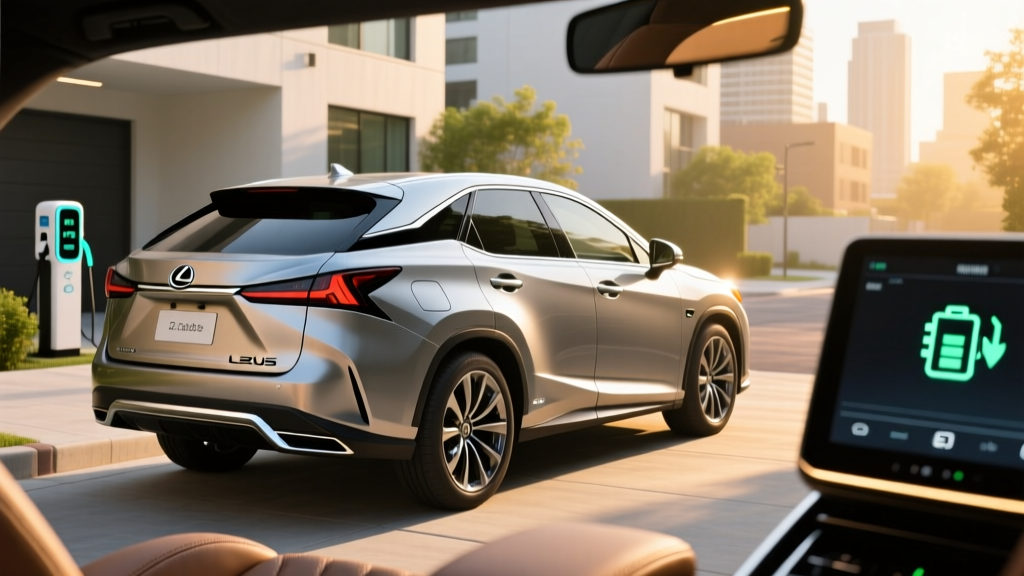
The Lexus RX has anchored the luxury midsize SUV segment for over two decades, and its electrified variants now represent a meaningful share of RX sales. For 2026, Lexus offers the RX in two hybrid flavors: the conventional RX 350h (a self-charging hybrid, or HEV) and the plug-in hybrid RX 450h+ (a PHEV with usable electric-only range). The mileage differences between the two are substantial, and which one makes financial sense depends entirely on how you drive and whether you can charge at home.
Here are the EPA-confirmed fuel economy figures for both powertrains, followed by the real-world context that sticker numbers alone don't provide.
| Model | Powertrain | City MPG | Highway MPG | Combined MPG | MPGe (PHEV) |
|---|---|---|---|---|---|
| RX 350h | HEV (2.5L 4-cyl + motors) | 37 | 34 | 36 | N/A |
| RX 450h+ | PHEV (2.5L 4-cyl + motors) | 35 (charge-sustaining) | 33 (charge-sustaining) | 35 (charge-sustaining) | 65 |
HEV vs PHEV: How the Two RX Hybrids Differ
The distinction between the RX 350h and RX 450h+ is not just about plugging in — it's a fundamentally different ownership model. Here's how the two powertrains compare at a structural level.
RX 350h — Conventional Hybrid (HEV)
- Never needs plugging in. The 1.1 kWh battery charges through regenerative braking and the gas engine.
- 36 MPG combined, always — no charging behavior to manage.
- Lower purchase price; no home charging infrastructure needed.
- Total range: approximately 570 miles on a full 17.2-gallon tank.
- No federal tax credit eligibility.
RX 450h+ — Plug-In Hybrid (PHEV)
- Must be plugged in to capture the electric-range and MPGe benefits.
- 37 miles of electric-only range (EPA) on a full charge.
- 35 MPG combined once the battery is depleted (charge-sustaining mode).
- Total range: ~420 miles (37 electric + ~383 gas).
- Eligible for up to $3,750 federal tax credit (subject to §30D rules).
If you can install a Level 2 home charger and your daily commute falls under 35 miles round-trip, the RX 450h+ lets you drive almost entirely on electricity during the week while retaining gas-engine flexibility for road trips. If home charging isn't an option or your commute regularly exceeds 40 miles, the RX 350h delivers excellent efficiency without any plug-in logistics.
RX 450h+ Electric-Only Range and Charging Details
The RX 450h+ carries an 18.1 kWh lithium-ion battery pack (usable capacity approximately 15.4 kWh). That's enough for an EPA-rated 37 miles of pure electric driving before the 2.5-liter four-cylinder engine seamlessly starts and the vehicle operates as a conventional hybrid.
| Charging Level | Power (kW) | Time to Full (0–100%) | Notes |
|---|---|---|---|
| Level 1 (120V household) | ~1.4 kW | ~11 hours | Overnight; sufficient for daily replenishment of 37 mi |
| Level 2 (240V home/public) | 6.6 kW (onboard max) | ~2.5 hours | Recommended home setup; uses standard J1772 connector |
| DC Fast Charging | Not supported | N/A | No CCS or CHAdeMO port; PHEV batteries rarely support DCFC |
The 6.6 kW onboard charger is standard for PHEVs in this class. A full Level 2 charge in roughly 2.5 hours means you can replenish during a workday at a public charger or top off at home between morning and evening commutes. The absence of DC fast charging is typical — PHEV battery packs are small enough that Level 2 speeds are adequate, and adding DCFC hardware would increase cost and weight for minimal benefit.
Powertrain Specifications: What Moves the RX Hybrid
| Specification | RX 350h (HEV) | RX 450h+ (PHEV) |
|---|---|---|
| Engine | 2.5L inline-4 | 2.5L inline-4 |
| Electric Motors | Front + rear (eAWD) | Front + rear (eAWD) |
| Combined Horsepower | 246 hp | 302 hp |
| 0–60 mph | 7.4 seconds | 6.2 seconds |
| Drivetrain | AWD (electronic rear axle) | AWD (electronic rear axle) |
| Battery Capacity | ~1.1 kWh (NiMH) | 18.1 kWh (Li-ion) |
| Towing Capacity | 3,500 lbs | 3,500 lbs |
| Cargo Volume (rear seats up) | 29.6 cu ft | 29.6 cu ft |
The RX 450h+ isn't just more efficient in electric mode — it's meaningfully quicker. The 302 hp combined output (a 56-hp advantage over the 350h) comes from a more powerful front electric motor and the larger battery's ability to deliver sustained current. The 6.2-second 0–60 time puts the PHEV in the territory of the turbocharged RX 500h F Sport Performance, but with a fraction of the fuel consumption.
Pricing, Trims, and Federal Tax Credit Eligibility
| Trim | RX 350h MSRP | RX 450h+ MSRP |
|---|---|---|
| Premium | $52,900 | $64,750 |
| Premium+ | $55,400 | $67,250 |
| Luxury | $59,900 | $71,500 |
The RX 450h+ commands roughly an $11,850 premium over an equivalent RX 350h trim. Whether that gap closes depends on your access to incentives and your driving pattern.
Federal Tax Credit (§30D) for the RX 450h+
Under current IRS rules for 2026, the RX 450h+ qualifies for a partial federal tax credit of up to $3,750, contingent on meeting critical-mineral and battery-component sourcing thresholds. The full $7,500 credit requires satisfying both the critical-minerals and battery-component requirements; as of 2026, the RX 450h+ typically meets one but not both, yielding $3,750. Key eligibility rules include:
- MSRP cap: SUVs must be priced at or below $80,000. All RX 450h+ trims qualify.
- Buyer income cap: Modified AGI must not exceed $150,000 (single), $225,000 (head of household), or $300,000 (joint filers).
- Point-of-sale transfer: You may transfer the credit to the dealer at purchase, reducing your out-of-pocket cost directly — even if you owe less than $3,750 in federal tax.
- HEV exclusion: The RX 350h (conventional hybrid) does not qualify for any federal EV tax credit. It is not a plug-in vehicle.
Always verify current-year eligibility on irs.gov before purchasing, as battery-sourcing requirements tighten annually and manufacturer eligibility can shift mid-year.
Battery Warranty, Reliability, and Replacement Cost
Both the RX 350h and RX 450h+ carry Lexus's hybrid battery warranty of 10 years or 150,000 miles (whichever comes first), transferable to subsequent owners. The general hybrid system components (inverter, electric motors, control modules) are covered under the same 10-year/150,000-mile warranty. The remainder of the vehicle carries a 4-year/50,000-mile basic warranty and 6-year/70,000-mile powertrain coverage.
Lexus hybrid reliability is among the strongest in the industry. The brand's hybrid synergy drive system has been in continuous production since 1997, and the 2.5-liter four-cylinder used in the RX hybrids is a naturally aspirated Atkinson-cycle engine — simpler and less stressed than turbocharged alternatives. There is no turbocharger, no high-pressure fuel system, and no traditional starter motor to fail.
Hybrid Battery Replacement Cost
If a hybrid battery fails outside of warranty, replacement costs vary:
- RX 350h (1.1 kWh NiMH): Approximately $3,000–$4,500 for a new OEM battery pack, plus labor (~$500–$800). The small battery is relatively inexpensive to replace.
- RX 450h+ (18.1 kWh Li-ion): Approximately $8,000–$12,000 for the larger lithium-ion pack, plus labor. This is a more significant expense, though failures within the 150,000-mile warranty window are rare based on Lexus's historical data.
In practice, Lexus hybrid batteries routinely exceed 200,000 miles with minimal capacity loss, particularly the NiMH packs in the HEV models. Lithium-ion degradation in the PHEV is managed by a substantial buffer — the vehicle never fully charges or fully depletes the pack, keeping the cells in their optimal state-of-charge window to maximize longevity.
Who Should Choose the RX Hybrid — and Which One?
The decision between the two RX hybrids (and between a hybrid and a full battery-electric vehicle) comes down to three questions: Can you charge at home? How far do you drive daily? And how important is upfront cost versus long-term fuel savings?
✓ Choose the RX 350h (HEV) If:
- You cannot install a home charger (apartment, street parking, no garage)
- Your daily driving exceeds 40 miles and you don't want to think about charging
- You want the lowest purchase price in the RX hybrid lineup
- You prioritize proven, simple technology with minimal new infrastructure
- You drive primarily in city traffic where regenerative braking maximizes MPG
✓ Choose the RX 450h+ (PHEV) If:
- You have a garage or driveway where you can install a Level 2 charger
- Your daily commute is under 35 miles round-trip (most weekday driving is electric)
- You want near-EV running costs Monday through Friday with gas-engine freedom on weekends
- You value the extra 56 hp and quicker acceleration
- You qualify for the $3,750 federal credit and your state offers additional PHEV incentives
✗ Consider a Full EV Instead If:
- Your daily driving regularly exceeds 40 miles and you want zero gas consumption
- You have reliable home charging and access to DC fast chargers for road trips
- You want to qualify for the full $7,500 federal tax credit (available on eligible BEVs like the Tesla Model Y, Hyundai Ioniq 5, or Chevrolet Equinox EV)
- You want to eliminate oil changes, spark plugs, and exhaust-system maintenance entirely
Real-World Ownership Economics: RX 350h vs RX 450h+ vs Gas RX 350
To put the mileage differences into financial perspective, here's an estimated 5-year fuel cost comparison assuming 15,000 miles driven annually and $3.50/gallon regular unleaded (the RX hybrid uses regular, not premium):
| Model | Effective MPG | Gallons Used | Fuel Cost | Electricity Cost |
|---|---|---|---|---|
| RX 350 (gas, non-hybrid) | 24 combined | 3,125 | $10,938 | $0 |
| RX 350h (HEV) | 36 combined | 2,083 | $7,292 | $0 |
| RX 450h+ (PHEV, 70% electric comm.) | ~85 MPGe effective | 882 | $3,087 | ~$1,800 |
The RX 450h+ owner who charges consistently at home (at an average of $0.14/kWh) spends roughly $4,887 total on energy over five years — less than half the gas-only RX 350 and about $2,400 less than the RX 350h. However, the PHEV's $11,850 higher purchase price means the break-even point on fuel savings alone takes approximately 5–6 years, making the tax credit and any state incentives important for closing the gap sooner.
Frequently Asked Questions
How many MPG does the Lexus RX hybrid get?
The RX 350h is EPA-rated at 37 city / 34 highway / 36 combined MPG. In real-world city driving with frequent stops, owners commonly see 38–41 MPG thanks to aggressive regenerative braking. Highway cruising at 75 mph typically yields 32–34 MPG. The RX 450h+ achieves 35 MPG combined in charge-sustaining (hybrid) mode after the battery is depleted, plus 65 MPGe when factoring in electric-only driving.
How far can the RX 450h+ go on electric only?
The EPA rates the RX 450h+ at 37 miles of electric-only range. In mild weather at moderate speeds, 38–40 miles is achievable. In cold weather (below freezing) or at sustained highway speeds, expect 28–32 miles. Once the battery depletes, the vehicle seamlessly transitions to hybrid mode with no driver intervention required.
Does the Lexus RX 350h need to be plugged in?
No. The RX 350h is a conventional self-charging hybrid. Its small battery is charged entirely by the gas engine and regenerative braking. You simply fill it with gas and drive. Only the RX 450h+ (the plug-in hybrid) benefits from being plugged in.
Is the Lexus RX hybrid reliable?
Lexus consistently ranks at or near the top of J.D. Power and Consumer Reports reliability surveys, and the brand's hybrid powertrains are among the most proven in the industry. The 2.5-liter Atkinson-cycle engine is naturally aspirated and under-stressed. The hybrid battery carries a 10-year/150,000-mile warranty. Based on historical data from earlier Lexus and Toyota hybrid models, battery packs routinely last well beyond 200,000 miles.
Does the Lexus RX hybrid qualify for a tax credit?
The RX 450h+ (PHEV) qualifies for a partial federal tax credit of up to $3,750 under IRS §30D, subject to buyer income caps ($150K single / $300K joint) and the vehicle's MSRP being under $80,000. The credit can be transferred to the dealer at point of sale. The RX 350h (conventional hybrid) does not qualify for any federal EV tax credit. Check fueleconomy.gov for the latest eligibility details.
What is the hybrid battery replacement cost for the RX?
For the RX 350h, a new OEM NiMH battery pack costs approximately $3,000–$4,500 plus labor. For the RX 450h+, the larger lithium-ion pack runs $8,000–$12,000 plus labor. Both are covered under the 10-year/150,000-mile hybrid battery warranty, and real-world failure rates within that window are very low based on Lexus's track record.