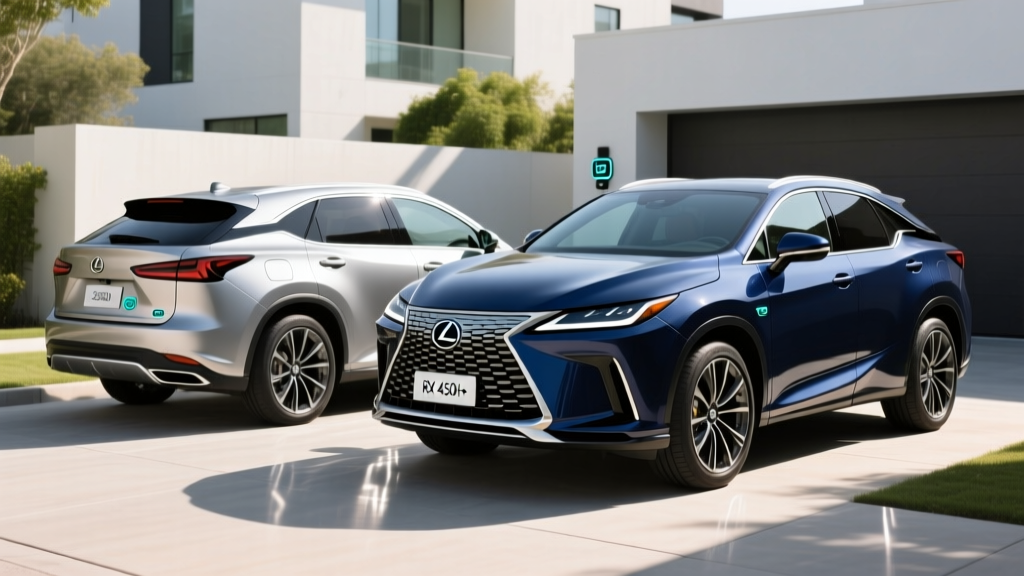
The Lexus RX has anchored the luxury midsize SUV segment for over two decades, and its electrified variants now account for a significant share of sales. If you're researching Lexus RX hybrid mileage, you're looking at two very different powertrains for 2026: the conventional hybrid RX 350h (HEV) and the plug-in hybrid RX 450h+ (PHEV). Both deliver strong efficiency, but their use cases, fuel-economy profiles, and ownership economics diverge sharply.
This guide breaks down every mileage figure that matters — EPA ratings, real-world expectations, electric-only range for the PHEV, and the total cost picture including federal tax credit eligibility under current IRS §30D rules.
RX 350h vs RX 450h+: HEV and PHEV Explained
Before diving into the numbers, the distinction between these two models is critical because it affects how you fuel them, what you pay at the pump (or charger), and whether you qualify for incentives.
| Attribute | RX 350h (HEV) | RX 450h+ (PHEV) |
|---|---|---|
| Powertrain Type | Conventional Hybrid — no plug needed | Plug-in Hybrid — requires external charging for EV mode |
| Battery Size | ~1.1 kWh (small, self-charging) | 18.1 kWh usable (lithium-ion) |
| How It Charges | Regenerative braking + engine | Level 1/Level 2 plug-in + regen + engine |
| Electric-Only Driving | Brief low-speed assist only | Up to 37 miles EPA at full charge |
| Best For | Drivers who want efficiency without changing habits | Drivers with home charging who want EV commuting + gas road trips |
The RX 350h never needs to be plugged in. Its small battery recharges through regenerative braking and the gasoline engine. The RX 450h+ has a much larger battery that you charge via a wall outlet or Level 2 home charger, enabling genuine electric-only commuting before the hybrid system takes over.
Lexus RX Hybrid Mileage: EPA MPG and MPGe Breakdown
Here are the official EPA fuel-economy figures for both 2026 RX hybrid variants, sourced from fueleconomy.gov.
| Model | City MPG | Highway MPG | Combined MPG | MPGe (PHEV EV mode) |
|---|---|---|---|---|
| RX 350h AWD | 37 | 34 | 36 | N/A |
| RX 450h+ AWD (charge-sustaining) | 35 | 34 | 35 | 83 MPGe |
Several things stand out in these numbers:
- The RX 350h actually returns better MPG than the RX 450h+ once the PHEV's battery is depleted. This is because the 450h+ carries roughly 350 extra pounds of battery mass. When driving in hybrid-only (charge-sustaining) mode, that weight works against efficiency.
- The RX 350h's city MPG exceeds its highway rating — a hallmark of Toyota/Lexus hybrid systems that use the electric motor heavily at low speeds and in stop-and-go traffic, where the engine shuts off frequently.
- The 83 MPGe rating for the RX 450h+ applies only when driving on battery charge in EV mode. MPGe (miles per gallon equivalent) converts electricity consumption into a gasoline-equivalent figure for comparison. Once the battery depletes, you're operating at 35 MPG combined.
Real-World MPG: What Owners Actually Report
EPA stickers are a starting point. Real-world Lexus RX hybrid mileage depends heavily on your driving environment.
RX 350h Real-World Expectations
EPA Combined: 36 MPG
City-dominant driving: 37–40 MPG (hybrids thrive in stop-and-go; many owners report exceeding EPA city numbers)
Highway-dominant (70-80 mph): 30–33 MPG (aerodynamic drag and sustained engine load reduce hybrid advantage)
Cold weather (below 30°F): 30–33 MPG combined (engine runs more often for cabin heat, battery efficiency drops)
RX 450h+ Real-World Expectations
Electric-only range: EPA 37 miles; expect 30–35 miles in mixed driving, as low as 25 miles in cold weather or at sustained highway speeds above 65 mph
After battery depletion: 33–36 MPG combined in hybrid mode
Total range (full tank + full charge): approximately 440–470 miles depending on conditions
The RX 350h's real-world efficiency edge in city driving is one of the strongest arguments for choosing the conventional hybrid if your commute involves heavy traffic. The hybrid system's ability to shut down the 2.5-liter four-cylinder engine at stops and crawl on electric power alone is where it earns its EPA city advantage.
RX 450h+ Electric-Only Range and Charging Details
For PHEV buyers, electric-only range is the headline spec — it determines whether your daily commute can be completed without burning a drop of gasoline.
| Specification | RX 450h+ Detail |
|---|---|
| Usable Battery Capacity | 18.1 kWh |
| EPA Electric-Only Range | 37 miles |
| EV Mode Top Speed | ~84 mph |
| Level 1 Charging (120V, 12A) | ~14 hours (0–100%) |
| Level 2 Charging (240V, 32A) | ~2.5 hours (0–100%) |
| DC Fast Charging | Not supported |
| Charge Port | J1772 (Level 2); no CCS/NACS connector |
A critical limitation: the RX 450h+ does not support DC fast charging. This is common among PHEVs — their smaller batteries make Level 2 charging practical for overnight replenishment, but it means you cannot top up at a public DC fast charger during a road trip. For the RX 450h+, that's largely irrelevant: on long trips, the gasoline engine handles propulsion once the battery depletes, and you simply recharge overnight at your destination.
With a 240V Level 2 home charger (the same setup EV owners use), a full charge takes roughly 2.5 hours. This means even a midday top-up during a work-from-home day can restore most of your electric range for the afternoon commute.
Powertrain Specs: Horsepower, Engine, and Acceleration
Both RX hybrid models use variants of Toyota's proven hybrid synergy drive system, but the power outputs differ meaningfully.
| Spec | RX 350h | RX 450h+ |
|---|---|---|
| Engine | 2.5L inline-4 + 2 electric motors | 2.5L inline-4 + 2 electric motors (higher output) |
| Combined Horsepower | 246 hp | 302 hp |
| 0–60 mph | 7.4 seconds | 6.2 seconds |
| Drivetrain | AWD (electronic rear motor) | AWD (electronic rear motor) |
| Towing Capacity | 3,500 lbs | 3,500 lbs |
The RX 450h+ is the clear performance pick, with a 1.2-second advantage to 60 mph that you'll notice during highway merging and passing. Both models use an electronically controlled CVT (e-CVT), which delivers smooth, stepless acceleration — though enthusiasts accustomed to geared transmissions may find the e-CVT's drone under hard acceleration unremarkable.
Pricing, Trims, and Tax Credit Eligibility
Pricing for the 2026 Lexus RX hybrid lineup positions both models firmly in the luxury midsize bracket. Here's where they land at base MSRP:
- RX 350h: Starting at approximately $53,000 (Premium trim), ranging to ~$60,000+ for Luxury and F SPORT Handling trims
- RX 450h+: Starting at approximately $62,500 (Premium trim), ranging to ~$70,000+ for Luxury trim
Federal Tax Credit: §30D Eligibility
The RX 450h+ (PHEV) may qualify for the federal plug-in hybrid tax credit under IRS §30D rules, but eligibility is not guaranteed and depends on several factors that change periodically:
- MSRP cap: SUVs must be at or below $80,000 MSRP — the RX 450h+ base qualifies, but loaded Luxury trims may exceed the cap
- Buyer income cap: Modified AGI must not exceed $150,000 (single), $225,000 (head of household), or $300,000 (joint filers)
- Battery sourcing requirements: Critical minerals and battery components must meet escalating domestic-content thresholds — verify current-year compliance with your dealer
- Point-of-sale transfer: As of 2024+, you can transfer the credit to the dealer for an immediate price reduction at purchase rather than claiming it on your tax return
The conventional RX 350h (HEV) does NOT qualify for the §30D federal tax credit — it applies only to plug-in vehicles with at least 7 kWh of battery capacity.
Always consult a tax professional and check the latest IRS guidance before counting on the credit. Battery sourcing rules in particular have shifted annually, and a vehicle that qualifies in January may face different requirements by mid-year.
Reliability, Battery Warranty, and Replacement Costs
Hybrid battery longevity remains the top concern for buyers transitioning from conventional vehicles. Lexus backs both RX hybrid models with robust warranty coverage:
| Coverage | Term |
|---|---|
| Hybrid Battery Warranty | 10 years / 150,000 miles (whichever comes first) |
| Hybrid System Components | 8 years / 100,000 miles |
| Basic Vehicle Warranty | 4 years / 50,000 miles |
| Powertrain Warranty | 6 years / 70,000 miles |
The 10-year/150,000-mile hybrid battery warranty is among the best in the luxury segment and applies in all 50 states (California-emissions states previously received extended coverage, but Lexus has standardized the 10/150k term nationally for recent model years).
Battery replacement cost if out of warranty: Based on current Lexus parts pricing and labor, a hybrid battery replacement for the RX 350h runs approximately $3,000–$4,500, while the RX 450h+'s larger PHEV battery pack can cost $6,000–$9,000. However, Toyota/Lexus hybrid batteries have demonstrated exceptional longevity in real-world use — many Prius and RX hybrid owners have exceeded 200,000 miles on the original battery pack. The nickel-metal-hydride (RX 350h) and lithium-ion (RX 450h+) chemistries used by Lexus have proven degradation-resistant, particularly because the hybrid system's battery management keeps the state of charge within a conservative operating window (roughly 40–80%), avoiding the deep cycles that accelerate wear.
Lexus also consistently ranks at or near the top of J.D. Power dependability studies, and the RX specifically has a long track record of low cost-of-ownership in the luxury midsize SUV class.
Hybrid vs PHEV vs EV: Which RX Fits Your Life?
Choosing between the RX 350h, RX 450h+, or stepping to a full battery-electric vehicle (BEV) comes down to three factors: charging access, daily mileage, and road-trip frequency.
Choose the RX 350h (HEV) if:
- You cannot install a home charger (apartment, street parking, no garage)
- You want maximum simplicity — no plugs, no charging apps, no range planning
- Your driving is predominantly city and suburban where the hybrid system excels
- You want the lowest entry price in the RX hybrid lineup
- You drive 12,000–15,000 miles per year and value consistent 34–38 MPG
Choose the RX 450h+ (PHEV) if:
- You have reliable Level 2 home charging (garage or driveway with 240V outlet)
- Your daily commute is under 35 miles round-trip (you'll rarely burn gas on weekdays)
- You take regular road trips where pure EV range would cause anxiety
- You want the performance bump (302 hp, 6.2s 0–60)
- You may qualify for the §30D tax credit, narrowing the price gap with the 350h
Consider a Full EV (like the Lexus RZ 450e) if:
- You have home charging and your daily driving is under 200 miles
- You want zero tailpipe emissions and minimal maintenance (no oil changes, no engine)
- You're comfortable planning charging stops on road trips
- You want the maximum federal tax credit (up to $7,500 for qualifying BEVs)
For the majority of luxury SUV buyers who lack home charging or who regularly drive more than 400 miles between stops, the RX 350h offers the most frictionless ownership experience. The RX 450h+ is the enthusiast-commuter's pick — electric weekday driving with the safety net of a 14.5-gallon fuel tank for weekends.
Frequently Asked Questions
How many MPG does the Lexus RX hybrid get?
The RX 350h gets an EPA-estimated 37 city / 34 highway / 36 combined MPG. The RX 450h+ PHEV gets 35 combined MPG once the battery is depleted, plus 83 MPGe when operating in electric mode. In real-world city driving, RX 350h owners commonly report 37–40 MPG thanks to the hybrid system's regenerative braking and engine shut-off at low speeds.
How far can the RX 450h+ drive on electric power alone?
The EPA rates the RX 450h+ at 37 miles of electric-only range. In practice, expect 30–35 miles in moderate temperatures with mixed driving, and as few as 25 miles in cold weather or at sustained highway speeds. The EV mode supports speeds up to approximately 84 mph.
Does the Lexus RX hybrid qualify for a tax credit?
The RX 450h+ plug-in hybrid may qualify for a partial or full federal tax credit under IRS §30D, subject to MSRP caps ($80,000 for SUVs), buyer income limits, and battery-sourcing requirements. The conventional RX 350h hybrid does not qualify for the federal plug-in vehicle credit. Check IRS.gov for current-year rules and consult a tax professional.
Is the Lexus RX hybrid reliable? What does a battery replacement cost?
Lexus ranks among the most reliable luxury brands, and the RX hybrid powertrain has a long track record of durability. The hybrid battery is warranted for 10 years/150,000 miles. Out-of-warranty replacement costs approximately $3,000–$4,500 for the RX 350h and $6,000–$9,000 for the RX 450h+, though many owners exceed 200,000 miles without battery replacement.
Do I need to plug in the RX 350h?
No. The RX 350h is a conventional hybrid (HEV) that charges its small battery entirely through regenerative braking and the gasoline engine. You fuel it like any other car — with gasoline only. Only the RX 450h+ (PHEV) requires plug-in charging to access its electric-only range.
Does the RX 450h+ support DC fast charging?
No. The RX 450h+ charges via J1772 at Level 1 (120V) or Level 2 (240V) only. A full Level 2 charge takes about 2.5 hours. DC fast charging is not available, which is typical for plug-in hybrids with smaller battery packs.