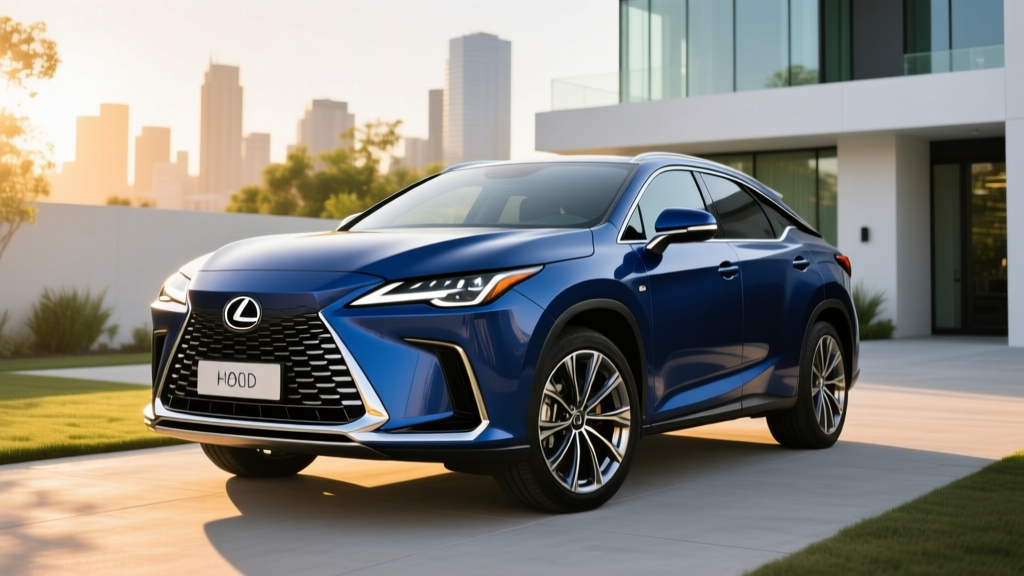
The 2025 Lexus RX Hybrid lineup gives midsize SUV shoppers two distinct paths to electrification: the conventional RX 350h hybrid (HEV) that never needs a plug, and the RX 450h+ plug-in hybrid (PHEV) that covers most commutes on electricity alone. Both share the fifth-generation RX platform, Lexus Safety System+ 3.0, and a premium cabin — but their powertrains, efficiency profiles, and ownership economics diverge sharply. This guide breaks down every number that matters.
HEV vs PHEV: Which 2025 Lexus RX Hybrid Are You Looking At?
Before diving into specs, the distinction matters because it determines your fueling routine, your electric-only capability, and your tax-credit eligibility.
RX 350h — Conventional Hybrid (HEV)
The RX 350h pairs a 2.5-liter four-cylinder engine with front and rear electric motors and a small 1.6 kWh nickel-metal hydride (NiMH) traction battery. It recovers energy through regenerative braking and engine optimization. You never plug it in. The battery recharges itself during driving. Think of it as a highly efficient gas vehicle that uses electric assist to slash fuel consumption.
RX 450h+ — Plug-In Hybrid (PHEV)
The RX 450h+ uses a larger 18.1 kWh lithium-ion battery paired with a 2.5-liter engine and more powerful electric motors. You plug it in to access its 37-mile electric-only range. Once the battery depletes, it operates as a conventional hybrid. This is the trim for drivers with short commutes and access to a Level 2 home charger who want EV-like daily driving without range anxiety on longer trips.
Fuel Economy: EPA MPG and Real-World Expectations
The RX 350h's headline figure is 36 MPG combined — a strong result for a 4,600-pound luxury SUV. But hybrid efficiency behaves differently depending on your driving mix, and real-world numbers often deviate from the EPA sticker in predictable ways.
| Model | EPA City | EPA Highway | EPA Combined | Real-World Expectation |
|---|---|---|---|---|
| RX 350h AWD | 37 MPG | 34 MPG | 36 MPG | 34–38 MPG (city-favors hybrid) |
| RX 450h+ AWD (charge-depleted hybrid mode) | 35 MPG | 32 MPG | 34 MPG | 32–36 MPG |
| RX 450h+ AWD (electric + hybrid combined) | 65 MPGe combined | Varies heavily by charging frequency | ||
Why real-world MPG can beat the EPA in the city: Hybrids recapture braking energy in stop-and-go traffic, meaning the RX 350h's 37 MPG city rating often understates what drivers see in dense urban commuting. On the highway, where regenerative braking opportunities are scarce and aerodynamic drag dominates, expect numbers closer to 32–34 MPG at 70–75 mph.
Cold-weather impact: In sub-freezing temperatures, expect a 5–10% MPG reduction in the RX 350h as the engine runs more frequently for cabin heat. The RX 450h+ PHEV loses more — its electric-only range can drop to 28–31 miles in winter conditions due to battery chemistry sensitivity and cabin heating demands.
RX 450h+ Electric-Only Range and Charging Details
The RX 450h+ is rated by the EPA at 37 miles of electric-only driving on a full charge. That covers the average American one-way commute (roughly 16 miles) with room to spare for errands — all without burning a drop of gasoline.
PHEV Battery and Charging Specifications
| Specification | RX 450h+ Detail |
|---|---|
| Battery capacity | 18.1 kWh (lithium-ion) |
| Usable battery capacity | ~14.5 kWh (buffer-protected) |
| EPA electric-only range | 37 miles |
| Total range (electric + hybrid) | ~410 miles |
| Level 1 charging (120V, 12A) | ~11 hours (full charge) |
| Level 2 charging (240V, 32A) | ~2.5 hours (full charge) |
| DC fast charging | Not supported |
| Charge port | J1772 (Level 2) |
No DC fast charging: This is a notable limitation. The RX 450h+ cannot accept DC fast charging, which is common among PHEVs (the smaller batteries make Level 2 sufficient for overnight top-ups). If you charge at home on a 240V Level 2 circuit, the battery refills in about 2.5 hours — meaning you could theoretically recharge midday if you work from home. On a standard 120V outlet, plan for overnight charging.
kW vs kWh reminder: The 18.1 kWh figure is the battery's energy capacity (how much it holds). The Level 2 charge rate of approximately 6.6 kW is the power flowing in (how fast it fills). Dividing 14.5 kWh usable by 6.6 kW gives roughly 2.2 hours — the math checks out against Lexus's 2.5-hour estimate, which accounts for tapering near full charge.
Powertrain Specs: Horsepower, 0-60, and Drivetrain
| Specification | RX 350h | RX 450h+ |
|---|---|---|
| Engine | 2.5L inline-4 + 2 electric motors | 2.5L inline-4 + 2 electric motors (higher output) |
| Combined horsepower | 246 hp | 302 hp |
| 0-60 mph | 7.4 seconds | 6.2 seconds |
| Drivetrain | AWD (e-AWD, electronic rear motor) | AWD (e-AWD, electronic rear motor) |
| Transmission | eCVT | eCVT |
| Towing capacity | Not rated for towing | Not rated for towing |
The RX 350h's 246 hp is adequate for highway merging and passing, though it won't feel sporty in a 4,600-lb SUV. The RX 450h+ adds 56 hp and shaves 1.2 seconds off the 0-60 time, giving it genuinely quick acceleration — especially in EV mode, where electric torque is instant. Both use an electronically controlled continuously variable transmission (eCVT), which prioritizes efficiency over the stepped gear feel of a conventional automatic.
The e-AWD system in both models uses a dedicated rear-axle electric motor rather than a mechanical driveshaft. It engages automatically when the front wheels lose traction or under hard acceleration, but it's not designed for serious off-road use.
Pricing, Trims, and Tax Credit Eligibility
| Trim | MSRP (incl. destination) | Federal §30D Tax Credit |
|---|---|---|
| RX 350h Premium | $53,195 | Not eligible (HEV) |
| RX 350h Premium+ | $56,595 | Not eligible (HEV) |
| RX 350h Luxury | $61,095 | Not eligible (HEV) |
| RX 450h+ Premium | $62,695 | Up to $7,500 (see rules below) |
| RX 450h+ Luxury | $67,595 | Up to $7,500 (see rules below) |
Federal §30D Tax Credit Rules for the RX 450h+ (2025)
The RX 450h+ may qualify for up to $7,500 under the IRS §30D Clean Vehicle Credit, but eligibility depends on several conditions that change frequently:
- MSRP cap: SUVs must be under $80,000 — both RX 450h+ trims qualify.
- Buyer income cap: Modified AGI must not exceed $150,000 (single), $225,000 (head of household), or $300,000 (joint).
- Battery sourcing: Critical minerals and battery components must meet phased-in domestic/free-trade sourcing requirements. The RX 450h+ is assembled in Cambridge, Ontario, Canada, but battery-component and critical-mineral sourcing requirements may reduce the credit to $3,750 or eliminate it entirely depending on the model year's compliance status.
- Point-of-sale transfer: As of 2024, you can transfer the credit to the dealer for an immediate price reduction at purchase, rather than waiting to claim it on your tax return.
Always verify current eligibility on irs.gov and with your dealer before purchasing. State incentives may also apply — check your local energy office or AFDC incentive database.
The RX 350h does not qualify for the federal EV tax credit. Conventional hybrids (HEVs) are not eligible under §30D, which requires a minimum battery capacity and plug-in capability. Some states offer their own hybrid incentives, but these are uncommon and vary by jurisdiction.
Battery Warranty, Lifespan, and Replacement Costs
Hybrid battery longevity is the single most common concern among first-time hybrid buyers. Here's what the data shows for the 2025 RX lineup:
Lexus Hybrid Battery Warranty
| RX 350h (NiMH battery) | 10 years / 150,000 miles (whichever comes first) |
| RX 450h+ (lithium-ion battery) | 10 years / 150,000 miles (whichever comes first) |
| Hybrid system components | 8 years / 100,000 miles |
| Capacity retention warranty (RX 450h+) | Covered if battery drops below ~70% during warranty period |
Real-world lifespan: Toyota/Lexus hybrid systems have one of the strongest longevity track records in the industry. NiMH batteries in models like the Prius and RX 400h routinely last 150,000–200,000+ miles before significant degradation. Lithium-ion PHEV batteries are newer but benefit from conservative buffer management — the RX 450h+ uses only ~14.5 kWh of its 18.1 kWh total capacity, keeping the cells in a healthier state-of-charge window.
Replacement cost: If a hybrid battery does fail outside warranty, expect:
- RX 350h NiMH battery: $2,500–$4,000 (parts + labor)
- RX 450h+ lithium-ion battery: $6,000–$9,000 (parts + labor)
These are estimates based on current Lexus hybrid battery pricing. Refurbished and third-party replacement options may reduce costs. In practice, most Lexus hybrid batteries outlast the vehicle's ownership cycle.
Who Should Choose the RX 350h, RX 450h+, or a Full EV?
Decision Framework: Which Electrified RX Fits Your Life?
Choose the RX 350h (HEV) if:
- You don't have access to home or workplace charging
- You want maximum simplicity — no plugs, no charging apps, no route planning
- Your driving is a mix of city and highway with no single dominant pattern
- You want a meaningful MPG improvement (36 vs ~25 MPG for the gas RX 350) without changing habits
- Budget is a priority — the 350h starts ~$9,500 below the 450h+
Choose the RX 450h+ (PHEV) if:
- Your daily round-trip commute is under 35 miles
- You can install a Level 2 charger at home (garage or driveway with 240V access)
- You take road trips where EV charging infrastructure is sparse
- You want the performance benefit (302 hp, 6.2-sec 0-60)
- You may qualify for the §30D tax credit, narrowing the price gap with the 350h
Choose a full EV (like the Lexus RZ 450e or Tesla Model Y) if:
- You have reliable home Level 2 charging
- Your daily driving rarely exceeds 200 miles
- You want zero tailpipe emissions and minimal maintenance (no oil changes, no engine)
- You're comfortable planning longer road trips around DC fast-charging stops
Ownership Costs: 5-Year Comparison
| Cost Factor (5 years / 75,000 miles) | RX 350h | RX 450h+ | Gas RX 350 (baseline) |
|---|---|---|---|
| Fuel / electricity | ~$7,300 | ~$4,800 (with regular charging) | ~$10,500 |
| Maintenance | ~$2,800 | ~$2,500 | ~$3,200 |
| Estimated depreciation | ~$22,000 | ~$25,000 | ~$21,000 |
| Federal tax credit | $0 | Up to -$7,500 | $0 |
Fuel estimates assume $3.50/gallon gasoline and $0.15/kWh electricity (national averages — your local rates may differ). The RX 450h+ fuel cost assumes the driver charges nightly and completes ~70% of miles on electricity. Without regular charging, the 450h+ reverts to 34 MPG hybrid mode and fuel costs rise to roughly $7,700 — only marginally better than the 350h.
RX 350h Pros
- 36 MPG combined — excellent for a luxury midsize SUV
- No plug required — zero lifestyle change
- Lower starting price ($53,195)
- Proven Lexus hybrid reliability
- Strong resale value
RX 350h Cons
- No federal tax credit
- Modest 246 hp for the class
- 7.4-sec 0-60 feels leisurely when merging
- No electric-only driving capability
RX 450h+ Pros
- 37 miles electric-only covers most commutes
- 302 hp and 6.2-sec 0-60 — genuinely quick
- Potential $7,500 federal tax credit
- No range anxiety on road trips
- 65 MPGe when regularly charged
RX 450h+ Cons
- $9,500 price premium over RX 350h
- No DC fast charging
- Requires home Level 2 to maximize value
- Heavier — impacts handling feel
- Tax credit eligibility uncertain due to sourcing rules
Frequently Asked Questions
How many MPG does the 2025 Lexus RX 350h hybrid get?
The RX 350h is EPA-rated at 37 city / 34 highway / 36 combined MPG. In real-world city driving, many owners report 37–39 MPG thanks to regenerative braking. Highway driving at 75 mph typically yields 32–34 MPG. These figures apply to all RX 350h trims, which all use the same AWD powertrain.
How far can the RX 450h+ go on electric power alone?
The EPA rates the RX 450h+ at 37 miles of electric-only range on a full charge. In mild weather with gentle driving, expect 35–38 miles. In cold weather (below 32°F), range drops to roughly 28–31 miles due to battery chemistry and cabin heating load. Once the battery depletes, the vehicle seamlessly transitions to hybrid mode at 34 MPG combined.
Does the 2025 Lexus RX Hybrid qualify for a tax credit?
The RX 350h (conventional hybrid) does not qualify for the federal §30D Clean Vehicle Credit — only plug-in vehicles are eligible. The RX 450h+ (plug-in hybrid) may qualify for up to $7,500, but eligibility depends on battery-component and critical-mineral sourcing requirements, buyer income limits, and the $80,000 SUV MSRP cap. Check IRS.gov for the latest sourcing compliance status before purchasing.
Is the Lexus RX Hybrid reliable? What about battery replacement cost?
Lexus consistently ranks at or near the top of J.D. Power and Consumer Reports reliability studies, and its hybrid systems are among the most proven in the industry. The hybrid battery is warrantied for 10 years / 150,000 miles. Out-of-warranty replacement runs $2,500–$4,000 for the RX 350h NiMH battery and $6,000–$9,000 for the RX 450h+ lithium-ion pack. In practice, Lexus hybrid batteries commonly exceed 150,000 miles without failure.
Can I charge the RX 350h at home?
No. The RX 350h is a conventional hybrid (HEV) — it has no charge port and cannot be plugged in. Its small 1.6 kWh battery recharges through regenerative braking and the gasoline engine during normal driving. Only the RX 450h+ PHEV has a plug-in charge port (J1772 connector for Level 2 home charging).
Does the RX 450h+ support DC fast charging?
No. The RX 450h+ supports Level 1 (120V) and Level 2 (240V) AC charging only. A full charge on Level 2 takes approximately 2.5 hours. DC fast charging is not available, which is typical for PHEVs with smaller battery packs — the 18.1 kWh battery charges quickly enough on Level 2 that DC fast-charging hardware would add cost and weight without practical benefit.
How does the RX Hybrid compare to the gas-only RX 350?
The gas RX 350 (turbocharged 2.4L, 275 hp) is rated at 22 city / 29 highway / 25 combined MPG. The RX 350h delivers a 44% improvement in combined fuel economy (36 vs 25 MPG) while the RX 450h+ can achieve 65 MPGe when regularly charged. The trade-off is higher upfront cost: the RX 350h starts about $4,000 above the gas RX 350, and the RX 450h+ is roughly $13,500 more. Fuel savings typically close the gap in 5–7 years depending on mileage and local fuel prices.