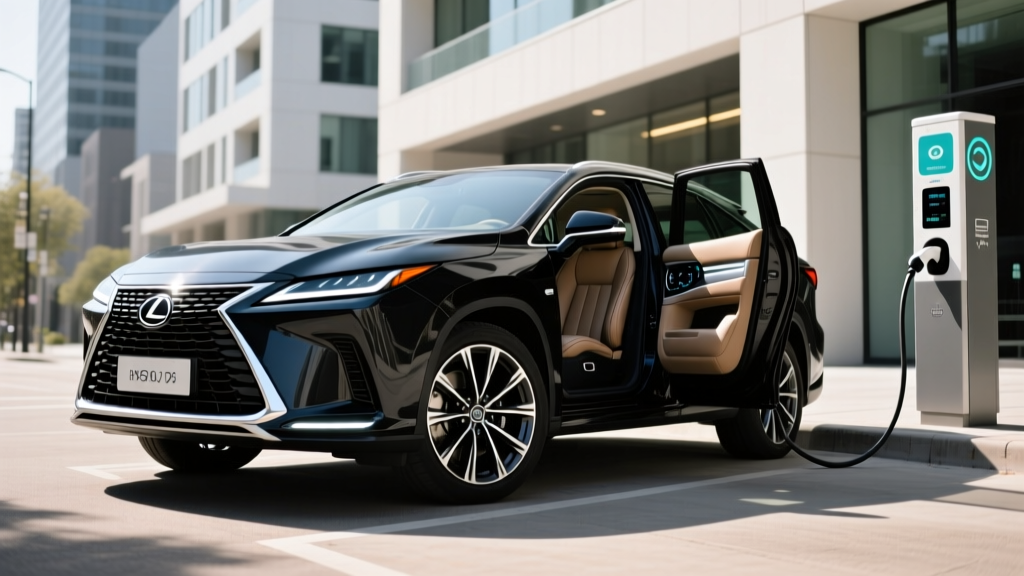
Quick Verdict: The Lexus RX 350h Hybrid in 2025
The 2025 Lexus RX 350h is a conventional hybrid electric vehicle (HEV) — not a plug-in — that pairs a 2.5-liter four-cylinder engine with two electric motors to deliver 246 combined horsepower and an EPA-estimated 36 MPG combined. Starting at $51,710 including destination, it undercuts the more powerful RX 500h F SPORT Performance hybrid and the RX 450h+ plug-in hybrid (PHEV) while offering the best fuel economy of any non-plug-in RX variant. For luxury SUV buyers who want hybrid efficiency without plugging in, the RX 350h remains the volume choice in the lineup.
| Spec | 2025 Lexus RX 350h |
|---|---|
| Powertrain | 2.5L I4 + 2 electric motors (HEV) |
| Combined Horsepower | 246 HP |
| Drivetrain | AWD (standard all trims) |
| EPA MPG (City / Hwy / Combined) | 37 / 34 / 36 |
| 0–60 mph | 7.4 seconds (est.) |
| Towing Capacity | 3,500 lbs |
| Cargo Volume (rear seats up / down) | 29.6 / 46.2 cu ft |
| Base MSRP (Premium trim) | $51,710 |
| Hybrid Battery Warranty | 10 years / 150,000 miles |
| Federal Tax Credit (§30D) | Not eligible (HEV) |
HEV vs PHEV: Where the RX 350h Fits in the Lexus Lineup
Lexus offers three electrified RX variants for 2025, and the distinction matters for your wallet and daily routine:
| Attribute | RX 350h (HEV) | RX 450h+ (PHEV) | RX 500h (HEV) |
|---|---|---|---|
| Type | Conventional Hybrid | Plug-In Hybrid | Conventional Hybrid |
| Combined HP | 246 | 302 | 367 |
| EPA MPG Combined | 36 | 35 (gas) / 83 MPGe | 28 |
| Electric-Only Range | N/A | 37 miles | N/A |
| Needs Plugging In? | No | Yes (for EV range) | No |
| Starting MSRP | $51,710 | $63,360 | $62,350 |
| Federal Tax Credit | None | Up to $7,500* | None |
The RX 350h is a conventional hybrid (HEV). It charges its own small battery through regenerative braking and the gas engine. You never plug it in. The RX 450h+ is a plug-in hybrid (PHEV) with an 18.1 kWh battery that delivers 37 miles of electric-only driving before the gas engine engages. If you have home charging and a short commute, the PHEV may save more fuel — but it costs over $11,000 more upfront.
Fuel Economy: EPA Numbers and Real-World MPG
| Driving Condition | EPA Estimate | Real-World Expectation |
|---|---|---|
| City | 37 MPG | 35–39 MPG |
| Highway | 34 MPG | 30–33 MPG |
| Combined | 36 MPG | 33–36 MPG |
Like most Toyota/Lexus hybrids, the RX 350h tends to match or exceed its EPA city estimate in stop-and-go traffic, where regenerative braking recaptures energy most effectively. Highway driving is where real-world numbers dip below the sticker: sustained 75+ mph cruising reduces the hybrid system's advantage, and you should expect 30–33 MPG on long interstate trips according to owner-reported data on fueleconomy.gov.
In cold weather (below 30°F), expect a 5–10% reduction in fuel economy as the engine runs longer to generate cabin heat and the battery operates less efficiently. This is normal for all hybrids and far less severe than the 20–40% range loss a full EV experiences in winter.
With a 17.2-gallon fuel tank, the RX 350h delivers approximately 619 miles of total range at the EPA combined figure — enough for most drivers to go two to three weeks between fill-ups.
Powertrain and Performance
The RX 350h uses Lexus's fourth-generation hybrid system: a 2.5-liter Atkinson-cycle inline-four producing 184 HP, paired with a front electric motor (134 kW / 180 HP) and a rear electric motor (40 kW / 54 HP) that provides standard all-wheel drive. Combined system output is 246 horsepower.
Acceleration to 60 mph takes approximately 7.4 seconds — adequate for merging and passing but noticeably slower than the RX 500h (5.9 seconds) or the RX 450h+ PHEV (6.2 seconds). The continuously variable transmission (eCVT) prioritizes smoothness over sportiness, and the hybrid system's seamless torque fill from the electric motors makes the RX 350h feel more responsive in city driving than the 0–60 time suggests.
The 3,500-pound towing capacity matches the non-hybrid RX 350 and is sufficient for a small trailer or a pair of personal watercraft, though buyers needing serious towing should look at the RX 500h or a body-on-frame SUV.
Pricing, Trims, and Tax Credit Eligibility
The 2025 Lexus RX 350h is offered in four trims:
- Premium: $51,710 — leatherette seats, 9.8-inch touchscreen, wireless Apple CarPlay/Android Auto, Lexus Safety System+ 3.0
- Premium+: $54,660 — adds panoramic moonroof, heated/ventilated front seats, heated steering wheel
- Luxury: $59,210 — semi-aniline leather, 14-inch touchscreen, 21-inch wheels, adaptive variable suspension
- F SPORT Handling: $58,110 — sport-tuned suspension, F SPORT seats, aluminum pedals, unique styling
Federal Tax Credit (§30D): The RX 350h does not qualify for the federal EV tax credit. Under current IRS rules, the §30D credit of up to $7,500 applies only to battery electric vehicles (BEVs) and plug-in hybrids (PHEVs) with sufficient battery capacity and domestic battery/mineral sourcing. Conventional hybrids like the RX 350h are excluded regardless of price or income.
Some states offer hybrid-specific rebates or reduced registration fees — check your state's energy office or DMV for current programs.
Battery Warranty, Reliability, and Replacement Cost
| Coverage | Term |
|---|---|
| Hybrid Battery Warranty | 10 years / 150,000 miles |
| Hybrid System Components | 8 years / 100,000 miles |
| Basic Vehicle Warranty | 4 years / 50,000 miles |
| Powertrain Warranty | 6 years / 70,000 miles |
Lexus (parent company Toyota) has the longest track record of any automaker in hybrid production, dating to the 1997 Prius. The RX 350h's nickel-metal hydride (NiMH) hybrid battery is far smaller than a full EV battery — roughly 1.6 kWh — and is designed for shallow charge/discharge cycles that minimize degradation. Toyota/Lexus hybrid batteries routinely last 150,000–200,000+ miles before needing replacement, and many first-generation Prius batteries exceeded 200,000 miles.
If replacement is needed out of warranty, a refurbished RX hybrid battery costs approximately $2,000–$3,500 installed at an independent hybrid specialist, or $4,000–$6,000 for a new OEM battery at a Lexus dealer. This is a fraction of full EV battery replacement costs ($10,000–$25,000+), reflecting the smaller battery size.
Lexus consistently ranks at or near the top of J.D. Power Vehicle Dependability Studies, and the hybrid system adds proven, low-maintenance components rather than untested technology. The eCVT transmission has no traditional gears or clutch packs to wear out, which reduces long-term drivetrain maintenance costs compared to conventional automatics.
Who Should Choose the RX 350h Hybrid?
Choose the RX 350h (HEV) if:
- You want better fuel economy without changing your fueling habits (no plugging in)
- You drive 12,000–15,000 miles/year and want to save ~$500–$800 annually vs. the gas-only RX 350
- You live in an apartment or lack access to home charging
- You prioritize proven reliability and low long-term maintenance costs
- You want AWD standard without a fuel-economy penalty
Choose the RX 450h+ (PHEV) instead if:
- You have home Level 2 charging and a commute under 37 miles round-trip
- You want to drive mostly on electricity during the week and take gas-powered road trips on weekends
- You qualify for the up-to-$7,500 federal tax credit (subject to IRS §30D income and sourcing rules), which narrows the price gap
Choose a full EV (like the Tesla Model X or Rivian R1S) if:
- You have reliable home charging and want zero tailpipe emissions
- You want the lowest per-mile fuel cost (electricity at ~$0.04–$0.06/mile vs. gasoline at ~$0.12–$0.16/mile for the RX 350h)
- You're ready to plan around DC fast charging on road trips
Stick with the gas RX 350 (turbo) if:
- You drive fewer than 8,000 miles/year and the fuel savings won't offset the hybrid's ~$3,000 premium
- You prioritize the lowest possible purchase price in the RX lineup
Pros and Cons
Pros
- 36 MPG combined is excellent for a luxury midsize SUV
- No plug-in required — fuel it like any gas car
- Standard AWD across all trims
- 10-year/150,000-mile hybrid battery warranty
- Lexus reliability and resale value track record
- Smooth, quiet hybrid powertrain with seamless electric torque fill
Cons
- 246 HP feels modest for the price; slower than turbo RX 350 and other hybrid trims
- No federal tax credit eligibility
- eCVT drone under hard acceleration
- $3,000+ premium over the gas RX 350 takes years to recoup at low mileage
- Highway MPG drops below EPA estimate at sustained speeds above 75 mph
- Rear cargo space slightly reduced vs. gas RX due to hybrid battery placement
Frequently Asked Questions
How many MPG does the 2025 Lexus RX 350h hybrid get?
The EPA rates the RX 350h at 37 MPG city, 34 MPG highway, and 36 MPG combined. Real-world city driving often matches or slightly exceeds the EPA city number, while sustained highway driving above 75 mph typically yields 30–33 MPG.
Does the Lexus RX 350h need to be plugged in?
No. The RX 350h is a conventional hybrid (HEV). It charges its battery through regenerative braking and the gasoline engine. You simply fill it with regular unleaded fuel like any other car. If you want a Lexus RX that plugs in for electric-only driving, look at the RX 450h+ PHEV.
Does the 2025 RX 350h qualify for the $7,500 federal EV tax credit?
No. Under current IRS §30D rules, the federal clean vehicle credit applies only to battery electric vehicles and plug-in hybrids that meet battery capacity, critical mineral sourcing, and buyer income requirements. Conventional hybrids like the RX 350h do not qualify regardless of price or buyer income.
How long will the RX 350h hybrid battery last, and what does replacement cost?
The hybrid battery is covered by a 10-year/150,000-mile warranty. Based on Toyota/Lexus's two-decade hybrid track record, these batteries commonly last 150,000–200,000+ miles. If replacement is needed, expect $2,000–$3,500 for a refurbished unit or $4,000–$6,000 for a new OEM battery — far less than a full EV battery replacement.
Is the RX 350h more reliable than the gas-only RX 350?
Lexus hybrids historically match or exceed the reliability of their gas-only counterparts. The eCVT has fewer moving parts than a conventional automatic transmission, and the hybrid system's regenerative braking reduces wear on friction brake pads (many owners report 80,000+ miles on original brake pads). Lexus's overall brand reliability consistently ranks at the top of industry surveys.
How does the RX 350h compare to the RX 450h+ plug-in hybrid?
The RX 450h+ PHEV offers 37 miles of electric-only range, 302 combined HP, and potential eligibility for up to $7,500 in federal tax credits — but starts at $63,360, roughly $11,650 more than the RX 350h. The PHEV makes financial sense if you can charge at home and your daily commute is under 37 miles, effectively eliminating weekday gasoline use. The 350h is the better value for buyers who can't plug in or who drive longer distances daily.
What is the annual fuel cost savings vs. the gas RX 350?
At 15,000 miles/year and $3.50/gallon, the gas RX 350 (25 MPG combined) costs approximately $2,100/year in fuel. The RX 350h (36 MPG combined) costs approximately $1,458/year — a savings of roughly $642 annually. At that rate, the hybrid's price premium over the gas model pays for itself in approximately 4–5 years, after which the savings are pure gain.