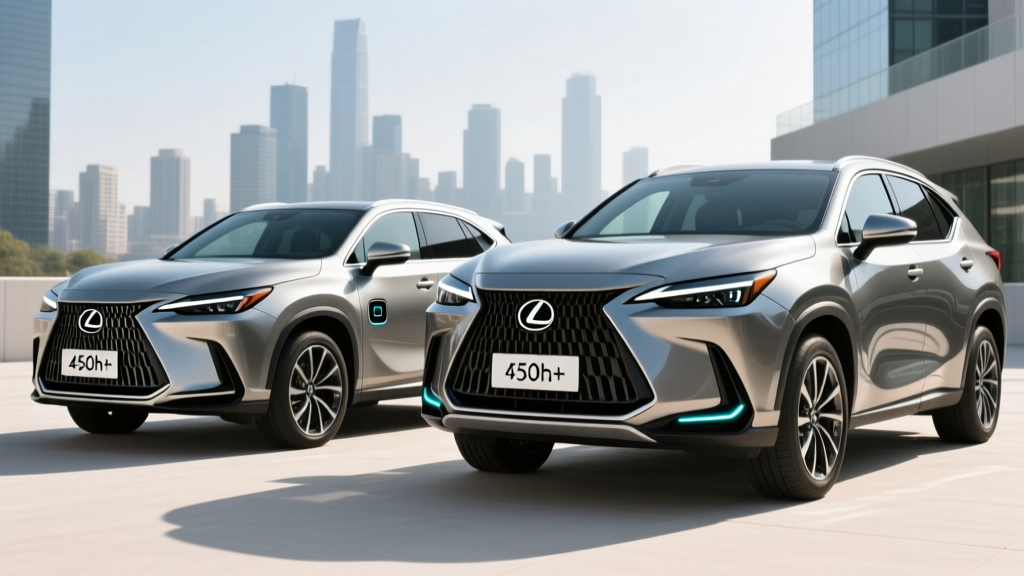
If you're shopping for a Lexus plug-in hybrid SUV in 2026, you have two distinct options: the compact NX 450h+ and the three-row TX 550h+. Both pair Toyota's proven hybrid architecture with a larger traction battery you can charge from a wall outlet, delivering meaningful electric-only commuting range before the gas engine ever starts. But they serve very different buyers, and the spec differences — battery size, electric range, charging capability, and tax-credit eligibility — matter enormously.
This guide breaks down both models with exact EPA figures, real-world expectations, battery and warranty data, and a clear framework for deciding whether a Lexus PHEV, a conventional Lexus HEV, or a full battery-electric vehicle (BEV) is the right call for your household.
HEV vs. PHEV: What Lexus Plug-In Hybrids Actually Do Differently
Before diving into specs, it's critical to separate Lexus's conventional hybrids (badged h, like the NX 350h or RX 350h) from its plug-in hybrids (badged h+). The distinction changes how you fuel, how far you drive electric, and what you pay at the pump.
| Feature | Lexus HEV (e.g., NX 350h) | Lexus PHEV (e.g., NX 450h+) |
|---|---|---|
| Plug-in charging | No — self-charging via regen & engine | Yes — Level 1/Level 2 AC charging |
| Electric-only range | ~1-2 miles at low speed | 37 miles (NX) / 33 miles (TX) EPA |
| Battery capacity | ~1.6 kWh (small buffer) | 18.1 kWh usable (NX) / 20.1 kWh usable (TX) |
| Gas engine role | Primary power + battery charging | Kicks in after EV range depleted |
| Combined MPG (after EV range) | 39 MPG combined (NX 350h) | 36 MPG combined (NX 450h+, charge-sustaining) |
| Federal tax credit (§30D) | Not eligible | Potentially up to $3,750 (see rules below) |
| Starting MSRP | ~$43,965 (NX 350h) | ~$60,805 (NX 450h+) |
The PHEV's advantage is the daily commute: if your round trip is under ~35 miles and you charge at home overnight, you may burn little to no gasoline on weekdays. The HEV's advantage is lower upfront cost and zero behavior change — it drives and fuels like a normal car, just more efficiently.
2026 Lexus NX 450h+: Range, MPG, and Powertrain Specs
The NX 450h+ is the best-selling Lexus plug-in hybrid SUV and shares its powertrain architecture with the Toyota RAV4 Prime. It pairs a 2.5-liter inline-4 Atkinson-cycle engine with front and rear electric motors for standard all-wheel drive (AWD).
| Spec | Value |
|---|---|
| Combined horsepower | 304 hp (net system) |
| Engine | 2.5L I-4 Atkinson + 2 AC motors (F/R) |
| Battery (usable) | 18.1 kWh, lithium-ion (NMC chemistry) |
| EPA electric-only range | 37 miles |
| EPA MPGe (electric + gas) | 84 MPGe combined |
| MPG (charge-sustaining, gas only) | 36 combined (38 city / 33 highway) |
| Total combined range | ~520 miles (EV + gas tank) |
| 0-60 mph | 6.0 seconds |
| AC charging (Level 2, 6.6 kW) | ~2.5 hours (0-100%) |
| DC fast charging | Not available |
| Cargo volume | 22.7 cu ft (rear seats up) / 46.9 cu ft (folded) |
| Base MSRP (Premium trim) | $60,805 |
Charging the NX 450h+
The NX 450h+ accepts up to 6.6 kW on Level 2 AC charging (240V, 28A). This is the onboard charger's maximum — plugging into a 48A or higher circuit won't speed things up. A full 0-100% charge takes roughly 2.5 hours on a Level 2 home charger, or about 10-12 hours on a standard 120V Level 1 outlet.
There is no DC fast charging capability on the NX 450h+. This is standard for compact PHEVs — the battery is small enough that DC fast-charging infrastructure isn't necessary for the use case. You charge at home or at work, and the gas engine handles longer trips.
2026 Lexus TX 550h+: Three-Row Plug-In Hybrid Specs
Introduced for the 2024 model year, the TX 550h+ is Lexus's largest plug-in hybrid and the only three-row PHEV SUV in the luxury segment. It's mechanically related to the Toyota Grand Highlander Hybrid but tuned for Lexus refinement.
| Spec | Value |
|---|---|
| Combined horsepower | 406 hp (net system) |
| Engine | 3.5L V6 + electric motors (F/R) |
| Battery (usable) | 20.1 kWh, lithium-ion |
| EPA electric-only range | 33 miles |
| EPA MPGe (electric + gas) | 76 MPGe combined |
| MPG (charge-sustaining, gas only) | 35 combined (36 city / 34 highway) |
| Total combined range | ~490 miles |
| 0-60 mph | 5.8 seconds |
| AC charging (Level 2, 6.6 kW) | ~3 hours (0-100%) |
| DC fast charging | Not available |
| Seating | 6- or 7-passenger |
| Cargo (behind 3rd row) | 14.6 cu ft |
| Base MSRP | $75,950 |
The TX 550h+ sacrifices a few miles of electric range compared to the NX due to its larger mass and frontal area, but 33 miles still covers most daily school runs, commutes, and errands. The 406 hp system output gives it confident highway merging even when loaded with passengers — a meaningful upgrade over the four-cylinder TX 500h F Sport Performance.
Fuel Economy Breakdown: EPA vs. Real-World MPG
Hybrid and PHEV fuel economy depends heavily on driving patterns. Here's how both Lexus plug-in hybrid SUVs perform across scenarios, based on EPA data from fueleconomy.gov and aggregated owner reports:
| Scenario | NX 450h+ | TX 550h+ |
|---|---|---|
| EPA city (gas only, battery depleted) | 38 MPG | 36 MPG |
| EPA highway (gas only, battery depleted) | 33 MPG | 34 MPG |
| EPA combined (gas only) | 36 MPG | 35 MPG |
| Real-world city (warm, battery depleted) | 37-41 MPG | 34-38 MPG |
| Real-world highway (75 mph, depleted) | 30-33 MPG | 31-34 MPG |
| Short commutes (<35 mi, daily charge) | 90+ MPGe effective | 80+ MPGe effective |
The key insight: if you charge daily and your commute is within the EV range, your gasoline consumption approaches zero on weekdays. Many NX 450h+ owners report going 1,500-2,000 miles between fill-ups when they plug in consistently. Skip the charging, and you're driving a 36 MPG hybrid — still excellent for a 4,400-lb luxury AWD crossover, but you're paying the PHEV price premium for nothing.
Battery Longevity, Warranty, and Replacement Costs
How Long Do Lexus PHEV Batteries Last?
Lexus (and parent company Toyota) has the longest track record in hybrid battery durability of any automaker. The Prius hybrid battery, which uses similar NMC cell chemistry, routinely exceeds 200,000 miles with gradual, predictable degradation. The PHEV battery is larger and operates in a shallower state-of-charge window (the system reserves a buffer at the top and bottom), which reduces stress on the cells.
Based on Toyota RAV4 Prime data (same platform as NX 450h+), expect approximately 8-12% capacity loss over the first 100,000 miles under normal use. This translates to roughly 3-4 miles less EV range after a decade of daily charging — noticeable but not debilitating.
Battery Replacement Cost
Out-of-warranty hybrid battery replacement for the NX 450h+ currently runs $5,000-$7,500 including labor at a Lexus dealer. The TX 550h+ battery, being slightly larger, is estimated at $6,500-$9,000. These costs have been trending downward as cell prices decline, and third-party refurbishment options are becoming available for older Toyota/Lexus hybrids at roughly 40-50% of dealer pricing. However, given the 10-year/150,000-mile warranty coverage, most original owners will never face this expense.
Pricing, Trims, and Federal Tax Credit Eligibility
2026 Lexus NX 450h+ Pricing
- Premium: $60,805
- Premium+: $64,505
- Luxury: $68,105
2026 Lexus TX 550h+ Pricing
- Premium: $75,950
- Luxury: $82,450
Does the Lexus Plug-In Hybrid SUV Qualify for a Federal Tax Credit?
Under IRS §30D Clean Vehicle Credit rules (current for 2026), PHEVs must meet the same criteria as full EVs:
- Battery capacity: At least 7 kWh — both models qualify (18.1 and 20.1 kWh)
- MSRP cap: SUVs must be under $80,000 — NX 450h+ all trims qualify; TX 550h+ Luxury trim exceeds the cap
- Buyer income cap: AGI must not exceed $150,000 (single) / $300,000 (joint filing)
- Final assembly: Must be in North America — both are assembled in Japan, which disqualifies both models from the §30D federal credit
- Critical minerals / battery sourcing: Must meet phased-in percentages — moot due to assembly location
Bottom line: As of 2026, neither the NX 450h+ nor the TX 550h+ qualifies for the $7,500 federal tax credit because both are assembled in Japan (Toyota's Tahara and Fukuoka plants). This is the single biggest financial drawback compared to U.S.-assembled PHEV competitors like the Jeep Wrangler 4xe or Chrysler Pacifica Hybrid. However, some states offer separate PHEV rebates that don't have domestic-assembly requirements — check your state energy office or the Alternative Fuels Data Center for local incentives. Always consult a tax professional to verify eligibility.
Who Should Choose a Lexus PHEV vs. a Full EV or Gas Car?
- Your daily commute is 20-35 miles round trip and you can charge at home
- You take 4+ road trips per year and don't want to plan around DC fast chargers
- You want Lexus reliability and dealer service with minimal behavior change
- You live in a cold climate where EV range loss is a concern
- You need three rows and want to electrify school runs and local errands
- Your household has only one garage charging spot and needs one vehicle to do everything
- You want 400+ hp for mountain passes and highway merging with a full load
- You have reliable home Level 2 charging and your daily driving is under 200 miles
- You want the lowest per-mile fuel cost and zero engine maintenance
- You qualify for the full $7,500 federal credit on a U.S.-assembled BEV
- You can't charge at home (apartment, street parking, no garage outlet)
- You want the lowest purchase price and simplest ownership experience
- Your daily mileage consistently exceeds 50+ miles (the PHEV premium won't pay back)
Reliability and Ownership Experience
Lexus consistently tops IIHS and J.D. Power dependability rankings, and the hybrid powertrain is a core reason. The e-CVT transmission has no traditional gears or clutch packs to wear, regenerative braking extends pad life to 80,000-100,000+ miles, and the Atkinson-cycle engine runs under less thermal stress than a conventional turbo engine.
Both PHEV models carry Lexus's standard 4-year/50,000-mile basic warranty and 6-year/70,000-mile powertrain warranty, with the hybrid battery covered separately at 10 years/150,000 miles. Scheduled maintenance is minimal — oil changes every 10,000 miles, cabin air filter, and tire rotations. Lexus includes complimentary maintenance for the first year or 10,000 miles.
Insurance costs for the NX 450h+ are typically 10-15% higher than the NX 350h due to the higher MSRP and battery replacement cost exposure. The TX 550h+ insurance is comparable to other luxury three-row SUVs in its price range.
Frequently Asked Questions
How many MPG does the Lexus plug-in hybrid SUV get?
Once the battery is depleted, the NX 450h+ achieves 36 MPG combined (38 city / 33 highway) and the TX 550h+ achieves 35 MPG combined (36 city / 34 highway). If you charge daily and drive within the EV range, your effective fuel economy can exceed 80-90 MPGe for local driving.
How far can the Lexus PHEV SUV go on electric only?
The NX 450h+ is EPA-rated at 37 miles electric-only; the TX 550h+ at 33 miles. Real-world range varies: expect 28-32 highway miles, 38-42 city miles in warm weather, and 22-27 miles in freezing conditions with cabin heat.
Can I charge the Lexus PHEV at a DC fast charger?
No. Neither the NX 450h+ nor the TX 550h+ supports DC fast charging. They use a J1772 AC charging port, accepting up to 6.6 kW on Level 2. This is intentional — the batteries are small enough that overnight Level 2 charging (2.5-3 hours) fully replenishes them.
Is the Lexus plug-in hybrid reliable? What about battery replacement?
Lexus/Toyota hybrid systems have a 25+ year reliability track record. The PHEV battery is warrantied for 10 years/150,000 miles. Out-of-warranty replacement runs $5,000-$9,000 depending on model, though most owners will never need one. The e-CVT and Atkinson-cycle engine are among the most durable powertrain components in the industry.
Does the Lexus plug-in hybrid SUV qualify for a tax credit?
As of 2026, neither model qualifies for the federal §30D Clean Vehicle Credit because both are assembled in Japan, which fails the North American final assembly requirement. State-level PHEV incentives may still apply — check your local programs. The conventional Lexus HEV models do not qualify for any federal credit regardless of assembly location.
Hybrid vs. PHEV vs. EV — which Lexus SUV fits me?
If you can charge at home and commute under 35 miles daily, the PHEV gives you electric commuting with gas road-trip freedom. If you can't charge at home, the conventional HEV is the smarter buy — you'll save the PHEV price premium and still get 39+ MPG. If you have home charging, rarely drive over 200 miles in a day, and want the lowest running costs, a full BEV like the Lexus RZ or a competitor may serve you better long-term.
What happens if I never plug in the Lexus PHEV?
You'll drive a perfectly capable 36 MPG hybrid — but you'll have paid a ~$10,000-$12,000 premium over the NX 350h for battery capacity you never use. The PHEV only makes financial sense if you plug in regularly. If charging access is uncertain, the conventional HEV is the better choice.
- 37/33 miles EV range covers most commutes
- 36/35 MPG hybrid after battery depletion — no range anxiety
- Proven Toyota/Lexus hybrid reliability with 10yr/150k battery warranty
- Smooth, quiet EV driving for daily errands
- Strong resale value and Lexus dealer network
- AWD standard on both models
- No federal tax credit (Japan assembly)
- $10,000-$15,000 premium over equivalent HEV trims
- No DC fast charging
- EV range drops significantly in cold weather
- TX 550h+ Luxury trim exceeds $80K SUV MSRP cap
- Requires home charging to realize fuel-cost benefit