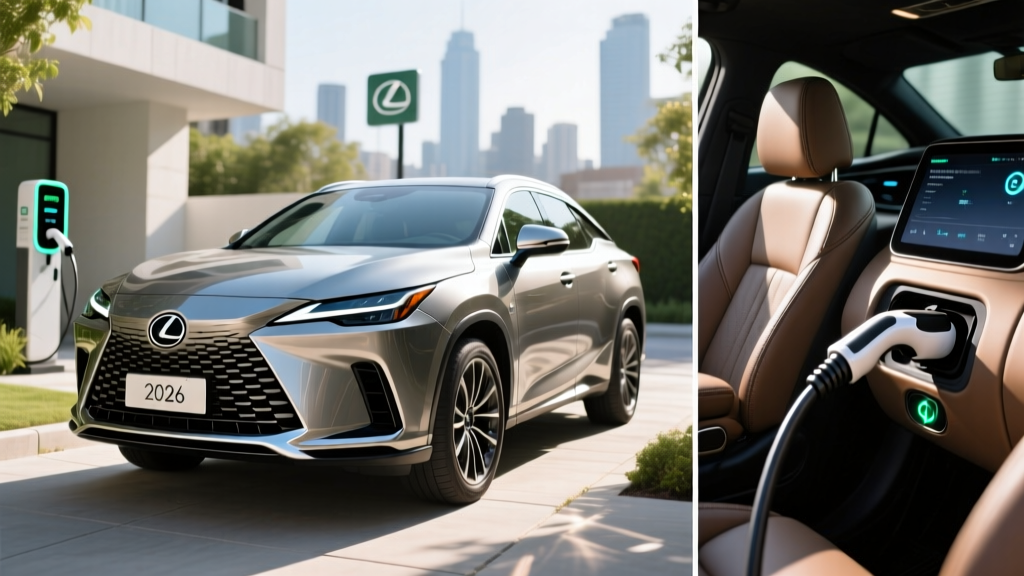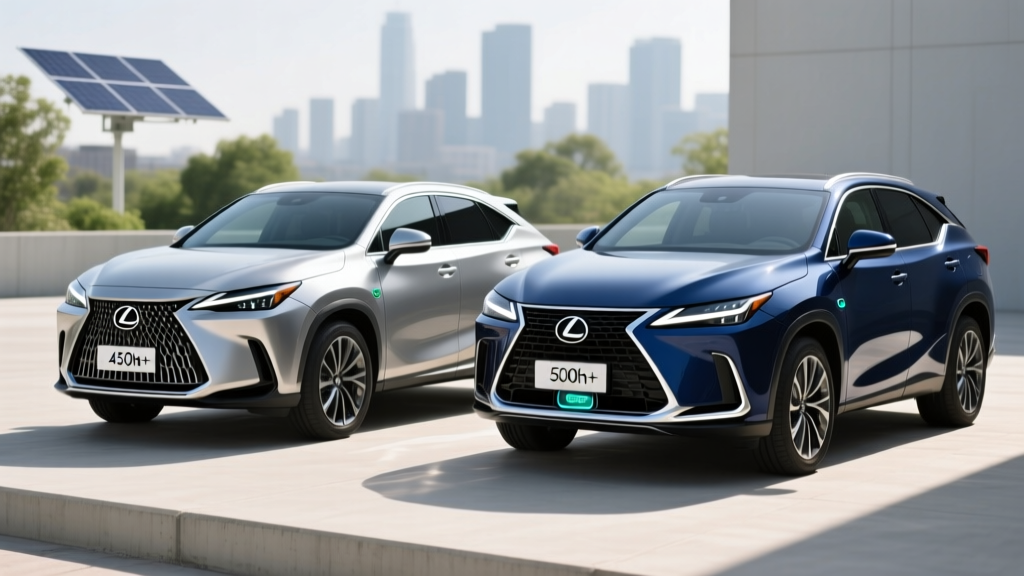
Lexus has carved a distinct niche in the luxury electrified market: plug-in hybrids that prioritize refinement, reliability, and seamless transitions between electric and gasoline power. For the 2026 model year, the Lexus plug-in hybrid lineup centers on two models — the compact NX 450h+ and the midsize RX 500h+ — both offering meaningful electric-only commuting range before the gasoline engine ever fires up.
But plug-in hybrids occupy a specific middle ground. They're not full EVs, and they're not conventional hybrids. If you're researching a Lexus plug-in hybrid, you likely want luxury-crossover comfort with the ability to do daily errands on electricity alone — without committing to a charging-dependent lifestyle. This guide breaks down exact EPA figures, real-world expectations, battery specs, pricing, and whether these models qualify for federal tax credits in 2026.
HEV vs. PHEV: What Lexus Actually Offers
Before diving into specs, it's essential to distinguish between Lexus's conventional hybrids and its plug-in hybrids. Lexus sells both, and the naming conventions can trip up first-time buyers.
| Feature | Conventional Hybrid (HEV) | Plug-in Hybrid (PHEV) |
|---|---|---|
| Examples (Lexus) | NX 350h, RX 350h, UX 300h | NX 450h+, RX 500h+ |
| Plug-in Charging | No — charges via regenerative braking and engine | Yes — plug in to charge the larger battery |
| Electric-Only Range | ~1 mile at low speed, not practical | 37–38 miles (EPA) |
| Battery Size | ~1.6 kWh (small buffer) | 18.1 kWh (usable ~14.4 kWh) |
| Federal Tax Credit | Not eligible (§30D requires plug-in + ≥7 kWh) | Eligible if sourcing/income/MSRP rules met |
| Best For | Drivers who want MPG gains without plugging in | Drivers with home charging who commute ≤35 miles |
The "h+" suffix in Lexus nomenclature signals a plug-in hybrid. The standard "h" (as in NX 350h) denotes a conventional self-charging hybrid. Both are excellent in different ways, but only the PHEV models offer electric-only commuting and potential federal tax credit eligibility.
2026 Lexus NX 450h+: Specs, Range, and MPG
The NX 450h+ is Lexus's compact luxury PHEV crossover, sharing its TNGA-K platform with the Toyota RAV4 Prime but wrapped in a far more refined interior with Lexus's latest infotainment and driver-assistance suite.
| Specification | 2026 Lexus NX 450h+ |
|---|---|
| Powertrain | 2.5L 4-cyl + 2 electric motors (eAWD) |
| Combined Horsepower | 304 hp |
| 0–60 mph | 6.0 seconds |
| Battery (Gross / Usable) | 18.1 kWh / ~14.4 kWh (Lithium-ion) |
| EPA Electric-Only Range | 37 miles |
| EPA MPGe (Electric + Gas) | 84 MPGe combined |
| EPA MPG (Gas Only, After Depletion) | 37 city / 34 highway / 36 combined |
| Total Combined Range | ~470 miles |
| Level 2 Charging (240V) | ~4.5 hours (3.3 kW onboard charger) |
| DC Fast Charging | Not available |
| Base MSRP | $53,490 (NX 450h+ Premium) |
2026 Lexus RX 500h+: The Midsize PHEV Option
For buyers needing more interior space, the RX 500h+ brings plug-in hybrid capability to Lexus's best-selling midsize crossover. It pairs a turbocharged 2.4L engine with electric motors for substantially more power than the NX.
| Specification | 2026 Lexus RX 500h+ |
|---|---|
| Powertrain | 2.4L turbo 4-cyl + electric motors (DIRECT4 eAWD) |
| Combined Horsepower | 366 hp |
| 0–60 mph | 5.6 seconds |
| Battery (Gross / Usable) | 18.1 kWh / ~14.4 kWh (Lithium-ion) |
| EPA Electric-Only Range | 35 miles |
| EPA MPGe (Electric + Gas) | 78 MPGe combined |
| EPA MPG (Gas Only, After Depletion) | 34 city / 32 highway / 33 combined |
| Total Combined Range | ~440 miles |
| Level 2 Charging (240V) | ~4.5 hours (3.3 kW onboard charger) |
| DC Fast Charging | Not available |
| Base MSRP | $64,750 (RX 500h+ Premium) |
The RX 500h+ sacrifices 2 miles of electric range compared to the NX due to its larger mass and less aerodynamic profile. However, the DIRECT4 all-wheel-drive system — which can vector torque independently to each rear wheel — provides noticeably better handling dynamics than the NX's simpler eAWD setup.
Charging: What to Expect at Home
Neither the NX 450h+ nor RX 500h+ supports DC fast charging. This is a deliberate engineering choice: Lexus prioritized interior space and cost over fast-charging capability, reasoning that most PHEV owners charge overnight at home.
With the included Level 1 charging cable (120V household outlet), a full charge takes approximately 12–13 hours. Most owners will want a Level 2 home charger (240V), which reduces this to roughly 4.5 hours thanks to the 3.3 kW onboard charger.
| Charging Method | Power | 0–100% Time | Miles Added per Hour |
|---|---|---|---|
| Level 1 (120V outlet) | ~1.2 kW | ~12–13 hours | ~3 miles/hr |
| Level 2 (240V, 16A) | 3.3 kW | ~4.5 hours | ~8 miles/hr |
| DC Fast Charge | N/A — not supported | N/A | N/A |
Practical note: The 3.3 kW onboard charger is the limiting factor. Even if you plug into a 48-amp Level 2 station capable of delivering 11.5 kW, the car will only draw 3.3 kW. This is adequate for overnight replenishment but means you can't top up quickly at a public charger during the day. A Level 2 home installation typically costs $800–$2,000 depending on your electrical panel's proximity to the parking spot.
Federal Tax Credit: Does a Lexus Plug-in Hybrid Qualify?
Under the IRS §30D Clean Vehicle Credit, both the NX 450h+ and RX 500h+ have the potential to qualify for up to $3,750 — not the full $7,500. Here's why:
- Battery capacity requirement: Both exceed the 7 kWh minimum ✓
- MSRP cap: SUVs must be under $80,000 MSRP. The NX 450h+ starts at $53,490 and the RX 500h+ at $64,750 — both pass, but heavily optioned RX trims can approach the cap ✓
- Buyer income cap: Modified AGI must not exceed $150,000 (single) / $300,000 (joint) ✓ (buyer-dependent)
- Critical minerals requirement ($3,750): Battery mineral sourcing must meet annual thresholds. Lexus/Toyota's supply chain has partially met this — check the latest fueleconomy.gov listing for current status
- Battery components requirement ($3,750): Battery component assembly must occur in North America. As of 2026, most Lexus PHEV battery packs are assembled in Japan, meaning the $3,750 battery-component half is typically not met ✗
- Point-of-sale transfer: If eligible, the credit can be applied at purchase as an immediate price reduction
Net result: most buyers will see $0 to $3,750 in federal credit depending on the current critical-minerals determination. Always verify on IRS.gov before purchasing, as sourcing determinations update periodically.
Many states offer additional hybrid/PHEV incentives (California's CVRP, Colorado's state credit, etc.), but these vary by jurisdiction and income. Check your state energy office for current programs.
Battery Longevity, Warranty, and Replacement Costs
Lexus's hybrid battery track record is among the best in the industry. Toyota/Lexus hybrid systems have accumulated billions of real-world miles since the original Prius in 1997, and failure rates are remarkably low. The PHEV battery is larger and operates in a shallower state-of-charge window (the system never fully charges or fully depletes the pack), which reduces cell stress and extends lifespan.
Replacement cost if out of warranty: A Lexus PHEV battery pack replacement runs approximately $8,000–$12,000 including labor at a dealership. However, individual module replacement (if only a few cells degrade) can cost significantly less. Third-party hybrid battery specialists often offer refurbished packs for $4,000–$6,000.
Degradation expectations: Based on long-term data from Toyota/Lexus PHEV platforms, expect roughly 10–15% capacity loss over 10 years of typical use. This translates to losing 4–5 miles of electric range over a decade — noticeable but not debilitating. The thermal management system (liquid cooling) helps mitigate calendar degradation.
Real-World MPG: Where Lexus Hybrids Overdeliver
One consistent pattern with Lexus/Toyota hybrid systems: real-world city MPG often exceeds the EPA estimate. This is because the EPA city test cycle includes moderate acceleration and stops, while real city driving — especially gentle, anticipatory driving — lets the electric motors do more of the work.
| Model | EPA Combined (Gas) | Real-World City (Owner Reports) | Real-World Highway |
|---|---|---|---|
| NX 450h+ (after battery depletion) | 36 MPG | 38–41 MPG | 32–34 MPG |
| RX 500h+ (after battery depletion) | 33 MPG | 34–37 MPG | 30–32 MPG |
Highway driving is the worst-case scenario for any hybrid, since the gasoline engine runs continuously at high load. Cold weather (below 30°F) reduces both electric range and gas-mode MPG by roughly 15–20% due to cabin heating demands and reduced battery efficiency. A heat pump is not included on these models — they rely on a resistive PTC heater and engine waste heat.
Who Should Buy a Lexus Plug-in Hybrid?
Choose a Lexus PHEV If…
- You have home Level 2 charging and a commute under 35 miles round-trip
- You want luxury refinement and Lexus's reliability reputation
- You regularly take road trips where charging infrastructure is uncertain
- You want electric commuting without range anxiety
- You value strong resale value and a 10-year battery warranty
Look Elsewhere If…
- You want DC fast charging for public top-ups
- You need more than 37 miles of electric range
- You want a full EV experience (one-pedal driving, frunk, instant torque at all speeds)
- Your daily commute exceeds 40 miles and you want to stay electric-only
- You're counting on the full $7,500 federal tax credit
- Choose the Lexus PHEV if you can charge at home, drive ≤35 miles daily, but also take 3+ road trips per year where you don't want to plan around chargers.
- Choose a full EV (like a Tesla Model Y, BMW iX, or Genesis Electrified GV70) if you have reliable home charging, rarely drive more than 250 miles in a day, and want zero gasoline expenses.
- Choose a conventional Lexus HEV (NX 350h or RX 350h) if you can't charge at home, want excellent MPG without behavior change, and don't need electric-only driving.
Frequently Asked Questions
How many MPG does the Lexus NX 450h+ get?
After the battery is depleted, the NX 450h+ achieves an EPA-rated 37 city / 34 highway / 36 combined MPG. In real-world city driving, many owners report 38–41 MPG. During electric-only operation, it achieves 84 MPGe combined.
How far can the Lexus RX 500h+ go on electric only?
The EPA rates the RX 500h+ at 35 miles of electric-only range. Real-world expectations are 28–32 miles at highway speeds or in cold weather, and 33–37 miles in mild-weather city driving with gentle acceleration.
Does a Lexus plug-in hybrid qualify for the $7,500 federal tax credit?
Not the full amount. Under current IRS §30D rules, Lexus PHEVs may qualify for up to $3,750 (the critical-minerals half) but typically fail the battery-component North American assembly requirement. Eligibility also depends on buyer income and MSRP caps. Verify on fueleconomy.gov before purchasing.
Is the Lexus PHEV battery reliable, and what does replacement cost?
Lexus covers the hybrid battery for 10 years / 150,000 miles. Toyota/Lexus hybrid batteries have an industry-leading reliability record with low failure rates. Out-of-warranty replacement costs approximately $8,000–$12,000 for a full pack, though individual module repairs cost less. Expect 10–15% capacity degradation over 10 years.
Can I DC fast charge a Lexus plug-in hybrid?
No. Neither the NX 450h+ nor RX 500h+ supports DC fast charging. Level 2 charging (240V) replenishes the battery in about 4.5 hours. Level 1 (120V) takes 12–13 hours. This is adequate for overnight home charging but limits public charging utility.
What's the difference between the NX 450h+ and NX 350h?
The NX 350h is a conventional hybrid (HEV) — it cannot plug in, has no meaningful electric-only range, and gets 39 MPG combined. The NX 450h+ is a plug-in hybrid (PHEV) with 37 miles of electric range, 304 hp, and a larger 18.1 kWh battery. The PHEV costs roughly $10,000 more but offers electric commuting and potential tax credit eligibility.