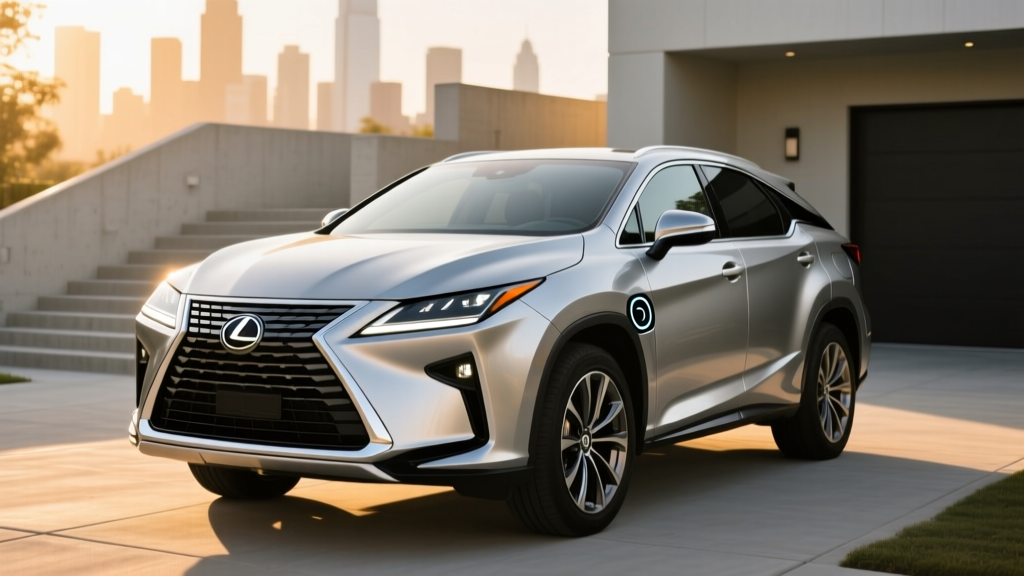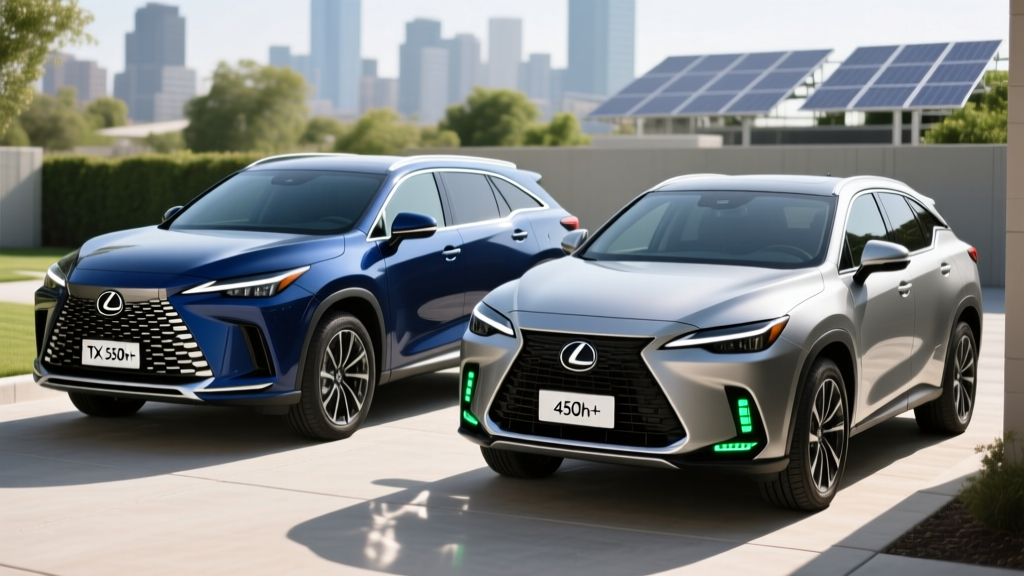
Shoppers searching for a Lexus PHEV SUV in 2026 have two distinct choices: the midsize three-row TX 550h+ and the compact NX 450h+. Both pair a plug-in hybrid powertrain with Lexus's reputation for long-term reliability, but they serve very different buyers. This guide breaks down the exact EPA numbers, battery specs, charging realities, pricing, and federal tax credit eligibility you need to decide which one fits your commute — or whether a conventional hybrid or full EV makes more sense.
HEV vs PHEV: The Lexus Distinction
Conventional Hybrid (HEV) — Models like the Lexus RX 350h or TX 500h use a small battery recharged by the engine and regenerative braking. You never plug them in. They deliver strong city MPG but no meaningful electric-only driving.
Plug-In Hybrid (PHEV) — The TX 550h+ and NX 450h+ carry a larger lithium-ion battery you can recharge from a wall outlet or public charger, giving 30+ miles of electric-only range before the gas engine engages. Plug them in nightly and many owners burn almost no gasoline on weekdays.
2026 Lexus NX 450h+: The Compact PHEV SUV
The NX 450h+ remains Lexus's volume plug-in model. Built on the TNGA-K platform shared with the Toyota RAV4 Prime, it pairs a 2.5-liter four-cylinder engine with front and rear electric motors for a combined 304 horsepower. The result is a 0-60 mph time of 6.0 seconds — genuinely quick for a luxury compact crossover — and standard electronic all-wheel drive.
| Spec | Value |
|---|---|
| Combined Horsepower | 304 hp |
| Engine | 2.5L I4 + dual electric motors |
| Battery (usable) | ~14.5 kWh lithium-ion |
| EPA Electric Range | 37 miles |
| EPA MPGe (electric+gas) | 84 MPGe |
| EPA MPG (gas only, combined) | 36 MPG |
| Level 2 Charge Time (0-100%) | ~3.5 hours at 6.6 kW |
| DC Fast Charging | Not available |
| 0-60 mph | 6.0 seconds |
| Drivetrain | AWD (electronic rear motor) |
| Base MSRP | ~$61,500 (2026 est.) |
2026 Lexus TX 550h+: The Three-Row PHEV SUV
Introduced for the 2024 model year and refreshed for 2026, the TX 550h+ is Lexus's only three-row plug-in hybrid. It uses a 3.5-liter V6 paired with high-output electric motors for a combined 406 horsepower — enough to move this 5,100-pound SUV to 60 mph in roughly 5.9 seconds. The larger battery pack pushes electric-only range above 30 miles, making school runs and grocery trips fully electric for most families.
| Spec | Value |
|---|---|
| Combined Horsepower | 406 hp |
| Engine | 3.5L V6 + dual electric motors |
| Battery (usable) | ~18.1 kWh lithium-ion |
| EPA Electric Range | 33 miles |
| EPA MPGe (electric+gas) | 77 MPGe |
| EPA MPG (gas only, combined) | 29 MPG |
| Level 2 Charge Time (0-100%) | ~4.5 hours at 6.6 kW |
| DC Fast Charging | Not available |
| 0-60 mph | 5.9 seconds |
| Drivetrain | AWD (DIRECT4) |
| Base MSRP | ~$75,000 (2026 est.) |
Neither Lexus PHEV supports DC fast charging — a notable limitation. Both use a J1772 connector for Level 1 (120V) and Level 2 (240V) AC charging. At 6.6 kW onboard charger capacity, a standard Level 2 home station replenishes the battery overnight, which is all most PHEV owners need. Just don't expect to top up at a highway Electrify America station.
MPG Breakdown: Real-World vs EPA Numbers
Plug-in hybrids are rated two ways: MPGe (miles-per-gallon-equivalent) when operating on battery plus gas, and conventional MPG once the battery is depleted. Here's how the Lexus PHEV SUV lineup compares, with real-world context from fueleconomy.gov data and owner reports.
| Model | City | Highway | Combined | EV Range |
|---|---|---|---|---|
| NX 450h+ (PHEV, gas-only mode) | 38 | 34 | 36 | 37 mi |
| TX 550h+ (PHEV, gas-only mode) | 30 | 28 | 29 | 33 mi |
| RX 350h (HEV, for comparison) | 37 | 34 | 36 | N/A |
| TX 500h (HEV, for comparison) | 27 | 28 | 27 | N/A |
Real-world MPG insight: Conventional Lexus hybrids (HEVs) frequently exceed their EPA city rating in stop-and-go traffic because regenerative braking recovers energy that friction brakes waste. PHEVs are different — their gas-mode MPG is respectable but not exceptional because of the extra 300-500 lbs of battery mass. The NX 450h+'s 36 MPG combined in charge-depleted mode is strong; the heavier TX 550h+ at 29 MPG is adequate for its class. The real efficiency win with a PHEV comes from plugging in: if your daily round-trip commute is under 35 miles, you may use the gas engine only a few times per month.
Battery Warranty, Lifespan, and Replacement Cost
Lexus Hybrid Battery Warranty
Coverage: 10 years / 150,000 miles (whichever comes first) on the hybrid battery pack and all hybrid-system components, transferable to subsequent owners.
Capacity Threshold: Lexus does not publish a specific degradation-replacement threshold, but warranty claims are typically honored when the battery can no longer hold sufficient charge to deliver rated electric range or when cells develop faults.
Replacement Cost (out of warranty): Based on current dealer pricing and third-party hybrid shops, expect $6,000-$9,000 for an NX 450h+ battery and $8,000-$12,000 for the TX 550h+ pack, including labor. These figures may decline as more aftermarket refurbished packs become available.
Lexus hybrid batteries have an excellent longevity record. Toyota/Lexus has been building hybrids since the 1997 Prius, and data from fleet operators and high-mileage owners shows most hybrid packs retain 85-90% of original capacity after 100,000 miles. The smaller battery in a PHEV cycles more deeply than a conventional HEV battery, but Lexus's thermal management and conservative state-of-charge buffers (the car never uses the top or bottom ~15% of the pack) protect long-term health. Most Lexus PHEV owners will sell the vehicle before any battery concern arises.
Federal Tax Credit and Pricing
Under current IRS §30D rules, a new plug-in hybrid can qualify for up to $7,500 in federal tax credits — but only if it meets strict battery-sourcing, critical-mineral, MSRP, and buyer-income requirements.
- MSRP Cap: SUVs must have an MSRP at or below $80,000. The NX 450h+ (base ~$61,500) qualifies; a fully loaded TX 550h+ may exceed the cap depending on options.
- Buyer Income Cap: Modified adjusted gross income must not exceed $150,000 (single), $225,000 (head of household), or $300,000 (joint filers).
- Battery Sourcing: A percentage of critical minerals and battery components must be sourced from the US or free-trade-agreement countries. This requirement tightens annually and is subject to change. Check the fueleconomy.gov tax credit lookup for current eligibility on specific VINs.
- Point-of-Sale Transfer: As of 2024, buyers can transfer the credit to the dealer as an immediate price reduction rather than waiting to claim it on their tax return.
Important: Conventional Lexus hybrids (HEVs like the RX 350h or TX 500h) do not qualify for the §30D federal tax credit — that credit applies only to plug-in vehicles with at least 7 kWh of battery capacity. Some states offer separate hybrid incentives; check your state energy office for details.
Who Should Choose a Lexus PHEV vs a Full EV or Gas Car?
Decision Framework
Choose the Lexus PHEV SUV if: You can charge at home (Level 1 or Level 2), your daily driving is under 40 miles, but you also take road trips where charging infrastructure is sparse or unreliable. A PHEV gives you electric commuting with zero range anxiety on long drives.
Choose a full EV (like the Lexus RZ 450e) if: You have reliable home charging, rarely drive more than 250 miles in a day, and want the lowest per-mile energy cost and zero tailpipe emissions. You'll also benefit from DC fast charging on road trips.
Choose a conventional Lexus HEV if: You cannot charge at home (apartment, street parking), you want maximum simplicity, and you drive a mix of city and highway miles. Hybrids like the RX 350h deliver 36 MPG combined with no behavioral changes required.
The Lexus PHEV buyer is typically a homeowner with a garage or driveway, a commute under 35 miles, and a family that takes 2-4 road trips per year. The PHEV eliminates weekday gas consumption while keeping the gas engine available for a 600-mile Thanksgiving drive without route-planning around chargers. It's a bridge technology — but a very practical one for households not yet ready to commit to a battery-electric vehicle.
Pros
- 33-37 miles electric range covers most commutes
- 304-406 hp with smooth, quiet electric torque
- No range anxiety — gas engine for long trips
- 10-year/150,000-mile hybrid battery warranty
- Standard AWD on both models
- Lexus reliability and resale value track record
Cons
- No DC fast charging — road-trip top-ups are slow
- Premium pricing: $61K-$75K+ before options
- Heavy: extra battery weight hurts gas-only MPG
- TX 550h+ may exceed the $80K MSRP tax-credit cap when loaded
- Only ~14-18 kWh battery — electric range drops in cold weather
- Cargo space slightly reduced vs HEV siblings
Frequently Asked Questions
How many MPG does a Lexus PHEV SUV get?
Once the battery is depleted, the NX 450h+ returns an EPA-estimated 36 MPG combined (38 city / 34 highway), and the TX 550h+ achieves 29 MPG combined (30 city / 28 highway). While operating with a charged battery, MPGe ratings are 84 and 77, respectively. In practice, PHEV owners who plug in daily report using the gas engine only 20-30% of the time.
How far can the Lexus PHEV SUV go on electric only?
The NX 450h+ is EPA-rated at 37 electric miles; the TX 550h+ at 33 miles. Real-world results vary: expect 5-15% less range in winter temperatures below 40°F, and slightly more in mild city driving with frequent regenerative braking. Neither model offers a "range-extender" mode that meaningfully increases electric-only distance.
Does the Lexus PHEV SUV qualify for a tax credit?
Potentially — under IRS §30D, the NX 450h+ and base TX 550h+ may qualify for up to $7,500 if the buyer meets income limits (≤$300K joint), the vehicle MSRP is ≤$80,000, and battery-sourcing requirements are satisfied. Eligibility changes as sourcing rules tighten. Always verify on fueleconomy.gov or with a tax professional before purchasing. Conventional Lexus HEVs do not qualify.
Is the Lexus PHEV battery reliable, and what does replacement cost?
Lexus hybrid batteries carry a 10-year/150,000-mile warranty and have a strong longevity record — most retain 85-90% capacity at 100K miles. Out-of-warranty replacement runs $6,000-$12,000 depending on the model. For context, most original owners sell or trade the vehicle well before battery replacement becomes necessary.
Can I DC fast charge a Lexus PHEV?
No. Neither the NX 450h+ nor the TX 550h+ supports DC fast charging. Both are limited to AC charging via a J1772 connector at up to 6.6 kW (Level 2), which fully replenishes the battery in 3.5-4.5 hours. This is typical for PHEVs — the smaller battery makes DC fast charging less cost-effective for manufacturers to include — but it means highway charging-station top-ups are not an option.
Hybrid vs PHEV vs EV — which Lexus SUV fits me?
If you can charge at home and commute under 35 miles daily but take occasional long road trips, the PHEV (NX 450h+ or TX 550h+) is ideal. If you cannot charge at home, choose a conventional HEV (RX 350h, TX 500h) for effortless efficiency. If you have home charging, rarely exceed 250 miles per day, and want the lowest operating cost, consider the all-electric Lexus RZ 450e — but know its 220-mile EPA range requires more trip planning.