Quick Verdict: Two Hybrids, Very Different Value Propositions
The 2026 Lexus NX Hybrid lineup splits into two distinct camps. The NX 350h is a conventional hybrid (HEV) — no plug required, 39 MPG combined, and an MSRP starting at $41,565 (including destination). The NX 450h+ is a plug-in hybrid (PHEV) with 37 miles of electric-only range, 304 combined horsepower, and a base MSRP of $59,515. Both use Lexus's proven 2.5-liter four-cylinder hybrid architecture, but they serve different buyers: the 350h for those who want set-it-and-forget-it fuel savings, the 450h+ for drivers with home charging who want EV-like daily commutes with a gas safety net.
| Spec | NX 350h (HEV) | NX 450h+ (PHEV) |
|---|---|---|
| Base MSRP (incl. destination) | $41,565 | $59,515 |
| Powertrain | 2.5L I4 + dual motors | 2.5L I4 + dual motors |
| Combined Horsepower | 240 hp | 304 hp |
| EPA Combined MPG / MPGe | 39 MPG | 84 MPGe / 37 MPG (gas) |
| EPA City / Highway | 41 / 37 MPG | 84 MPGe / 37 MPG |
| Electric-Only Range (PHEV) | N/A | 37 miles |
| Total Range | ~550 miles | ~545 miles (combined EV + gas) |
| Battery Capacity (usable) | ~1.6 kWh (NiMH) | 18.1 kWh (Lithium-ion) |
| DC Fast Charging | N/A | No (AC only) |
| Level 2 Charge Time (0–100%) | N/A | ~4.0 hours (240V, 16A) |
| 0–60 mph | 7.2 sec | 6.0 sec |
| Drivetrain | AWD (eAWD) | AWD (eAWD) |
| Hybrid Battery Warranty | 10 yr / 150,000 mi | 10 yr / 150,000 mi |
Sources: fueleconomy.gov, Lexus NX Hybrid specs. MSRP reflects 2026 model-year pricing with destination charge included.
HEV vs PHEV: What's the Actual Difference?
Before comparing trims, the fundamental distinction matters:
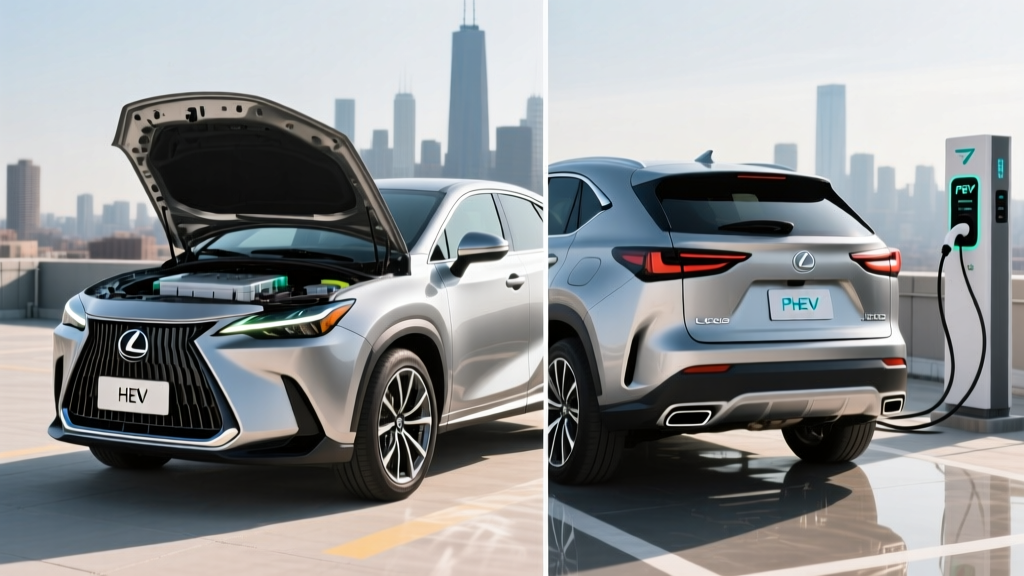
- Conventional Hybrid (HEV — NX 350h): The gas engine and regenerative braking charge a small battery. You never plug it in. The electric motor assists during acceleration and enables low-speed electric-only driving for short stretches. The result is dramatically better fuel economy than a gas-only vehicle with zero behavior change from the driver.
- Plug-in Hybrid (PHEV — NX 450h+): A much larger battery (18.1 kWh usable) can be charged from a wall outlet or Level 2 charger, giving you a genuine 37-mile electric-only range for daily commuting. Once that battery depletes, the vehicle operates as a conventional hybrid at 37 MPG combined. You get the best of both worlds — but only if you actually plug it in regularly.
Key warning: A PHEV you never plug in is just a heavier, more expensive hybrid. The NX 450h+ returns 37 MPG on gas alone — respectable, but only 2 MPG less than the NX 350h at nearly $18,000 more upfront. The PHEV only delivers value when you charge it.
Fuel Economy: EPA Numbers and Real-World MPG
| Metric | NX 350h (HEV) | NX 450h+ (PHEV, gas only) |
|---|---|---|
| EPA City | 41 MPG | 38 MPG |
| EPA Highway | 37 MPG | 35 MPG |
| EPA Combined | 39 MPG | 37 MPG |
| Real-World Combined (owner avg) | 38–42 MPG | 35–38 MPG (gas mode) |
| MPGe (electric + gas combined) | N/A | 84 MPGe |
Lexus hybrids have a well-documented tendency to exceed EPA city estimates in real-world driving. Toyota's Hybrid Synergy Drive system leans heavily on the electric motor at low speeds — exactly where gas engines are least efficient. Owners who do mostly city and suburban driving frequently report 42–44 MPG in the NX 350h during warm months. Highway-heavy commutes, however, tend to land 1–3 MPG below the EPA sticker, since the electric motor contributes less at sustained 70+ mph speeds.
For the NX 450h+, the 84 MPGe figure applies only when you're using the full battery charge plus gas. Once the battery depletes, you're looking at 35–38 MPG in mixed real-world driving. Cold weather reduces the electric-only range from 37 miles to roughly 28–32 miles, as the battery's usable capacity shrinks and cabin heating draws energy.
NX 450h+ Electric Range, Charging, and Battery
The NX 450h+ carries an 18.1 kWh lithium-ion battery (gross capacity), delivering the EPA-rated 37 miles of electric-only range. That covers the average American's one-way commute with margin to spare — the Bureau of Transportation Statistics puts the average daily round-trip commute at roughly 32 miles.
Charging specifics:
- Level 1 (120V household outlet): ~12–14 hours for a full charge. Functional for overnight top-ups if your daily electric-only need is under 25 miles.
- Level 2 (240V, 16A): ~4.0 hours from empty to full. This is the practical daily charging method — plug in when you get home, wake up to a full battery.
- DC Fast Charging: Not available. The NX 450h+ uses a J1772 AC port only. This is standard for most PHEVs — DC fast charging hardware adds weight, cost, and packaging complexity that doesn't justify itself on an 18 kWh battery.
Practical tip: The NX 450h+ includes a charge timer you can set in the Lexus app. If your utility offers off-peak electricity rates (common overnight), schedule charging for 11 PM–6 AM to cut your per-mile electricity cost to roughly $0.03–$0.05/mile — compared to $0.12–$0.16/mile on gas at 37 MPG.
Hybrid Battery Warranty and Replacement Cost
Both the NX 350h and NX 450h+ come with Lexus's 10-year / 150,000-mile hybrid battery warranty, which covers defects and capacity loss below a specified threshold (typically 70% of original capacity). This is one of the longest hybrid battery warranties in the luxury segment.
Replacement cost if out of warranty:
- NX 350h (NiMH battery): $3,000–$4,500 including labor
- NX 450h+ (lithium-ion battery): $8,000–$12,000 including labor
In practice, Toyota/Lexus hybrid batteries have demonstrated exceptional longevity. Data from fleet operators and long-term owners shows most hybrid batteries retain 80%+ capacity at 150,000 miles. The NX 350h's NiMH pack is chemically conservative and thermally robust — failures before 200,000 miles are uncommon. The NX 450h+'s lithium-ion pack is newer technology, but benefits from a sophisticated thermal management system that limits degradation.
Powertrain and Performance: 240 vs 304 Horsepower
Both models share a 2.5-liter Atkinson-cycle inline-four engine paired with dual electric motors driving all four wheels through Lexus's eAWD system. The rear axle is powered entirely by an electric motor — there's no mechanical driveshaft connecting front and rear.
NX 350h: The 2.5L engine produces 184 hp and 168 lb-ft of torque, supplemented by a front electric motor (134 kW) and a rear motor (40 kW). Combined system output is 240 horsepower. The 0–60 mph time of 7.2 seconds is adequate for merging and passing, though not sporty. Where the 350h excels is seamless, vibration-free low-speed driving — the transition between electric and gas power is among the smoothest in the segment.
NX 450h+: The same 2.5L engine is paired with more powerful electric motors and the larger battery, yielding 304 combined horsepower and a 0–60 mph time of 6.0 seconds. The extra power is immediately noticeable in highway passing and on-ramp acceleration. In EV mode, the NX 450h+ can reach 84 mph on electric power alone — sufficient for most highway driving without engaging the gas engine.
Pricing, Trims, and Tax Credit Eligibility
Here's the 2026 Lexus NX Hybrid MSRP breakdown by trim:
| Trim | Model | MSRP (incl. $1,150 dest.) |
|---|---|---|
| Premium | NX 350h | $41,565 |
| Premium+ | NX 350h | $44,765 |
| Luxury | NX 350h | $48,465 |
| F SPORT Handling | NX 350h | $47,215 |
| Premium | NX 450h+ | $59,515 |
| Premium+ | NX 450h+ | $62,365 |
| Luxury | NX 450h+ | $66,565 |
| F SPORT Handling | NX 450h+ | $63,715 |
Does the Lexus NX Hybrid Qualify for a Federal Tax Credit?
Here's where the two models diverge sharply under current IRS §30D rules:
NX 350h (HEV): Conventional hybrids do not qualify for the federal clean vehicle tax credit. The §30D credit is reserved for plug-in electric vehicles (BEVs and PHEVs) that meet battery sourcing, critical mineral, MSRP, and buyer income requirements.
NX 450h+ (PHEV): As a plug-in hybrid, the NX 450h+ is potentially eligible for up to $7,500 under §30D, but eligibility depends on multiple conditions that change frequently:
- MSRP cap: The NX 450h+ qualifies as an SUV under IRS rules, so the MSRP cap is $80,000. All current trims fall below this threshold.
- Buyer income cap: Modified AGI must not exceed $150,000 (single), $225,000 (head of household), or $300,000 (joint filers).
- Battery sourcing requirements: Critical minerals and battery components must meet phased-in domestic/FTE sourcing thresholds. These requirements tighten annually. Verify current-year compliance on the IRS clean vehicle credit page or with your Lexus dealer before purchase.
- Point-of-sale transfer: If eligible, you can transfer the credit to the dealer at purchase, reducing your out-of-pocket cost immediately rather than waiting for tax filing.
Important: Battery sourcing rules have disqualified several previously eligible PHEVs in recent years. Always confirm current eligibility via fueleconomy.gov and consult a tax professional before relying on the credit in your purchase decision.
Who Should Choose the NX Hybrid vs a Full EV or Gas Car?
Choose the NX 350h (HEV) if:
- You don't have access to home or workplace charging
- You want 39+ MPG without changing any driving habits
- Your budget is $41K–$49K and you want a luxury compact SUV
- You plan to keep the vehicle 8+ years (proven long-term reliability)
- You take frequent road trips and don't want to plan around charging
Choose the NX 450h+ (PHEV) if:
- You have Level 2 charging at home or work
- Your daily commute is under 35 miles round-trip (you'll rarely use gas)
- You want EV-like daily driving but need gas flexibility for longer trips
- You may qualify for the $7,500 federal tax credit (bringing effective price closer to NX 350h Luxury)
- You want the 304 hp performance upgrade
Choose a full BEV (e.g., Tesla Model Y, Genesis GV70 EV) if:
- You have reliable home charging and live in an area with good public DC fast charging
- You want zero tailpipe emissions and the lowest per-mile fuel cost
- You're comfortable with 250+ mile range and 20–30 minute DC fast-charge stops on road trips
- You want to eliminate oil changes and engine maintenance entirely
Stick with a gas-only SUV if:
- Your annual mileage is under 8,000 miles (fuel savings won't offset the hybrid premium)
- You're in a region with extreme cold and no garage (battery efficiency drops significantly)
NX 350h Pros
- 39 MPG combined with no plug-in required
- Class-leading reliability track record (Toyota hybrid system)
- 10-year/150K-mile hybrid battery warranty
- Strong resale value (Lexus hybrids hold value exceptionally well)
- Competitive MSRP for a luxury hybrid SUV
NX 350h Cons
- 7.2-second 0–60 feels sluggish vs turbo competitors
- No federal tax credit eligibility
- CVT-like driving feel under hard acceleration
- Rear cargo space slightly reduced by hybrid battery placement
NX 450h+ Pros
- 37 miles EV range covers most daily commutes
- 304 hp — quickest NX in the lineup
- Potential $7,500 federal tax credit
- Operates as a 37 MPG hybrid once battery depletes
- Smooth, silent EV-mode driving at highway speeds
NX 450h+ Cons
- $18,000 premium over NX 350h base
- No DC fast charging (AC only)
- Tax credit eligibility uncertain due to sourcing rules
- Heavier — impacts handling vs NX 350h
- Lithium-ion replacement cost ($8K–$12K) significantly higher than NiMH
Reliability: Why Lexus Hybrids Lead the Segment
Toyota's hybrid system — which underpins every Lexus hybrid — has accumulated over 25 years of real-world data since the original 1997 Prius. The planetary gear-based power split device has no clutch packs, belts, or traditional transmission components to wear out. The eCVT is mechanically simpler than any conventional automatic.
Lexus consistently ranks at or near the top of J.D. Power Vehicle Dependability Studies, and the NX specifically has strong long-term owner satisfaction scores. The hybrid components — inverter, electric motors, and battery — are shared across millions of Toyota/Lexus vehicles globally, meaning any qualified hybrid technician can service them.
What typically wears out on a Lexus hybrid: The same things as any car — brake pads (though regenerative braking extends their life significantly, often to 80K+ miles), suspension components, and 12V auxiliary batteries. The hybrid traction battery and motors are essentially maintenance-free.
Frequently Asked Questions
How many MPG does the Lexus NX Hybrid get?
The NX 350h achieves an EPA-rated 41 city / 37 highway / 39 combined MPG. Real-world owners frequently report 40–44 MPG in city-heavy driving and 35–37 MPG on highway-dominant commutes. The NX 450h+ PHEV delivers 84 MPGe when using its full electric charge, then 37 MPG combined on gas alone once the battery is depleted.
How far can the NX 450h+ go on electric only?
The EPA rates the NX 450h+ at 37 miles of electric-only range. In warm weather with moderate driving, expect 35–39 real-world miles. In cold weather (below 32°F), expect 28–32 miles due to reduced battery efficiency and cabin heating demand. At highway speeds above 75 mph, electric range drops to roughly 30–33 miles even in mild conditions.
Does the Lexus NX Hybrid need to be plugged in?
The NX 350h (conventional hybrid) never needs to be plugged in — it charges its small battery through regenerative braking and the gas engine. The NX 450h+ (plug-in hybrid) should be plugged in daily to realize its value. Without regular charging, it operates as a heavier hybrid at 37 MPG — still efficient, but you're paying an $18,000 premium for electric range you're not using.
Is the Lexus NX Hybrid reliable, and what does battery replacement cost?
Lexus hybrids are among the most reliable vehicles in the industry. The hybrid battery is covered by a 10-year/150,000-mile warranty. Out-of-warranty replacement runs $3,000–$4,500 for the NX 350h (NiMH) and $8,000–$12,000 for the NX 450h+ (lithium-ion). Real-world data shows most Toyota/Lexus hybrid batteries retain 80%+ capacity beyond 150,000 miles, with many lasting the life of the vehicle.
Does the Lexus NX Hybrid qualify for a federal tax credit?
The NX 350h (conventional hybrid) does not qualify for any federal tax credit. The NX 450h+ (PHEV) is potentially eligible for up to $7,500 under IRS §30D, subject to buyer income limits ($150K single / $300K joint), MSRP caps ($80K for SUVs — all trims qualify), and battery sourcing requirements that change annually. Always verify current eligibility at irs.gov before purchasing.
How long does it take to charge the NX 450h+?
On a standard 120V household outlet (Level 1), a full charge takes approximately 12–14 hours. On a 240V Level 2 charger at 16 amps, expect about 4 hours from empty to full. The NX 450h+ does not support DC fast charging — this is typical for PHEVs, as the 18.1 kWh battery doesn't justify the added weight and cost of DC charging hardware.