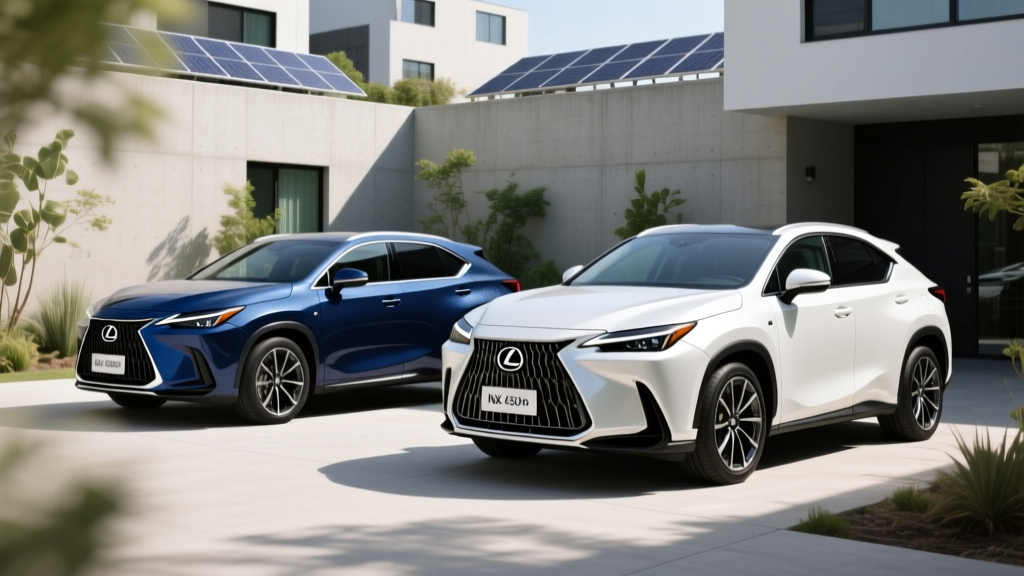
Lexus NX Hybrid MPG at a Glance
The Lexus NX lineup offers two distinct electrified paths: the NX 350h conventional hybrid (HEV) and the NX 450h+ plug-in hybrid (PHEV). Both share a 2.5-liter four-cylinder engine paired with electric motors, but their efficiency profiles diverge sharply depending on how you drive and whether you plug in. Here's exactly what the EPA says and what real-world owners report.
| Spec | 2026 NX 350h (HEV) | 2026 NX 450h+ (PHEV) |
|---|---|---|
| EPA Combined MPG | 39 MPG | 36 MPG (hybrid mode) |
| EPA City / Highway | 41 city / 37 highway | 38 city / 34 highway |
| MPGe (PHEV electric mode) | N/A | 84 MPGe combined |
| Electric-Only Range | N/A | 37 miles |
| Total Combined Range | ~550 miles | ~520 miles (EV + gas) |
| Battery Capacity | ~1.6 kWh (NiMH) | 18.1 kWh (lithium-ion) |
| Combined Horsepower | 240 hp | 304 hp |
| 0-60 mph | 7.0 sec | 6.0 sec |
| Drivetrain | AWD (e-motor rear axle) | AWD (e-motor rear axle) |
| Base MSRP | $43,965 | $60,765 |
The NX 350h's 39 MPG combined is the headline number for shoppers searching for Lexus NX hybrid MPG data. That figure holds up well in real-world use, particularly in city driving where the hybrid system's regenerative braking and electric assist shine.
Real-World MPG: City vs. Highway vs. Cold Weather
The EPA's 41 MPG city rating for the NX 350h isn't just a sticker number — it's where this powertrain genuinely excels. In stop-and-go traffic, the electric motor handles low-speed propulsion, the engine shuts off at stops, and regenerative braking recaptures energy that would otherwise be lost as heat. Owners who drive predominantly urban routes consistently report 40-43 MPG.
Highway driving tells a different story. At sustained 70-80 mph speeds, the gasoline engine carries most of the load, and aerodynamic drag works against the NX's crossover profile. Expect 34-37 MPG on the highway — slightly below the EPA's 37 MPG estimate if you drive at 75+ mph or carry a full load of passengers and cargo.
Cold weather introduces a 10-15% efficiency penalty. The engine runs longer to heat the cabin and bring the catalytic converter to operating temperature. In sub-40°F conditions, city MPG can dip to 35-37. The NX 450h+ benefits from a heat pump for cabin heating in electric mode, which partially mitigates this loss when operating on battery power.
Real-World MPG Expectations: NX 350h
| Driving Scenario | Expected MPG | Notes |
|---|---|---|
| City (stop-and-go) | 40-43 MPG | Best-case scenario for hybrids |
| Highway (65-70 mph) | 35-37 MPG | Near EPA estimate |
| Highway (75-80 mph) | 33-35 MPG | Aero drag penalty at speed |
| Cold weather city (<40°F) | 35-37 MPG | Engine runs for cabin heat |
| Combined annual average | 37-40 MPG | Typical mixed driving |
The NX 450h+ in hybrid mode (battery depleted, engine running) returns 36 MPG combined — slightly less than the 350h due to the additional 200+ lbs of battery mass it carries. But that comparison only matters once you've used up the 37 miles of electric range.
NX 350h vs. NX 450h+: HEV and PHEV Compared
The distinction between these two powertrains matters enormously for your daily routine and fuel budget:
NX 350h (Conventional Hybrid / HEV): You never plug it in. The small 1.6 kWh battery charges itself through regenerative braking and engine power. It can't drive on electric power alone for meaningful distances — the motor assists the engine but doesn't replace it. You fuel it like a normal car at a gas station and simply get better MPG.
Nx 450h+ (Plug-in Hybrid / PHEV): The larger 18.1 kWh lithium-ion battery gives you 37 miles of pure electric driving — enough for most daily commutes. You plug it in at home (Level 2) or at public chargers. Once the battery depletes, it seamlessly transitions to hybrid mode and operates like the 350h, returning 36 MPG.
For the NX 450h+, charging takes approximately 2.5 hours on a 240V Level 2 home charger (3.3 kW onboard charger). There is no DC fast charging capability — this is common for PHEVs, which prioritize home charging convenience over public fast-charging infrastructure. The 3.3 kW rate means even a standard 120V outlet can replenish the battery overnight in about 5.5 hours, though Level 2 is strongly recommended for daily use.
The powertrain difference is also substantial. The NX 450h+ produces 304 combined horsepower — 64 hp more than the 350h — thanks to a more powerful rear electric motor. That translates to a 6.0-second 0-60 time versus 7.0 seconds. The PHEV is noticeably quicker and more responsive, particularly when the battery is charged and both motors deliver full torque.
Pricing, Trims, and Federal Tax Credit Eligibility
The 2026 NX 350h starts at $43,965 (Premium trim) and ranges up to approximately $52,000 for the F SPORT Handling variant. The NX 450h+ starts at $60,765 and tops out near $66,000 fully equipped.
Does the Lexus NX Qualify for a Federal Tax Credit?
Under current IRS §30D rules for 2026, only the NX 450h+ (PHEV) is potentially eligible for a federal tax credit — and the amount is not guaranteed to be the full $7,500. Here's what determines eligibility:
- MSRP cap: SUVs must be under $80,000 — the NX 450h+ qualifies at all trims
- Buyer income limits: Modified AGI must not exceed $150,000 (single), $225,000 (head of household), or $300,000 (joint filing)
- Battery sourcing: Critical minerals and battery components must meet phased-in percentage thresholds for North American or FTA-partner sourcing — this requirement tightens annually and may reduce or eliminate the credit amount for some model years
- Point-of-sale transfer: Eligible buyers can transfer the credit to the dealer at purchase, reducing the purchase price directly rather than waiting for a tax refund
The NX 350h (conventional hybrid) does not qualify for the §30D federal credit. Conventional hybrids have not been eligible for a federal purchase credit since the early 2010s. Some states offer their own incentives for hybrids — check your state's energy or DMV website for current programs.
Always verify current eligibility on IRS.gov or consult a tax professional before making a purchase decision based on credit assumptions. Battery sourcing requirements change, and a model that qualifies in January may have different eligibility by mid-year.
Battery Warranty, Longevity, and Replacement Cost
Lexus Hybrid Battery Warranty
Both the NX 350h and NX 450h+ carry Lexus's hybrid battery warranty: 10 years or 150,000 miles (whichever comes first) in all 50 states. This covers the hybrid battery pack against defects and capacity loss below a specified threshold (typically 60-70% of original capacity).
Lexus (and parent company Toyota) has the longest track record in hybrid technology of any automaker — the Prius launched in 1997, and their hybrid battery failure rates are among the lowest in the industry. Real-world data from Toyota/Lexus hybrids shows battery packs regularly lasting 150,000-200,000+ miles before significant degradation.
If replacement is needed outside warranty, costs vary by powertrain:
- NX 350h (1.6 kWh NiMH pack): $2,000-$3,500 for a replacement battery, plus labor. The smaller pack is less expensive, and refurbished options are increasingly available from third-party suppliers.
- NX 450h+ (18.1 kWh lithium-ion pack): $6,000-$9,000 estimated. The larger lithium-ion pack is more costly, though it benefits from the same 10-year/150,000-mile warranty coverage.
The NX 350h's nickel-metal hydride (NiMH) battery is a mature, proven chemistry with excellent longevity characteristics. The NX 450h+ uses lithium-ion cells — the same chemistry in full EVs — which offer higher energy density but require more sophisticated thermal management. Lexus's hybrid system is conservative with charge/discharge cycles (never fully depleting or fully charging the buffer), which significantly extends pack life.
Who Should Choose the NX 350h, the NX 450h+, or a Full EV?
Decision Framework
Choose the NX 350h (HEV) if:
- You don't have access to home or workplace charging
- Your commute is longer than 37 miles each way (the PHEV's electric range won't cover it)
- You want maximum simplicity — no charging cables, no apps, no plug
- You want Lexus reliability with a $43K-$52K budget
- You drive mostly city miles where the 41 MPG city rating pays dividends
Choose the NX 450h+ (PHEV) if:
- You can charge at home (Level 2 strongly recommended)
- Your daily driving is under 35-37 miles (you'll rarely use gas on weekdays)
- You want EV-like daily driving with gas-engine flexibility for road trips
- You qualify for the federal tax credit and want to offset the higher MSRP
- You value the extra 64 hp and 1-second quicker 0-60 time
Choose a full EV (like the Lexus RZ or Tesla Model Y) if:
- You have reliable home charging and your daily range needs are under 250 miles
- You want zero tailpipe emissions and minimal maintenance (no oil changes, no engine)
- You're ready to rely on public DC fast charging for road trips
- You want the full $7,500 federal credit (if eligible and the model qualifies)
The NX 450h+ occupies a compelling middle ground. For a household with one EV and one gas car, it can serve as the daily commuter that runs on electricity 80% of the time while retaining the ability to drive 520+ total miles on a road trip without charging stops. The trade-off is the $17,000 price premium over the NX 350h — even with a potential tax credit, the payback period on fuel savings alone is long.
The NX 350h, meanwhile, is one of the most pragmatic luxury crossovers on the market. At 39 MPG combined, it sips fuel at a rate that undercuts nearly every competitor in the luxury compact SUV segment — the BMW X3, Mercedes GLC, and Audi Q5 all return 25-28 MPG combined in their gas-only variants. That's a 40-50% fuel savings on every fill-up, and it requires zero behavioral change from the driver.
NX 350h Pros
- 39 MPG combined — class-leading for a luxury SUV
- No plug-in required — zero lifestyle adjustment
- 10-year/150,000-mile hybrid battery warranty
- Proven Toyota/Lexus hybrid reliability
- Starts under $44K
NX 350h Cons
- No electric-only driving capability
- No federal tax credit eligibility
- 7.0-second 0-60 is adequate, not quick
- Highway MPG drops noticeably above 75 mph
NX 450h+ Pros
- 37 miles electric-only covers most commutes
- 304 hp and 6.0-second 0-60
- 84 MPGe in electric mode
- Potential federal tax credit
- Seamless transition to hybrid mode for road trips
NX 450h+ Cons
- $60,765 starting price — significant premium
- No DC fast charging
- 36 MPG hybrid mode is less than the 350h
- Heavy — the battery adds ~200 lbs
- Tax credit eligibility depends on sourcing rules
Frequently Asked Questions
How many MPG does the Lexus NX hybrid get?
The 2026 Lexus NX 350h (conventional hybrid) achieves an EPA-estimated 39 MPG combined, with 41 MPG city and 37 MPG highway. The NX 450h+ (plug-in hybrid) gets 36 MPG combined in hybrid mode once the battery is depleted, plus 84 MPGe when operating on electric power. In real-world city driving, NX 350h owners frequently report 40-43 MPG thanks to the hybrid system's regenerative braking.
How far can the Lexus NX 450h+ go on electric only?
The EPA rates the NX 450h+ at 37 miles of electric-only range on a full charge. In real-world conditions — moderate temperatures, suburban speeds under 50 mph — you can expect 33-37 miles. Highway driving at 70+ mph or cold weather below 40°F will reduce that to approximately 28-32 miles. The total combined range (electric + gasoline) is approximately 520 miles.
Is the Lexus NX hybrid reliable?
Lexus and Toyota have built millions of hybrids since 1997, and their hybrid systems are among the most reliable powertrains in the automotive industry. The hybrid battery is warranted for 10 years or 150,000 miles. Independent reliability surveys from Consumer Reports and J.D. Power consistently rank Lexus at or near the top. The NX 350h's NiMH battery chemistry is particularly proven, while the NX 450h+'s lithium-ion pack benefits from conservative charge management that extends its usable life.
What does it cost to replace a Lexus NX hybrid battery?
For the NX 350h (NiMH battery), replacement costs approximately $2,000-$3,500 including labor. For the NX 450h+ (lithium-ion battery), expect $6,000-$9,000. However, hybrid battery failures before 150,000 miles are uncommon in Lexus/Toyota vehicles, and the 10-year warranty provides substantial coverage. Many owners never need a battery replacement during their ownership.
Does the Lexus NX hybrid qualify for any tax credit?
The NX 350h conventional hybrid does not qualify for any federal purchase tax credit. The NX 450h+ plug-in hybrid is potentially eligible for the IRS §30D federal clean vehicle credit (up to $7,500), but eligibility depends on the buyer's income (must be under $150K-$300K depending on filing status), the vehicle's MSRP (under $80K for SUVs — the NX qualifies), and battery component/critical mineral sourcing requirements that change annually. Check IRS.gov for current rules. Some states also offer additional incentives for PHEVs.
Do I need to plug in the Lexus NX 350h?
No. The NX 350h is a conventional hybrid (HEV) — it charges its own small battery through regenerative braking and the gasoline engine. You never plug it in. Only the NX 450h+ (PHEV) requires plugging in to access its 37 miles of electric-only range. If you don't plug in the 450h+, it simply operates as a conventional hybrid with 36 MPG combined.
Hybrid vs. PHEV vs. EV — which Lexus NX should I choose?
If you can't charge at home, the NX 350h (HEV) is your best option — 39 MPG with zero lifestyle change. If you can charge at home and drive under 37 miles daily, the NX 450h+ (PHEV) lets you commute on electricity while keeping gas-engine flexibility for road trips. If you're ready for full electric driving, consider the Lexus RZ or a competitor like the Tesla Model Y — but only if your range needs and charging access support it.