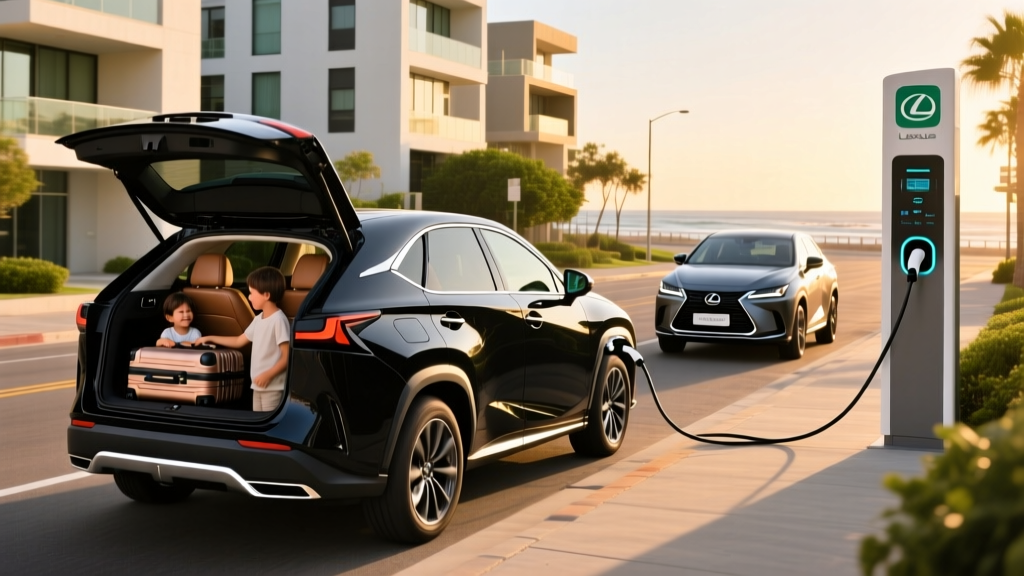
The Lexus NX 350h occupies a specific niche: a luxury compact SUV that prioritizes fuel economy and refinement over outright performance or all-electric ambition. For buyers who want premium badging and excellent MPG without plugging in, it's one of the most compelling options in the segment. This review covers the 2026 NX 350h's real-world efficiency, powertrain details, ownership costs, and how it compares to both its plug-in sibling (the NX 450h+) and full battery-electric alternatives.
2026 Lexus NX 350h: Quick Verdict
The NX 350h pairs a 2.5-liter four-cylinder engine with two electric motors and a continuously variable transmission (CVT) to deliver 244 combined horsepower through standard all-wheel drive. The EPA rates it at 41 MPG combined — a figure that's genuinely achievable in mixed driving and often exceeded in city traffic, where the hybrid system recovers the most energy through regenerative braking. Starting around $42,400, it undercuts many luxury EV rivals while delivering fuel costs closer to a Toyota RAV4 Hybrid. The trade-off is modest acceleration (0-60 mph in approximately 7.2 seconds) and a driving experience tuned for comfort rather than engagement.
Fuel Economy: EPA Ratings and Real-World MPG
| Cycle | MPG |
|---|---|
| City | 41 MPG |
| Highway | 37 MPG |
| Combined | 41 MPG |
Source: fueleconomy.gov
Real-World MPG: Where the NX 350h Excels
Toyota and Lexus hybrid systems have a well-documented tendency to meet or exceed their EPA city ratings in real-world stop-and-go driving. The NX 350h is no exception. In urban and suburban conditions with frequent regenerative-braking opportunities, owners commonly report 42-45 MPG. Highway cruising at 70-75 mph typically yields 34-37 MPG, since the engine does more of the work without electric-motor assist from braking events.
Combined real-world economy over a mix of driving generally lands between 38 and 43 MPG depending on climate, terrain, and driving style. In cold weather (below freezing), expect a 5-10% reduction as the engine runs more frequently to maintain cabin heat and battery temperature. This is a minor penalty compared to the 20-30% range loss a full EV experiences in the same conditions.
Powertrain and Performance Specifications
| Specification | Value |
|---|---|
| Engine | 2.5L inline-4 Atkinson cycle |
| Electric Motors | Front + rear (eAWD) |
| Combined Horsepower | 244 hp |
| Transmission | eCVT (electronically controlled) |
| Drivetrain | AWD (standard) |
| 0-60 mph | ~7.2 seconds |
| Hybrid Battery | ~1.6 kWh nickel-metal hydride (NiMH) |
| Towing Capacity | 2,000 lbs |
| Fuel Type | Regular unleaded (87 octane) |
The NX 350h uses Toyota's fourth-generation hybrid synergy drive system. The Atkinson-cycle engine sacrifices some low-end torque for thermal efficiency, while the electric motors fill in the torque gap during acceleration. The rear motor provides electronic AWD — there's no mechanical driveshaft connecting the front and rear axles. This reduces weight and complexity while still delivering confident traction in rain and light snow.
The eCVT is not a traditional belt-driven CVT; it uses a planetary gearset to blend engine and motor power. The result is smooth, stepless acceleration without the "rubber-band" drone associated with older CVTs. However, under hard acceleration, the engine does hold at higher RPMs — a characteristic of the power-split design rather than a true geared transmission.
NX 350h (HEV) vs. NX 450h+ (PHEV): Which NX Hybrid Fits You?
| Feature | NX 350h (HEV) | NX 450h+ (PHEV) |
|---|---|---|
| Plug-in Required? | No — self-charging | Yes — for EV range |
| Battery Size | ~1.6 kWh (NiMH) | 18.1 kWh (lithium-ion) |
| Electric-Only Range | N/A (EV mode ~1-2 mi at low speed) | 37 miles (EPA) |
| Combined MPG / MPGe | 41 MPG | 84 MPGe (charge-sustaining: 36 MPG) |
| Combined HP | 244 hp | 304 hp |
| 0-60 mph | ~7.2 sec | ~6.0 sec |
| Level 2 Charge Time | N/A | ~3.5 hours (3.3 kW onboard charger) |
| DC Fast Charge? | No | No |
| Starting MSRP (est. 2026) | ~$42,400 | ~$59,900 |
The NX 450h+ commands a significant price premium — roughly $17,500 more than the 350h — in exchange for 37 miles of electric-only driving, 60 additional horsepower, and a lithium-ion battery pack. The PHEV makes sense if you have reliable home or workplace charging and a commute under 35 miles round-trip. In that scenario, you could drive months between fill-ups. However, the math rarely favors the 450h+ purely on fuel savings: at $635/year in savings, it would take over 27 years to recoup the price gap through fuel alone. The PHEV is a lifestyle and performance upgrade, not a cost-saving one.
Neither the NX 350h nor the NX 450h+ supports DC fast charging. The PHEV charges at 3.3 kW on Level 2 (240V), which is adequate for overnight replenishment but slower than competitors like the Toyota RAV4 Prime (which charges at 6.6 kW on higher trims).
Pricing, Trims, and Tax Credit Eligibility
The 2026 Lexus NX 350h is expected to start around $42,400 (including destination) in base Premium trim. Higher trims — including the NX 350h Luxury — push the price toward $50,000-$53,000 with options like the Mark Levinson audio system, panoramic moonroof, and 20-inch wheels.
Battery Warranty, Reliability, and Replacement Cost
Toyota and Lexus hybrid systems have an exceptional reliability track record spanning over two decades, dating back to the original Prius. The NX 350h's NiMH battery pack is conservative in size and operates within a narrow state-of-charge window (typically 40-80%), which dramatically reduces degradation stress. Real-world data from Toyota RAV4 Hybrids and Camry Hybrids using similar systems shows battery packs routinely lasting 150,000-200,000+ miles without significant capacity loss.
Should the hybrid battery require replacement outside of warranty, expect a cost between $3,000 and $5,000 for a new OEM pack, including labor. Refurbished or aftermarket options may reduce this to $1,500-$2,500. However, given the 10-year/150,000-mile warranty and the proven longevity of these systems, battery replacement is an unlikely expense for most first and second owners.
Lexus as a brand consistently ranks at or near the top of J.D. Power Vehicle Dependability Studies and Consumer Reports reliability surveys. The NX specifically has earned strong reliability marks across its generation.
Interior, Technology, and Daily Livability
The current-generation NX interior is anchored by a standard 9.8-inch touchscreen (14.0-inch on higher trims) running Lexus Interface, the brand's significantly improved infotainment platform. Wireless Apple CarPlay and Android Auto are standard. The cabin materials — soft-touch surfaces, available semi-aniline leather, and aluminum or open-pore wood trim — deliver the premium feel expected at this price point.
Cargo volume measures 22.7 cubic feet behind the rear seats and 46.9 cubic feet with the rear seats folded. The hybrid battery is packaged under the rear seat, so cargo space is identical to the gas-only NX 350. The NX 350h does not offer a spare tire; a tire repair kit is standard.
Lexus Safety System+ 3.0 is standard across all trims, including pre-collision with pedestrian detection, lane tracing assist, dynamic radar cruise control, and road sign assist. This is a Level 2 driver-assistance system per SAE classification — the driver must remain attentive and keep hands on the wheel at all times.
Who Should Choose the NX 350h — and Who Shouldn't
Choose the NX 350h if:
- You want luxury SUV comfort with 40+ MPG and no plug-in requirement
- You live in an apartment or lack reliable home charging access
- You drive 10,000-15,000 miles/year and want to minimize fuel costs without range anxiety
- You value long-term reliability and strong resale value
- You want standard AWD without the complexity of a plug-in system
Look elsewhere if:
- You want electric-only commuting — consider the NX 450h+ PHEV or a full BEV like the Tesla Model Y or Genesis GV60
- You prioritize acceleration and sporty dynamics — the NX 350h's 7.2-second 0-60 and CVT aren't thrilling
- You need more than 2,000 lbs of towing capacity
- You want the lowest possible fuel cost — a full EV charged at home on off-peak electricity can cut fuel costs to the equivalent of 100+ MPGe
Frequently Asked Questions
How many MPG does the Lexus NX 350h get?
The EPA rates the NX 350h at 41 MPG city, 37 MPG highway, and 41 MPG combined. In real-world driving, city-heavy commutes often yield 42-45 MPG, while sustained highway driving at 70+ mph typically returns 34-37 MPG. Expect 38-43 MPG combined for most drivers.
Does the NX 350h need to be plugged in?
No. The NX 350h is a conventional hybrid (HEV). Its small battery charges through regenerative braking and the gasoline engine. You simply fuel it like any other car. Only the NX 450h+ (the PHEV variant) benefits from being plugged in.
Is the NX 350h hybrid battery reliable and expensive to replace?
Lexus hybrid batteries have an outstanding reliability record, routinely lasting 150,000-200,000+ miles. The NX 350h battery is covered by a 10-year/150,000-mile warranty. Out-of-pocket replacement (if ever needed) costs approximately $3,000-$5,000 for an OEM pack.
Does the Lexus NX 350h qualify for a federal tax credit?
No. The IRS §30D Clean Vehicle Credit applies only to plug-in vehicles (BEVs and PHEVs). The NX 350h, as a conventional hybrid, is not eligible. The NX 450h+ PHEV may qualify depending on current-year sourcing and income rules. Always verify with the IRS before purchasing.
Hybrid vs. PHEV vs. full EV — which is right for me?
Choose a conventional hybrid (HEV) like the NX 350h if you have no home charging, drive long or unpredictable distances, and want maximum simplicity. Choose a PHEV like the NX 450h+ if you can charge at home and want 30-40 miles of electric commuting with a gas engine for longer trips. Choose a full EV if you have reliable charging, want the lowest per-mile fuel cost, and are comfortable with 250-330 miles of range and DC fast charging for road trips.
What is the total driving range of the NX 350h?
With a 14.5-gallon fuel tank and 41 MPG combined, the NX 350h delivers approximately 595 miles of total range per fill-up — significantly more than most full EVs and comparable to the best gas-powered SUVs. Highway-only range at 37 MPG is roughly 536 miles.
Does the NX 350h require premium fuel?
No. The NX 350h runs on regular 87-octane unleaded, which helps keep operating costs down. This is a notable advantage over the turbocharged gas-only NX 350, which requires premium fuel.