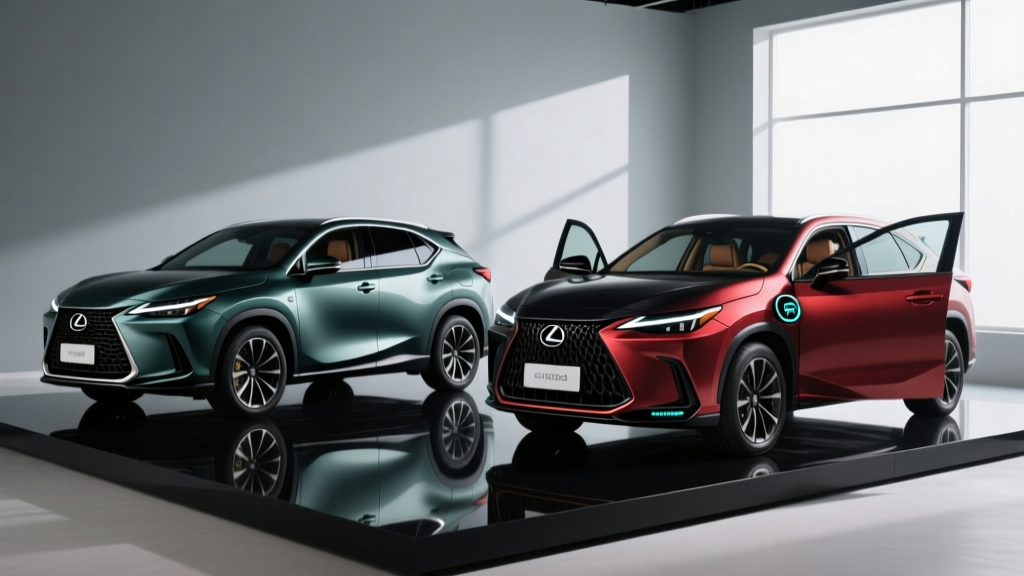
Lexus has spent two decades refining hybrid powertrains, and the 2026 model year represents the brand's most diverse electrified SUV lineup yet. From the subcompact UX 250h to the three-row TX 500h, every Lexus SUV now offers at least one hybrid variant — and in some cases, a plug-in hybrid (PHEV) option as well. If you're researching a hybrid SUV Lexus model, this guide breaks down exact EPA fuel economy, real-world efficiency expectations, powertrain specs, pricing, and tax-credit eligibility for every current model.
HEV vs. PHEV: What Lexus Hybrid Buyers Need to Know
Before comparing models, it's essential to understand the two distinct hybrid architectures Lexus uses:
Conventional Hybrid (HEV)
How it works: A small battery (typically 1.0–2.0 kWh) is charged exclusively through regenerative braking and the gasoline engine. You never plug it in.
Best for: Drivers without reliable home charging access, or those who want maximum simplicity with zero behavior change from a gas car.
Lexus HEV models: NX 350h, RX 350h, TX 350h, TX 500h, UX 250h
Plug-In Hybrid (PHEV)
How it works: A larger battery (18–20+ kWh) can be charged from a wall outlet or public charger, enabling 20–40 miles of electric-only driving before the gas engine engages.
Best for: Drivers with home Level 2 charging who commute under 40 miles daily but want gas-engine flexibility for road trips.
Lexus PHEV models: NX 450h+, RX 450h+
The distinction matters enormously for daily costs, tax-credit eligibility, and whether you need to install a home charger. A conventional Lexus HEV requires zero infrastructure — just fill up with gas and drive. A PHEV rewards you with electric-only commuting but benefits significantly from a Level 2 home charger to maximize that electric range.
2026 Lexus Hybrid SUV Lineup: MPG, Range & Specs
| Model | Type | EPA City | EPA Hwy | EPA Combined | EV Range (PHEV) | Combined HP | Battery | Starting MSRP |
|---|---|---|---|---|---|---|---|---|
| UX 250h | HEV | 43 | 41 | 42 | — | 181 | ~1.4 kWh NiMH | $39,790 |
| NX 350h | HEV | 41 | 37 | 39 | — | 244 | ~1.6 kWh NiMH | $43,965 |
| NX 450h+ | PHEV | 84 MPGe | 36 (gas) | 84 MPGe / 36 gas | 37 mi | 304 | 18.1 kWh Li-ion | $53,665 |
| RX 350h | HEV | 37 | 34 | 36 | — | 250 | ~1.6 kWh NiMH | $53,045 |
| RX 450h+ | PHEV | 83 MPGe | 32 (gas) | 83 MPGe / 32 gas | 37 mi | 304 | 18.1 kWh Li-ion | $64,040 |
| TX 350h | HEV | 27 | 28 | 27 | — | 275 | ~1.6 kWh NiMH | $58,455 |
| TX 500h | HEV (Performance) | 27 | 28 | 27 | — | 371 | ~1.8 kWh NiMH | $65,755 |
Source: fueleconomy.gov and Lexus official specifications. MSRP reflects 2026 base trims before destination charges. PHEV MPGe figures apply when operating on combined electric+gas; once the battery depletes, gas-only MPG applies.
Real-World MPG: What to Actually Expect
EPA estimates for Lexus hybrids tend to be conservative in city driving and slightly optimistic on the highway. This is a characteristic of the Toyota Hybrid System (THS) that underpins all Lexus HEVs: the system maximizes electric-motor usage at low speeds, where regenerative braking recaptures the most energy.
Real-World MPG Expectations
City driving: Most Lexus HEVs (NX 350h, RX 350h, UX 250h) meet or exceed their EPA city ratings by 1–3 MPG in stop-and-go traffic. The UX 250h regularly returns 44–46 MPG in urban commuting.
Highway driving: Expect 2–4 MPG below the EPA highway figure at sustained 70–75 mph speeds. The NX 350h, rated at 37 MPG highway, typically returns 33–35 MPG on long interstate trips.
Cold weather penalty: Hybrid fuel economy drops 10–15% in sub-freezing temperatures because the engine must run more often to generate cabin heat and maintain battery temperature. An RX 350h rated at 36 combined may return 30–32 MPG in January in northern climates.
PHEV caveat: The NX 450h+ and RX 450h+ achieve their headline MPGe numbers only when starting with a full charge. If you never plug in, expect gas-only MPG of roughly 34–36 combined — still excellent for the class, but far below the 84 MPGe sticker.
PHEV Deep Dive: NX 450h+ and RX 450h+ Electric Range & Charging
For buyers considering a Lexus plug-in hybrid, the NX 450h+ and RX 450h+ share a proven powertrain: a 2.5-liter inline-four paired with front and rear electric motors and an 18.1 kWh lithium-ion battery. Both deliver 304 combined horsepower and 37 miles of EPA-rated electric-only range.
| Charging Level | Power | Charge Time (0–100%) | Notes |
|---|---|---|---|
| Level 1 (120V household) | ~1.4 kW | ~12 hours | Emergency/trickle only; not practical for daily use |
| Level 2 (240V home/public) | ~6.6 kW | ~2.5–3 hours | Standard home charger; fully recharge overnight |
| DC Fast Charge | Not supported | — | Lexus PHEVs do not have DC fast-charging capability |
The lack of DC fast charging is typical for PHEVs in this segment — the smaller battery makes it unnecessary for most use cases. With a Level 2 home charger (which typically costs $500–$1,500 to install, depending on your electrical panel), you can fully recharge overnight and start every morning with a full 37 miles of electric range.
On electric-only power, the NX 450h+ is adequate for city commuting and suburban errands but will feel modestly powered compared to its 304-hp combined output, since electric-only mode doesn't engage the gas engine for maximum thrust. Plan on roughly 30–34 miles of real-world electric range in mixed driving, or as low as 25 miles in freezing temperatures when the climate system demands more energy.
Pricing, Tax Credits & Total Cost of Ownership
Lexus hybrid SUVs carry a premium over their gas-only counterparts, but the fuel savings and reliability record help justify the upcharge over a typical ownership period.
| Model | Base MSRP | Federal §30D Credit | Effective Price (if eligible) |
|---|---|---|---|
| UX 250h | $39,790 | Not eligible (HEV) | $39,790 |
| NX 350h | $43,965 | Not eligible (HEV) | $43,965 |
| NX 450h+ | $53,665 | Up to $3,750* | ~$49,915 |
| RX 350h | $53,045 | Not eligible (HEV) | $53,045 |
| RX 450h+ | $64,040 | Up to $3,750* | ~$60,290 |
| TX 350h | $58,455 | Not eligible (HEV) | $58,455 |
| TX 500h | $65,755 | Not eligible (HEV) | $65,755 |
*Federal tax credit for PHEVs is subject to IRS §30D rules including battery-component and critical-mineral sourcing requirements, buyer income caps ($150K single / $300K joint AGI), and MSRP limits ($80K for SUVs). The credit may be taken at point of sale. Conventional hybrids (HEVs) do not qualify for the federal EV credit. Always verify current eligibility at irs.gov and consult a tax professional.
Over five years and 75,000 miles, an NX 350h owner driving at the national average of 15,000 miles/year and paying $3.50/gallon for fuel would spend roughly $5,700 on gas. A comparable gas-only NX 250 (rated at 28 MPG combined) would cost approximately $9,375 — a savings of about $3,675 in fuel alone, partially offsetting the hybrid's higher purchase price.
Reliability & Battery Warranty: What Lexus Owners Should Know
Lexus Hybrid Battery Warranty
Coverage: 10 years / 150,000 miles (whichever comes first) on the hybrid battery and all hybrid-system components, including the inverter, electric motors, and control modules.
Capacity retention threshold: Lexus does not publish a specific degradation percentage trigger, but warranty claims are honored when the battery fails to function properly or triggers a hybrid-system warning.
Replacement cost (out of warranty): Typically $2,500–$4,500 for HEV battery replacement depending on model; PHEV battery replacement can cost $6,000–$9,000 due to the larger lithium-ion pack. Refurbished and third-party replacement options are increasingly available at lower cost.
Lexus hybrid reliability is among the strongest in the industry. The Toyota Hybrid System architecture is now in its fourth generation, with millions of units on the road globally. Unlike full EV batteries, the small HEV batteries in Lexus hybrids rarely degrade to a point requiring replacement — most failures are isolated cell issues rather than wholesale capacity loss. Consumer Reports and J.D. Power consistently rank Lexus among the top brands for long-term powertrain reliability.
For PHEV models, the 18.1 kWh lithium-ion battery carries the same 10-year/150,000-mile warranty. Real-world data from the Toyota RAV4 Prime (which shares this powertrain) suggests minimal degradation in the first 5–7 years, with most owners retaining 90%+ of original electric range after 60,000 miles.
Pros
- Class-leading fuel economy across the lineup (UX 250h at 42 MPG combined)
- Proven hybrid reliability with 10yr/150k-mile battery warranty
- No range anxiety — HEVs refuel at any gas station in 5 minutes
- PHEV models offer 37 miles of EV commuting with 400+ mile total range
- Strong resale value; Lexus hybrids depreciate slower than most competitors
- AWD standard on all hybrid variants (rear motor for e-AWD)
Cons
- HEV models do not qualify for the federal §30D tax credit
- PHEV models lack DC fast charging (Level 2 only)
- Hybrid premium of $2,000–$5,000 over gas-only trims
- CVT-style driving feel lacks engagement under hard acceleration
- PHEV electric range (37 mi) trails some competitors (RAV4 Prime: 42 mi)
- TX hybrid fuel economy (27 MPG) is modest for the segment
Which Lexus Hybrid SUV Fits Your Situation?
Choose the UX 250h if:
You want the most affordable entry into a Lexus hybrid, prioritize city fuel economy (43 MPG city), and don't need more than compact-SUV cargo space. Ideal for urban commuters and couples without children.
Choose the NX 350h if:
You want a small luxury SUV with strong fuel economy (39 combined), 244 hp for confident merging, and no plug-in requirement. This is the best all-around Lexus hybrid for most buyers who lack home charging.
Choose the NX 450h+ (PHEV) if:
You have Level 2 home charging, your daily commute is under 35 miles, and you want to drive on electricity most days while keeping gas-engine flexibility for road trips. The potential $3,750 federal credit helps offset the $9,700 premium over the NX 350h.
Choose the RX 350h if:
You need midsize-SUV space and comfort, value smooth highway cruising, and want proven hybrid efficiency in a larger package. The RX remains Lexus's best-selling model for good reason.
Choose the RX 450h+ (PHEV) if:
You want the RX experience with electric-only commuting capability, have home charging, and want the most powerful RX variant short of the performance-oriented RX 500h turbo hybrid.
Choose the TX 350h or TX 500h if:
You need three-row seating for six or seven passengers and still want hybrid efficiency. The TX 500h's 371 hp makes it the most powerful Lexus hybrid SUV, while the TX 350h prioritizes value and fuel economy.
Hybrid vs. PHEV vs. Full EV: The Decision Framework
Many Lexus shoppers cross-shop hybrid models against full battery-electric vehicles (BEVs) like the Tesla Model Y, Hyundai Ioniq 5, or the Lexus RZ 450e. Here's how to decide:
Choose a Lexus HEV if: You have no reliable home charging, frequently take long road trips through areas with sparse charging infrastructure, or simply want the lowest-complexity ownership experience. You'll save 30–40% on fuel compared to a gas-only equivalent without changing any habits.
Choose a Lexus PHEV if: You have home Level 2 charging and a commute under 37 miles, but you also take regular road trips where you don't want to plan around DC fast-charging stops. PHEVs give you EV-like daily driving with gas-car flexibility — but only if you actually plug in regularly.
Choose a full EV (like the Lexus RZ) if: You have reliable home charging, your daily driving is under 200 miles, you want the lowest per-mile energy cost (electricity at $0.14/kWh is roughly equivalent to $1.20/gallon gas), and you're comfortable planning charging stops on road trips. Full EVs also qualify for the full $7,500 federal credit when eligible, which can make them cheaper than a PHEV after incentives.
Frequently Asked Questions
How many MPG does the Lexus NX 350h hybrid get?
The 2026 Lexus NX 350h is EPA-rated at 41 MPG city, 37 MPG highway, and 39 MPG combined. In real-world city driving with frequent stops, many owners report 42–44 MPG thanks to the hybrid system's regenerative braking. Highway cruising at 75 mph typically returns 33–35 MPG.
How far can the Lexus NX 450h+ go on electric only?
The NX 450h+ is EPA-rated for 37 miles of electric-only range. Real-world results vary: expect 30–34 miles in mild weather with mixed driving, and as low as 25 miles in freezing temperatures when the battery and cabin heating demand more energy. After the battery depletes, the gas engine provides 36 MPG combined for a total range exceeding 420 miles.
Is the Lexus RX 350h reliable, and what does battery replacement cost?
The RX 350h uses Toyota's fourth-generation hybrid system, which has an outstanding reliability track record across millions of vehicles. The hybrid battery is warranted for 10 years/150,000 miles. Out-of-warranty replacement typically costs $3,000–$4,500, but most Lexus hybrid batteries last well beyond the warranty period without significant issues.
Does any Lexus hybrid SUV qualify for the federal tax credit?
Only the plug-in hybrid models — the NX 450h+ and RX 450h+ — may qualify for a partial federal tax credit under IRS §30D rules (up to $3,750, depending on battery sourcing requirements). Conventional hybrids (NX 350h, RX 350h, UX 250h, TX) do not qualify. Eligibility also depends on buyer income limits, MSRP caps, and battery-component sourcing rules. Always check fueleconomy.gov for the latest credit status.
Do I need to plug in a Lexus hybrid to charge it?
No — only the PHEV models (NX 450h+ and RX 450h+) benefit from plugging in. Conventional Lexus hybrids (HEVs) charge their small batteries entirely through regenerative braking and the gasoline engine. You simply fill up at a gas station and drive normally.
How does the Lexus TX 500h hybrid compare to the TX 350h?
The TX 500h uses a turbocharged hybrid powertrain producing 371 hp (vs. 275 hp for the TX 350h), giving it significantly stronger acceleration. However, both are EPA-rated at 27 MPG combined — the TX 500h prioritizes performance over efficiency. The TX 500h starts at $65,755, roughly $7,300 more than the TX 350h.
What is the total range of a Lexus PHEV when the battery is empty?
Both the NX 450h+ and RX 450h+ have approximately 14.5-gallon fuel tanks. After the electric range depletes, the gas engine delivers roughly 34–36 MPG combined, yielding an additional 490–520 miles of gas-only range. Combined with the 37-mile electric range, total range exceeds 530 miles on a single fill-up and charge.