The 2026 Lexus Hybrid SUV Lineup at a Glance
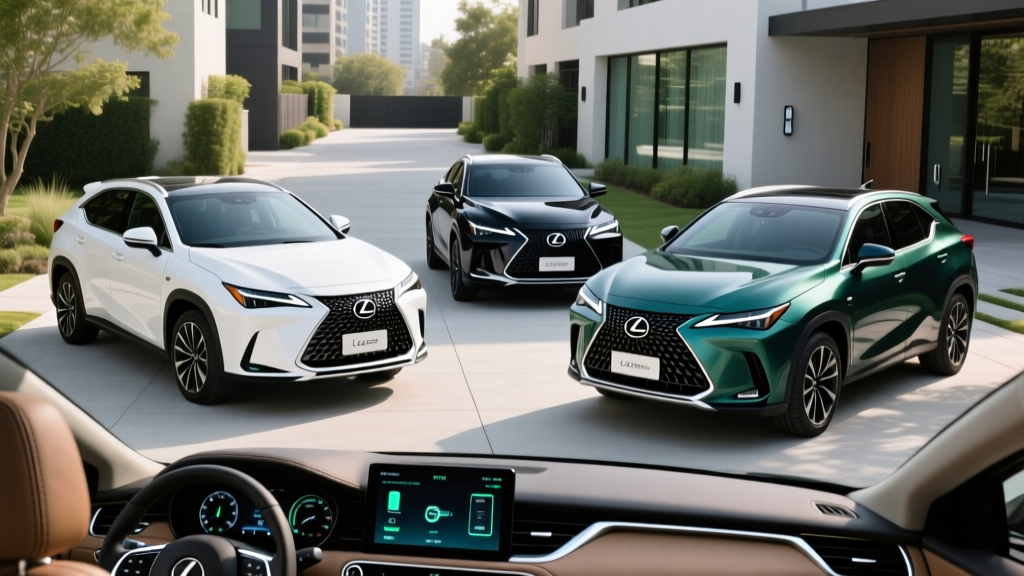
Lexus offers more hybrid SUVs than any other luxury brand, and for 2026 the lineup spans four distinct models—from the subcompact UX 300h to the three-row TX 550h+. Every one of them pairs a gasoline engine with electric motors, but the similarities end there. Two are conventional hybrids (HEVs) that never need plugging in, and two are plug-in hybrids (PHEVs) that deliver 30+ miles of electric-only driving before the engine fires up. Choosing the right one depends on whether you have access to home charging, how far your commute is, and whether you need a third row.
Below is the complete spec breakdown for every 2026 Lexus hybrid SUV currently on sale, followed by a real-world efficiency analysis, ownership-cost math, and a decision framework to match you to the right model.
| Model | Type | Combined HP | EPA Combined MPG / MPGe | EV-Only Range | Battery (kWh usable) | 0-60 mph | Base MSRP |
|---|---|---|---|---|---|---|---|
| UX 300h | HEV | 196 hp | 42 MPG | N/A | ~1.4 kWh (NiMH) | 8.0 sec | $40,250 |
| NX 450h+ | PHEV | 304 hp | 84 MPGe / 36 MPG (gas) | 37 mi | 18.1 kWh (Li-ion) | 6.0 sec | $59,765 |
| RX 500h F SPORT | HEV | 366 hp | 27 MPG | N/A | ~1.4 kWh (NiMH) | 5.7 sec | $62,350 |
| TX 550h+ | PHEV | 406 hp | 64 MPGe / 23 MPG (gas) | 33 mi | 20.5 kWh (Li-ion) | 5.8 sec | $75,150 |
Source: fueleconomy.gov and Lexus USA. Prices include destination. MPGe applies when operating on electricity; MPG (gas) applies after the battery is depleted.
HEV vs PHEV: Which Lexus Hybrid SUV Architecture Fits You?
The most common buyer mistake is conflating a conventional hybrid with a plug-in hybrid. They operate fundamentally differently, and the right choice depends on your daily routine and charging access.
Conventional Hybrid (HEV) — UX 300h, RX 500h
- Never plugs in. The battery recharges through regenerative braking and the gasoline engine.
- Small battery (~1-2 kWh) provides electric assist during acceleration and enables low-speed electric creep, but cannot sustain highway speeds on electricity alone.
- Best for: drivers without home charging, apartment dwellers, road-trippers who don't want to think about plugging in.
- No federal tax credit under current IRS §30D rules (the credit applies only to plug-in vehicles with ≥7 kWh battery capacity).
Plug-In Hybrid (PHEV) — NX 450h+, TX 550h+
- Plugs in to recharge a much larger battery (18-21 kWh), enabling 33-37 miles of pure electric driving.
- Operates as an EV for daily commutes, then seamlessly switches to hybrid mode for longer trips—no range anxiety.
- Level 2 home charging (240V) fully recharges in ~2.5-3 hours. Neither PHEV supports DC fast charging.
- Best for: commuters with ≤35-mile one-way trips and access to a Level 2 home charger or workplace charger.
- May qualify for up to $7,500 federal tax credit (§30D) depending on battery sourcing, buyer income, and MSRP caps.
Fuel Economy Breakdown: EPA Numbers vs Real-World MPG
Lexus hybrids have a well-documented tendency to exceed their EPA city ratings in stop-and-go traffic, where regenerative braking recaptures the most energy. Highway MPG typically dips below the EPA combined figure because the engine carries a greater share of the load at sustained speed. Here's what to expect from each model in daily driving.
| Model | EPA City | EPA Highway | EPA Combined | Real-World Expectation |
|---|---|---|---|---|
| UX 300h | 43 MPG | 41 MPG | 42 MPG | 40-45 MPG city; 37-40 MPG highway |
| NX 450h+ (gas mode) | 38 MPG | 34 MPG | 36 MPG | 35-40 MPG city; 30-33 MPG highway |
| RX 500h | 27 MPG | 28 MPG | 27 MPG | 25-28 MPG city; 24-26 MPG highway |
| TX 550h+ (gas mode) | 25 MPG | 22 MPG | 23 MPG | 22-25 MPG city; 20-22 MPG highway |
The UX 300h's 42 MPG combined is genuinely exceptional for a luxury crossover and translates to roughly 525 miles of total range from its 12.4-gallon tank. The TX 550h+ returns lower numbers, but context matters: it's a 5,000-pound, three-row SUV with 406 horsepower. Compared to the gas-only TX 350 (23 MPG combined), the plug-in hybrid saves fuel on any trip under 33 miles where it runs purely on electricity.
PHEV Electric-Only Range and Charging Details
For NX 450h+ and TX 550h+ buyers, the electric-only range is the headline spec. Both use Toyota's fourth-generation plug-in hybrid system with a series-parallel architecture that allows the electric motors to drive the wheels independently of the engine.
| Spec | NX 450h+ | TX 550h+ |
|---|---|---|
| Battery capacity (gross / usable) | 18.1 kWh / ~14.5 kWh | 20.5 kWh / ~16.5 kWh |
| Battery chemistry | Lithium-ion (NMC) | Lithium-ion (NMC) |
| EPA electric-only range | 37 miles | 33 miles |
| Total combined range (EV + gas) | ~460 miles | ~430 miles |
| Level 1 charging (120V, 12A) | ~12 hours (0-100%) | ~14 hours (0-100%) |
| Level 2 charging (240V, 32A) | ~2.5 hours (0-100%) | ~3 hours (0-100%) |
| DC fast charging | Not supported | Not supported |
| Charge port | J1772 | J1772 |
A critical note on PHEV charging: neither Lexus plug-in hybrid supports DC fast charging. This is typical for PHEVs—the batteries are small enough that Level 2 replenishes them quickly, and adding DC hardware would increase cost and weight. If you rely on public DC fast chargers during road trips, you'll be operating in hybrid mode anyway, so this limitation has minimal practical impact.
Real-world electric range will vary. Expect 30-34 miles from the NX 450h+ and 27-30 miles from the TX 550h+ in cold weather (below 40°F) or at sustained highway speeds above 65 mph, where aerodynamic drag and cabin heating reduce efficiency. In mild weather around town, some owners report exceeding the EPA estimates by 2-3 miles.
Powertrain Details: Engine, Motors, and Performance
Every 2026 Lexus hybrid SUV uses all-wheel drive (Lexus calls it E-Four or DIRECT4, depending on the model), with at least one electric motor powering the rear axle. This eliminates the mechanical driveshaft, reducing weight and enabling precise torque vectoring.
UX 300h — 196 hp Combined
A 2.0-liter inline-4 Atkinson-cycle engine paired with two electric motors (one front, one rear). Total system output is 196 horsepower. The 0-60 mph time of 8.0 seconds is adequate for commuting but not brisk. The tradeoff is best-in-class efficiency.
NX 450h+ — 304 hp Combined
A 2.5-liter inline-4 Atkinson-cycle engine with front and rear electric motors producing 304 combined horsepower. The DIRECT4 all-wheel-drive system can send up to 80% of torque to the rear wheels. The 6.0-second 0-60 time makes this the quickest compact luxury PHEV crossover in its price bracket.
RX 500h F SPORT Performance — 366 hp Combined
Lexus pairs a turbocharged 2.4-liter inline-4 with a high-output electric motor setup for 366 horsepower and 406 lb-ft of torque. This is the performance-oriented hybrid in the lineup, trading efficiency for acceleration (5.7 seconds to 60 mph). The DIRECT4 system and rear-wheel steering give it genuinely engaging handling for a midsize SUV.
TX 550h+ — 406 hp Combined
The range-topping plug-in hybrid uses a 3.5-liter V6 Atkinson-cycle engine with front and rear electric motors for 406 combined horsepower. Despite being the largest and heaviest Lexus SUV, it hits 60 mph in 5.8 seconds—faster than many gas-only competitors in the three-row segment. The V6 is notably smoother and quieter than the four-cylinder setups in the smaller models.
Pricing, Trims, and Federal Tax Credit Eligibility
Lexus hybrid SUVs carry a price premium over their gas-only counterparts, but the fuel savings and potential tax incentives can close the gap within a few years of ownership.
| Model | Base Trim MSRP | Mid Trim MSRP | Top Trim MSRP |
|---|---|---|---|
| UX 300h | $40,250 (Premium) | $43,750 (Premium+) | $47,500 (F SPORT Handling) |
| NX 450h+ | $59,765 (Premium) | $63,250 (Premium+) | $66,900 (F SPORT Handling) |
| RX 500h | $62,350 (F SPORT Performance) | $64,850 (F SPORT Handling) | — |
| TX 550h+ | $75,150 (Premium) | $78,500 (Premium+) | $81,200 (Luxury) |
Federal Tax Credit: What Applies in 2026?
Under IRS §30D rules effective for the 2026 tax year, only the plug-in hybrid models (NX 450h+ and TX 550h+) are potentially eligible for the federal clean vehicle credit. Conventional hybrids (UX 300h, RX 500h) do not qualify because they lack sufficient battery capacity.
- Maximum credit: Up to $7,500 (split into $3,750 for critical minerals sourcing + $3,750 for battery component sourcing).
- Battery capacity: Must be ≥7 kWh — both NX 450h+ (18.1 kWh) and TX 550h+ (20.5 kWh) qualify.
- MSRP cap: SUVs must have an MSRP ≤$80,000. All NX 450h+ trims qualify; the TX 550h+ Luxury trim ($81,200) exceeds the cap.
- Buyer income cap: Modified AGI must not exceed $150,000 (single), $225,000 (head of household), or $300,000 (joint).
- Battery sourcing requirements: Critical minerals and battery components must meet escalating domestic/free-trade sourcing thresholds. As of 2026, the critical-minerals requirement may reduce the credit for some Toyota/Lexus models depending on supply-chain updates. Verify current status at IRS.gov.
- Point-of-sale transfer: Eligible buyers can transfer the credit to the dealer at purchase, reducing the out-of-pocket price immediately rather than waiting for a tax refund.
Bottom line: Most NX 450h+ buyers who meet income requirements should expect the full or partial $7,500 credit. TX 550h+ buyers should choose the Premium or Premium+ trim to stay under the $80,000 MSRP cap. Always confirm eligibility with a tax professional before purchase, as sourcing rules are updated annually.
Reliability, Battery Warranty, and Replacement Costs
Lexus consistently ranks at or near the top of J.D. Power and Consumer Reports reliability studies, and the hybrid powertrain is a major reason: the e-CVT transmission has no traditional gear sets to wear, and the Atkinson-cycle engine operates under lower thermal stress than a conventional powertrain.
Hybrid Battery Warranty — All 2026 Lexus Models
Coverage: 10 years / 150,000 miles (whichever comes first) for all hybrid and PHEV battery packs, effective from the 2020 model year onward.
What's covered: Defects and capacity loss below a specified threshold (typically 60-70% of original capacity, varies by model). Normal degradation above the threshold is not a warranty claim.
Out-of-warranty replacement cost: $3,000-$5,000 for HEV models (UX 300h, RX 500h) and $6,000-$9,000 for PHEV models (NX 450h+, TX 550h+), including parts and labor. These are estimates based on current Toyota/Lexus hybrid battery pricing; exact costs vary by model year and dealer.
Real-world data from Toyota/Lexus hybrids in taxi and fleet service shows that nickel-metal hydride (NiMH) batteries in the HEV models typically retain 80%+ capacity after 150,000 miles. The lithium-ion packs in the PHEV models are newer to market, but Toyota's thermal management system (liquid cooling on the TX 550h+) is designed to minimize calendar degradation. Most owners will trade the vehicle before the battery needs replacement.
Who Should Buy a Lexus Hybrid SUV vs a Full EV or Gas Car?
Choose a Lexus HEV (UX 300h or RX 500h) if:
- You live in an apartment or lack access to home or workplace charging.
- You want maximum simplicity — no cords, no apps, no charging planning.
- Your priority is low fuel cost without behavioral changes (the UX 300h at 42 MPG saves ~$800/year vs a 25 MPG gas SUV at 12,000 miles/year).
- You frequently take long road trips and don't want to plan around charging stops.
Choose a Lexus PHEV (NX 450h+ or TX 550h+) if:
- You have a garage or driveway where you can install a Level 2 (240V) charger.
- Your daily round-trip commute is under 35 miles — you'll drive on electricity most days and rarely use gas.
- You want EV-like daily driving with the security of a gas engine for weekend road trips.
- You're eligible for the federal tax credit, which can offset the ~$8,000-$10,000 PHEV premium over a comparable gas model.
Choose a Full BEV (like the Lexus RZ 450e or a competitor) if:
- You have reliable home charging and your daily driving rarely exceeds 200 miles.
- You want zero tailpipe emissions and the lowest per-mile fuel cost (electricity at $0.13/kWh costs ~$0.04/mile vs $0.14/mile for a 30 MPG hybrid on $3.50/gal gas).
- You're willing to plan DC fast charging stops on road trips.
Stick with a Gas-Only SUV if:
- You drive fewer than 6,000 miles per year, making the hybrid premium difficult to recoup through fuel savings.
- You regularly tow more than 5,000 pounds (the TX gas model tows 5,000 lbs; the TX 550h+ tows 5,000 lbs but loses electric range under load).
Lexus Hybrid SUV Pros
- Best-in-class reliability track record and 10-year/150k-mile battery warranty
- UX 300h achieves 42 MPG without plugging in — lowest running cost in luxury compact SUVs
- NX 450h+ delivers 37 mi EV range + 304 hp with no range anxiety on road trips
- All models include Lexus Safety System+ 3.0 (adaptive cruise, lane-keeping, pre-collision)
- Strong resale value — Lexus hybrids depreciate slower than most EVs
Lexus Hybrid SUV Cons
- PHEV models do not support DC fast charging
- TX 550h+ Luxury trim exceeds the $80,000 MSRP cap for the federal tax credit
- RX 500h prioritizes performance over efficiency (27 MPG) — not the greenest choice
- Infotainment system, while improved, still trails competitors in responsiveness
- PHEV premium ($8,000-$10,000 over gas equivalent) requires 5-7 years to recoup via fuel savings without the tax credit
Frequently Asked Questions
How many MPG does a 2026 Lexus hybrid SUV get?
It depends on the model. The UX 300h achieves an EPA-estimated 42 MPG combined (43 city / 41 highway), making it one of the most fuel-efficient luxury crossovers sold. The NX 450h+ returns 36 MPG combined in gas-only mode after the battery depletes, plus 37 miles of electric-only driving rated at 84 MPGe. The RX 500h is rated at 27 MPG combined, and the three-row TX 550h+ achieves 23 MPG combined in hybrid mode. Real-world city MPG for all models tends to match or slightly exceed EPA figures thanks to aggressive regenerative braking in stop-and-go traffic.
How far can the Lexus PHEV SUVs go on electric only?
The NX 450h+ has an EPA-rated 37 miles of electric-only range, and the TX 550h+ is rated at 33 miles. In real-world driving, expect 30-34 miles from the NX and 27-30 miles from the TX in cold weather or at highway speeds. In mild conditions around town, some drivers report 39-40 miles from the NX 450h+ by staying under 45 mph and using the climate system sparingly.
Hybrid vs PHEV vs EV — which is right for me?
If you can't charge at home, choose a conventional hybrid (HEV) like the UX 300h or RX 500h — they never need plugging in and still save significant fuel. If you have home charging and a commute under 35 miles, a PHEV like the NX 450h+ lets you drive on electricity daily while keeping the gas engine for road trips. If you have home charging, rarely drive more than 200 miles in a day, and want the lowest operating cost, a full EV is the most efficient choice — but you'll need to plan around DC charging on long trips.
Are Lexus hybrid SUVs reliable, and what does battery replacement cost?
Lexus has one of the strongest reliability records in the industry, and the hybrid system is a core reason — the e-CVT has fewer moving parts than a conventional transmission, and the Atkinson-cycle engine runs under lower stress. All 2026 Lexus hybrid batteries carry a 10-year/150,000-mile warranty. Out-of-warranty replacement costs range from approximately $3,000-$5,000 for the HEV models to $6,000-$9,000 for the PHEV models. Based on long-term Toyota/Lexus fleet data, most hybrid batteries retain over 80% capacity at 150,000 miles, meaning many will outlast the vehicle's ownership cycle.
Does any 2026 Lexus hybrid SUV qualify for a tax credit?
Only the plug-in hybrids — the NX 450h+ and TX 550h+ — are potentially eligible for the federal §30D clean vehicle credit (up to $7,500). Conventional hybrids (UX 300h, RX 500h) do not qualify. Eligibility depends on buyer income (≤$300,000 joint AGI), MSRP (≤$80,000 for SUVs), and battery-component/critical-mineral sourcing requirements that update annually. The TX 550h+ Luxury trim ($81,200 MSRP) exceeds the cap; choose Premium or Premium+ to remain eligible. The credit can be transferred to the dealer at point of sale for an immediate price reduction. Confirm current eligibility at IRS.gov and consult a tax professional before purchasing.
Do I need to install a home charger for a Lexus PHEV?
It's strongly recommended. While both PHEVs can charge from a standard 120V outlet (Level 1), a full recharge takes 12-14 hours — barely enough to top up overnight if you deplete the battery daily. A Level 2 (240V) home charger reduces that to 2.5-3 hours, ensuring you start every morning with a full battery. A basic Level 2 installation typically costs $500-$1,500 for the charger and electrician labor, assuming your electrical panel has sufficient capacity.