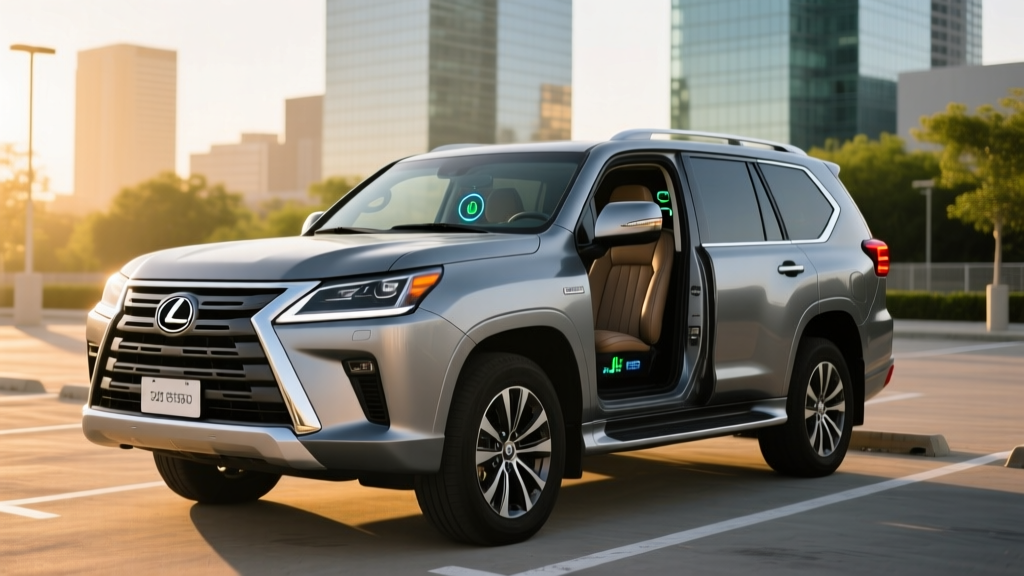
The Lexus GX has long been the body-on-frame SUV for buyers who want Land Cruiser capability wrapped in luxury leather. For 2026, the GX 550 Hybrid variant pairs Toyota's i-FORCE MAX twin-turbo hybrid powertrain with the GX's serious off-road hardware, promising both towing muscle and meaningful fuel economy gains over the standard V6. Here's a data-driven breakdown of what this conventional hybrid (HEV) actually delivers—and where it falls short.
Quick Verdict: The GX 550 Hybrid in One Paragraph
The 2026 Lexus GX 550 Hybrid is a conventional hybrid (HEV), not a plug-in. It requires no charging infrastructure, uses a small battery recharged through regenerative braking and the engine, and delivers an EPA-estimated 23 MPG combined—a notable improvement over the standard GX 550's 17 MPG combined. With 457 combined horsepower and 583 lb-ft of torque, it's the most powerful GX ever sold, and it retains the 8,000-pound towing capacity buyers expect. Starting around $72,000, it trades a premium over the gas model for years of fuel savings and smoother low-speed driving.
HEV vs. PHEV vs. EV: Where the GX 550 Hybrid Fits
Conventional Hybrid (HEV) — this vehicle: The GX 550 Hybrid uses a small battery pack (approximately 1.8 kWh) that charges itself through regenerative braking and engine power. You never plug it in. It improves fuel economy by assisting the engine during acceleration and enabling brief low-speed electric-only driving. Think of it as a more efficient gas vehicle.
Plug-in Hybrid (PHEV): A PHEV carries a larger battery (typically 15–25 kWh) that you plug in to charge, offering 25–50 miles of pure electric range before the gas engine kicks in. The GX does not currently offer a PHEV variant. If you want plug-in Lexus luxury, the TX 550h+ is the closest three-row alternative.
Battery Electric Vehicle (BEV): A full EV has no gas engine and relies entirely on a large battery pack (80–120+ kWh). The closest electric equivalent in size would be vehicles like the Rivian R1S or Cadillac Escalade IQ, though neither matches the GX's off-road pedigree.
EPA Fuel Economy: GX 550 Hybrid MPG Breakdown
According to fueleconomy.gov, the 2026 Lexus GX 550 Hybrid achieves the following EPA estimates:
| Metric | GX 550 Hybrid (HEV) | GX 550 (Gas Only) |
|---|---|---|
| City MPG | 22 | 15 |
| Highway MPG | 24 | 19 |
| Combined MPG | 23 | 17 |
| Fuel Tank (gallons) | 22.5 | 22.5 |
| Estimated Total Range | ~517 miles | ~382 miles |
That's a 35% combined MPG improvement over the non-hybrid GX 550. For a body-on-frame, three-row SUV with 8,000-pound towing capacity, 23 MPG combined is genuinely competitive—it matches some midsize crossovers.
Real-World MPG vs. EPA Sticker
Toyota's hybrid systems historically perform close to or slightly above EPA city estimates in real-world stop-and-go driving, where regenerative braking recovers the most energy. On highway-heavy road trips at 75+ mph, expect the hybrid advantage to narrow—real-world highway figures typically land between 21–23 MPG. In mixed suburban driving, owners report 22–25 MPG. If your commute involves heavy city traffic, the hybrid's advantage over the gas model becomes even more pronounced.
Real-World Expectation: EPA combined 23 MPG. Expect 21–25 MPG in mixed driving. Highway-heavy trips at 75+ mph may yield 20–22 MPG. Towing a loaded trailer will drop this to roughly 12–14 MPG.
Powertrain Specs: i-FORCE MAX Twin-Turbo Hybrid
The GX 550 Hybrid uses Toyota's i-FORCE MAX powertrain, the same architecture found in the Tundra and Sequoia hybrids but tuned for the GX's luxury positioning.
| Specification | 2026 GX 550 Hybrid |
|---|---|
| Engine | 3.4L Twin-Turbo V6 |
| Electric Motor | Integrated between engine & transmission |
| Combined Horsepower | 457 hp |
| Combined Torque | 583 lb-ft |
| Transmission | 10-speed automatic |
| Drivetrain | Full-time 4WD with Torsen center diff |
| 0–60 mph | ~6.5 seconds (est.) |
| Max Towing Capacity | 8,000 lbs |
| Hybrid Battery | ~1.8 kWh (NiMH), self-charging |
| Plug-in Required? | No — conventional HEV |
The electric motor sits between the engine and transmission, providing instant torque fill at low RPMs where turbo lag would otherwise be felt. This gives the GX 550 Hybrid noticeably smoother acceleration from stops compared to the gas-only model, particularly in city driving. The motor also enables silent, electric-only crawling at very low speeds (parking lots, driveways) for brief distances.
Pricing, Trims & Tax Credit Eligibility
The 2026 Lexus GX 550 Hybrid is offered across several trims, with pricing as follows:
| Trim | MSRP (est.) | Key Features |
|---|---|---|
| Premium | $72,000 | Hybrid powertrain, 14" touchscreen, heated/ventilated front seats |
| Premium+ | $77,000 | Mark Levinson audio, head-up display, panoramic roof |
| $79,500 | Off-road tuned suspension, 33" tires, rear locker, skid plates | |
| Luxury | $85,000 | Semi-aniline leather, massaging seats, adaptive suspension |
| Luxury+ | $92,000 | Executive rear seating, cooled second row, full tech suite |
Federal Tax Credit: Does the GX 550 Hybrid Qualify?
The GX 550 Hybrid is a conventional hybrid (HEV), not a plug-in. Under current IRS §30D rules, the federal clean vehicle credit of up to $7,500 applies only to battery electric vehicles (BEVs) and plug-in hybrids (PHEVs) that meet battery sourcing, critical mineral, MSRP cap, and buyer income requirements.
Key Point: The GX 550 Hybrid does not qualify for the §30D federal EV tax credit because it is a conventional HEV with no plug-in capability. Some states may offer modest hybrid incentives—check your state energy office or AFDC state incentive database for local programs.
Battery Warranty, Lifespan & Replacement Cost
Hybrid battery longevity is consistently the top concern among first-time hybrid buyers. Here's what Lexus provides:
Hybrid Battery Warranty: 10 years / 150,000 miles (whichever comes first), covering defects and capacity loss below functional thresholds. This applies to all 2026 Lexus hybrid models and is transferable to subsequent owners.
How Long Will the Hybrid Battery Actually Last?
Toyota and Lexus hybrid batteries have an exceptional track record. The Prius, now in its third decade, routinely sees original hybrid batteries lasting 150,000–200,000+ miles with minimal degradation. The GX 550 Hybrid's battery pack is small (~1.8 kWh) and operates within a conservative state-of-charge window (roughly 40–80%), which dramatically reduces stress on the cells compared to a full EV battery that cycles through a wider range.
Replacement cost if out of warranty: Based on current Toyota/Lexus hybrid battery pricing, a replacement pack for the i-FORCE MAX system is estimated at $2,500–$4,000 (parts and labor). This is far less than EV traction battery replacement ($10,000–$20,000+) because the hybrid pack is small and simple. Third-party refurbished options may reduce this further.
Overall Reliability Outlook
Lexus consistently ranks at or near the top of J.D. Power and Consumer Reports reliability studies. The GX's body-on-frame platform (shared with the Land Cruiser 300/250 series) is proven in global markets. The i-FORCE MAX powertrain has been in production since the 2022 Tundra, giving it several model years of real-world validation. The primary risk factors are the twin-turbo system's long-term durability under heavy towing loads—a consideration for buyers who regularly max out the 8,000-pound rating.
Who Should Buy the GX 550 Hybrid (and Who Shouldn't)
Reasons to Choose It
- You want serious off-road and towing capability with better fuel economy than a traditional V8 or non-hybrid V6
- You lack home charging access and don't want to deal with plug-in logistics
- You drive mostly in the city, where the hybrid system recovers the most energy
- You value the smooth, torque-rich acceleration the electric motor provides at low speeds
- You want Lexus reliability and a 10-year hybrid battery warranty
Reasons to Look Elsewhere
- You want pure electric driving for daily commutes — consider a PHEV or BEV instead
- You need three rows but prioritize fuel economy above all else — the TX 550h+ PHEV offers 33 miles electric-only
- You want to maximize federal tax credits — HEVs don't qualify for §30D
- You rarely drive in the city, where the hybrid advantage is smallest
- Budget is tight — the hybrid premium adds $3,000–$5,000 over the gas-only GX
Decision Framework: GX 550 Hybrid vs. Alternatives
Choose the GX 550 Hybrid if: You need body-on-frame durability, 8,000-lb towing, and off-road chops, but want to cut fuel costs by ~35% versus the gas model without ever plugging in.
Choose the Lexus TX 550h+ (PHEV) if: You want three rows, daily electric-only commuting (33 miles), and eligibility for partial federal credits, and you can sacrifice some off-road capability.
Choose a full EV (Rivian R1S, Escalade IQ) if: You have reliable home charging, want zero tailpipe emissions, and don't need extreme off-road or heavy-towing capability.
Choose the gas-only GX 550 if: Budget is the top priority and you drive mostly highway miles where the hybrid advantage is smallest.
Frequently Asked Questions
How many MPG does the GX 550 Hybrid get?
The 2026 Lexus GX 550 Hybrid achieves an EPA-estimated 22 city / 24 highway / 23 combined MPG. That's a 35% improvement over the gas-only GX 550 at 17 MPG combined. Real-world results in mixed suburban driving typically range from 21–25 MPG.
Does the GX 550 Hybrid need to be plugged in?
No. The GX 550 Hybrid is a conventional hybrid (HEV). Its small battery recharges automatically through regenerative braking and the gasoline engine. You fuel it like any other vehicle—just fill up at the pump.
Can the GX 550 Hybrid drive on electric power only?
Yes, but only at very low speeds (under ~15 mph) for short distances—think parking lots or creeping in traffic. It does not offer meaningful electric-only range like a plug-in hybrid. The electric motor's primary role is assisting the gas engine for better acceleration and efficiency.
Is the GX 550 Hybrid reliable?
Lexus ranks among the most reliable luxury brands in J.D. Power and Consumer Reports surveys. The i-FORCE MAX hybrid system has been in production since 2022 in the Tundra and Sequoia. Toyota/Lexus hybrid batteries have a demonstrated lifespan of 150,000–200,000+ miles, backed by a 10-year/150,000-mile warranty.
What does a hybrid battery replacement cost for the GX 550?
If the hybrid battery fails outside warranty coverage, replacement is estimated at $2,500–$4,000 including labor. This is significantly less than EV battery replacement because the hybrid pack is small (~1.8 kWh). The 10-year/150,000-mile warranty should cover most original owners entirely.
Does the GX 550 Hybrid qualify for any tax credits?
No. As a conventional hybrid (HEV), the GX 550 Hybrid does not qualify for the federal §30D clean vehicle credit, which applies only to plug-in vehicles (BEVs and PHEVs). Some states offer modest hybrid incentives—check the AFDC database for your state.
How does the GX 550 Hybrid compare to the Sequoia Hybrid?
The Toyota Sequoia uses a similar i-FORCE MAX powertrain but is larger, seats up to eight, and achieves 21 MPG combined. The GX is more compact, more off-road capable, more luxurious, and slightly more efficient at 23 MPG combined. If you need maximum interior space, the Sequoia wins. If you want luxury and trail capability, the GX is the pick.
How much does the hybrid add to the GX's price?
The hybrid powertrain typically adds $3,000–$5,000 over an equivalently trimmed gas-only GX 550. With a ~6 MPG combined improvement, the payback period depends on your annual mileage and local fuel prices. At 15,000 miles/year and $3.50/gallon, the hybrid saves approximately $1,100–$1,300 annually in fuel, reaching payback in roughly 3–4 years.