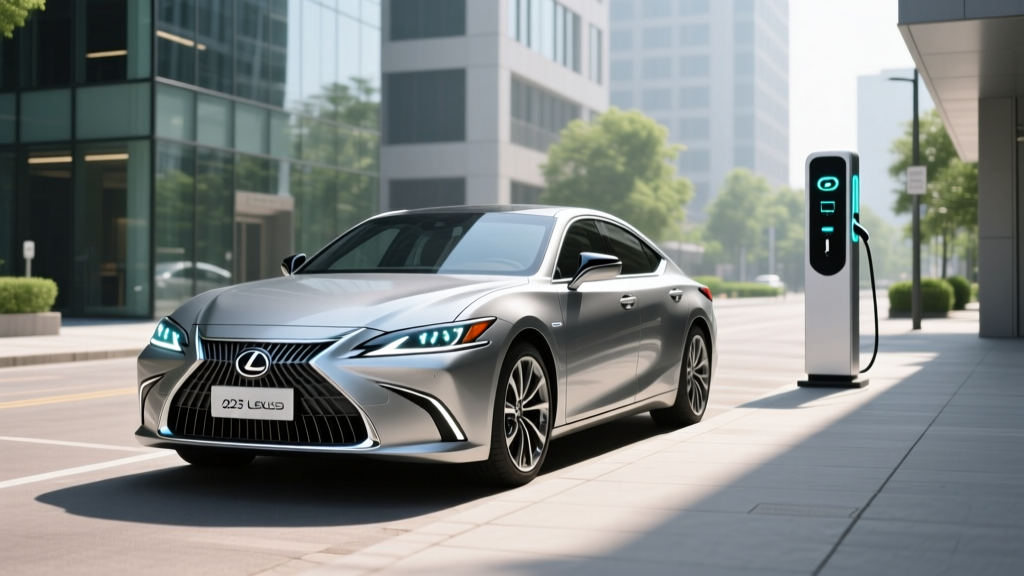
The 2025 Lexus ES Hybrid — officially badged the ES 300h — remains one of the most fuel-efficient luxury sedans on the market without requiring a charging cable. It is a conventional hybrid electric vehicle (HEV), meaning you never plug it in; the gasoline engine and regenerative braking keep its small battery charged. For buyers who want luxury-car quietness with commuter-car efficiency, the ES 300h occupies a specific niche that neither a full EV nor a turbocharged gas sedan can replicate.
This guide covers the 2025 Lexus ES 300h powertrain, EPA and real-world fuel economy, battery longevity, pricing, and how it stacks up against plug-in hybrids and full battery-electric alternatives.
2025 Lexus ES Hybrid Fuel Economy: EPA and Real-World MPG
The ES 300h pairs a 2.5-liter four-cylinder engine with an electric motor integrated into the transaxle, driving the front wheels through an electronically controlled continuously variable transmission (eCVT). Here is the official EPA fuel economy breakdown:
| Metric | Value |
|---|---|
| City MPG | 43 |
| Highway MPG | 44 |
| Combined MPG | 44 |
| Fuel Tank Capacity | 13.2 gallons |
| Total Driving Range | ~580 miles |
Real-World MPG: What Owners Actually See
Toyota and Lexus hybrids routinely match or exceed their EPA city estimates because the electric motor handles low-speed driving where gasoline engines are least efficient. In mixed suburban commuting (25–45 mph with frequent stops), owners commonly report 42–46 MPG. Highway driving at 70–80 mph tends to drop to 38–41 MPG, since aerodynamic drag dominates and the engine carries more of the load. In cold weather (below 35°F), expect a 3–5 MPG reduction during warm-up cycles as the engine runs longer to heat the cabin and catalytic converter.
Powertrain Specs: Engine, Motor, and Combined Output
The ES 300h uses Toyota's fourth-generation hybrid system, refined for smoothness rather than sportiness. The combined system output is modest by luxury-sedan standards but more than adequate for daily driving.
| Specification | Detail |
|---|---|
| Engine | 2.5L inline-4 (A25A-FXS) |
| Engine Power | 176 hp @ 5,700 rpm |
| Electric Motor Power | 118 hp (front) |
| Combined System Output | 215 hp |
| Transmission | eCVT (planetary gearset) |
| Drivetrain | Front-wheel drive |
| 0–60 mph | ~7.7 seconds |
| Hybrid Battery | ~1.6 kWh lithium-ion (sealed, not plug-in) |
| Curb Weight | ~3,790 lbs |
The 1.6 kWh battery pack is small by PHEV or BEV standards because it only needs to buffer energy from regenerative braking and engine generation — not store plug-in electricity. This is the fundamental distinction between an HEV and a PHEV: the ES 300h never plugs in, carries minimal battery weight, and avoids the complexity of onboard charging hardware.
HEV vs PHEV vs EV: Which Powertrain Fits You?
Buyers cross-shopping the ES 300h often consider plug-in hybrids like the BMW 330e or full EVs like the Tesla Model S or BMW i5. Here is how these powertrain types differ in practice:
| Factor | HEV (ES 300h) | PHEV (e.g., BMW 330e) | BEV (e.g., BMW i5) |
|---|---|---|---|
| Plug-in Required? | No | Yes (for EV range) | Yes |
| Electric-Only Range | ~1 mi at low speed | 20–25 mi | 250–340 mi |
| Combined Efficiency | 44 MPG | 28 MPG + 75 MPGe | 85–100 MPGe |
| Home Charging Needed? | No | Recommended | Essential |
| Federal Tax Credit | Not eligible | Up to $7,500 (varies) | Up to $7,500 (varies) |
| Maintenance Complexity | Low | Moderate | Lowest (no engine) |
| Best For | No home charging access | Short commute + road trips | Home charging + daily driving |
Does the 2025 Lexus ES Hybrid Qualify for a Tax Credit?
No. The ES 300h is a conventional hybrid (HEV) and does not qualify for the federal §30D Clean Vehicle Credit. That credit applies only to plug-in hybrids (PHEVs) and battery-electric vehicles (BEVs) that meet battery capacity, critical-mineral sourcing, MSRP caps, and buyer income limits. Some states offer modest rebates for conventional hybrids, but these are rare and typically small ($500–$1,000). Check your state energy office for current programs.
Pricing: 2025 Lexus ES 300h Trims and MSRP
Lexus positions the ES 300h as the efficiency-oriented trim within the broader ES lineup. Pricing for the 2025 model year:
| Trim | MSRP (incl. destination) |
|---|---|
| ES 300h Base | $44,690 |
| ES 300h Luxury | $48,390 |
| ES 300h F SPORT Design | $48,190 |
| ES 300h F SPORT Handling | $50,340 |
The hybrid carries roughly a $2,000 premium over the equivalent gas-only ES 250 AWD, which returns 25/34/28 MPG. At 15,000 miles per year and $3.50/gallon fuel, the ES 300h saves approximately $750–$900 annually in fuel costs versus the ES 250, recouping the hybrid premium in about 2–3 years.
Battery Warranty, Reliability, and Replacement Cost
Hybrid battery longevity is the single most common concern among first-time hybrid buyers. Lexus covers the ES 300h hybrid battery with one of the industry's strongest warranties:
Powertrain Warranty: 6 years / 70,000 miles.
Basic Vehicle Warranty: 4 years / 50,000 miles.
How Long Do Lexus Hybrid Batteries Last?
Toyota and Lexus hybrid batteries have demonstrated exceptional longevity in real-world use. Data from fleet operators and owner surveys shows that most Toyota/Lexus hybrid battery packs retain functional capacity well past 150,000 miles. The ES 300h's lithium-ion pack is smaller and less stressed than a PHEV or BEV battery because it operates within a narrow state-of-charge window (typically 40–80%), which dramatically reduces degradation.
If replacement is needed out of warranty, a new OEM hybrid battery for the ES 300h costs approximately $3,000–$4,500 including labor. Refurbished or reconditioned packs are available for $1,500–$2,500. Individual module replacement (only the failed cells) can reduce cost to $800–$1,500 at a hybrid-specialist shop.
Overall Reliability
Lexus consistently ranks at or near the top of J.D. Power Vehicle Dependability Studies. The ES nameplate has been in production since 1989, and the hybrid variant since 2013. The eCVT transmission has no traditional clutch packs or bands to wear — it uses a planetary gearset with no fixed gear ratios — which contributes to the powertrain's mechanical durability. The main maintenance items remain conventional: oil changes, brake pads (which last longer due to regenerative braking), and cabin air filters.
Who Should Buy the 2025 Lexus ES Hybrid?
Pros
- 44 MPG combined with no plug-in requirement
- 580-mile total range — fewer fuel stops on road trips
- 10-year / 150,000-mile hybrid battery warranty
- Quiet, composed ride quality with excellent cabin isolation
- Strong resale value typical of Lexus sedans
- Lower maintenance cost than turbocharged luxury competitors
Cons
- 215 hp feels leisurely — not a sport sedan
- No all-wheel-drive option on the hybrid
- Infotainment touchpad legacy still irks some users
- No federal tax credit (HEV, not PHEV)
- Rear-seat headroom tight for passengers over 6'2"
- eCVT drone under hard acceleration
The Ideal ES 300h Buyer
You are the right buyer if you commute 20–60 miles daily in mixed city/suburban driving, do not have access to home or workplace charging, and want a luxury badge without the maintenance costs of German competitors. The ES 300h excels in stop-and-go traffic where its electric motor handles most low-speed propulsion, returning its best MPG precisely where gas-only cars are worst.
You should look elsewhere if you want EV-only daily driving (consider a PHEV like the Toyota RAV4 Prime or a BEV), need all-wheel drive for snow-belt winters (the ES 250 AWD or a hybrid SUV like the Lexus RX 350h), or prioritize acceleration and handling dynamics over efficiency.
2025 Lexus ES Hybrid FAQ
How many MPG does the 2025 Lexus ES Hybrid get?
The EPA rates the 2025 Lexus ES 300h at 43 city / 44 highway / 44 combined MPG. In real-world driving, owners typically see 40–46 MPG depending on route mix and climate, with city-heavy commutes returning the best numbers.
Does the Lexus ES Hybrid need to be plugged in?
No. The ES 300h is a conventional hybrid (HEV). Its battery charges through regenerative braking and the gasoline engine. There is no plug, no charging cable, and no electric-only driving range beyond very low-speed maneuvering.
Is the Lexus ES available as a plug-in hybrid (PHEV)?
No. Lexus does not offer the ES sedan as a plug-in hybrid. If you want a Lexus PHEV, the RX 500h+ and NX 450h+ are current options with 30–37 miles of electric-only range. For a luxury PHEV sedan, the BMW 330e or Mercedes-Benz C 300e (market-dependent) are alternatives.
How reliable is the Lexus ES 300h hybrid system?
Very reliable. Lexus ranks at the top of long-term dependability studies, and Toyota/Lexus hybrid powertrains have accumulated billions of real-world miles since the Prius launched in 1997. The hybrid battery is warranted for 10 years / 150,000 miles, and most packs last well beyond that period without significant capacity loss.
What does a Lexus ES hybrid battery replacement cost?
A new OEM hybrid battery replacement costs approximately $3,000–$4,500 with labor. Refurbished packs run $1,500–$2,500, and individual module replacement at a hybrid specialist can cost $800–$1,500. Given the 10-year warranty and the battery's demonstrated longevity, most original owners will never face this expense.
Does the 2025 Lexus ES Hybrid qualify for any tax credit?
The ES 300h does not qualify for the federal §30D Clean Vehicle Credit, which is limited to PHEVs and BEVs meeting battery sourcing, MSRP, and income requirements. Some states offer small hybrid rebates — check your state energy office for current programs. The IRS publishes current eligibility rules at irs.gov.
How does the ES 300h compare to a full EV like the Tesla Model 3?
The ES 300h costs roughly $5,000–$10,000 less than a comparably equipped Model 3 Long Range and requires no charging infrastructure. However, the Model 3 qualifies for a partial or full federal tax credit (income and sourcing dependent), has dramatically lower per-mile energy costs (roughly $0.04/mile on electricity vs. $0.08/mile on gasoline for the ES 300h), and delivers far stronger acceleration. The trade-off is charging access: if you cannot install a Level 2 home charger, the ES 300h eliminates that friction entirely.