The Lexus ES 350h hybrid occupies a specific lane in the midsize luxury sedan market: it prioritizes fuel efficiency, ride comfort, and long-term reliability over sporty dynamics. For 2026, the ES 350h pairs a 2.5-liter four-cylinder engine with Lexus's fourth-generation hybrid system to deliver an EPA-estimated 44 MPG combined — a number that stands out in a segment where rivals like the BMW 5 Series and Mercedes-Benz E-Class don't offer conventional hybrid variants at all. This review breaks down the real-world fuel economy you can expect, the powertrain specifications, battery longevity data, and whether the ES 350h makes financial sense compared to a plug-in hybrid or full battery-electric vehicle.
Quick Verdict: Who the Lexus ES 350h Hybrid Is For
The 2026 Lexus ES 350h is the right pick if you want luxury-sedan comfort with hybrid-level fuel costs and zero lifestyle change. There's no plug, no range anxiety, no charging-app frustration. You fill up at any gas station and drive. The trade-off is that you're still burning gasoline — about 9.5 gallons per 500 miles of mixed driving — and you won't access HOV lanes or federal tax credits that plug-in hybrids and BEVs can offer. If your daily commute is under 30 miles and you have home charging access, a PHEV or BEV will likely save you more. But if you rack up highway miles, live in an apartment without charging, or simply want the lowest-complexity path to 40+ MPG in a luxury badge, the ES 350h is the most refined option available.
Fuel Economy: EPA Ratings and Real-World MPG
The EPA rates the 2026 Lexus ES 350h at 43 MPG city, 44 MPG highway, and 44 MPG combined. These numbers come from fueleconomy.gov and apply to the FWD configuration, which is the only drivetrain offered on the 350h trim.
| Driving Cycle | EPA MPG |
|---|---|
| City | 43 MPG |
| Highway | 44 MPG |
| Combined | 44 MPG |
| Annual Fuel Cost (15,000 mi) | ~$1,650* |
*Based on $3.50/gal regular unleaded, 15,000 miles/year, 55% city / 45% highway split.
Lexus's hybrid system excels in stop-and-go traffic where the electric motor handles low-speed propulsion and regenerative braking recaptures energy. In real-world suburban commuting with frequent stops, owners commonly report 45–48 MPG — slightly above the EPA city figure. On sustained highway trips at 75+ MPH, expect 39–42 MPG as the gasoline engine carries more of the load. In cold weather (below 30°F), the engine runs more frequently to maintain cabin heat and battery temperature, dropping observed economy to 36–39 MPG until the powertrain reaches operating temperature.
Powertrain Specs: Engine, Motor, and Combined Output
The 2026 ES 350h uses Lexus's proven hybrid architecture: a 2.5-liter Atkinson-cycle four-cylinder gasoline engine mated to a permanent-magnet synchronous electric motor via an electronically controlled continuously variable transmission (eCVT). The system prioritizes smoothness over aggression — there are no simulated gear shifts, and the power delivery is linear rather than punchy.
| Specification | Value |
|---|---|
| Gasoline Engine | 2.5L Atkinson-cycle I-4 |
| Engine Output | 176 hp / 163 lb-ft torque |
| Electric Motor Output | 134 hp / 155 lb-ft torque |
| Net Combined System Power | 215 hp |
| Drivetrain | Front-wheel drive (FWD) |
| Transmission | eCVT |
| 0–60 MPH | 8.1 seconds (manufacturer est.) |
| Fuel Tank Capacity | 13.2 gallons |
| Total Driving Range | ~580 miles (combined) |
The 215 combined horsepower is adequate for merging and passing but won't satisfy anyone seeking sport-sedan acceleration. The ES 350h is tuned for isolation: the cabin stays quiet, the suspension absorbs road imperfections, and the hybrid system transitions between electric and gasoline power nearly imperceptibly. If you want the faster ES, the non-hybrid ES 350 (302 hp V6) or the turbo-four ES 350h's stablemate, the ES 500h (not offered for 2026 — Lexus dropped the V6 hybrid after the prior generation), are the alternatives, though neither approaches the 350h's efficiency.
HEV vs. PHEV vs. EV: Which Powertrain Fits Your Life?
The ES 350h is a conventional hybrid (HEV). It cannot be plugged in, has no electric-only driving mode of meaningful distance, and carries a small ~1.6 kWh nickel-metal hydride (NiMH) battery pack. This is fundamentally different from a plug-in hybrid (PHEV) or a battery-electric vehicle (BEV). Here's how the three compare:
| Factor | HEV (ES 350h) | PHEV (e.g., BMW 530e) | BEV (e.g., Tesla Model S) |
|---|---|---|---|
| Plug-in Required? | No | Yes (for EV range) | Yes |
| Electric-Only Range | ~1 mi at low speed | 20–40 mi typical | 300–400+ mi |
| Total Range | ~580 mi | 400–500 mi combined | 300–400 mi |
| Home Charging Needed? | No | Recommended | Essential |
| Federal Tax Credit (§30D) | Not eligible | Up to $7,500 (if eligible) | Up to $7,500 (if eligible) |
| Maintenance Complexity | Low (no plug, simple battery) | Moderate (two full powertrains) | Low (fewer moving parts) |
| Best For | No home charging, highway-heavy driving | Short commutes + road trips | Home charging + daily driving under 300 mi |
- You live in an apartment or condo without charging access
- Your driving is predominantly highway (where PHEVs lose their EV-range advantage)
- You want zero behavior change — just gas up and go
- You prioritize long-term reliability and low ownership complexity
- You have Level 2 home charging and a commute under 35 miles (PHEV covers it on electricity)
- You want to access federal tax credits or HOV lane perks
- You want to eliminate or dramatically reduce gasoline use
Pricing, Trims, and Tax Credit Eligibility
The 2026 Lexus ES 350h starts at an MSRP of $44,490 (including destination) for the base trim. Lexus packages the ES 350h in a single well-equipped grade, with optional packages for navigation, premium audio (Mark Levinson), and the Lexus Safety System+ 3.0 suite, which comes standard. A fully loaded ES 350h with the Luxury Package and Technology Package typically lands between $50,000 and $53,000.
| Configuration | MSRP (incl. destination) |
|---|---|
| ES 350h Base | $44,490 |
| ES 350h + Navigation/Premium Audio | ~$47,500 |
| ES 350h + Luxury Package | ~$50,200 |
| ES 350h Fully Loaded | ~$53,000 |
Federal Tax Credit: Not Eligible
Under current IRS §30D Clean Vehicle Credit rules, conventional hybrids like the ES 350h do not qualify for the federal tax credit. The §30D credit applies only to plug-in electric vehicles (PHEVs and BEVs) that meet battery-capacity, critical-mineral sourcing, MSRP caps, and buyer income thresholds. The ES 350h's small NiMH battery and lack of plug-in capability place it outside the credit's scope entirely.
- Vehicle must be a plug-in EV or PHEV with ≥7 kWh battery capacity — ES 350h has ~1.6 kWh, no plug
- Conventional HEVs are excluded from §30D by statute
- No point-of-sale transfer option for non-plug-in vehicles
- Some states offer separate hybrid rebates — check your state's energy office for current programs
Battery Warranty, Longevity, and Replacement Cost
Hybrid battery durability is the most common concern among first-time hybrid buyers. Lexus covers the ES 350h's hybrid battery with a 10-year/150,000-mile warranty (whichever comes first) in all 50 states — an improvement over the older 8-year/100,000-mile standard that applied to pre-2020 models. This warranty guarantees the battery will retain sufficient capacity to function as designed; if it fails or degrades below a usable threshold, Lexus replaces it at no cost.
- Hybrid Battery Warranty: 10 years / 150,000 miles
- Hybrid System Components: 8 years / 100,000 miles
- Battery Chemistry: Nickel-Metal Hydride (NiMH)
- Battery Capacity: ~1.6 kWh (traction battery)
- Replacement Cost (out of warranty): $2,500–$4,000 (dealer), $1,500–$2,500 (independent hybrid specialist with refurbished unit)
In practice, Lexus and Toyota hybrid batteries have demonstrated exceptional longevity. Data from fleet operators and long-term owner surveys show that the NiMH packs in vehicles like the Prius, Camry Hybrid, and ES 350h routinely last 150,000–200,000+ miles before any meaningful degradation. Unlike the larger lithium-ion packs in BEVs, the ES 350h's small battery is never deeply cycled — the hybrid system keeps it in a narrow state-of-charge window (roughly 40–80%), which dramatically reduces wear. The risk of a premature battery failure is very low, and out-of-pocket replacement costs are a fraction of what a BEV battery swap would cost.
Reliability, Safety, and Ownership Costs
Lexus consistently ranks at or near the top of J.D. Power's Vehicle Dependability Study and Consumer Reports' reliability surveys. The ES nameplate specifically has been a reliability benchmark for over two decades. The 2026 ES 350h benefits from a mature powertrain — this generation of Lexus's 2.5L hybrid system has been in production since 2019 with iterative refinements, meaning most early-production issues have been resolved.
On the safety front, the ES earned the IIHS Top Safety Pick+ designation in its most recent evaluation, with "Good" ratings across all crashworthiness tests. The standard Lexus Safety System+ 3.0 includes pre-collision braking with pedestrian detection, lane-departure alert with steering assist, dynamic radar cruise control, and road-sign assist. Note: these are SAE Level 1–2 driver-assistance features. The driver must remain fully engaged at all times — the ES does not offer hands-free driving capability.
| Cost Category | 5-Year Estimate |
|---|---|
| Fuel (15,000 mi/yr, $3.50/gal) | ~$8,250 |
| Insurance (national avg. luxury sedan) | ~$9,500 |
| Maintenance (hybrid — no plug, fewer brake replacements) | ~$2,800 |
| Depreciation (Lexus retains ~55% at 5 yr) | ~$20,000 |
| Total Estimated 5-Year Cost | ~$40,550 |
The ES 350h's regenerative braking system extends brake-pad life significantly — many owners report 60,000+ miles on original pads. Oil changes follow the standard 10,000-mile interval using 0W-16 synthetic, keeping routine maintenance costs low.
Interior, Tech, and Driving Experience
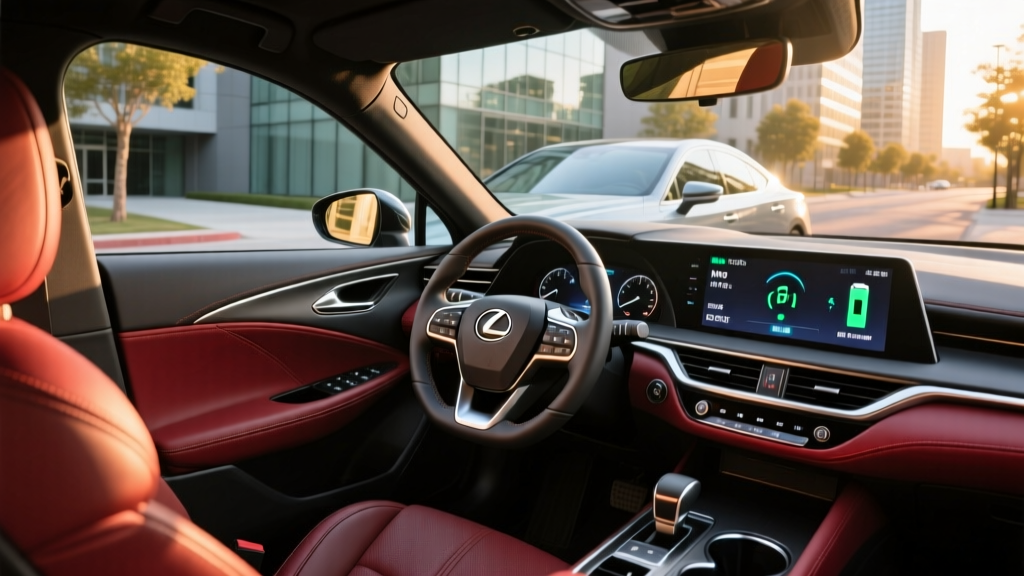
The 2026 ES 350h's cabin is built around a 12.3-inch touchscreen running Lexus's latest interface, replacing the frustrating touchpad controller of prior years. Wireless Apple CarPlay and Android Auto are standard, along with a 10-speaker audio system (Mark Levinson 17-speaker upgrade available). The front seats are heated and ventilated on most configurations, and rear-seat legroom remains generous at 39.2 inches — competitive with the long-wheelbase versions of European rivals.
Cargo space is 13.9 cubic feet in the trunk. The hybrid battery is mounted under the rear seat, which preserves trunk volume and allows for a 60/40 split-folding rear seatback — a practical advantage over some PHEVs and BEVs where battery placement compromises cargo flexibility.
On the road, the ES 350h delivers exactly what its spec sheet promises: quiet, composed, and unhurried. The eCVT eliminates shift shock, and the transition from electric-only creeping to gasoline-assisted acceleration is nearly seamless. Steering is light and precise but offers minimal feedback — this is a car designed for relaxed cruising, not canyon carving. The ride quality on the standard 17-inch wheels is particularly impressive, absorbing highway expansion joints and potholes with minimal intrusion.
- 44 MPG combined EPA — class-leading for a luxury sedan
- 10-year/150,000-mile hybrid battery warranty
- No plug-in required — zero lifestyle change
- Exceptional ride comfort and cabin quietness
- Strong resale value and proven reliability
- IIHS Top Safety Pick+ rating
- 8.1-second 0–60 — noticeably slower than turbocharged rivals
- FWD only — no AWD option on the 350h
- No federal tax credit eligibility
- eCVT drone under hard acceleration
- Trunk space average for the class at 13.9 cu ft
- No plug-in hybrid variant available in the US
Frequently Asked Questions
How many MPG does the Lexus ES 350h hybrid get?
The EPA rates the 2026 Lexus ES 350h at 43 MPG city, 44 MPG highway, and 44 MPG combined. In real-world suburban driving with frequent stops, owners often see 45–48 MPG. Sustained highway driving at 75+ MPH typically yields 39–42 MPG.
Does the Lexus ES 350h need to be plugged in?
No. The ES 350h is a conventional hybrid (HEV). Its small battery recharges through regenerative braking and the gasoline engine. You never plug it in — you simply refuel at any gas station with regular unleaded.
How far can the ES 350h drive on electric power alone?
Only about 1 mile at very low speeds (under 25 MPH) on a fully charged hybrid battery. This isn't a meaningful electric-only driving mode — it's designed for creeping through parking lots or residential streets briefly. The ES 350h is not a PHEV and does not offer a dedicated EV driving range.
Is the Lexus ES 350h reliable, and what does battery replacement cost?
Yes — the ES 350h benefits from Lexus's top-tier reliability record and a mature hybrid powertrain with millions of cumulative fleet miles. The hybrid battery is covered by a 10-year/150,000-mile warranty. Out-of-warranty replacement costs $2,500–$4,000 at a dealer or $1,500–$2,500 through an independent hybrid specialist using a refurbished unit. In practice, these NiMH batteries routinely last 150,000–200,000+ miles.
Does the Lexus ES 350h qualify for any tax credit?
No. The ES 350h is a conventional hybrid, not a plug-in vehicle. Federal §30D Clean Vehicle Credits apply only to PHEVs and BEVs meeting specific battery-capacity, sourcing, MSRP, and income requirements. Check with your state energy office for any local hybrid incentives, as a few states offer separate rebates.
Should I buy the ES 350h or wait for a plug-in hybrid Lexus?
Lexus currently offers the NX 450h+ (compact SUV PHEV) and RX 450h+ (midsize SUV PHEV) in the US, but there is no plug-in hybrid ES sedan in the current lineup, and Lexus has not announced one as of early 2026. If you specifically need a luxury PHEV sedan, the BMW 530e (up to 35 miles EV range) or Mercedes-Benz E 350e are the closest alternatives. If sedan efficiency without plug-in complexity is your priority, the ES 350h remains the strongest option.
How does the ES 350h compare to the non-hybrid ES 350?
The gasoline-only ES 350 uses a 3.5L V6 producing 302 hp and achieves 22/31/25 MPG (city/highway/combined). It's significantly quicker (0–60 in ~6.6 seconds) but costs roughly $1,000 more per year in fuel over 15,000 miles of driving. The ES 350h trades 87 horsepower for nearly double the fuel economy, making it the better choice for cost-conscious and efficiency-minded buyers who don't need V6 acceleration.