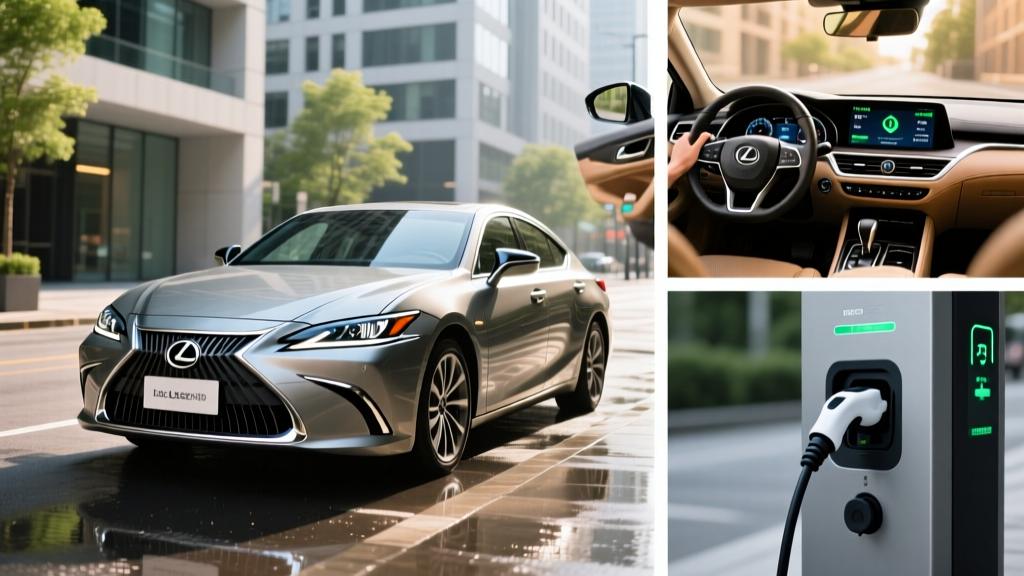
The Lexus ES 300h has occupied a specific lane in the luxury midsize sedan market for over a decade: quiet, comfortable, and stubbornly efficient. The 2026 Lexus ES Hybrid continues that formula with Toyota's fifth-generation hybrid system, delivering an EPA-estimated 44 MPG combined while offering a cabin that punches above its price class. It is not a plug-in hybrid, it is not a sport sedan, and it makes no apologies for either. For buyers navigating the spectrum from conventional gas to full electric, the ES 300h sits at a pragmatic midpoint — no charging infrastructure required, no range anxiety, and a proven hybrid powertrain with over two decades of real-world reliability data behind it.
This guide covers the 2026 Lexus ES 300h in detail: exact EPA fuel economy, real-world MPG observations, the hybrid powertrain architecture, battery longevity and warranty, pricing across trims, tax credit eligibility, and a clear framework for deciding whether this HEV, a PHEV, or a full BEV fits your situation.
2026 Lexus ES 300h Fuel Economy: EPA Numbers and Real-World MPG
The 2026 Lexus ES 300h carries over the 2.5-liter four-cylinder hybrid powertrain introduced with the current generation's refresh. Here are the official EPA figures:
| Trim | City MPG | Highway MPG | Combined MPG | Annual Fuel Cost* |
|---|---|---|---|---|
| ES 300h (all trims) | 43 | 44 | 44 | ~$1,450 |
*Based on 15,000 miles/year, 55% city / 45% highway, and $3.50/gallon regular unleaded. Your costs will vary with local fuel prices.
The ES 300h is one of the hybrids that routinely meets or slightly exceeds its EPA city estimate. In stop-and-go urban driving, the electric motor handles low-speed propulsion and regenerative braking recaptures energy aggressively. Expect 44–47 MPG in city-heavy commutes. Highway-only driving at 75+ MPH typically yields 39–42 MPG, as the gasoline engine carries more of the load at sustained speed. Combined real-world driving over a full tank generally lands between 41–45 MPG. In cold weather (below 30°F), expect a 3–5 MPG reduction during warm-up cycles due to the engine running longer to heat the cabin and bring the catalytic converter to operating temperature.
For context, the non-hybrid ES 250 AWD returns an EPA 25/34/28 MPG (city/highway/combined). The hybrid's 16-MPG combined advantage translates to roughly 180 fewer gallons of fuel per year at 15,000 miles — approximately $630 in annual savings at current fuel prices.
HEV vs. PHEV: Understanding What the ES 300h Is (and Isn't)
The Lexus ES 300h is a conventional hybrid electric vehicle (HEV). It does not plug in. It does not have a charge port. It charges its own small battery through regenerative braking and the gasoline engine. This distinction matters because buyers sometimes confuse HEVs with plug-in hybrids (PHEVs), which do offer electric-only driving range and require external charging to realize their full efficiency potential.
| Feature | HEV (ES 300h) | PHEV (e.g., BMW 550e xDrive) | BEV (e.g., Tesla Model S) |
|---|---|---|---|
| Plugs in? | No | Yes (Level 1/2) | Yes (Level 1/2/DC) |
| Electric-only range | ~1 mile at low speed | 30–40 miles typical | 300–400+ miles |
| Battery size | ~1.6 kWh (NiMH) | 18–25 kWh (NMC) | 75–100 kWh (NMC/LFP) |
| Gas engine? | Yes (primary) | Yes (backup) | No |
| Home charging needed? | No | Recommended | Essential |
| Federal tax credit (§30D) | No | Up to $7,500 if eligible | Up to $7,500 if eligible |
| Best for | No charging access, simple ownership | Short commute + charging access | Full electric lifestyle |
Lexus does not currently offer a plug-in hybrid variant of the ES in the US market. If you want a Lexus PHEV, you would need to look at the NX 450h+ or RX 500h+ (PHEV SUVs). The ES lineup remains HEV (300h), turbo-four (250 AWD), and V6 (350) only. For sedan buyers who want plug-in capability in the luxury midsize segment, competitors include the BMW 550e xDrive PHEV and the Volvo S90 Recharge PHEV — both of which offer roughly 30–40 miles of electric-only range.
Powertrain: 215-HP Hybrid System with Fifth-Gen Toyota Architecture
The 2026 ES 300h uses Toyota's well-established hybrid synergy drive, pairing a 2.5-liter Atkinson-cycle inline-four with two motor-generators and a planetary gearset acting as the continuously variable transmission (eCVT).
| Specification | Value |
|---|---|
| Engine | 2.5L Atkinson-cycle I-4 |
| Engine output | 176 hp / 163 lb-ft torque |
| Electric motor output | 88 kW (118 hp) |
| Net combined system output | 215 hp |
| Transmission | eCVT (planetary gearset) |
| Drivetrain | Front-wheel drive |
| 0–60 mph | 8.1 seconds (manufacturer est.) |
| Hybrid battery | ~1.6 kWh nickel-metal hydride (NiMH) |
| Curb weight | ~3,785 lbs |
| Towing capacity | Not rated |
The 215-hp combined output is adequate for confident highway merging and passing but not sporty. The eCVT delivers seamless, stepless acceleration — there are no gear shifts to feel, and the electric motor fills in torque instantly from a stop. Where this powertrain excels is in urban efficiency: the engine shuts down at stops, the motor handles initial acceleration, and regenerative braking recaptures kinetic energy that a conventional sedan would waste as heat.
One note for driving enthusiasts: the eCVT means engine RPM and vehicle speed are not directly linked. Under hard acceleration, the engine holds a steady drone as the gearset adjusts ratios continuously. Lexus has programmed simulated shift points in Sport mode to mimic a stepped transmission, but the sensation is still distinctly hybrid. This is a comfort-first sedan, and the powertrain behavior matches that priority.
Battery Longevity, Warranty, and Replacement Costs
- Hybrid battery: 10 years / 150,000 miles (whichever comes first)
- Hybrid system components (inverter, motor, control module): 8 years / 100,000 miles
- Basic vehicle warranty: 4 years / 50,000 miles
- Powertrain warranty: 6 years / 70,000 miles
The hybrid battery in the ES 300h is a relatively small ~1.6 kWh nickel-metal hydride (NiMH) pack. NiMH chemistry is less energy-dense than the lithium-ion packs in PHEVs and BEVs, but it has a well-documented track record for longevity. Toyota/Lexus hybrid batteries from the Prius lineage have demonstrated the ability to last 150,000–200,000+ miles with gradual capacity loss rather than sudden failure.
Real-world degradation data: Toyota's hybrid system never fully charges or fully depletes the battery — it operates in a narrow state-of-charge window (roughly 40–80%) to minimize stress. This buffer management is a primary reason these packs last so long. Fleet data from Toyota Prius taxis and Camry Hybrids shows typical capacity retention of 75–85% at 150,000 miles. The ES 300h's efficiency may decrease slightly over time as the battery ages, but the effect is far less noticeable than in a BEV because the battery is small and the gas engine compensates.
Battery replacement cost: If the hybrid battery does fail outside warranty, a new OEM replacement pack for the ES 300h typically costs between $3,000 and $5,000 installed at a Lexus dealer. Refurbished/remanufactured packs are available from third-party suppliers for $1,500–$2,500 installed. Individual cell modules can sometimes be replaced for $500–$1,200 if only a portion of the pack has degraded. These costs are dramatically lower than BEV battery replacements ($8,000–$20,000+) because the ES 300h's pack is small.
Pricing, Trims, and Tax Credit Eligibility
The 2026 Lexus ES 300h is available in four trims. Pricing below reflects base MSRP including destination charge:
| Trim | Base MSRP | Key Additions |
|---|---|---|
| ES 300h Base | $44,790 | Lexus Safety System+ 3.0, 12.3" touchscreen, heated front seats |
| ES 300h Premium | $47,290 | Wood interior trim, power rear sunshade, ambient lighting |
| ES 300h Luxury | $51,190 | Semi-aniline leather, ventilated front seats, 10-way power passenger |
| ES 300h F SPORT Handling | $50,690 | Adaptive variable suspension, F SPORT seats, 19" alloy wheels |
Federal Tax Credit Status
The 2026 Lexus ES 300h does not qualify for the federal §30D clean vehicle tax credit. Under current IRS rules, the §30D credit applies only to plug-in electric vehicles (PHEVs and BEVs) with a battery capacity of at least 7 kWh that meet battery component and critical mineral sourcing requirements. The ES 300h's ~1.6 kWh NiMH battery and conventional hybrid architecture place it outside the credit's scope entirely.
This means the purchase price is the purchase price — no point-of-sale transfer, no income-cap calculations, no MSRP-cap concerns. For some buyers, this simplicity is actually an advantage: there is no paperwork, no dealer credit processing, and no risk of losing the credit due to tax liability limitations. However, if the federal tax credit is a significant factor in your budget (potentially $3,750–$7,500 off a qualifying PHEV or BEV), the ES 300h will not help you there.
State incentives: A small number of states offer rebates or HOV lane access for conventional hybrids, but these programs are increasingly rare as policy shifts toward plug-in vehicles. Check your state's energy office or department of environmental quality for current programs. California's Clean Vehicle Rebate Project (CVRP), for example, no longer covers conventional HEVs.
Five-Year Ownership Cost Snapshot
| Cost Category | ES 300h (44 MPG) | BMW 530i (28 MPG) | Tesla Model 3 LR (BEV) |
|---|---|---|---|
| Purchase price (base) | $44,790 | $58,900 | $42,490 |
| Federal tax credit | $0 | $0 | Up to $7,500* |
| Fuel/energy (5 yr) | $7,250 | $11,370 | $3,750** |
| Maintenance (5 yr) | $2,800 | $5,200 | $1,900 |
| Insurance (5 yr est.) | $8,500 | $9,800 | $10,200 |
| Depreciation (est.) | $18,500 | $26,000 | $19,000 |
| 5-Year Total Cost | ~$55,340 | ~$85,270 | ~$50,940 |
*Tesla Model 3 LR eligibility for the full $7,500 credit depends on buyer income, MSRP caps, and battery sourcing requirements per IRS §30D rules. Confirm eligibility with a tax professional.
**BEV energy cost assumes $0.14/kWh home charging average. Public DC fast charging costs significantly more.
The ES 300h's total cost of ownership lands between the gas-only German competitor and the Tesla, with the advantage of requiring zero charging infrastructure and zero behavioral change. You fuel it like any other car; it simply uses far less fuel.
Reliability, Safety, and the Lexus Hybrid Track Record
Lexus consistently ranks at or near the top of J.D. Power Vehicle Dependability Studies and Consumer Reports reliability surveys, and the ES line specifically has been a reliability benchmark for over a decade. The hybrid powertrain adds complexity in theory but has proven extraordinarily robust in practice — Toyota's hybrid system has accumulated billions of real-world miles across the Prius, Camry Hybrid, RAV4 Hybrid, and Lexus lines with very low failure rates.
For the 2026 model year, the ES 300h comes standard with Lexus Safety System+ 3.0, which includes:
- Pre-Collision System with Pedestrian Detection
- Lane Departure Alert with Steering Assist
- Lane Tracing Assist (centering)
- Dynamic Radar Cruise Control (full-speed adaptive)
- Road Sign Assist
- Proactive Driving Assist (gentle deceleration when approaching slower vehicles)
These features constitute an SAE Level 2 driver-assistance system. The driver must remain fully engaged — hands on the wheel, eyes on the road — at all times. This is not autonomous driving. Lexus does not currently offer a hands-free highway driving system comparable to GM's Super Cruise or Ford's BlueCruise on the ES platform.
Safety ratings from the NHTSA and IIHS for the 2026 model year should be confirmed as test results are published; the prior-generation ES earned IIHS Top Safety Pick+ status in its most recent evaluation cycle.
Who Should Buy the 2026 Lexus ES 300h Hybrid?
- You want luxury-sedan comfort with 44 MPG and no charging hassle
- You lack access to home or workplace EV charging
- You prioritize reliability and low maintenance costs over performance
- You drive 12,000–20,000+ miles per year (fuel savings compound)
- You want a proven powertrain with a 10-year/150,000-mile hybrid battery warranty
- You prefer traditional sedan styling and a quiet, composed ride
- You want plug-in electric-only range — consider a PHEV sedan or a BEV
- You need all-wheel drive — the ES 300h is FWD only (the ES 250 AWD is non-hybrid)
- You want sport-sedan dynamics — the ES is tuned for comfort, not corner-carving
- You want the federal tax credit — only PHEVs and BEVs qualify under §30D
- You regularly carry more than four adults — rear seat space is generous but the trunk pass-through is narrow
Frequently Asked Questions
How many MPG does the 2026 Lexus ES 300h hybrid get?
The EPA rates the 2026 ES 300h at 43 city / 44 highway / 44 combined MPG. Real-world driving typically yields 41–47 MPG depending on your city/highway mix, with city-heavy commutes often exceeding the EPA city estimate thanks to aggressive regenerative braking and frequent engine shutoff.
Does the Lexus ES 300h plug in?
No. The ES 300h is a conventional hybrid (HEV), not a plug-in hybrid (PHEV). It charges its own battery through regenerative braking and the gasoline engine. There is no charge port and no need for any charging infrastructure. You fuel it exclusively at gas stations.
How far can the ES 300h drive on electric power alone?
Effectively about one mile at very low speeds (under 25 mph) on a fully charged hybrid battery. The electric motor assists the gas engine continuously, but it cannot sustain highway speeds or extended distances on electricity alone. This is normal for a conventional HEV — the battery is too small (~1.6 kWh) for meaningful electric-only range. If you want 30+ miles of electric-only driving, you need a PHEV or BEV.
Is the Lexus ES 300h hybrid reliable, and what does battery replacement cost?
Lexus hybrids are among the most reliable vehicles on the road. Toyota's hybrid system has been refined over 25+ years and billions of real-world miles. The hybrid battery is warrantied for 10 years/150,000 miles. If replacement is needed out of warranty, expect $3,000–$5,000 for a new OEM pack or $1,500–$2,500 for a refurbished unit — far less than a BEV battery replacement.
Does the 2026 Lexus ES 300h qualify for any federal tax credit?
No. The federal §30D clean vehicle credit applies only to plug-in vehicles (PHEVs and BEVs) with batteries of 7 kWh or larger that meet sourcing requirements. The ES 300h's ~1.6 kWh NiMH battery does not qualify. Some states may offer minimal hybrid incentives, but these are increasingly rare. Check IRS.gov for current federal rules.
How does the ES 300h compare to a full EV like the Tesla Model 3?
The Model 3 Long Range offers 341 miles of EPA range, significantly lower per-mile energy costs, and access to the federal tax credit (if eligible). But it requires home charging infrastructure, longer road-trip stops for DC fast charging, and a behavioral shift. The ES 300h offers 600+ miles of total range per tank, refuels in 3 minutes at any gas station, and requires zero infrastructure. If you can charge at home and drive under 300 miles daily, the BEV saves more money. If you lack charging access or frequently drive long distances in areas with sparse charging networks, the HEV is more practical.
What is the total driving range of the 2026 Lexus ES 300h?
With a 13.2-gallon fuel tank and 44 MPG combined, the ES 300h delivers approximately 580 miles of total range per fill-up. In real-world mixed driving, expect 520–560 miles between fill-ups. This exceeds virtually every BEV on the market and eliminates any range concern for road trips.