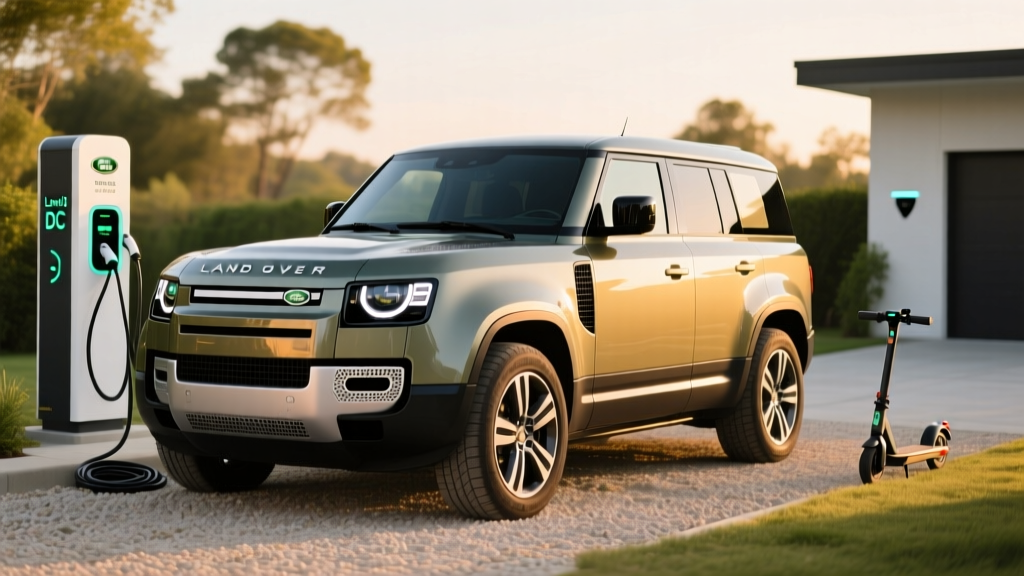
The Land Rover Defender has always been a rugged icon, but the 2026 Defender P400e plug-in hybrid (PHEV) adds an electric dimension that changes how this off-roader fits into daily life. With roughly 32 miles of electric-only range and a combined 404 horsepower from its turbocharged inline-four and electric motor, the Defender PHEV targets buyers who want genuine off-road capability without burning fuel on every school run and commute. But does the math actually work? Let's break down the EPA figures, real-world expectations, charging logistics, and ownership economics of the Defender PHEV to help you decide if this is your next electrified SUV.
Defender PHEV Powertrain: Engine, Motor, and Combined Output
The 2026 Defender P400e pairs a 2.0-liter turbocharged inline-four gasoline engine with a 141-hp electric motor integrated into the eight-speed ZF automatic transmission. Combined system output sits at 404 horsepower and 472 lb-ft of torque, routed through Land Rover's permanent all-wheel-drive system with a two-speed transfer case. The 0-60 mph sprint takes approximately 5.6 seconds — genuinely quick for a vehicle that weighs over 5,500 pounds.
The electric motor draws from a 19.2 kWh usable lithium-ion battery pack (NMC chemistry, ~22 kWh gross capacity). This pack sits beneath the cargo floor, slightly reducing load space compared to the mild-hybrid P400 variant. The battery supports regenerative braking with adjustable intensity, though true one-pedal driving is not available — you'll still need the brake pedal for full stops.
| Spec | Value |
|---|---|
| Combined Output | 404 hp / 472 lb-ft |
| Gas Engine | 2.0L turbocharged I-4 (300 hp) |
| Electric Motor | 141 hp (integrated in 8-speed auto) |
| Battery (usable) | 19.2 kWh NMC lithium-ion |
| EPA Electric Range | ~32 miles |
| EPA Combined (gas) | ~19 MPG (gas-only, after battery depleted) |
| EPA MPGe (electric+gas) | ~43 MPGe |
| 0-60 mph | ~5.6 seconds |
| Max DC Fast Charge | 50 kW (CCS) |
| Level 2 Charge (0-100%) | ~2 hours at 7.4 kW |
| Cargo Volume (behind 2nd row) | ~27.7 cu ft |
| Base MSRP (110 body) | ~$76,700 |
| Battery Warranty | 8 years / 100,000 miles |
Fuel Economy: EPA MPG, MPGe, and Real-World Expectations
PHEV fuel economy is inherently complex because it depends entirely on how often you charge. The EPA publishes two numbers: MPGe (miles-per-gallon-equivalent when running primarily on electricity) and gas-only MPG (once the battery is depleted and the engine takes over). Here's how the Defender P400e breaks down per fueleconomy.gov:
| Mode | City | Highway | Combined |
|---|---|---|---|
| Electric + Gas (MPGe) | — | — | ~43 MPGe |
| Gas Only (MPG) | ~18 | ~21 | ~19 |
The critical insight: the Defender PHEV's efficiency advantage exists only if you charge regularly. A daily 25-mile round-trip commute, charged nightly at home, means you might burn zero gasoline on weekdays. A 400-mile road trip, however, will feel like driving any heavy turbocharged SUV at the pump.
Electric-Only Range and Charging: What PHEV Owners Need to Know
The Defender P400e's ~32-mile EPA electric-only range covers a meaningful portion of daily driving. According to FHWA data, the average American drives roughly 37 miles per day — meaning the Defender PHEV can handle most weekday errands, commutes, and school drops on electricity alone, with the gas engine available whenever you exceed the battery's capacity.
Charging Speeds and Connectors
| Level | Power | 0-100% Time | Miles of Range per Hour |
|---|---|---|---|
| Level 1 (120V outlet) | ~1.4 kW | ~14 hours | ~2-3 mi/hr |
| Level 2 (240V home/public) | 7.4 kW | ~2 hours | ~16 mi/hr |
| DC Fast Charge (CCS) | 50 kW peak | 0-80% in ~30 min | ~40+ mi/hr |
The Defender P400e uses a CCS1 connector for DC fast charging and a J1772 connector for Level 1/2 AC charging. The 50 kW DC fast-charging capability is a genuine advantage over many PHEVs that accept only AC charging — you can add roughly 20 miles of electric range during a 20-minute stop at a highway Electrify America or EVgo station. However, at 50 kW peak, this is not the 150-250 kW charging you'd find on a full EV like an Ioniq 5 or Model Y; the smaller battery simply can't absorb power that quickly.
For home charging, a standard 240V Level 2 wallbox (7.4 kW) will fully replenish the 19.2 kWh battery in about two hours. This means a midday top-up or an overnight charge both work seamlessly. Installation of a Level 2 home charger typically runs $500-$1,800 depending on your electrical panel's capacity and the distance from panel to charger location.
HEV vs. PHEV vs. Full EV: Which Powertrain Fits You?
The Defender lineup offers a choice that mirrors the broader market. Let's clarify what separates each option:
Conventional Hybrid (HEV)
Uses a small battery charged by regenerative braking and the engine. No plug required. Improves MPG modestly (e.g., Toyota RAV4 Hybrid at 39 MPG combined). The Defender mild-hybrid (P400) uses a 48V system for slight stop-start smoothing — it is not a full HEV.
Plug-In Hybrid (PHEV)
Larger battery you plug in to charge. Offers 20-40 miles of electric-only driving, then operates as a gas vehicle. Ideal if you can charge at home and most daily trips are short. The Defender P400e falls here.
Full EV (BEV)
No gas engine at all. 250-400+ mile range, zero tailpipe emissions, lowest fuel cost per mile. Requires reliable home or public charging access. Example: Rivian R1S if you want an electric off-roader.
Choose the Defender PHEV if: You can charge at home nightly, your daily driving is under 35 miles, you want genuine off-road capability, and you're not ready to commit to a full EV for long road trips.
Choose a full EV (e.g., Rivian R1S, BMW iX) if: You have home charging, you drive a full EV-compatible daily route, and you want the lowest per-mile operating cost and zero tailpipe emissions.
Choose the Defender mild-hybrid (P400) if: You cannot charge at home, you take frequent long road trips, and you want the Defender experience without PHEV complexity or price premium.
Pricing, Trims, and Federal Tax Credit Eligibility
The 2026 Land Rover Defender P400e is offered exclusively in the 110 (four-door) body style. Pricing starts around $76,700 MSRP for the base P400e trim, climbing to $82,000+ for the P400e X-Dynamic HSE with upgraded interior materials, Meridian audio, and the full suite of driver-assistance features.
Does the Defender PHEV Qualify for the §30D Federal Tax Credit?
Under current IRS §30D rules, new PHEVs can qualify for up to $7,500 in federal tax credits — but the vehicle must meet all of the following requirements:
- MSRP Cap: SUVs must have an MSRP at or below $80,000 (the Defender P400e base qualifies; loaded HSE trims may exceed this)
- Buyer Income Cap: Modified AGI must not exceed $150,000 (single), $225,000 (head of household), or $300,000 (joint)
- Battery Sourcing: Critical minerals and battery components must meet phased-in domestic/FRTA sourcing thresholds — Land Rover's JLR supply chain compliance varies by model year and must be verified on the IRS eligible vehicle list
- Minimum Battery Capacity: At least 7 kWh (the Defender's 19.2 kWh easily clears this)
- Point-of-Sale Transfer: Eligible buyers can apply the credit as an instant rebate at the dealership rather than waiting for tax filing
Reliability, Battery Warranty, and Long-Term Costs
Land Rover's historical reliability ratings remain below industry averages according to J.D. Power and Consumer Reports data, though the PHEV powertrain itself is relatively straightforward — the electric motor has far fewer moving parts than the gasoline engine, and the ZF 8-speed transmission is well-proven across the industry.
JLR covers the Defender P400e's high-voltage battery for 8 years or 100,000 miles, whichever comes first, with a capacity retention threshold of 70%. If the battery degrades below 70% of its original 19.2 kWh capacity within the warranty period, JLR will repair or replace it at no cost.
Out-of-warranty replacement cost: Based on current JLR parts pricing and industry data for PHEV battery packs in this capacity range, expect a full battery replacement to cost between $8,000 and $12,000 (parts and labor). However, PHEV batteries in this size class typically retain 85-90% capacity after 100,000 miles under normal use — complete failure is rare.
The conventional 12V auxiliary battery (separate from the traction battery) will need replacement every 4-6 years at typical cost ($200-$400). Insurance premiums for the Defender P400e tend to run 15-25% higher than the mild-hybrid P400 due to the higher MSRP and the specialized high-voltage components that require certified repair facilities after collision damage.
Real-World Ownership: Who Should Buy the Defender PHEV?
After evaluating the specs, charging behavior, and ownership costs, the Defender P400e PHEV makes sense for a specific buyer profile:
✓ Pros
- 32-mile electric range covers most daily commutes gas-free
- 404 hp and 472 lb-ft — genuinely quick for an off-roader
- Genuine Land Rover off-road hardware (locking diffs, wade sensing, terrain response)
- 50 kW DC fast charging is rare for PHEVs
- No range anxiety — gas engine for road trips
- Distinctive styling and premium interior
✗ Cons
- Only 19 MPG gas-only — worse than many non-hybrid SUVs when not charged
- $76,700+ starting price; loaded trims exceed tax-credit MSRP cap
- Land Rover reliability history lags Japanese/German rivals
- Reduced cargo space vs. mild-hybrid Defender (battery under floor)
- Heavy curb weight (5,500+ lbs) impacts tire wear and braking distances
- Premium fuel recommended for optimal performance
The ideal Defender PHEV owner has home Level 2 charging, a daily commute under 35 miles, weekend off-road or towing needs, and the budget to absorb higher insurance and maintenance costs. If you cannot charge at home, the PHEV premium over the P400 mild-hybrid is difficult to justify — you'll be carrying 600+ pounds of battery and motor weight without accessing the electric range.
If off-road capability is secondary and daily efficiency is paramount, a full EV like the Rivian R1S (316-mile range, ~$75,900) or the BMW iX xDrive50 (324-mile range, ~$87,000) delivers dramatically lower per-mile energy costs and stronger federal tax credit eligibility — but neither matches the Defender's low-range gearing or heritage appeal.
Frequently Asked Questions
How many MPG does the Defender PHEV get?
The EPA rates the 2026 Defender P400e at approximately 43 MPGe when using its electric range, and about 19 MPG combined (18 city / 21 highway) once the battery is depleted and you're running on gasoline alone. Real-world highway driving at 70+ mph typically yields 17-18 MPG in gas-only mode.
How far can the Defender PHEV go on electric only?
The EPA rates the Defender P400e at approximately 32 miles of electric-only range. In real-world conditions, expect 28-32 miles in moderate temperatures and 22-25 miles in cold weather (below 35°F) due to battery chemistry limitations and cabin heating energy demands.
Does the Defender PHEV qualify for a federal tax credit?
It may qualify for up to $7,500 under IRS §30D, but eligibility depends on the vehicle's battery-sourcing compliance, the buyer's income (capped at $150K-$300K depending on filing status), and the trim's MSRP staying at or below $80,000 for SUVs. Always check the current IRS eligible vehicle list and consult a tax professional before purchasing.
Is the Defender PHEV reliable, and what does a battery replacement cost?
Land Rover's brand reliability scores remain below average, though the PHEV drivetrain components (electric motor, ZF transmission) are proven. The high-voltage battery is warrantied for 8 years/100,000 miles at 70% capacity retention. Out-of-warranty battery replacement is estimated at $8,000-$12,000, though complete battery failure is uncommon in modern PHEV packs.
Can I charge the Defender PHEV at a DC fast charger?
Yes. The Defender P400e supports DC fast charging at up to 50 kW via a CCS1 connector. A 0-80% charge takes approximately 30 minutes at a compatible station. This is slower than full EVs (which charge at 150-350 kW) but faster than many competing PHEVs that only support AC Level 2 charging.
Hybrid vs. PHEV vs. EV — which should I choose?
A conventional hybrid (HEV) needs no plug and offers modest MPG gains. A PHEV like the Defender P400e gives 20-40 miles of plug-in electric range plus a gas engine for long trips — ideal if you can charge at home. A full EV (BEV) eliminates gasoline entirely with 250-400+ mile range but requires reliable charging access. Your choice depends on home charging availability, daily mileage, and road-trip frequency.