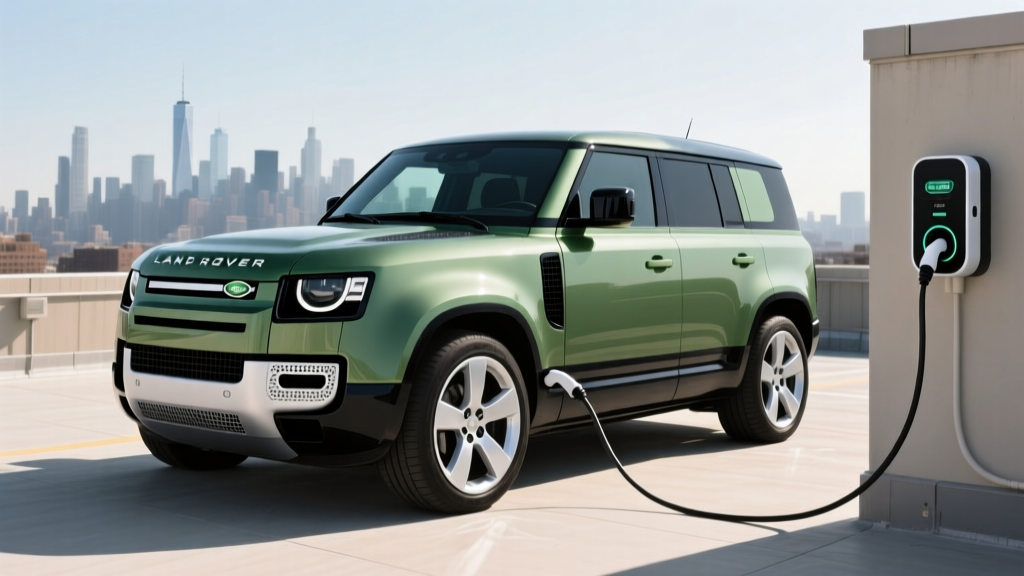
The Land Rover Defender has always been an unlikely candidate for electrification. It's a boxy, body-on-frame-style off-roader with the aerodynamics of a garden shed. Yet the Defender PHEV (officially the Defender 110 P400e) exists to bridge a gap: buyers who want genuine off-road capability, daily electric commuting, and the flexibility of a gas engine for long hauls. For 2026, the Defender PHEV continues with a 19.2 kWh battery pack, a turbocharged inline-six paired with an electric motor, and a combined output of 502 horsepower. Here's everything you need to know about living with one.
HEV vs PHEV: What the Defender Actually Is
Land Rover doesn't offer a conventional hybrid (HEV) Defender in the U.S. market — only the plug-in hybrid (PHEV) variant. That distinction matters enormously for how you'll use and fuel this vehicle.
Conventional Hybrid (HEV) vs Plug-In Hybrid (PHEV)
| Feature | HEV (e.g., Toyota RAV4 Hybrid) | PHEV (Defender P400e) |
|---|---|---|
| Plug-in charging | No — charges via regenerative braking only | Yes — plug in for electric-only driving |
| Electric-only range | 0–1 mile at low speed | 18 miles (EPA est.) |
| Battery size | ~1–2 kWh | 19.2 kWh |
| Gas engine | Primary propulsion, motor assists | Motor or gas or both — driver-selectable |
| Fuel savings potential | Moderate (better MPG) | High (if you charge daily) |
| Tax credit eligible | No | Potentially — see §30D details below |
The Defender PHEV operates in three modes: EV (electric-only for short commutes), Hybrid (blends gas and electric for efficiency), and Save (reserves battery for later, running on gas). If you never plug it in, it functions as a heavy, less-efficient hybrid — you're carrying 500+ lbs of battery you're not utilizing.
EPA Range, MPGe, and Real-World Fuel Economy
| Metric | EPA Estimate | Real-World Expectation |
|---|---|---|
| Electric-only range | 18 miles | 14–17 mi (highway/cold weather) |
| Combined MPGe (EV mode) | 44 MPGe | 38–42 MPGe |
| Combined MPG (gas only) | 19 MPG | 16–18 MPG highway, 19–21 city regen-assisted |
| City MPG (gas only) | 20 MPG | 18–20 MPG |
| Highway MPG (gas only) | 18 MPG | 15–17 MPG at 75+ mph |
| Total combined range | ~400 miles | ~350–380 miles |
The 18-mile EPA electric range is modest by 2026 PHEV standards — the Toyota RAV4 Prime delivers 42 miles, and the Jeep Wrangler 4xe manages 21. But the Defender's electric range is enough for short school runs, grocery trips, or a brief commute if you charge at home overnight.
Once the battery is depleted, the 3.0-liter turbocharged inline-six takes over. Expect 19 MPG combined on gas alone, which is typical for a 5,500-lb luxury SUV but far from economical. Real-world highway driving at 75+ mph drops that figure further due to the Defender's brick-wall aerodynamics and 2,500-kg curb weight.
Powertrain Specs: 502 HP and Serious Torque
| Specification | 2026 Defender 110 P400e |
|---|---|
| Engine | 3.0L turbocharged inline-six + P0 mild-hybrid + P2 electric motor |
| Combined output | 502 hp / 516 lb-ft torque |
| Gas engine alone | ~395 hp |
| Electric motor alone | ~141 hp (105 kW) |
| 0–60 mph | 5.4 seconds |
| Transmission | 8-speed automatic (ZF) |
| Drivetrain | Permanent AWD with two-speed transfer case |
| Battery capacity | 19.2 kWh (usable ~17.0 kWh) |
| Battery chemistry | NMC (nickel manganese cobalt) |
| Towing capacity | 6,614 lbs (reduced vs gas model) |
| Curb weight | ~5,550 lbs |
| Ground clearance | 11.5 inches (air suspension) |
| Wading depth | 35.4 inches |
The P400e is the quickest Defender you can buy short of the V8 variant. The electric motor fills in the torque gap at low RPMs before the turbo spools, giving it a responsive launch that the gas-only P300 and P400 models can't match. The 5.4-second 0–60 time is genuinely quick for a vehicle with the aerodynamic profile of a shipping container.
One important caveat: towing capacity is reduced compared to the gas-only Defender 110 (which rates up to 8,201 lbs). If you plan to tow frequently, the PHEV's heavier curb weight and battery placement reduce payload margin. The air suspension helps manage load leveling, but don't expect class-leading tow ratings.
Charging: Level 2 Times and the DC Fast-Charge Gap
| Charging Method | Power | 0–100% Time | Notes |
|---|---|---|---|
| Level 1 (120V household) | ~1.4 kW | ~14 hours | Not practical for daily use |
| Level 2 (240V, 32A) | 7.2 kW | ~2.5 hours | Standard home wallbox |
| Level 2 (240V, 48A) | 7.2 kW (vehicle-limited) | ~2.5 hours | Vehicle caps at 7.2 kW onboard |
| DC Fast Charge | Not supported | N/A | No CCS or NACS DC port |
The Defender PHEV charges at a maximum of 7.2 kW on Level 2, which means a full charge from empty takes about two and a half hours on a standard 240V home charger. The onboard charger is the bottleneck — even a 48A or higher circuit won't speed things up.
The most significant omission is DC fast charging. Unlike the Jeep Wrangler 4xe (which doesn't support DC fast charging either) or newer PHEVs like the Chrysler Pacifica Hybrid, the Defender PHEV cannot accept DC rapid charge. This means road-trip charging isn't practical — you're limited to Level 2 at hotels, workplaces, or destination chargers. For a vehicle marketed for overlanding and long-distance adventure, this is a real limitation.
Home charging setup is straightforward: a NEMA 14-50 outlet or hardwired Level 2 station (like a ChargePoint Home Flex or Tesla Universal Wall Connector) will fully replenish the battery overnight. Expect $500–$1,500 for professional Level 2 installation depending on your electrical panel capacity and run length, per typical 2026 electrician rates.
Pricing, Trims, and Federal Tax Credit Eligibility
| Trim / Configuration | 2026 MSRP (est.) |
|---|---|
| Defender 110 P400e S | $75,300 |
| Defender 110 P400e SE | $79,800 |
| Defender 110 P400e X-Dynamic HSE | $85,200 |
| Defender 110 P400e Autobiography | $92,500 |
The Defender PHEV carries a substantial premium over the gas-only Defender 110 P400 (starting around $64,800). You're paying roughly $10,000–$12,000 extra for the plug-in hybrid powertrain, which includes the larger battery, electric motor integration, and standard air suspension on P400e trims.
Does the Defender PHEV Qualify for the §30D Federal Tax Credit?
This is where it gets complicated. Under current IRS §30D rules, the Defender P400e faces multiple eligibility hurdles:
- MSRP cap: SUVs must be under $80,000 MSRP. The S and SE trims qualify; the HSE and Autobiography trims exceed the cap.
- Battery sourcing: Critical minerals and battery components must meet escalating annual thresholds for North American or FTA-partner sourcing. Land Rover (JLR) has not publicly confirmed that the Defender PHEV battery meets 2026 sourcing requirements.
- Buyer income limits: AGI must not exceed $150,000 (single), $225,000 (head of household), or $300,000 (joint).
- Final assembly: Must be assembled in North America. The Defender is assembled in Nitra, Slovakia — this disqualifies it from the §30D new-vehicle credit.
Because the Defender is built in Slovakia, it does not meet the North American final assembly requirement. This means the new-vehicle §30D credit of up to $7,500 is not available regardless of trim, income, or battery sourcing. The point-of-sale transfer option is also unavailable for this reason.
Some buyers may explore the used-EV credit (§25E) if purchasing a pre-owned Defender PHEV under $25,000 — though given current depreciation curves, that price point is unlikely for a 2024-or-newer model in 2026.
Battery Warranty, Reliability, and Replacement Costs
Defender PHEV Battery Warranty
- High-voltage battery: 8 years / 62,000 miles (whichever comes first)
- Capacity retention guarantee: JLR warrants the battery will retain at least 70% of original capacity during the warranty period
- Powertrain warranty: 4 years / 50,000 miles
- Bumper-to-bumper: 4 years / 50,000 miles
JLR's high-voltage battery warranty is competitive with industry standards (Toyota offers 10 years/150,000 miles on hybrid batteries, which is notably longer). The 70% capacity retention threshold is typical but means a battery that degrades to 69% capacity would trigger a warranty replacement — while still functioning, just with reduced electric range (roughly 12–13 miles from the original 18).
Reliability is the honest concern here. JLR has historically ranked near the bottom of J.D. Power Vehicle Dependability Studies, and the PHEV powertrain adds complexity — two propulsion systems, high-voltage electronics, air suspension, and the integration software that manages them. The Defender specifically has drawn criticism for electrical gremlins in early model years (2020–2022).
If the battery does need out-of-warranty replacement, expect a cost between $8,000 and $12,000 including labor, based on current JLR parts pricing. This is a significant sum, though battery replacement on PHEVs is rare within the first decade of ownership under normal use.
Who Should Buy the Defender PHEV (and Who Shouldn't)
Pros
- Genuine off-road capability (35.4" wading, locking diffs, terrain response)
- 502 hp with seamless electric torque fill
- 18-mile EV range covers most short daily errands
- Distinctive design — nothing else looks or feels like a Defender
- Air suspension standard on P400e trims
- Quiet, refined EV-mode driving around town
Cons
- Only 18 miles of electric range (trails most 2026 PHEVs)
- No DC fast charging capability
- Does not qualify for §30D federal tax credit (Slovakia assembly)
- 19 MPG gas-only — expensive to fuel on long trips
- JLR reliability history raises long-term ownership risk
- Premium pricing ($75K+ base) with steep depreciation
- Reduced towing capacity vs gas-only Defender
Choose the Defender PHEV if:
- You need serious off-road capability but want electric commuting for short daily trips
- You have reliable home Level 2 charging and a commute under 18 miles round-trip
- Design, presence, and brand cachet are top priorities
- You accept higher long-term maintenance costs as a trade-off for exclusivity
Choose a full EV (e.g., Rivian R1S, BMW iX) if:
- You want 250+ miles of range and DC fast charging for road trips
- Lower operating costs and fewer moving parts matter to you
- You don't need extreme off-road capability
Choose the gas Defender (P400) if:
- You can't charge at home and would never use the electric range
- You need maximum towing capacity (8,201 lbs)
- You want a lower purchase price and simpler powertrain
Choose a different PHEV (e.g., RAV4 Prime, Wrangler 4xe) if:
- You want more electric range (42 mi for RAV4 Prime) or tax credit eligibility
- Budget is under $50,000
Frequently Asked Questions
How many MPG does the Land Rover Defender PHEV get?
The 2026 Defender 110 P400e is EPA-rated at 44 MPGe when operating in electric-assisted mode and 19 MPG combined on gasoline alone after the battery is depleted. In real-world driving, expect 16–18 MPG on the highway and 19–21 MPG in city driving where regenerative braking assists. If you charge daily and drive under 18 miles, you may use very little gasoline for weeks at a time.
How far can the Defender PHEV go on electric only?
The EPA estimates 18 miles of electric-only range. In real-world conditions — particularly at highway speeds, in cold weather, or with climate control running — expect 14–17 miles. Below freezing, that can drop to 11–14 miles. Once depleted, the gas engine engages automatically.
Hybrid vs PHEV vs EV — which fits my lifestyle?
A conventional hybrid (HEV) is best if you can't charge at home and want better MPG without lifestyle change. A PHEV like the Defender is ideal if you have home charging, a short daily commute, and occasional long-trip needs where you want gas-engine flexibility. A full EV (BEV) suits drivers who want the lowest operating costs, have charging access, and don't need 400+ miles of single-fill range. For the Defender specifically, the PHEV only makes financial sense if you'll plug in regularly — otherwise you're paying a premium to haul dead battery weight.
Is the Defender PHEV reliable, and what does battery replacement cost?
JLR ranks below average in long-term dependability studies, and the PHEV system adds complexity over the gas-only model. The high-voltage battery is warranted for 8 years/62,000 miles with a 70% capacity retention guarantee. Out-of-warranty battery replacement is estimated at $8,000–$12,000. The 4-year/50,000-mile bumper-to-bumper warranty is shorter than competitors like Genesis or BMW. Budget for an extended warranty or maintenance reserve if you plan to keep the vehicle beyond the warranty period.
Does the Defender PHEV qualify for any tax credit?
No. The 2026 Defender PHEV does not qualify for the federal §30D new clean vehicle credit because it is assembled in Nitra, Slovakia — the law requires North American final assembly. State-level incentives vary: some states (like Colorado or California) may offer additional rebates for PHEVs, but eligibility depends on income, battery size, and current program funding. Check your state energy office or the AFDC state incentive database for current programs. Always consult a tax professional before relying on incentive eligibility for purchase decisions.
Can the Defender PHEV charge at a DC fast charger?
No. The Defender P400e only supports Level 1 (120V) and Level 2 (240V) AC charging, with a maximum onboard charge rate of 7.2 kW. There is no CCS, NACS, or CHAdeMO DC fast-charge port. This means you cannot top up the battery at highway rest stops or Electrify America stations — a notable limitation for an adventure-oriented vehicle.
What's the difference between the Defender P400e and the Defender P400 mild hybrid?
The P400 uses a 48-volt mild-hybrid system (MHEV) that cannot drive on electric power alone — it only provides torque assist and enables smoother stop-start. The P400e is a true plug-in hybrid with a 19.2 kWh battery capable of 18 miles of zero-emission driving. The P400e is more powerful (502 hp vs 395 hp), heavier, more expensive, and requires plug-in charging to realize its efficiency advantage.