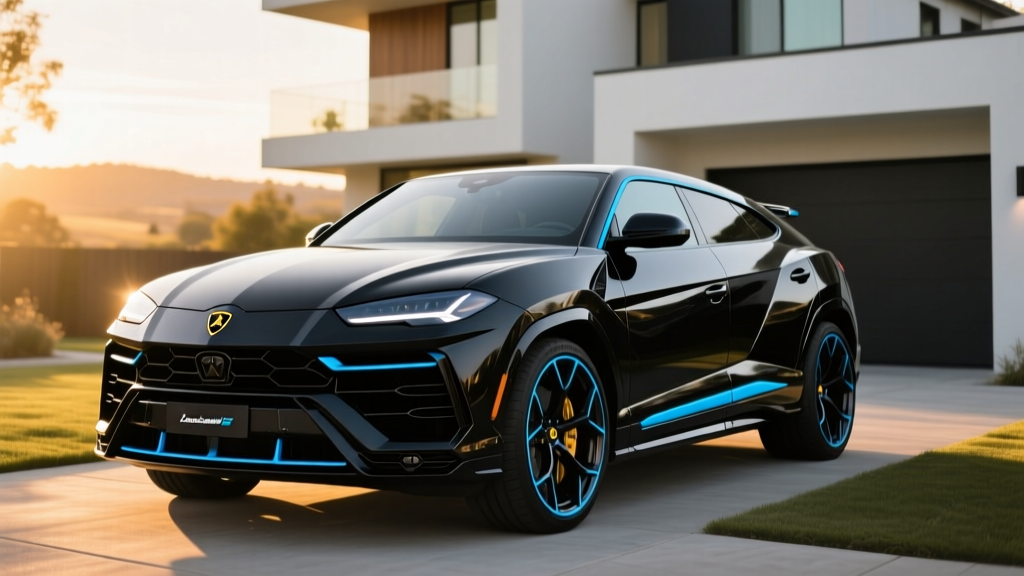
The Urus SE: Lamborghini's First Plug-In Hybrid Super SUV
The 2026 Lamborghini Urus SE plug-in hybrid replaces the outgoing Urus S and Performante as the brand's flagship performance SUV — and marks a fundamental powertrain shift for Sant'Agata Bolognese. Where the original Urus relied solely on a twin-turbo V8, the SE pairs that engine with a 141-kW electric motor and a 25.9 kWh lithium-ion battery pack mounted beneath the cargo floor. The result: 789 combined horsepower, a claimed 0-60 mph time of 3.4 seconds, and an EPA-estimated 37 miles of electric-only driving range.
This is a PHEV, not a conventional hybrid. That distinction matters for everything from how you fuel it to whether it qualifies for federal incentives. Below, we break down every spec that matters — range, charging, real-world efficiency, warranty, and ownership economics — using manufacturer data and EPA figures so you know exactly what you're buying before stepping into a dealer.
| Spec | Value |
|---|---|
| Powertrain | 4.0L twin-turbo V8 + electric motor (PHEV) |
| Combined Output | 789 hp / 701 lb-ft torque |
| Engine (ICE only) | 611 hp @ 6,000 rpm |
| Electric Motor | 141 kW (189 hp) / 354 lb-ft |
| Battery Capacity | 25.9 kWh (usable ~22 kWh, NMC chemistry) |
| EPA Electric Range | 37 miles |
| Total Combined Range | ~410 miles (est.) |
| EPA MPGe (EV mode) | 52 MPGe |
| EPA MPG (charge-sustaining) | 17 city / 22 hwy / 19 combined |
| 0-60 mph | 3.4 seconds |
| Top Speed | 194 mph |
| AC Charging (Level 2) | 11 kW onboard charger |
| DC Fast Charging | Not supported |
| 10-100% Level 2 Charge Time | ~2.5 hours |
| Drivetrain | AWD with torque vectoring, rear-axle e-diff |
| Curb Weight | ~5,600 lbs |
| Base MSRP | $268,000 (est.) |
| Battery Warranty | 8 years / 62,000 miles (60% capacity retention) |
HEV vs PHEV: Where the Urus SE Fits
Before evaluating the Urus SE's efficiency, it's worth clarifying what it is — and what it isn't.
Conventional Hybrid (HEV)
A standard hybrid like the Toyota RAV4 Hybrid uses a small battery (typically 1-2 kWh) recharged entirely by regenerative braking and the gas engine. You never plug it in. Electric-only driving is limited to brief low-speed moments. Think of it as a gas car that sips fuel more efficiently.
Plug-In Hybrid (PHEV) — Urus SE Category
A PHEV carries a substantially larger battery (the Urus SE uses 25.9 kWh) and can be plugged into a wall outlet or Level 2 charger. It offers meaningful electric-only range — here, 37 EPA miles — before the gas engine engages. Once the battery depletes, it operates like a conventional hybrid in "charge-sustaining" mode. The Urus SE cannot be driven as a pure HEV without ever plugging in; you'd forfeit its core efficiency advantage.
Lamborghini positions the SE against ultra-luxury PHEV rivals like the Porsche Cayenne E-Hybrid (44 miles EV range, 25.9 kWh battery) and the Ferrari Purosangue — though Ferrari notably chose a V12 without hybrid assist, making the Urus SE the only super-SUV PHEV in its price bracket.
Electric Range, Charging, and Daily Usability
The 25.9 kWh battery pack is the heart of the Urus SE's daily-driver proposition. Lamborghini targets owners who can handle short commutes, school runs, and city errands without burning a drop of gasoline — then unleash 789 hp on a canyon road when desired.
Real-world expectation: Plan for 28-33 miles in mixed driving with climate control active. Highway-speed electric driving at 70+ mph will reduce range to roughly 22-26 miles due to aerodynamic drag on a 5,600-lb SUV. Cold weather (below 35°F) can cut EV range by 20-30%, yielding as little as 20-25 miles. The Urus SE does not feature a heat pump, so cabin heating draws directly from the traction battery in EV mode.
Charging Speeds and Connector
| Level | Power | Time (0-100%) | Notes |
|---|---|---|---|
| Level 1 (120V household) | ~1.4 kW | ~18 hours | Emergency/trickle only |
| Level 2 (240V home/public) | Up to 11 kW | ~2.5 hours | Recommended daily method |
| DC Fast Charge | N/A | N/A | Not equipped — CCS/NACS not available |
The 11 kW onboard charger is generous for a PHEV — many competitors cap at 7.2 kW — meaning a home Level 2 station replenishes the battery in roughly two and a half hours. However, the absence of DC fast charging is a notable omission. On long road trips, you cannot rapid-charge at Electrify America or Tesla Supercharger stations; the V8 handles all propulsion once the battery depletes.
The Urus SE uses a CCS1 (J1772 combo) charge port for Level 2 AC charging. If your home charger has a NACS (Tesla-style) plug, you'll need a J1772 adapter — widely available for $100-$200.
Fuel Economy: EPA Numbers vs Real-World MPG
Once the battery is depleted, the Urus SE operates in charge-sustaining hybrid mode. The 4.0L twin-turbo V8 and electric motor work together, with the motor providing torque fill and enabling brief engine-off coasting. Here's what the EPA estimates:
| Mode | City | Highway | Combined |
|---|---|---|---|
| Charge-Sustaining (hybrid) | 17 MPG | 22 MPG | 19 MPG |
| EV Mode (MPGe) | 52 MPGe | 52 MPGe | 52 MPGe |
Real-world MPG reality check: The 19 MPG combined figure assumes you start with a full battery and deplete it over the test cycle. If you never charge the battery and drive it purely as a heavy hybrid SUV, expect closer to 14-16 MPG combined — the V8 is still hauling 5,600 lbs. Conversely, if your daily commute is under 35 miles and you charge every night, you could go weeks without visiting a gas station. Track-day use in Sport or Corsa modes will push fuel consumption well below 10 MPG.
For context, the outgoing gas-only Urus S returned an EPA 14 city / 19 highway / 16 combined. The SE's hybrid system delivers a modest but measurable improvement in charge-sustaining mode — roughly 3 MPG better combined — with the added benefit of silent EV driving for short trips.
Powertrain Deep Dive: V8 Meets Electric Torque
The Urus SE's powertrain is a collaboration between Lamborghini's internal engineering team and the broader Volkswagen Group parts bin — specifically, the PHEV architecture shared with the Porsche Cayenne Turbo E-Hybrid, though extensively recalibrated.
Internal Combustion Engine
The 4.0L twin-turbocharged V8 produces 611 hp and 590 lb-ft of torque on its own. It's the same hot-vee architecture found across VW Group performance applications, but Lamborghini tunes it with unique intake and exhaust mapping, including the brand's signature high-RPM wail.
Electric Motor and Integration
A 141-kW (189 hp) electric motor is sandwiched between the engine and the eight-speed automatic transmission. It delivers 354 lb-ft of instantaneous torque, filling the low-RPM gap where turbo lag traditionally lives. Combined system output reaches 789 hp and 701 lb-ft — 141 hp more than the outgoing Urus S.
The electric motor also enables torque vectoring at the rear axle via an electronically controlled limited-slip differential. In EV mode, the Urus SE is rear-wheel drive only, which Lamborghini claims adds a different dynamic character for quiet city driving versus the full AWD assault of hybrid mode.
Driving Modes and Electrification Strategy
Lamborghini offers four hybrid-specific drive modes alongside its traditional Strada, Sport, and Corsa:
- EV Drive: Pure electric, rear-wheel drive, limited to ~84 mph. Ideal for residential areas and zero-emission zones.
- Hybrid Mode: System manages engine/motor blending for optimal efficiency.
- Performance: Engine always active, motor provides torque fill. Battery maintains minimum charge for responsiveness.
- Recharge: Engine prioritizes battery replenishment — useful before entering an EV-only zone or for saving electric range for later.
Pricing, Tax Credits, and Ownership Economics
The 2026 Urus SE carries an estimated base MSRP of $268,000, with well-optioned examples reaching $310,000+ after Lamborghini's extensive Ad Personam customization program. For reference, the outgoing Urus S started around $241,000 — the SE commands a premium reflecting its additional power, PHEV hardware, and updated interior technology.
Federal Tax Credit Eligibility (§30D)
Does the Urus SE qualify for the $7,500 federal EV tax credit? Almost certainly not. Here's why, based on current IRS §30D rules:
- MSRP Cap: SUVs must have an MSRP at or below $80,000. The Urus SE at $268,000 exceeds this by over 3x.
- Buyer Income Cap: Modified AGI must not exceed $300,000 (joint) / $225,000 (head of household) / $150,000 (individual). Many Urus buyers will exceed these thresholds.
- Battery Sourcing: Critical minerals and battery components must meet escalating domestic/free-trade sourcing percentages. VW Group battery supply chains are still transitioning.
Bottom line: No federal purchase incentive applies. State-level incentives (California's CVRP, for example) also have MSRP caps typically between $60,000-$75,000, excluding the Urus SE. Buyers should consult a tax professional for any applicable deductions related to alternative-fuel vehicle infrastructure (home charger installation may qualify for up to $1,000 under §30C).
Five-Year Ownership Cost Snapshot
| Category | Est. Cost |
|---|---|
| Purchase Price (base) | $268,000 |
| Fuel (60% EV / 40% gas) | $9,200 |
| Insurance (avg. luxury SUV) | $28,500 |
| Maintenance (scheduled) | $8,500 |
| Depreciation (est. 45% over 5 yr) | $120,600 |
| Total Estimated 5-Year Cost | $434,800 |
Fuel savings vs. the gas-only Urus S are real but modest in this price bracket: roughly $1,800-$2,400 over five years if you charge regularly. The PHEV powertrain's value proposition here isn't economy — it's access (EV-only driving in low-emission zones, silent neighborhood departures) combined with more power.
Battery Warranty, Reliability, and Replacement Costs
High-Voltage Battery Warranty
Lamborghini covers the Urus SE's 25.9 kWh battery pack for 8 years or 62,000 miles (whichever comes first), with a capacity retention threshold of 60%. This aligns with CARB (California Air Resources Board) mandates adopted by most automakers for PHEV traction batteries. If the battery falls below 60% of original capacity within the warranty period, Lamborghini will repair or replace it at no cost.
Reliability Considerations
The Urus SE is too new for long-term reliability data specific to this powertrain. However, the underlying VW Group PHEV architecture — shared with the Porsche Cayenne E-Hybrid and Panamera E-Hybrid — has been in production since 2018. Reported issues in those applications have centered on software integration and occasional onboard charger faults rather than catastrophic battery failures.
The NMC (nickel-manganese-cobalt) battery chemistry used in the Urus SE prioritizes energy density over the extreme cycle life of LFP (lithium iron phosphate) cells. For a PHEV that cycles between 20-100% state of charge daily, NMC degradation typically runs 2-3% per year under normal conditions. After 8 years, expect roughly 75-85% original capacity — comfortably above the 60% warranty threshold.
Battery Replacement Cost
Out-of-warranty replacement of the 25.9 kWh pack is estimated at $12,000-$18,000 including labor, based on comparable VW Group PHEV battery pricing. Individual module replacement (if only certain cells degrade) may cost $3,000-$6,000. For context, this is a fraction of the cost of replacing a full-BEV battery pack (typically $15,000-$25,000+ for 80+ kWh packs).
The conventional 12V auxiliary battery — which powers electronics and starts the system — is a separate maintenance item and typically requires replacement every 4-6 years at roughly $300-$500.
Who Should Buy the Urus SE — And Who Shouldn't
Choose the Urus SE PHEV if:
- You want super-SUV performance (3.4s 0-60, 789 hp) with the ability to drive silently on electric power for daily errands
- Your commute is under 35 miles round-trip and you have home Level 2 charging access
- You live in or travel to cities with low-emission zones that restrict or tax ICE-only vehicles
- You want the latest Lamborghini technology and plan to keep the vehicle within the 8-year battery warranty
Consider a Full EV (like the Lotus Eletre R) if:
- You want zero tailpipe emissions and 250+ miles of range without gas-engine maintenance
- You have reliable home and public charging access and rarely drive beyond 250 miles in a day
- Lower running costs (no oil changes, fewer moving parts) matter even at this price point
Stick with a Gas-Only SUV if:
- You lack home charging access and don't want to manage plug-in routines
- You frequently drive 400+ mile trips where PHEV electric range is irrelevant and DC fast charging matters
- You prefer mechanical simplicity and a proven track record with no high-voltage system complexity
Pros
- 789 hp — most powerful production Urus ever
- 37 miles EV range covers most daily commutes
- 11 kW Level 2 charging is quick for a PHEV
- Torque-vectoring rear e-diff enhances handling dynamics
- Silent EV mode for residential and luxury settings
- Updated interior with dual-screen infotainment
Cons
- No DC fast charging capability
- 19 MPG combined once battery depletes — thirsty for a hybrid
- No federal or state tax credit eligibility (MSRP too high)
- 5,600-lb curb weight affects handling vs. gas Urus
- No heat pump — cold-weather EV range drops significantly
- $268K+ price with premium over outgoing gas model
Frequently Asked Questions
How many MPG does the Lamborghini Urus SE plug-in hybrid get?
The EPA rates the Urus SE at 17 city / 22 highway / 19 combined MPG in charge-sustaining (hybrid) mode after the battery is depleted. In EV mode, it achieves 52 MPGe. Real-world results vary: expect 14-16 MPG if you never plug in, and potentially zero gasoline use if your daily driving stays under 35 miles with nightly charging.
How far can the Urus SE go on electric only?
The EPA rates the Urus SE at 37 miles of electric-only range. In real-world mixed driving with climate control, plan for 28-33 miles. Highway-speed EV driving and cold weather reduce this to 20-26 miles. Top speed in EV mode is limited to approximately 84 mph.
Hybrid vs PHEV vs EV — which powertrain fits me?
A conventional hybrid (HEV) requires no plug-in and delivers modest fuel savings — ideal if you lack charging access. A PHEV like the Urus SE offers the best of both worlds: electric-only commuting with gas-engine range for road trips, but requires regular plug-in charging to realize its efficiency benefits. A full EV eliminates gasoline entirely, has lower per-mile fuel costs, and requires less drivetrain maintenance, but demands charging infrastructure and acceptance of range limitations on long trips. For Urus SE buyers with home charging and sub-35-mile commutes, the PHEV is the pragmatic performance choice.
Is the Urus SE hybrid reliable, and what does battery replacement cost?
The VW Group PHEV architecture underlying the Urus SE has been in production since 2018 with no widespread battery failure patterns. The high-voltage battery is warrantied for 8 years/62,000 miles at 60% capacity retention. Out-of-warranty replacement is estimated at $12,000-$18,000. Annual degradation for NMC chemistry in PHEV duty cycles typically runs 2-3%, leaving 75-85% capacity after 8 years.
Does the Lamborghini Urus SE qualify for any tax credit?
No. The federal §30D clean vehicle credit caps SUV MSRPs at $80,000 — the Urus SE at $268,000 far exceeds this. Buyer income limits ($150K-$300K depending on filing status) also exclude many prospective owners. State incentives similarly have MSRP caps that disqualify the Urus SE. However, home charger installation may qualify for up to $1,000 under the §30C alternative fuel infrastructure credit. Always consult a tax professional for your specific situation.
Can the Urus SE charge at Tesla Superchargers or DC fast-charging stations?
No. The Urus SE does not support DC fast charging of any kind. It charges exclusively via AC Level 1 (120V) or Level 2 (240V) using a CCS1/J1772 connector. A full Level 2 charge takes approximately 2.5 hours at its 11 kW onboard charger rate. For road trips beyond the 37-mile EV range, the V8 engine handles all propulsion.
What happens if I never plug in the Urus SE?
The vehicle will operate as a heavy conventional hybrid in charge-sustaining mode, returning approximately 14-19 MPG depending on driving style. You'll forfeit the 37 miles of EV range, the 52 MPGe efficiency, silent electric driving, and the performance benefit of a fully charged battery buffer. The PHEV system adds roughly 400 lbs of battery and motor weight — carrying that without utilizing electric drive defeats the engineering purpose.