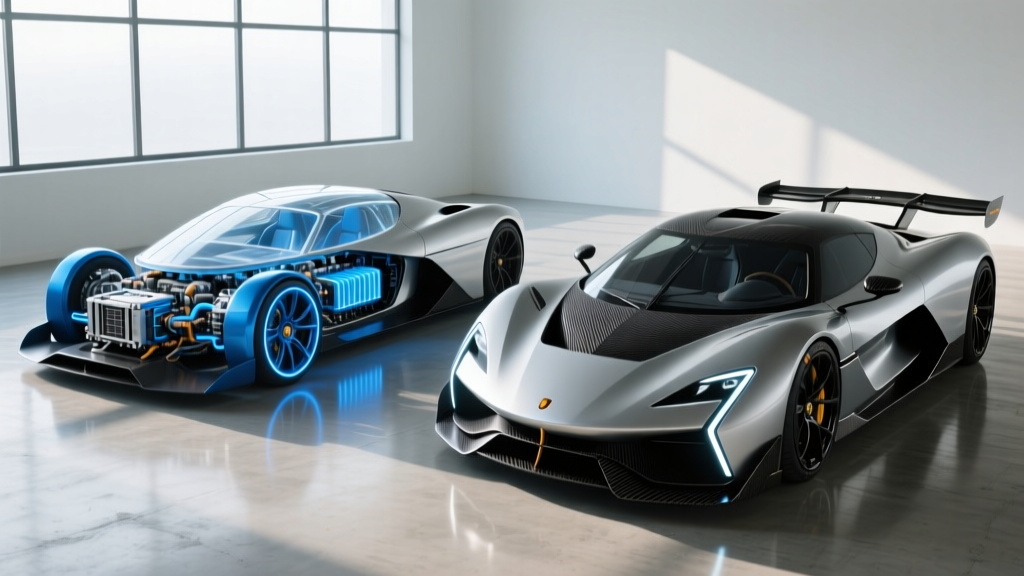
Koenigsegg doesn't build hybrids for fuel savings. The Swedish hypercar maker engineers electrified powertrains to exploit the instant torque of electric motors while retaining the visceral punch of internal combustion. The result is a new class of machine: vehicles like the Koenigsegg Gemera and the hybrid-assisted Jesko Absolut that produce outputs measured in four-digit horsepower. If you've searched for a "Koenigsegg hybrid" and wondered what that actually means mechanically, this guide breaks down every spec that matters.
These are not Toyota Prius competitors. They are low-volume, multi-million-dollar machines that use hybridization as a performance tool, not an efficiency one. Below, we examine the powertrain architecture, battery and motor specifications, real-world drivability, and how Koenigsegg's approach to hybrid tech fits into the broader electrified-vehicle landscape in 2026.
What Does "Koenigsegg Hybrid" Actually Mean?
Koenigsegg currently offers two primary vehicles that incorporate electrification:
- Koenigsegg Gemera — a four-seat "Mega-GT" offered in multiple powertrain configurations, including a full hybrid variant pairing a twin-turbo 2.0-liter three-cylinder engine (the "Tiny Friendly Giant" or TFG) with three electric motors.
- Koenigsegg Jesko — primarily a twin-turbo V8 hypercar, but with hybrid-adjacent technology including a 48V mild-hybrid system and an electric motor-driven ancillary setup.
The Gemera is the definitive Koenigsegg hybrid. It was announced in 2020 and entered customer deliveries in 2024–2025, with the full hybrid powertrain variant being the most technically complex option. Let's be precise about the distinction:
HEV vs. PHEV — Where Does Koenigsegg Fit?
Conventional Hybrid (HEV): A small battery recharged by the engine and regenerative braking. No plug. Electric-only range is minimal (1-3 miles). Think Toyota Camry Hybrid.
Plug-in Hybrid (PHEV): A larger battery that can be plugged in to charge. Offers meaningful electric-only range (typically 25-50 miles). Think Toyota RAV4 Prime.
Koenigsegg Gemera Hybrid: Technically closer to a performance HEV architecture with a 15 kWh battery pack. It can be plugged in for charging, but electric-only range is approximately 31 miles (50 km) — making it functionally a PHEV, though Koenigsegg doesn't market it that way. The battery's primary job is feeding three electric motors for combined peak output, not commuting on electrons alone.
Gemera Hybrid Powertrain: The Numbers
| Specification | Value |
|---|---|
| Engine | 5.0L Twin-Turbo V8 (HV8 variant) OR 2.0L Twin-Turbo 3-cyl (TFG variant) |
| Electric Motors | 3 (one per rear wheel + one on crankshaft) |
| Combined System Output (HV8) | 2,300 HP / 2,750 Nm torque |
| Combined System Output (TFG) | 1,700 HP / 3,500 Nm torque |
| Battery Capacity | 15 kWh (800V architecture) |
| Battery Chemistry | NMC (Nickel Manganese Cobalt) |
| Electric-Only Range | ~31 miles (50 km) estimated |
| Total Combined Range | ~590 miles (950 km) with fuel + battery |
| 0-60 mph | ~1.9 seconds (HV8 AWD) |
| Top Speed | 248+ mph (400+ km/h) |
| Drivetrain | AWD with torque vectoring (twin rear e-motors) |
| Transmission | Koenigsegg Direct Drive (single-speed, no traditional gearbox) |
| Curb Weight | ~4,079 lbs (1,850 kg) |
| Seating | 4 adults |
| Base Price | ~$4,000,000 (varies by spec) |
| Production Run | 300 units total |
Understanding the TFG Engine
The "Tiny Friendly Giant" (TFG) is a Koenigsegg-developed 2.0-liter inline-three with twin turbos and Freevalve technology — a camless valve actuation system that uses pneumatic-hydraulic-electronic actuators instead of a traditional camshaft. This allows infinitely variable valve timing and lift, optimizing combustion across the entire RPM range. On its own, the TFG produces 600 HP. Combined with the three electric motors, the TFG-hybrid Gemera delivers 1,700 HP.
The HV8 variant swaps in Koenigsegg's 5.0-liter twin-turbo V8 (from the Jesko) producing 1,500 HP on E85, then adds the electric motors for a combined 2,300 HP. This is, as of 2026, the most powerful production car powertrain ever assembled.
Battery, Charging, and Electric-Only Capability
The Gemera's 15 kWh battery operates on an 800-volt architecture — the same voltage used by high-performance EVs like the Porsche Taycan and Hyundai Ioniq 5 for fast-charging efficiency. However, the Gemera's battery is not designed for road-trip DC fast charging. Here's the practical breakdown:
| Charging Level | Power (kW) | Estimated Time (0-100%) | Notes |
|---|---|---|---|
| Level 1 (120V household) | ~1.4 kW | ~10-11 hours | Trickle charge; not practical daily |
| Level 2 (240V home/public) | ~7-11 kW | ~1.5-2 hours | Standard garage outlet or wallbox |
| DC Fast Charge | Not supported | N/A | No CCS/NACS DC inlet |
The 31-mile electric-only range is enough for silent neighborhood departures or short city hops, but this is not a vehicle designed for electric commuting. The battery exists primarily to fill the torque gap while the turbochargers spool — eliminating turbo lag entirely — and to enable torque vectoring across the rear axle via the twin rear electric motors.
Regenerative braking recovers energy under deceleration, and the engine acts as a generator to sustain battery charge during aggressive driving, similar to a series-hybrid setup at high load.
Fuel Economy: Not the Point, But Here Are the Numbers
Koenigsegg does not publish EPA fuel economy ratings for the Gemera in the same way mass-market manufacturers do, as the vehicle is produced in extremely limited numbers and may fall under low-volume manufacturer exemptions. However, based on the powertrain architecture and comparable hypercars:
| Driving Scenario | Estimated MPG / MPGe |
|---|---|
| Electric-only (31 mi range) | ~55-65 MPGe |
| City (hybrid mode, mixed regen) | ~14-16 MPG |
| Highway (sustained ICE cruise) | ~18-20 MPG |
| Combined (EPA-style estimate) | ~15-17 MPG |
| Track use | ~4-6 MPG (E85) |
For context, the Bugatti Tourbillon (naturally aspirated V16 hybrid, ~1,800 HP) achieves a similar real-world combined figure. When you're producing over 2,000 horsepower, fuel economy is a rounding error in the ownership experience. The Gemera's 23.8-gallon (90-liter) fuel tank provides the range that matters: roughly 590 miles combined with a full battery and full tank.
Battery Warranty and Replacement
Koenigsegg provides a factory battery warranty that covers the hybrid battery for approximately 4 years / unlimited mileage, though exact terms vary by market and individual purchase contract. As a low-volume manufacturer producing 300 Gemeras total, Koenigsegg handles warranty service on a case-by-case basis through its Ängelholm, Sweden facility and authorized regional service partners.
Estimated battery replacement cost: $30,000–$50,000+ for the 15 kWh 800V pack. However, at this production volume, Koenigsegg is more likely to offer cell-level repair or module replacement rather than full pack swaps. NMC chemistry in a 15 kWh pack with moderate cycle depth should retain 85-90% capacity after 8-10 years of typical use.
Pricing and Tax Credit Reality
The Gemera starts at approximately $4,000,000, with the HV8 variant commanding a significant premium — rumored to be in the $4.5–5 million range before options. All 300 units are accounted for.
Does the Gemera Qualify for the Federal EV Tax Credit?
No. Under IRS §30D rules, the federal clean vehicle credit has hard MSRP caps: $80,000 for SUVs, pickups, and vans; $55,000 for sedans and other body styles. The Gemera, at $4 million, exceeds the cap by a factor of roughly 70x. Buyer income limits ($300,000 AGI for joint filers) would also eliminate most buyers, though this is academic at this price point.
No state-level hybrid or PHEV incentives meaningfully apply either. California's CVRP, for example, caps eligibility at an MSRP of $60,000-$75,000 depending on vehicle type. The Gemera is a tax-credit-ineligible machine — its buyers are optimizing for performance and exclusivity, not purchase incentives.
Gemera vs. Other Hybrid Hypercars
The Koenigsegg hybrid isn't alone in using electrification for hypercar performance. Here's how it stacks up against its closest rivals:
| Spec | Koenigsegg Gemera HV8 | Bugatti Tourbillon | Ferrari SF90 XX Stradale |
|---|---|---|---|
| Powertrain | TT V8 + 3 e-motors | NA V16 + 3 e-motors | TT V8 + 3 e-motors |
| Combined HP | 2,300 | 1,800 | 1,016 |
| Battery (kWh) | 15 kWh | 25 kWh | 7.9 kWh |
| EV Range | ~31 mi | ~37 mi | ~16 mi |
| 0-60 mph | ~1.9 sec | ~2.0 sec | ~2.3 sec |
| Top Speed | 248+ mph | 277 mph | 199 mph (limited) |
| Seating | 4 | 2 | 2 |
| Price | ~$4.5M | ~$4.1M | ~$850K |
| Production | 300 | 250 | 799 |
The Gemera HV8 holds the outright horsepower and torque crown. The Bugatti Tourbillon targets top speed and analog engineering purity (naturally aspirated V16 with a Rimac-developed hybrid system). The Ferrari SF90 XX is the most "accessible" of the three — if you can call an $850K track-focused hybrid accessible — and the only one you might realistically encounter at a dealer.
Who Should Consider a Koenigsegg Hybrid?
Why Choose It
- Unmatched combined output: 2,300 HP in a road-legal, four-seat vehicle
- Torque vectoring via twin rear e-motors delivers cornering precision no mechanical differential can match
- 800V architecture and Freevalve engine represent genuine engineering innovation, not badge engineering
- ~590-mile total range eliminates the range limitations of pure-electric hypercars
- Four full-size seats and dihedral synchro-helix doors make it the most practical hypercar ever built
Why Look Elsewhere
- $4M+ price and 300-unit production — allocation is essentially closed
- No DC fast charging — road trips rely entirely on the ICE and Level 2 top-ups
- Service and parts availability limited to Koenigsegg's global network (very sparse outside Europe/Middle East)
- Insurance costs are extreme — expect $30,000-$60,000+ annually through specialty underwriters
- Not eligible for any federal or state hybrid/PHEV tax incentives
Decision Framework
Choose the Koenigsegg Gemera hybrid if: You are a hypercar collector who wants the absolute highest-output production powertrain available, values four-seat practicality in a mega-GT format, and views the vehicle as both a driving instrument and an engineering landmark.
Choose a full EV (Rimac Nevera, Lotus Evija) if: You want pure-electric instant torque with no combustion complexity, prioritize 0-60 records, and have access to high-power DC fast charging infrastructure.
Choose a performance PHEV (Ferrari 296 GTB, McLaren Artura) if: You want hybrid performance in a more accessible package ($300K-$400K), with dealer support, shorter electric-only range but meaningful fuel savings in daily driving, and easier service logistics.
Reliability and Long-Term Ownership
Reliability data on the Gemera is, by definition, scarce. With 300 units allocated and deliveries only beginning in 2024-2025, there is no long-term ownership dataset. However, several factors inform expectations:
- Koenigsegg's track record: The brand has produced roughly 300 vehicles total across all models since 2002. Build quality is hand-assembled and meticulous, but service turnaround can take weeks or months due to parts availability.
- TFG Freevalve complexity: The camless valve system eliminates timing chains and camshafts but introduces pneumatic-hydraulic actuators that are unproven at scale. Early Jesko and Gemera owners should expect software calibration updates and potential actuator service.
- 800V battery system: High-voltage hybrid packs in low-volume applications carry higher replacement risk. The 15 kWh NMC pack is not shared with any mass-market vehicle, so aftermarket replacement options don't exist.
- Hybrid system integration: Three electric motors, a custom inverter, and a bespoke engine — any failure in the integration layer requires factory-level diagnostics.
For comparison, the IIHS and NHTSA do not crash-test low-volume hypercars, so no safety ratings exist. The Gemera's carbon-fiber monocoque and F1-derived crash structures are engineered to exceed regulatory requirements, but official test data is unavailable.
Frequently Asked Questions
How many MPG does the Koenigsegg Gemera hybrid get?
An estimated 15-17 MPG combined in hybrid mode, with the HV8 V8 variant likely on the lower end. Electric-only operation yields roughly 55-65 MPGe over its 31-mile EV range. Fuel economy is not a design priority for a 2,300 HP vehicle.
How far can the Gemera go on electric only?
Approximately 31 miles (50 km) on battery power alone, using the three electric motors. This is sufficient for leaving a neighborhood silently or completing short city trips without engaging the combustion engine.
Is the Koenigsegg Gemera a hybrid or a plug-in hybrid?
Functionally, it operates as a PHEV — it has a 15 kWh battery that can be plugged in to charge and provides meaningful electric-only range. However, Koenigsegg positions it as a hybrid performance vehicle rather than a plug-in commuter, and it lacks DC fast charging capability.
Hybrid vs. PHEV vs. full EV — which hypercar approach is best?
It depends on your priority. A hybrid hypercar (Gemera, Tourbillon) maximizes total output and eliminates range anxiety by retaining a combustion engine. A full EV hypercar (Rimac Nevera) delivers the quickest 0-60 times and simplest mechanical layout but limits range to ~300 miles and requires DC fast charging for road trips. A PHEV supercar (Ferrari 296 GTB) offers a middle ground with daily EV commuting and weekend ICE performance.
Is the Koenigsegg hybrid reliable, and what does battery replacement cost?
Long-term reliability data doesn't yet exist given the vehicle's newness and 300-unit production run. Koenigsegg's hand-built quality is exceptional, but the Freevalve system and 800V hybrid architecture are complex. Battery replacement is estimated at $30,000-$50,000+, handled exclusively through Koenigsegg's factory service network.
Does the Koenigsegg Gemera qualify for any tax credit?
No. The IRS §30D clean vehicle credit caps eligible MSRP at $55,000 (cars) or $80,000 (SUVs/vans). The Gemera's ~$4,000,000 price tag makes it ineligible. No state incentives apply either.
Can I still buy a Koenigsegg Gemera?
All 300 units are allocated as of 2025. Secondary market transactions are possible but rare, and prices typically exceed the original MSRP. Contact Koenigsegg directly regarding waitlist availability or authorized resale channels.