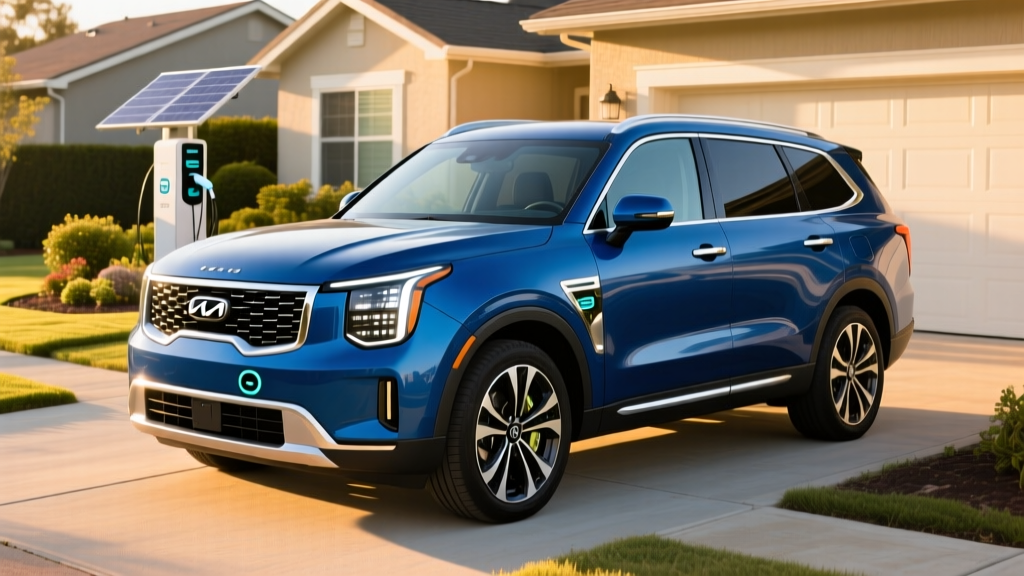
The three-row SUV segment has long been dominated by gas-only powertrains, but the 2026 Kia Telluride hybrid SUV aims to change that equation. Kia introduced a turbocharged hybrid variant of its best-selling family hauler, promising meaningful fuel savings without sacrificing the cargo space, towing capability, and upscale interior that made the Telluride an IIHS Top Safety Pick. For buyers who need three rows but want to cut fuel costs, the Telluride hybrid is one of the most compelling options on the market — though it faces stiff competition from the Toyota Grand Highlander Hybrid and Hyundai Santa Fe Hybrid.
In this guide, we break down exactly what the Telluride hybrid offers: real EPA fuel economy numbers, how the hybrid powertrain works, pricing across trims, tax credit eligibility, and whether this SUV is the right fit compared to a plug-in hybrid or full EV.
Telluride Hybrid vs. Telluride PHEV: What's the Difference?
Before diving into specs, it's critical to understand that Kia offers two distinct electrified Telluride variants for 2026. Confusing them is one of the most common buyer mistakes in this segment.
| Feature | Telluride HEV (Conventional Hybrid) | Telluride PHEV (Plug-In Hybrid) |
|---|---|---|
| Needs to plug in? | No — charges via regenerative braking and engine | Yes — plugs into Level 1 or Level 2 charger |
| Electric-only driving | Limited low-speed assist only | Estimated ~33 miles on battery alone |
| Battery size | ~1.5 kWh (small, self-charging) | ~18.1 kWh (larger, plug-in capable) |
| DC fast charging | No | No (Level 2 AC only) |
| Federal tax credit | Not eligible (§30D requires plug-in) | Up to $7,500 (subject to IRS §30D rules) |
| Best for | Drivers without home charging access | Drivers with home charging and short commutes |
The conventional hybrid (HEV) is the simpler choice. You never plug it in — the small battery charges through regenerative braking and the gasoline engine. It's ideal if you live in an apartment, street-park, or simply don't want to think about charging. The plug-in hybrid (PHEV) adds a much larger battery and a more powerful electric motor, letting you complete most daily commutes on electricity alone before the gas engine kicks in.
Fuel Economy: EPA MPG and Real-World Numbers
Fuel economy is the headline reason buyers cross-shop the Telluride hybrid against the gas-only V6 model. Here's how the numbers stack up across the lineup, based on EPA estimates from fueleconomy.gov:
| Powertrain | City MPG | Highway MPG | Combined MPG |
|---|---|---|---|
| Telluride Gas (2.5T V6 AWD) | 18 | 24 | 20 |
| Telluride HEV (Hybrid AWD) | 34 | 31 | 33 |
| Telluride PHEV (Plug-In AWD) | 33 MPG / 79 MPGe | 31 MPG | 32 MPG (charge-sustaining) |
The conventional hybrid's 33 MPG combined represents a 65% improvement over the gas-only Telluride. In real-world driving, hybrid SUVs tend to outperform their EPA city ratings in stop-and-go traffic because regenerative braking recovers energy that a gas car wastes as heat. Expect 35-37 MPG in urban driving and closer to 29-31 MPG on sustained highway trips at 70+ mph, where the engine does more of the work.
For the PHEV, the 79 MPGe figure applies only when the battery is fully charged and you're driving on electricity. Once the battery depletes (after roughly 33 miles), the PHEV operates as a conventional hybrid at around 32 MPG combined. This means the PHEV's advantage depends entirely on your daily mileage and charging habits.
Real-World Range Reality: With a 19.7-gallon fuel tank, the Telluride HEV delivers approximately 650 miles of total range in mixed driving. The PHEV adds ~33 electric miles on top of ~580 gas miles for a combined range of roughly 613 miles. Cold weather (below 30°F) typically reduces hybrid fuel economy by 5-10% and PHEV electric range by 15-25% due to cabin heating demands and reduced battery efficiency.
Powertrain Specs: Engine, Motors, and Horsepower
The Telluride hybrid doesn't sacrifice performance for efficiency. Both electrified variants pair a turbocharged 1.6-liter four-cylinder engine with electric motors and a 6-speed automatic transmission — no CVT drone here.
| Specification | Telluride HEV | Telluride PHEV |
|---|---|---|
| Engine | 1.6L Turbo 4-cyl | 1.6L Turbo 4-cyl |
| Electric motor | 47 kW (63 hp) | 72 kW (97 hp) |
| Combined system output | 290 hp / 277 lb-ft | 320 hp / 310 lb-ft |
| Drivetrain | AWD standard | AWD standard |
| Transmission | 6-speed automatic | 6-speed automatic |
| 0-60 mph (est.) | ~7.1 seconds | ~6.4 seconds |
| Towing capacity | 5,000 lbs | 5,000 lbs |
The PHEV's more powerful electric motor gives it a noticeable off-the-line advantage, especially in EV mode where acceleration is instant and silent. Both variants maintain the Telluride's 5,000-pound towing capacity, which is critical for buyers hauling boats or campers — a key advantage over some competing hybrid SUVs that sacrifice tow ratings for efficiency.
PHEV Charging: Battery Size, Charge Times, and Daily Usability
If you're considering the Telluride PHEV, understanding charging logistics is essential. The PHEV's ~18.1 kWh battery pack is substantially larger than the HEV's small self-charging cell, and it requires plug-in access to realize its efficiency advantage.
| Charging Level | Power | Time (0-100%) | Availability |
|---|---|---|---|
| Level 1 (120V household) | ~1.4 kW | ~12-13 hours | Any standard outlet |
| Level 2 (240V home/public) | ~7.2 kW | ~2.5-3 hours | Home wallbox, public stations |
| DC Fast Charging | N/A | N/A | Not supported |
The lack of DC fast charging is a deliberate choice by Kia — most PHEV owners charge overnight at home, and adding DC capability would increase cost and weight without much benefit for a 18 kWh battery. A Level 2 home charger (240V) is strongly recommended for PHEV ownership; installation typically costs $500-$2,000 depending on your electrical panel's proximity to the parking spot and whether a panel upgrade is needed.
Level 1 charging from a standard 120V outlet is technically possible but impractical as a daily routine — a full charge takes roughly 12 hours, meaning you'd need to plug in every evening and still might not reach 100% by morning if you start from a low state of charge.
Pricing, Trims, and Tax Credit Eligibility
The Telluride hybrid lineup commands a premium over the gas-only model, but the fuel savings and (for the PHEV) potential tax credits narrow the gap significantly.
| Trim | Telluride HEV MSRP | Telluride PHEV MSRP |
|---|---|---|
| EX | $43,490 | — |
| SX | $47,290 | $52,990 |
| SX-Prestige | $51,490 | $56,990 |
Tax credit eligibility is where the PHEV gains a major financial edge. Under current IRS §30D rules, the Telluride PHEV may qualify for up to $7,500 in federal tax credits, subject to three key requirements:
- MSRP cap: SUVs must be priced at or below $80,000 — all Telluride PHEV trims qualify.
- Buyer income cap: Modified AGI must not exceed $150,000 (single), $225,000 (head of household), or $300,000 (joint).
- Battery sourcing: Critical minerals and battery components must meet escalating domestic-content thresholds that tighten each year. Verify current-year compliance on the IRS qualified vehicles list before purchasing.
- Point-of-sale transfer: As of 2024, eligible buyers can transfer the credit to the dealer at purchase, reducing the out-of-pocket price immediately rather than waiting for tax filing.
The conventional Telluride HEV does not qualify for the §30D federal credit because it cannot be plugged in. Some states offer their own hybrid incentives — check your state's energy office or DMV for current programs, as these vary widely and change frequently.
When the full $7,500 credit applies, the PHEV SX effectively drops from $52,990 to roughly $45,490 — only $2,000 more than the HEV SX while offering electric-only commuting capability and more horsepower.
Battery Warranty, Reliability, and Replacement Costs
Hybrid battery longevity remains one of the top concerns for first-time hybrid buyers. Here's the data you need:
| Coverage | HEV | PHEV |
|---|---|---|
| Hybrid battery warranty | 10 years / 100,000 miles | 10 years / 100,000 miles |
| Hybrid system components | 10 years / 100,000 miles | 10 years / 100,000 miles |
| Basic vehicle warranty | 5 years / 60,000 miles | 5 years / 60,000 miles |
| Powertrain warranty | 10 years / 100,000 miles | 10 years / 100,000 miles |
Kia's 10-year/100,000-mile hybrid battery warranty is among the best in the industry and matches Hyundai's coverage. In states that follow California Air Resources Board (CARB) emissions standards — including California, New York, Colorado, and several others — the hybrid battery may be covered for up to 15 years / 150,000 miles under PZEV provisions.
Regarding reliability: Kia's turbocharged 1.6L hybrid powertrain is now in its third generation, having debuted in the Sorento Hybrid for the 2021 model year. The hybrid system has proven durable, with no widespread battery failure patterns reported. If a hybrid battery does need replacement out of warranty, expect a cost of approximately $2,500-$4,500 for the HEV pack and $6,000-$9,000 for the larger PHEV pack, based on current parts pricing and independent shop labor rates.
For context, Toyota's hybrid batteries in the Highlander and RAV4 have demonstrated 150,000-200,000+ mile lifespans in fleet data, and Kia's system uses similar nickel-metal-hydride (HEV) and lithium-ion polymer (PHEV) chemistries with proven track records. The battery is not a ticking time bomb — it's a wear component with a very long service life.
Telluride Hybrid vs. Gas vs. EV: Which Should You Choose?
The right choice depends on your driving patterns, charging access, and budget. Here's a practical decision framework:
Choose the Telluride HEV if:
- You don't have access to home or workplace charging
- You want maximum simplicity — no plugs, no apps, no charging planning
- You drive 15,000+ miles per year and want consistent fuel savings everywhere
- You frequently tow (hybrid efficiency holds up better than EV range under load)
Choose the Telluride PHEV if:
- You have reliable Level 2 home charging and a commute under 33 miles round-trip
- You qualify for the $7,500 federal tax credit (income and sourcing requirements met)
- You want EV-like daily driving with gas-engine flexibility for road trips
- You want the most powerful Telluride variant (320 hp)
Consider a full EV (e.g., Kia EV9) if:
- You have home charging and rarely drive more than 270 miles in a single day
- You want zero tailpipe emissions and the lowest per-mile fuel cost (~$0.04-$0.06/mile on home electricity)
- You don't need 5,000-lb towing capability (EV range drops significantly when towing)
- You want to eliminate oil changes and most powertrain maintenance
The math is straightforward: if your daily round-trip commute is under 30 miles and you can charge at home, the PHEV lets you burn almost zero gasoline on weekdays while retaining 580+ miles of gas range for weekend road trips. If charging isn't an option, the HEV still saves roughly $800-$1,200 per year in fuel costs compared to the gas V6 Telluride (based on 15,000 miles/year and $3.50/gallon).
Pros and Cons at a Glance
Pros
- 33 MPG combined (HEV) is exceptional for a 3-row, 5,000-lb-tow SUV
- Conventional 6-speed automatic avoids the CVT drone competitors use
- PHEV qualifies for up to $7,500 federal tax credit with point-of-sale transfer
- 10-year/100,000-mile hybrid battery warranty
- Full three-row seating and cargo space retained vs. gas model
- Strong 0-60 performance, especially PHEV at ~6.4 seconds
Cons
- PHEV lacks DC fast charging — Level 2 only
- HEV not eligible for any federal tax credit
- Hybrid trims start ~$5,000 above equivalent gas-only trims
- Real-world highway MPG drops to ~29-31 HEV (still strong, but below EPA sticker)
- PHEV electric range (~33 mi) is shorter than some competitors (RAV4 Prime: 42 mi)
- Third-row space tight for adults on long trips (unchanged from gas model)
Frequently Asked Questions
How many MPG does the Kia Telluride hybrid get?
The 2026 Telluride HEV is EPA-rated at 34 city / 31 highway / 33 combined MPG. In real-world driving, expect 35-37 MPG in city traffic (where regenerative braking excels) and 29-31 MPG on sustained highway cruising. The PHEV rates at 33 MPG combined once the battery is depleted, with 79 MPGe when operating on electricity.
How far can the Telluride PHEV go on electric only?
The Telluride PHEV provides an estimated 33 miles of electric-only range on a full charge. This covers most daily commutes and school runs without using any gasoline. Cold weather (below 30°F) can reduce this to roughly 25-28 miles due to cabin heating demands and reduced battery efficiency.
Does the Kia Telluride hybrid qualify for a tax credit?
The conventional Telluride HEV does not qualify for the federal §30D tax credit because it cannot be plugged in. The Telluride PHEV may qualify for up to $7,500, subject to buyer income limits ($300,000 joint / $150,000 single), the $80,000 SUV MSRP cap (all trims qualify), and current-year battery sourcing requirements. The credit can be transferred to the dealer at point of sale. Always verify eligibility on the IRS clean vehicle credit page before purchasing.
Is the Telluride hybrid reliable? What does battery replacement cost?
Kia's third-generation 1.6T hybrid system has demonstrated strong reliability since its 2021 debut, with no widespread battery failure patterns. The hybrid battery is covered by a 10-year/100,000-mile warranty (15 years/150,000 miles in CARB states). Out-of-warranty replacement costs approximately $2,500-$4,500 for the HEV battery and $6,000-$9,000 for the PHEV battery. Most hybrid batteries last 150,000+ miles based on industry fleet data.
Do I need to plug in the Telluride hybrid?
No — the conventional Telluride HEV never needs to be plugged in. It charges its small battery through regenerative braking and the gasoline engine. Only the Telluride PHEV requires plug-in charging to access its electric-only range; without plugging in, the PHEV operates as a conventional hybrid at ~32 MPG combined.
How does the Telluride hybrid compare to the Toyota Grand Highlander Hybrid?
The Grand Highlander Hybrid is EPA-rated at 34-36 MPG combined (depending on trim and drivetrain) — slightly ahead of the Telluride HEV's 33 MPG. However, the Telluride offers more horsepower (290 hp vs. 245 hp for the Toyota), a more powerful PHEV option, and Kia's longer 10-year warranty. The Toyota offers a Hybrid MAX variant with more power but lower fuel economy. Your choice depends on whether you prioritize maximum MPG (Toyota) or performance and warranty coverage (Kia).