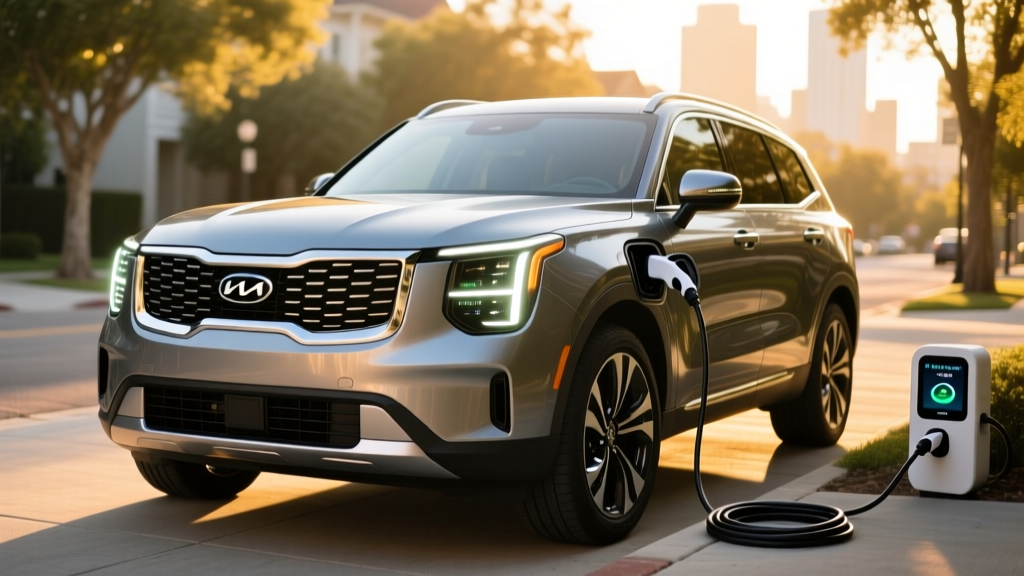
The Kia Telluride has been a three-row SUV benchmark since its 2020 debut, but one gap in the lineup persisted for years: a hybrid option. That changes with the 2026 Kia Telluride Hybrid, which pairs a turbocharged engine with an electric motor to slash fuel consumption without sacrificing the cargo space and towing capacity buyers expect. For families currently spending $300+ per month on gas in a conventional V6 Telluride, the hybrid variant represents a meaningful ownership upgrade — but it's important to understand exactly what kind of hybrid this is, what MPG you'll actually see, and whether the price premium pays for itself.
HEV vs PHEV: What Kind of Hybrid Is the Telluride?
The 2026 Telluride Hybrid is a conventional hybrid (HEV) — not a plug-in hybrid (PHEV). Here's why that distinction matters:
- Conventional Hybrid (HEV): The battery charges through regenerative braking and the gasoline engine. You never plug it in. The electric motor assists the engine during acceleration and enables brief low-speed electric-only driving, but the vehicle runs primarily on gasoline.
- Plug-in Hybrid (PHEV): Features a larger battery (typically 10–25 kWh) that you charge via a wall outlet or charging station. PHEVs offer 25–40 miles of electric-only range before the gas engine takes over, functioning as an EV for most daily commutes.
Kia has not announced a Telluride PHEV variant for the 2026 model year. If plug-in capability is a priority, competitors like the Toyota Grand Highlander Hybrid (HEV) and the Mazda CX-90 PHEV offer different approaches to three-row electrification.
2026 Telluride Hybrid Powertrain and Performance
The Telluride Hybrid uses a 1.6-liter turbocharged four-cylinder engine paired with an electric motor integrated into a six-speed automatic transmission. This is the same hybrid architecture Kia has refined in the Sorento Hybrid, scaled up for the Telluride's larger frame.
| Specification | 2026 Telluride Hybrid |
|---|---|
| Engine | 1.6L Turbocharged GDI 4-cylinder |
| Electric Motor | 47.7 kW (64 hp) permanent-magnet synchronous |
| Combined System Output | ~267 hp / 291 lb-ft torque (est.) |
| Transmission | 6-speed automatic |
| Drivetrain | AWD standard |
| Hybrid Battery | ~1.5 kWh lithium-ion (self-charging) |
| 0–60 mph (est.) | ~7.5 seconds |
| Towing Capacity | 5,000 lbs (with tow package) |
| Plug-In Required? | No — conventional HEV |
The combined 267 horsepower is competitive with the outgoing 3.8L V6 (291 hp), and the electric motor's instant torque fills in the low-end response that turbocharged engines sometimes lack off the line. AWD is standard across all hybrid trims, which matters for buyers in snow-belt states.
Fuel Economy: EPA Ratings and Real-World MPG
This is the headline number for any hybrid buyer. The conventional V6 Telluride returns an EPA-estimated 21 MPG combined (19 city / 24 highway with AWD). The hybrid powertrain delivers a substantial improvement.
| Configuration | City MPG | Highway MPG | Combined MPG |
|---|---|---|---|
| Telluride V6 AWD (gas) | 19 | 24 | 21 |
| Telluride Hybrid AWD | 34 | 31 | 33 |
| Toyota Grand Highlander Hybrid AWD | 36 | 32 | 35 |
Source: fueleconomy.gov — EPA estimates. Actual mileage will vary.
How many MPG does the Telluride Hybrid get?
The 2026 Telluride Hybrid is rated at an EPA-estimated 33 MPG combined (34 city / 31 highway) with standard AWD. Real-world results typically range from 30–37 MPG depending on driving conditions, with city-heavy routes favoring the hybrid system's regenerative braking.
Annual Fuel Cost Savings vs. Gas V6
The hybrid's MPG advantage translates directly to dollars. Using the EPA's fuel cost calculator assumptions of 15,000 miles per year, 55% city driving, and $3.50/gallon regular unleaded:
- V6 Telluride AWD (21 MPG combined): ~$2,500/year in fuel
- Telluride Hybrid AWD (33 MPG combined): ~$1,591/year in fuel
- Annual savings: ~$909
- Five-year savings: ~$4,545
At $4.00/gallon, the five-year savings stretch closer to $5,200. For high-mileage families logging 20,000+ miles annually, the payback period on any hybrid price premium shrinks considerably.
Pricing, Trims, and Tax Credit Eligibility
Kia has positioned the Telluride Hybrid across multiple trim levels, mirroring the gas model's lineup. Based on announced pricing:
- SX Prestige Hybrid: ~$50,000 MSRP
- EX Hybrid: ~$47,000 MSRP
- S Hybrid: ~$44,000 MSRP
Does the Telluride Hybrid qualify for a tax credit?
The conventional Telluride Hybrid (HEV) does not qualify for the federal §30D clean vehicle tax credit. Under current IRS rules, the §30D credit of up to $7,500 is available only for plug-in electric vehicles (BEVs) and plug-in hybrids (PHEVs) that meet battery sourcing, critical minerals, MSRP cap, and buyer income requirements. Since the Telluride Hybrid is a self-charging HEV with no plug-in capability, it falls outside the credit's scope.
Some states and utilities offer rebates for conventional hybrids — check your state energy office or local utility for current programs. These vary widely by jurisdiction and change frequently.
Reliability, Battery Warranty, and Replacement Costs
Hybrid battery longevity is the single most common concern among first-time hybrid buyers. The data is reassuring: modern lithium-ion hybrid batteries are engineered for the life of the vehicle, and failure rates remain low.
- Hybrid battery: 10 years / 100,000 miles (standard across all states)
- Hybrid system components: 10 years / 100,000 miles
- Basic vehicle warranty: 5 years / 60,000 miles
- Powertrain warranty: 10 years / 100,000 miles
Kia's hybrid battery warranty covers capacity degradation below a defined threshold (typically 70% state of health) as well as outright failure. The ~1.5 kWh battery pack in a conventional hybrid is far smaller than a full EV battery (75–100+ kWh), meaning replacement cost — if ever needed outside warranty — is substantially lower, typically in the $2,000–$3,500 range including labor.
Is the Telluride Hybrid reliable?
Kia's hybrid powertrain has been proven in the Sorento Hybrid and Sportage Hybrid since 2022, with strong reliability records reported by major automotive surveys. The Telluride platform itself earned top marks from the IIHS as a Top Safety Pick+. The hybrid system adds complexity but eliminates several gas-engine wear items — there's no traditional starter motor, the regenerative braking system extends pad life, and the engine operates under less stress thanks to electric motor assist.
Telluride Hybrid vs. Gas vs. Full EV: Which Fits Your Family?
Choose the Telluride Hybrid if:
- You drive 12,000–20,000 miles per year and want to cut fuel costs by ~$900 annually
- You don't have reliable access to home or workplace EV charging
- You take regular road trips and don't want to plan around charging stops
- You want three rows and 5,000-lb towing without the V6 fuel penalty
- You want a seamless transition — no plugging in, no behavior change required
Stick with the gas V6 Telluride if:
- You drive under 8,000 miles per year (the hybrid premium won't pay back quickly enough)
- You prioritize the lowest possible purchase price and hybrid trims aren't available in your budget
Consider a full EV (like the Kia EV9) if:
- You can install a Level 2 home charger (240V) and most of your driving is under 250 miles per day
- You want to access the federal §30D tax credit (up to $7,500, subject to IRS eligibility rules)
- You want the lowest per-mile energy cost (~$0.04–0.06/mile on home electricity vs. ~$0.12–0.15/mile in the hybrid)
- You don't need to tow more than 2,000–3,500 lbs regularly
Pros and Cons at a Glance
Pros
- 33 MPG combined — a 57% improvement over the V6
- No plug-in required; zero behavior change from a gas car
- AWD standard across all hybrid trims
- 10-year/100,000-mile hybrid battery warranty
- Same cargo room, passenger space, and 5,000-lb towing as the gas model
- Electric motor torque improves low-speed responsiveness
Cons
- No federal §30D tax credit eligibility (HEV, not PHEV)
- Price premium of ~$2,000–$3,000 over equivalent gas trims
- Highway MPG advantage narrows vs. V6 at sustained 80 mph speeds
- No PHEV option available — cannot drive on electric-only for commutes
- Hybrid trims may have limited initial availability at dealers
Frequently Asked Questions
Does the Kia Telluride Hybrid need to be plugged in?
No. The Telluride Hybrid is a conventional hybrid (HEV). Its small lithium-ion battery charges automatically through regenerative braking and the gasoline engine. You fuel it exactly like a regular gas car — just less often.
How far can the Telluride Hybrid drive on electric power alone?
As a conventional HEV, the Telluride Hybrid can operate on electric-only power for very short distances at low speeds (typically under 1 mile at parking-lot speeds). It is not designed for sustained electric-only driving. If you need 25–40 miles of EV range for a commute, you would need a PHEV — which Kia does not currently offer in the Telluride lineup.
How long will the hybrid battery last?
Kia covers the hybrid battery for 10 years or 100,000 miles. In practice, modern hybrid batteries from Kia's corporate powertrain family have demonstrated strong longevity well beyond the warranty period. The Sorento Hybrid, which shares this architecture, has shown minimal degradation in long-term fleet data. Replacement cost, if needed post-warranty, is estimated at $2,000–$3,500 — far less than a full EV battery replacement.
Is the hybrid Telluride slower than the V6?
The hybrid's estimated 267 combined horsepower is slightly below the V6's 291 hp, so 0–60 mph times are comparable (mid-7-second range for the hybrid vs. low-7s for the V6). However, the electric motor's instant torque makes the hybrid feel responsive in everyday driving — particularly in city traffic and during passing maneuvers where the turbo four-cylinder benefits from electric assist.
Can the Telluride Hybrid still tow 5,000 pounds?
Yes. When equipped with the factory tow package, the Telluride Hybrid maintains the same 5,000-pound towing capacity as the V6 model. Hybrid owners who tow frequently should expect MPG to drop significantly during towing — plan for 18–22 MPG when pulling a loaded trailer, which still matches or beats the V6's unladen efficiency.
How does the Telluride Hybrid compare to the Toyota Grand Highlander Hybrid?
The Grand Highlander Hybrid edges ahead on EPA fuel economy (35 combined vs. 33 combined) and offers a slightly more fuel-efficient powertrain. However, the Telluride Hybrid counters with Kia's industry-leading warranty coverage, a more intuitive infotainment interface, and competitive pricing. Both are strong choices — test-drive both and let dealer pricing and availability guide your decision.