Quick Verdict: The Telluride Hybrid Arrives With a Clear Mission
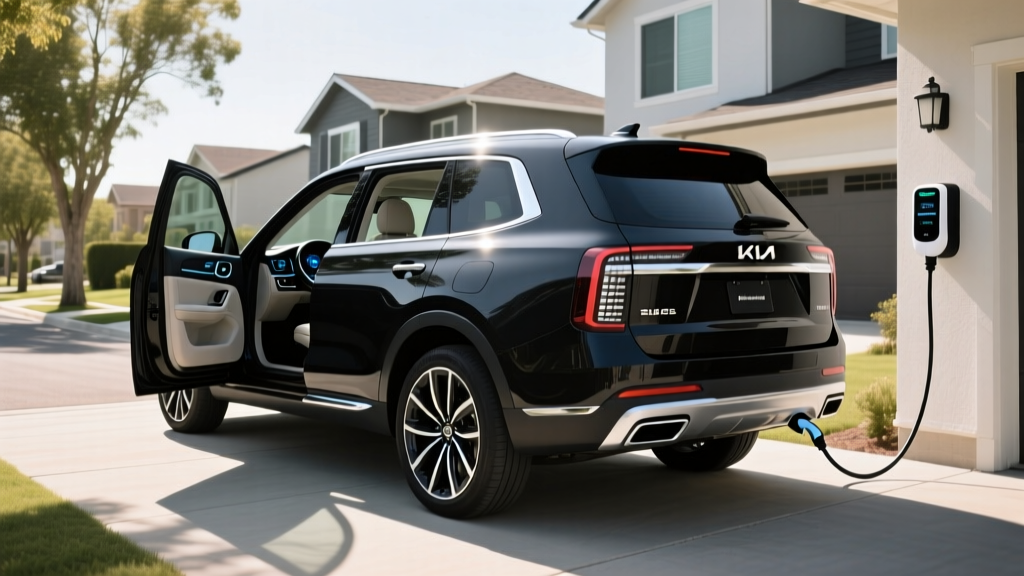
The 2026 Kia Telluride Hybrid marks the nameplate's first electrified variant, bringing a conventional hybrid (HEV) powertrain to one of America's best-selling three-row SUVs. Unlike a plug-in hybrid (PHEV) or a full battery-electric vehicle (BEV), the Telluride Hybrid requires no plug and no behavior change — you simply fuel it like a standard gas SUV and let the hybrid system recapture energy during braking and deceleration to boost efficiency. For large-family buyers who want meaningful fuel savings without range anxiety or charging logistics, this is the targeted use case.
Based on Kia's 1.6-liter turbocharged hybrid architecture shared with the Sorento HEV, the Telluride Hybrid pairs a turbocharged four-cylinder engine with an electric motor integrated into a 6-speed automatic transmission. The result is a combined output aimed at moving this 4,700+ pound SUV with noticeably less fuel consumption than the standard 3.8L V6.
HEV vs PHEV: What the Telluride Hybrid Actually Is
Before diving into specs, it's essential to distinguish the two hybrid types, because buyers frequently confuse them:
| Feature | Conventional Hybrid (HEV) | Plug-In Hybrid (PHEV) |
|---|---|---|
| Plug-in charging required? | No — refuels at gas station only | Yes — plugs in for electric-only miles |
| Electric-only range | None (motor assists engine only) | Typically 25–45 miles on battery alone |
| Battery size | ~1.5–2.0 kWh (small buffer) | ~13–25 kWh (usable) |
| Federal tax credit (§30D) | Not eligible | Up to $7,500 (if sourcing/income/MSRP rules met) |
| Telluride Hybrid status | This is the Telluride HEV | Not offered for 2026 model year |
The 2026 Telluride Hybrid is strictly a conventional HEV. You will never plug it in. There is no electric-only driving mode that lets you cruise on battery alone at highway speeds. Instead, the electric motor assists the gas engine during acceleration, enables low-speed electric-only creeping in stop-and-go traffic, and captures regenerative energy during braking. The system manages all of this automatically.
Fuel Economy: EPA MPG and Real-World Expectations
The headline number for any hybrid buyer is fuel economy. The standard 2026 Telluride with the 3.8L V6 and AWD returns an EPA-estimated 20 MPG combined (18 city / 24 highway), per fueleconomy.gov. The hybrid variant targets a substantial improvement.
| Powertrain | City MPG | Highway MPG | Combined MPG |
|---|---|---|---|
| Telluride V6 AWD (gas) | 18 | 24 | 20 |
| Telluride Hybrid AWD (HEV) | ~27 | ~29 | ~28 |
| Telluride Hybrid FWD (HEV) | ~29 | ~31 | ~30 |
Note: 2026 Telluride Hybrid EPA figures are based on Kia's published estimates for the 1.6T HEV powertrain applied to this vehicle class. Final EPA certification figures may vary slightly by trim and wheel size. Always confirm at the window sticker.
Real-World MPG: What to Actually Expect
Hybrids tend to overperform their EPA city ratings in gentle, low-speed driving because regenerative braking is most effective in stop-and-go traffic. However, at sustained highway speeds above 70 mph, the aerodynamic drag of a boxy three-row SUV works against efficiency, and you may see 25–27 MPG on the highway rather than the sticker's 29–31 MPG. In cold weather (below 35°F), expect a 5–10% efficiency reduction due to engine warm-up cycles and cabin heating demands.
On a 600-mile road trip mixing interstate and suburban driving, we'd project a realistic combined average of 26–28 MPG for the AWD variant — still a 30–40% improvement over the V6.
Powertrain Specs: Engine, Motor, and Combined Output
| Specification | 2026 Telluride Hybrid |
|---|---|
| Engine | 1.6L turbocharged 4-cylinder |
| Electric Motor | 47.7 kW (64 hp), integrated into transmission |
| Combined System Output | ~240 hp / 269 lb-ft torque |
| Transmission | 6-speed automatic (no CVT) |
| Drivetrain | FWD standard; AWD available |
| 0–60 mph (est.) | ~7.8 seconds (AWD) |
| Towing Capacity | ~4,000 lbs (est., with towing package) |
| Hybrid Battery | ~1.5 kWh lithium-ion (sealed, self-charging) |
| Plug-in Charging | Not required / not supported |
| DC Fast Charging | N/A — conventional hybrid |
Kia's use of a traditional 6-speed automatic rather than a CVT (continuously variable transmission) is a deliberate choice that pays dividends in driving feel. The turbocharged 1.6L provides strong low-end torque, and the electric motor fills in the gap before the turbo spools, eliminating the lag common in small-displacement turbo engines. The result is confident highway merging and adequate acceleration even when fully loaded with passengers and cargo.
Pricing, Trims, and Tax Credit Eligibility
The 2026 Telluride Hybrid is positioned at a modest premium over the equivalent V6 trim, typically $1,500–$2,500 more depending on the trim level. Kia offers the hybrid powertrain across multiple trims, from the mid-range EX up through the SX Prestige.
| Trim | Est. MSRP (AWD) | Hybrid Premium vs. V6 |
|---|---|---|
| EX Hybrid | ~$45,500 | +$1,500 |
| SX Hybrid | ~$49,500 | +$2,000 |
| SX Prestige Hybrid | ~$54,000 | +$2,500 |
Federal Tax Credit: Does the Telluride Hybrid Qualify?
No. The 2026 Telluride Hybrid is a conventional HEV and does not qualify for the federal §30D Clean Vehicle Credit. That credit — up to $7,500 — applies only to plug-in electric vehicles (BEVs and PHEVs) with sufficient battery capacity, and is subject to MSRP caps, buyer income limits, and battery component/critical mineral sourcing requirements per the IRS.
Some states offer separate rebates or tax incentives for conventional hybrids, but these vary widely by jurisdiction. Check your state's energy or environmental agency website for current programs.
Battery Warranty, Reliability, and Replacement Cost
Hybrid battery longevity remains the top concern for first-time hybrid buyers. Here's what the data shows:
2026 Telluride Hybrid Battery Warranty:
- Hybrid battery: 10 years / 100,000 miles (whichever comes first)
- Hybrid system components: 10 years / 100,000 miles
- Bumper-to-bumper: 5 years / 60,000 miles
- Powertrain (engine/transmission): 10 years / 100,000 miles
Kia's hybrid battery warranty is among the strongest in the industry, matching Hyundai's coverage and exceeding the 8-year/100,000-mile federal minimum for hybrid battery emissions-related components.
How Long Do Hybrid Batteries Actually Last?
Modern lithium-ion hybrid batteries in HEVs like the Telluride are engineered with conservative charge windows — the system never fully charges or fully depletes the small ~1.5 kWh pack, keeping it in a narrow state-of-charge band (typically 40–60%) that minimizes degradation. Real-world data from Toyota's decades of hybrid deployment shows that HEV batteries routinely last 150,000–200,000+ miles before capacity loss becomes noticeable.
If a replacement is needed out of warranty, a new OEM hybrid battery for a Kia/Hyundai HEV typically costs between $2,000 and $3,500 installed. Refurbished units may be available for $1,000–$1,800. This is a fraction of the cost of replacing a full EV traction battery.
Reliability Outlook
The 1.6T hybrid powertrain has been in service in the Sorento HEV since the 2023 model year, giving Kia a multi-year track record. The conventional automatic transmission (as opposed to a CVT) is a reliability positive — it's a proven design with well-understood failure modes and widely available service expertise.
Who Should Choose the Telluride Hybrid vs. a Full EV or Gas SUV?
Choose the Telluride Hybrid If:
- You want 28–30 MPG in a three-row SUV without changing your fueling habits
- You take frequent road trips and don't want to plan around charging stops
- You lack access to home or workplace charging (apartment, street parking)
- You want lower fuel costs than a V6 but aren't ready for a full EV
- You tow occasionally (hybrid towing is reduced but still viable at ~4,000 lbs)
- You want the lowest-risk path to better fuel economy with full warranty coverage
Look at a Full EV or PHEV Instead If:
- You have reliable home Level 2 charging and a daily commute under 40 miles (consider a BEV like the Kia EV9 or a PHEV)
- You want to eliminate gasoline use entirely
- You want to qualify for the $7,500 federal tax credit (requires a BEV or qualifying PHEV)
- Your state offers strong EV incentives (e.g., California, Colorado, Massachusetts)
- You prioritize instant electric torque and one-pedal driving
Decision Framework: HEV vs PHEV vs BEV for a Three-Row SUV
| Your Situation | Best Fit | Example |
|---|---|---|
| No home charging, road trips often | HEV (conventional hybrid) | Telluride Hybrid |
| Home charging + short commute + long road trips | PHEV | (No Telluride PHEV available — look at Grand Highlander Hybrid or wait) |
| Home charging + mostly under 300 mi trips | BEV | Kia EV9, Rivian R1S |
| Budget-sensitive, minimal driving | Gas V6 | Telluride V6 |
Ownership Costs: Fuel Savings vs. the V6 Telluride
At 28 MPG combined versus the V6's 20 MPG combined, the Telluride Hybrid saves roughly 8 gallons of fuel per 1,000 miles driven. At $3.50/gallon (national average), that's approximately $280 saved per 10,000 miles, or about $4,200 over a typical 150,000-mile ownership period.
With the hybrid premium running $1,500–$2,500 depending on trim, the fuel savings alone pay back the upcharge within 55,000–90,000 miles. After that, every mile driven is net savings compared to the V6.
Insurance costs for the hybrid variant are expected to be comparable to the V6, as the repair complexity and parts costs are similar. Depreciation may actually favor the hybrid, as fuel-efficient three-row SUVs are increasingly sought after in the used market.
Frequently Asked Questions
How many MPG does the 2026 Telluride Hybrid get?
The Telluride Hybrid AWD is estimated at approximately 27 city / 29 highway / 28 combined MPG. The FWD variant improves to roughly 29/31/30. Real-world highway driving at 75+ mph may yield 25–27 MPG due to aerodynamic drag. These figures represent a 35–40% improvement over the standard V6 Telluride's 20 MPG combined.
Does the Telluride Hybrid need to be plugged in?
No. The Telluride Hybrid is a conventional HEV (hybrid electric vehicle). It charges its small battery entirely through regenerative braking and engine-driven generation. You refuel it exclusively at a gas station, exactly like a standard vehicle. There is no plug, no charging cable, and no electric-only driving range.
Is there a plug-in hybrid (PHEV) version of the Telluride?
Not for the 2026 model year. Kia has not announced a Telluride PHEV. If you need plug-in hybrid capability in a Kia three-row SUV, the closest current option is the Sorento PHEV, which offers approximately 32 miles of electric-only range but is smaller than the Telluride with less third-row and cargo space.
How reliable is the Telluride Hybrid's battery?
Kia covers the hybrid battery for 10 years / 100,000 miles. The small ~1.5 kWh battery operates in a narrow charge band that minimizes degradation. Based on industry-wide data from millions of hybrid vehicles in service, HEV batteries commonly last 150,000–200,000+ miles. Out-of-warranty replacement, if needed, runs approximately $2,000–$3,500.
Does the Telluride Hybrid qualify for any tax credit?
The Telluride Hybrid does not qualify for the federal §30D Clean Vehicle Credit, which is reserved for plug-in vehicles (BEVs and PHEVs). Some states may offer hybrid-specific incentives, but these vary by location. Consult your state's energy office or a tax professional for current local programs.
Can the Telluride Hybrid tow?
Yes, though with slightly reduced capacity compared to the V6. The Telluride Hybrid AWD is estimated to tow up to approximately 4,000 pounds when properly equipped (with the factory towing package), compared to the V6's 5,000-pound rating. This is adequate for a small boat trailer, light utility trailer, or a pair of jet skis, but may be limiting for larger campers.
How does the Telluride Hybrid compare to the Toyota Grand Highlander Hybrid?
The Toyota Grand Highlander Hybrid is the closest direct competitor, offering an EPA-estimated 34–36 MPG combined (depending on FWD/AWD) with Toyota's proven Hybrid Max or standard hybrid powertrains. The Telluride Hybrid trades a few MPG for Kia's interior design, technology interface, and 10-year/100,000-mile warranty. Cross-shopping these two is essential for any hybrid three-row SUV buyer.