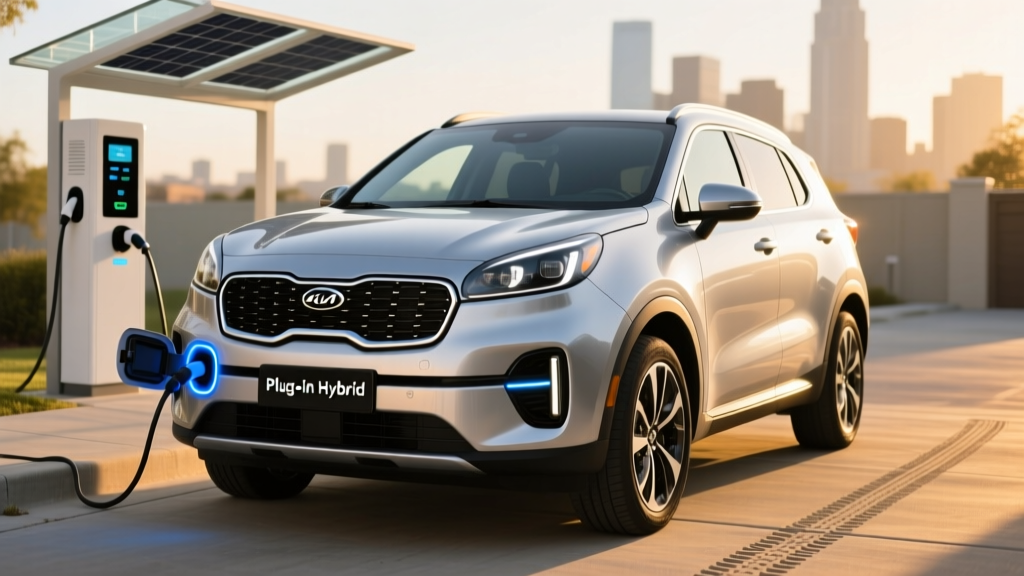
Quick Verdict: The Kia Sportage Plug-In Hybrid in 2026
The 2026 Kia Sportage Plug-In Hybrid (PHEV) occupies a narrow but compelling niche: it offers enough electric-only range to handle most daily commutes without burning a drop of gas, while retaining a gasoline engine for road trips where charging infrastructure remains unreliable. With an EPA-estimated 34 miles of electric-only driving and a combined 43 MPG once the battery is depleted, the Sportage PHEV bridges the gap between a conventional hybrid and a full battery-electric vehicle (BEV) — without the range anxiety or the charging dependency.
But is it the right electrified vehicle for your situation? This guide breaks down every number that matters — from real-world MPG to battery warranty to federal tax credit eligibility — so you can decide with confidence.
HEV vs. PHEV: Understanding the Sportage Lineup
Kia sells the 2026 Sportage in three powertrain variants. Understanding the difference is critical before you step into a dealership:
| Feature | Sportage Gas (ICE) | Sportage Hybrid (HEV) | Sportage Plug-In Hybrid (PHEV) |
|---|---|---|---|
| Needs to be plugged in? | No | No | Yes (for EV range) |
| Electric-only driving | None | Very limited (low-speed assist) | 34 miles EPA |
| Combined fuel economy | 28 MPG | 43 MPG | 43 MPG (hybrid mode) / 84 MPGe (EV+gas) |
| Battery capacity | 12V only | ~1.5 kWh | 13.8 kWh usable |
| Combined horsepower | 187 hp | 227 hp | 261 hp |
| Federal tax credit eligible | No | No | Varies (§30D rules apply) |
Key distinction: The conventional Sportage Hybrid (HEV) generates its own electricity through regenerative braking and the gasoline engine. You never plug it in. The Sportage Plug-In Hybrid (PHEV) has a much larger battery that you charge from a wall outlet or public charger, enabling meaningful electric-only driving before the gas engine engages.
Fuel Economy and Electric-Only Range: The Numbers
| Metric | EPA Estimate | Real-World Expectation |
|---|---|---|
| Electric-only range | 34 miles | 28–32 miles (highway/cold weather) |
| MPGe (electric + gas combined) | 84 MPGe | 70–80 MPGe (depends on charging frequency) |
| Gas-only city MPG | 38 MPG | 36–40 MPG (hybrids often beat EPA in city) |
| Gas-only highway MPG | 38 MPG | 34–37 MPG (aerodynamic drag at 70+ mph) |
| Gas-only combined MPG | 43 MPG | 38–42 MPG |
| Total range (full tank + full charge) | ~430 miles | ~380–420 miles |
According to fueleconomy.gov, the 2026 Sportage PHEV achieves an impressive 84 MPGe when operating with a full charge and the gasoline engine combined. Once the battery is depleted and the vehicle operates as a conventional hybrid, it delivers 43 MPG combined.
Real-world caveat: Electric-only range drops noticeably in two conditions. First, sustained highway speeds above 65 mph consume battery faster than the EPA test cycle suggests — expect closer to 28 miles. Second, cold weather (below 40°F) reduces lithium-ion battery efficiency, cutting EV range by 15–25%. In winter, plan for roughly 25–28 miles of electric driving. The gasoline engine also runs more frequently in cold weather to provide cabin heat unless you precondition the vehicle while plugged in.
Powertrain, Battery, and Charging Specifications
| Specification | 2026 Kia Sportage PHEV |
|---|---|
| Engine | 1.6L turbocharged 4-cylinder |
| Electric motor | Permanent magnet synchronous (66.9 kW) |
| Combined system output | 261 hp / 258 lb-ft torque |
| Transmission | 6-speed automatic |
| Drivetrain | AWD (standard on all PHEV trims) |
| Battery capacity (usable) | 13.8 kWh (lithium-ion polymer) |
| Level 1 charging (120V) | ~11 hours (0–100%) |
| Level 2 charging (240V, 7.2 kW onboard charger) | ~2 hours (0–100%) |
| DC fast charging | Not available |
| 0–60 mph | ~7.4 seconds |
| Towing capacity | 2,000 lbs |
The Sportage PHEV's 13.8 kWh battery is large enough for meaningful electric commuting but small enough to charge quickly on a standard Level 2 home charger. The 7.2 kW onboard charger means a full replenishment takes roughly two hours on a 240V circuit — practical for topping up during the workday if you have access to a Level 2 outlet at your workplace.
Important limitation: The Sportage PHEV does not support DC fast charging. This is typical for PHEVs in this class — the battery is too small to justify the hardware cost and weight. If you need rapid public charging, a full BEV is the better choice.
Pricing, Trims, and Federal Tax Credit Eligibility
The 2026 Kia Sportage Plug-In Hybrid is offered in two trims:
- X-Line: Starting at approximately $40,090 MSRP (including destination)
- X-Line Prestige: Starting at approximately $44,090 MSRP (including destination)
Federal Tax Credit (§30D) Eligibility
The Sportage PHEV may qualify for a partial or full federal tax credit under IRS §30D, but eligibility depends on several factors that change periodically:
- Battery sourcing requirements: The vehicle's battery components and critical minerals must meet phased-in domestic-sourcing thresholds. Kia's supply chain for the Sportage PHEV battery has historically faced challenges meeting these requirements.
- MSRP cap: SUVs must have an MSRP at or below $80,000. Both Sportage PHEV trims qualify.
- Income cap: Modified adjusted gross income must not exceed $150,000 (single), $225,000 (head of household), or $300,000 (joint filing).
- Point-of-sale transfer: If eligible, the credit can be transferred to the dealer at purchase, reducing your out-of-pocket cost immediately.
Always verify current eligibility on IRS.gov's qualified vehicles list before purchasing. Rules are subject to change, and a vehicle's eligibility status can shift between model years.
Several states also offer additional rebates or HOV lane access for PHEVs with sufficient electric range. Check your state's energy office or DMV for current programs.
Battery Warranty, Reliability, and Replacement Costs
| Coverage | Term |
|---|---|
| Hybrid/EV battery warranty | 10 years / 100,000 miles |
| Powertrain warranty | 10 years / 100,000 miles |
| Basic vehicle warranty | 5 years / 60,000 miles |
| Capacity retention threshold | Typically 70% of original capacity |
Kia's 10-year/100,000-mile hybrid battery warranty is among the best in the industry and provides genuine peace of mind. The warranty covers battery defects and excessive capacity loss — typically defined as dropping below 70% of original capacity during the warranty period.
Real-world reliability: Modern PHEV batteries from major manufacturers rarely require full replacement within the warranty period. Lithium-ion chemistry has matured significantly, and Kia's thermal management system keeps the battery within optimal temperature ranges. Based on data from earlier-generation Kia PHEV models (Niro, Sorento), battery degradation over 5 years and 60,000 miles is typically 8–12% — well within the warranty threshold.
Out-of-warranty replacement cost: If the battery does need replacement after the warranty expires, expect a cost between $4,000 and $7,000 including parts and labor. This is significantly less than full BEV battery replacements ($10,000–$20,000+) because the PHEV battery is much smaller. Individual module replacement may also be possible, reducing cost further.
Who Should Choose the Sportage PHEV — And Who Shouldn't
Choose the Sportage PHEV if:
- Your daily round-trip commute is under 30 miles and you can charge at home
- You want to drive mostly on electricity but need gas flexibility for road trips
- You lack reliable DC fast-charging infrastructure near your home or travel routes
- You want AWD and a compact SUV form factor
- You want to reduce fuel costs without committing to a full EV
Choose a full EV (BEV) instead if:
- You can install a Level 2 home charger and your daily driving exceeds 34 miles but is within BEV range
- You want zero tailpipe emissions and minimal maintenance (no oil changes, no gas engine)
- You want access to DC fast charging for road trips
- You want to maximize federal tax credit eligibility (BEVs have broader sourcing compliance)
Choose the Sportage HEV (non-plug-in) instead if:
- You cannot charge at home or at work (apartment, street parking)
- Your budget is tighter — the HEV starts roughly $8,000–$10,000 lower
- You want simplicity with no plug-in routine
- Your daily driving is moderate and you want strong MPG without behavioral changes
Choose a gas-only Sportage if:
- You drive very few miles per year (under 8,000) — the fuel savings won't offset the hybrid premium
- You want the lowest possible purchase price
Charging at Home: What You Need to Know
To unlock the Sportage PHEV's value proposition, you need regular access to charging. Here's what that looks like practically:
| Charging Level | Power | Time (0–100%) | Cost to Install |
|---|---|---|---|
| Level 1 (standard 120V outlet) | ~1.4 kW | ~11 hours | $0 (use included cord) |
| Level 2 (240V, dedicated circuit) | Up to 7.2 kW | ~2 hours | $500–$2,000 (electrician + outlet/charger) |
Level 1 is viable for PHEV owners because the battery is small. If you drive 25 miles per day and plug in overnight (10+ hours), a standard 120V outlet will replenish the battery fully. You don't need a Level 2 installation for a PHEV the way you do for a full EV.
Level 2 is ideal if you want to top up midday or if your daily driving exceeds 34 miles and you want to maximize electric driving with multiple charge sessions. A licensed electrician can install a 240V NEMA 14-50 outlet or a hardwired Level 2 EVSE for $500–$2,000 depending on your panel capacity and run length. Older homes may require a panel upgrade ($1,500–$3,000 additional) if you're near your amperage limit.
Real-World Ownership Economics
Let's compare the Sportage PHEV against the gas-only Sportage for a driver covering 15,000 miles per year with home charging access:
| Factor | Sportage Gas (28 MPG) | Sportage PHEV (assumes 70% electric driving) |
|---|---|---|
| Annual fuel/energy cost | ~$1,875 (gas at $3.50/gal) | ~$650 (electricity at $0.14/kWh + some gas) |
| Annual savings (PHEV vs. gas) | — | ~$1,225/year |
| 5-year fuel savings | — | ~$6,125 |
| Maintenance (oil, filters) | Standard ICE schedule | Reduced (less engine runtime) |
The PHEV premium over the gas Sportage is roughly $10,000–$12,000 at base trim. If you qualify for the full $7,500 federal tax credit (verify current eligibility), the effective premium drops to $2,500–$4,500, and fuel savings recoup that within 2–4 years. Without the credit, payback extends to 6–9 years depending on driving patterns.
Frequently Asked Questions
How many MPG does the Kia Sportage Plug-In Hybrid get?
The EPA rates the 2026 Sportage PHEV at 43 MPG combined in hybrid mode (after the battery is depleted), with 38 MPG city and 38 MPG highway. In practice, city MPG often exceeds the EPA estimate because regenerative braking recaptures energy in stop-and-go traffic. Expect 38–42 MPG combined in real-world mixed driving.
How far can the Sportage PHEV go on electric only?
The EPA estimates 34 miles of electric-only range. In real-world conditions — particularly highway driving above 65 mph or cold weather below 40°F — expect 25–32 miles. For most commuters with a sub-30-mile round trip, this covers daily driving entirely on electricity when charged nightly.
Does the Kia Sportage PHEV qualify for a federal tax credit?
It may, depending on current IRS §30D battery-sourcing requirements. The Sportage PHEV meets the MSRP cap ($80,000 for SUVs) and most buyers meet income caps, but the battery's critical mineral and component sourcing must comply with phased-in domestic-content thresholds. Check the IRS qualified vehicles list before purchasing, as eligibility can change between model years.
Is the Sportage PHEV reliable, and what does a battery replacement cost?
Kia's hybrid systems have demonstrated strong reliability based on data from the Niro and Sorento PHEV platforms. The 10-year/100,000-mile battery warranty covers defects and excessive degradation. Out-of-warranty battery replacement runs approximately $4,000–$7,000, though full replacement within the first 10 years is uncommon.
Do I need to install a home charger for the Sportage PHEV?
No — the included Level 1 charging cord works with any standard 120V household outlet and will fully recharge the 13.8 kWh battery in about 11 hours. For most PHEV owners who charge overnight, this is sufficient. A Level 2 (240V) installation reduces charge time to about 2 hours and is recommended only if you need faster turnaround or want to maximize electric driving with midday top-ups.
Can the Sportage PHEV DC fast charge?
No. The Sportage PHEV does not have a DC fast-charging port, which is standard for PHEVs in this class. The battery is too small to justify DC fast-charging hardware. All charging is AC via Level 1 or Level 2.
Hybrid vs. PHEV vs. full EV — which should I choose?
If you can charge at home and your commute is under 34 miles, the PHEV gives you electric daily driving with gas backup for longer trips. If you cannot charge at home, the conventional HEV delivers excellent MPG with zero plug-in hassle. If you want zero tailpipe emissions, minimal maintenance, and have reliable charging access, a full BEV like the Kia EV6 is worth considering — though at a higher purchase price.
Sources: EPA fuel economy data via fueleconomy.gov; Kia Motors America official specifications; IRS §30D qualified vehicle list at irs.gov. All specifications and pricing reflect 2026 model year information available at time of publication. Tax credit eligibility is subject to change — consult a tax professional and verify on IRS.gov before purchasing.