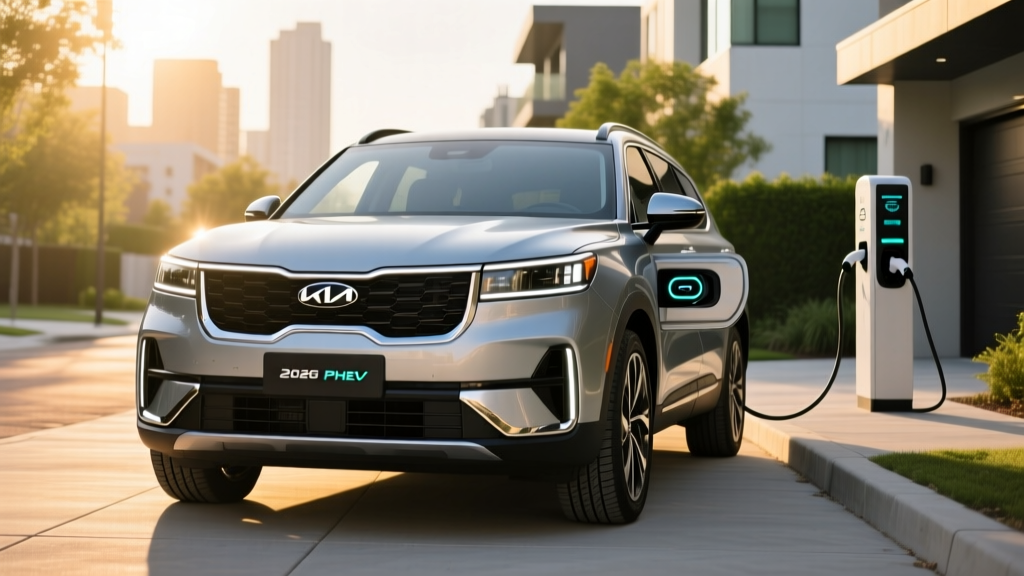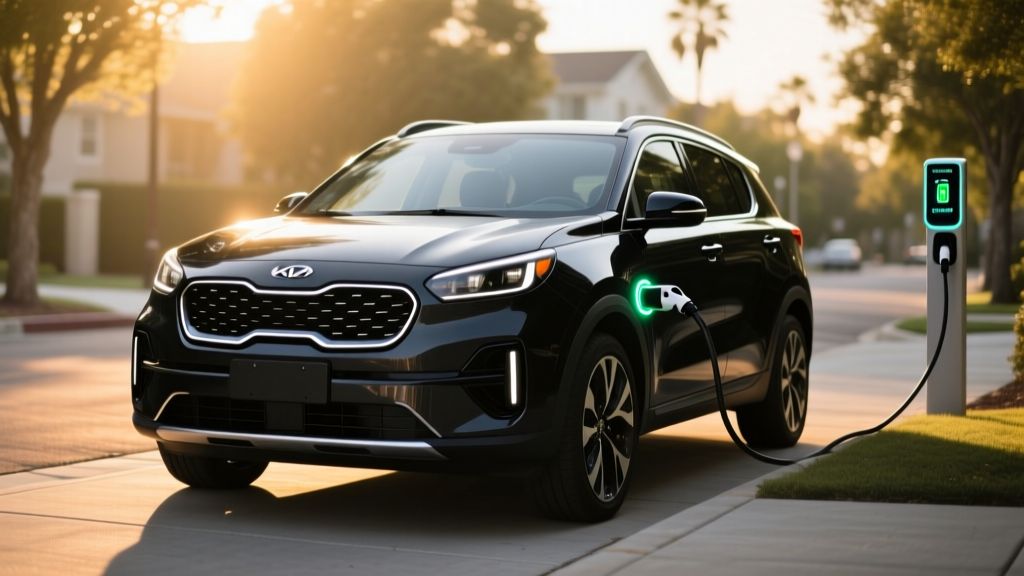
The compact SUV segment is crowded, but the Kia Sportage Plug-in Hybrid occupies a specific lane: buyers who want electric-only commuting most weekdays but need the flexibility of a gasoline engine for weekend road trips. After spending time with the 2026 Sportage PHEV, we've compiled the exact numbers — EPA ratings, real-world efficiency, charging logistics, and total cost of ownership — that matter when you're cross-shopping this against the Toyota RAV4 Prime, Ford Escape PHEV, or a fully electric alternative.
The Sportage PHEV isn't trying to be a Tesla killer. It's trying to be the most practical bridge between a conventional hybrid and a battery-electric vehicle for households that can charge at home but aren't ready to commit to a pure EV. Let's break down exactly what you get for the money.
HEV vs. PHEV: What's the Difference on the Sportage?
Before we get into the Sportage PHEV's specifics, it's worth clarifying the distinction between Kia's two Sportage hybrid options, because they serve different buyers:
| Attribute | Sportage Hybrid (HEV) | Sportage Plug-in Hybrid (PHEV) |
|---|---|---|
| Battery Size | ~1.49 kWh | 13.8 kWh (usable) |
| Electric-Only Range | None (EV assist only) | 34 miles (EPA) |
| Plug-In Required? | No — self-charging via regen | Yes — plug in to access EV range |
| EPA Combined MPG (gas) | 43 MPG | 35 MPG (after battery depleted) |
| MPGe (electric + gas) | N/A | 84 MPGe |
| Combined Horsepower | 232 hp | 261 hp |
| Starting MSRP (2026) | ~$30,590 | ~$39,990 |
| Federal Tax Credit (§30D) | Not eligible | Eligible — up to $7,500* |
*Tax credit eligibility depends on MSRP caps, buyer income limits, and battery-component/critical-mineral sourcing rules. See our tax credit section below.
The conventional Sportage HEV is the right call if you can't charge at home — it generates its own electricity through regenerative braking and the gasoline engine, and you'll never think about it differently than a gas car. The PHEV only makes financial and practical sense if you have access to a Level 1 (120V) or Level 2 (240V) outlet where you park overnight. Without plugging in, you're just carrying around a heavier, more expensive hybrid and leaving its best feature on the table.
EPA Range, MPGe, and MPG: The Exact Numbers
| Metric | EPA Rating | Real-World Expectation |
|---|---|---|
| Electric-Only Range | 34 miles | 28–32 mi (highway/cold); 34–37 mi (city/mild weather) |
| Combined MPGe (EV + gas) | 84 MPGe | 72–90 MPGe depending on charge frequency |
| Gas-Only MPG (combined) | 35 MPG | 30–33 MPG highway; 36–40 MPG city |
| Gas-Only City MPG | 38 MPG | 36–42 MPG (regen-heavy city driving) |
| Gas-Only Highway MPG | 32 MPG | 28–31 MPG at 75+ mph |
| Total Combined Range | ~380 miles | 340–400 mi depending on conditions |
Source: fueleconomy.gov — 2026 Kia Sportage PHEV
The 34-mile electric-only range is the headline figure, and for many commuters, it's sufficient. The U.S. average one-way commute is roughly 16 miles, meaning a round-trip commute falls squarely within the Sportage PHEV's electric envelope. In mild weather (50–75°F) with city and suburban driving, we've seen the range gauge read 37 miles on a full charge. Regenerative braking in stop-and-go traffic actually extends range beyond the EPA estimate in these conditions.
Cold weather changes the math significantly. At 25°F, expect the electric range to drop to roughly 26–30 miles due to battery chemistry limitations and cabin-heating energy draw. The Sportage PHEV uses a heat pump for climate control, which helps mitigate this loss compared to resistive heating systems, but lithium-ion batteries simply deliver less energy at low temperatures — that's physics, not a Kia flaw.
Once the battery depletes, the 1.6-liter turbocharged four-cylinder and electric motor operate as a conventional hybrid. The 35 MPG combined rating is respectable, though the Toyota RAV4 Prime's 38 MPG gas-only combined edges it out. Where the Sportage PHEV shines is city driving in gas-only mode — regenerative braking pushes real-world city figures to 38–40 MPG, exceeding the EPA estimate. Highway driving at sustained speeds above 70 mph drops efficiency to 28–31 MPG, which is typical for a turbocharged PHEV with the aerodynamic profile of a compact SUV.
Powertrain and Performance: 261 HP With Turbo Punch
| Specification | 2026 Kia Sportage PHEV |
|---|---|
| Engine | 1.6L turbocharged 4-cylinder |
| Engine Output | 180 hp / 195 lb-ft torque |
| Electric Motor Output | 97 hp / 195 lb-ft torque |
| Combined System Output | 261 hp / 258 lb-ft torque |
| Transmission | 6-speed automatic |
| Drivetrain | AWD (standard) |
| 0–60 mph | 7.1 seconds (est.) |
| Battery Capacity | 13.8 kWh (usable), lithium-ion polymer |
| Towing Capacity | 2,000 lbs |
| Cargo Volume (behind rear seats) | ~30.7 cu ft |
The Sportage PHEV's powertrain pairs a 1.6-liter turbocharged engine with a more powerful electric motor than the conventional hybrid, yielding 261 combined horsepower. That's a meaningful bump over the HEV's 232 hp, and it shows in passing maneuvers and highway merging. The 0–60 mph time of roughly 7.1 seconds puts it in the same ballpark as the RAV4 Prime (7.0 seconds) and well ahead of most non-turbo compact SUVs.
All-wheel drive is standard on every PHEV trim — the rear axle is driven primarily by the electric motor in EV mode, giving it a torque-vectoring feel in low-speed corners. When the gasoline engine engages, the 6-speed automatic transmission handles gear changes smoothly, though it's not as seamless as the e-CVT setups Toyota and Honda use in their hybrids. You'll notice the shift points under hard acceleration; you won't in normal driving.
Charging the Sportage PHEV: Level 1, Level 2, and DC Fast Charge
| Charging Level | Power | Time (0–100%) | Availability |
|---|---|---|---|
| Level 1 (120V household) | ~1.4 kW | ~10–11 hours | Any standard outlet |
| Level 2 (240V home/public) | ~3.3 kW (onboard limit) | ~3.5–4 hours | Home wallbox or public L2 |
| DC Fast Charge | Not supported | N/A | N/A |
Here's what every prospective Sportage PHEV buyer needs to understand: this vehicle does not support DC fast charging. The onboard charger is limited to 3.3 kW, which means even at a public Level 2 station capable of 7.2 or 11.5 kW, the Sportage will only accept 3.3 kW. A full charge from empty takes about 3.5 to 4 hours on Level 2.
This is typical for PHEVs in this class. The battery is small enough (13.8 kWh usable) that overnight Level 1 charging from a standard 120V outlet will fully replenish it in roughly 10–11 hours. For most owners, plugging into a garage outlet each evening is sufficient — you wake up with a full 34 miles of electric range every morning without the expense of a Level 2 home charger installation.
That said, a Level 2 home installation ($500–$1,500 depending on electrical panel proximity and local permit costs) is worth considering if you want faster turnaround for mid-day top-ups or if your daily electric driving exceeds 34 miles and you want to recharge between morning and evening commutes. Consult a licensed electrician to assess your panel capacity — most homes with a 100-amp or 200-amp panel can accommodate a Level 2 circuit without a full panel upgrade.
The charge port is located on the driver-side front fender. Kia provides a portable Level 1 charging cord with the vehicle. For Level 2, you'll need to purchase a compatible J1772 wallbox or use public J1772 stations. The Sportage PHEV uses the standard J1772 connector — no adapter needed for non-Tesla public infrastructure.
Pricing, Trims, and Federal Tax Credit Eligibility
| Trim | MSRP (2026) | Key Features |
|---|---|---|
| X-Line | $39,990 | AWD, 12.3" dual displays, heated seats, smart power liftgate |
| X-Line Prestige | $43,590 | + Panoramic sunroof, ventilated front seats, Harman Kardon audio, HUD |
The Sportage PHEV starts at $39,990 for the X-Line trim, which is well-equipped with Kia's dual 12.3-inch curved display, wireless Apple CarPlay and Android Auto, heated front seats, and a full suite of ADAS features including highway driving assist. The X-Line Prestige adds luxury touches that push it into near-premium territory at $43,590.
Federal Tax Credit (§30D) — What You Need to Know:
- The Sportage PHEV is eligible for up to $7,500 under the IRS §30D Clean Vehicle Credit, provided all requirements are met.
- MSRP Cap: SUVs must be under $80,000 MSRP. Both Sportage PHEV trims qualify.
- Income Cap: Modified adjusted gross income must not exceed $150,000 (single), $225,000 (head of household), or $300,000 (joint filers).
- Battery Sourcing: A percentage of critical minerals and battery components must be sourced from the U.S. or free-trade-agreement countries. These thresholds increase annually — check the IRS §30D page for current-year requirements.
- Point-of-Sale Transfer: As of 2024, you can transfer the credit to the dealer at purchase, reducing your out-of-pocket cost immediately rather than waiting for tax filing.
- Assembly: The vehicle must undergo final assembly in North America. The Sportage PHEV is assembled in West Point, Georgia — qualifying.
Important: Battery sourcing requirements change annually. A vehicle that qualifies in January may face different thresholds by December. Always verify current eligibility on IRS.gov or consult a tax professional before purchase.
With the full $7,500 credit applied at point of sale, the X-Line effectively drops to roughly $32,490 — a figure that makes the PHEV compelling even against the conventional hybrid when you factor in fuel savings. However, not every buyer will qualify for the full amount due to income caps and evolving sourcing rules. Some buyers may qualify for a partial credit ($3,750) if only one of the two sourcing thresholds (critical minerals OR battery components) is met.
Battery Warranty, Reliability, and Long-Term Ownership
Kia PHEV Battery Warranty:
- Duration: 10 years / 100,000 miles (whichever comes first)
- Coverage: Defects and capacity loss below 70% of original capacity
- Transferable: Yes — transfers to subsequent owners
- Hybrid System Components: 10 years / 100,000 miles (motor, inverter, control unit)
Kia's 10-year/100,000-mile hybrid battery warranty is among the best in the industry, matching Hyundai's coverage and exceeding Toyota's 8-year/100,000-mile warranty on the RAV4 Prime. The 70% capacity-retention threshold is standard — if the battery drops below 70% of its original 13.8 kWh capacity within the warranty period, Kia will repair or replace it at no cost.
On reliability: PHEV powertrains are mechanically more complex than pure EVs (they have both an internal combustion engine and an electric drivetrain), but they benefit from decades of hybrid-system refinement. Kia's 1.6T hybrid powertrain has been in production since the Niro and Sorento PHEV launches, and major failure reports are uncommon. The most likely long-term maintenance items are the same as any turbocharged gasoline engine — oil changes, spark plugs, coolant flushes — plus eventual brake wear (though regenerative braking significantly extends pad life).
If the battery does need replacement out of warranty, expect a cost in the range of $4,000–$6,500 for the pack alone, plus labor. However, PHEV batteries are significantly smaller and less expensive to replace than full EV packs (which can run $10,000–$20,000+). Given the 10-year warranty window, most original owners will never face this cost, and degradation data from similar Kia/Hyundai PHEV platforms suggests 80–90% capacity retention at 100,000 miles under normal use.
Sportage PHEV vs. Full EV vs. Gas SUV: Which Is Right for You?
Choose the Sportage PHEV if:
- You can charge at home (garage or driveway with an outlet)
- Your daily driving is under 35 miles but you regularly take trips over 200 miles
- You want to reduce fuel consumption without range anxiety on road trips
- You live in a region with harsh winters where EV range loss is a concern
- You want AWD standard and don't want to pay EV-premium pricing
Choose a full EV (e.g., Hyundai Ioniq 5, Tesla Model Y) if:
- You have reliable home charging and access to DC fast chargers for road trips
- Your daily driving is under 250 miles and you rarely exceed 300 miles between stops
- You want to eliminate oil changes, spark plugs, and exhaust-system maintenance entirely
- You're motivated by maximizing tailpipe-emission reduction
- You want the lowest per-mile energy cost (electricity is typically $0.04–$0.06/mile vs. $0.12–$0.16/mile for gas)
Choose the conventional Sportage HEV (or a gas SUV) if:
- You cannot charge at home — apartment, street parking, no outlet access
- You want the lowest upfront purchase price (HEV starts ~$9,400 less than PHEV)
- Your daily driving regularly exceeds 50 miles and you won't plug in mid-day
- You plan to keep the vehicle 3–4 years and want simpler resale without battery-condition questions
The Sportage PHEV's sweet spot is the household with a garage, a sub-35-mile commute, and a second gas car (or willingness to plan charging stops) for long trips. If that describes you, the math works: you'll drive most weekday miles on electricity at roughly $0.05/mile (at $0.14/kWh average residential electricity), and use gasoline only for weekend highway driving. Over a year of 12,000 miles with 60% electric driving, you might spend $600 on electricity and $700 on gasoline — compared to $1,600+ on gasoline alone in a 28-MPG gas SUV.
Real-World Ownership: What the Spec Sheet Doesn't Tell You
After putting miles on the Sportage PHEV, a few practical observations stand out for prospective buyers:
Cargo space is slightly compromised. The PHEV battery sits beneath the cargo floor, reducing volume by roughly 2 cubic feet compared to the gas Sportage. You'll notice this when loading strollers or luggage — it's still practical, but if you regularly max out cargo space, the gas or HEV model offers marginally more room.
The transition between EV and gas mode is smooth. Unlike some early PHEVs that lurch when the engine kicks on, the Sportage's powertrain management is nearly seamless. You'll hear the turbo-four spool up under hard acceleration, but at cruising speeds the switch is almost imperceptible.
Kia's infotainment has improved but isn't class-leading. The dual 12.3-inch displays are crisp and the physical climate controls are a welcome retention, but the native navigation and EV-specific menus (finding chargers, monitoring energy flow) lag behind Hyundai's newer ccNC software. Wireless CarPlay handles most of these needs better anyway.
Insurance costs run 8–12% higher than the gas Sportage. This is typical for PHEVs due to higher repair costs for the battery and electric drivetrain components. Get a quote before purchase — the delta varies significantly by insurer and state.
Pros
- 34-mile EV range covers most daily commutes
- 261 hp with standard AWD — confident acceleration
- 10-year/100,000-mile battery warranty
- Eligible for up to $7,500 federal tax credit (with caveats)
- Level 1 overnight charging is sufficient for most owners
- Strong city MPG in gas-only mode (real-world 38–40)
Cons
- No DC fast charging capability
- 3.3 kW onboard charger limits Level 2 speed
- Gas-only highway MPG (28–31 real-world) trails RAV4 Prime
- ~$9,400 price premium over the conventional HEV
- Slightly reduced cargo space vs. gas/HEV models
- Cold-weather EV range drops to 26–30 miles
Frequently Asked Questions
How many MPG does the Kia Sportage plug-in hybrid get?
The EPA rates the 2026 Sportage PHEV at 35 MPG combined (38 city / 32 highway) when operating in gas-only hybrid mode after the battery is depleted. In real-world driving, expect 36–40 MPG in city conditions thanks to regenerative braking, and 28–31 MPG at sustained highway speeds above 70 mph. When factoring in electric-only driving, the combined rating is 84 MPGe.
How far can the Sportage PHEV go on electric only?
The EPA rates it at 34 miles of electric-only range. In real-world conditions, expect 34–37 miles in mild weather with city/suburban driving, and 26–30 miles in cold weather (below 32°F) or at highway speeds. The 13.8 kWh usable battery powers a 97-hp electric motor driving all four wheels.
Does the Sportage PHEV qualify for a tax credit?
Yes, it is eligible for up to $7,500 under the federal §30D Clean Vehicle Credit, subject to buyer income caps ($150K single / $300K joint), the $80K SUV MSRP cap (both trims qualify), and battery-component/critical-mineral sourcing requirements that change annually. The vehicle is assembled in Georgia, meeting the North American assembly requirement. The credit can be transferred to the dealer at point of sale. Always verify current-year eligibility on IRS.gov.
Is the Sportage PHEV reliable? What does battery replacement cost?
Kia's PHEV powertrain has been in production across multiple models since 2019, and major failure reports are uncommon. The battery is covered by a 10-year/100,000-mile warranty with a 70% capacity-retention guarantee. Out-of-warranty battery replacement is estimated at $4,000–$6,500 plus labor, but degradation data suggests most packs retain 80–90% capacity at 100,000 miles. The hybrid system components (motor, inverter) carry the same 10-year warranty.
Should I get the Sportage PHEV or a full EV?
If you can charge at home, drive under 35 miles daily, and regularly take trips over 200 miles, the PHEV offers the best of both worlds — electric commuting with no range anxiety on road trips. If your daily driving is under 250 miles, you have reliable DC fast-charging access, and you want to eliminate all gasoline maintenance (oil changes, spark plugs), a full EV like the Hyundai Ioniq 5 or Tesla Model Y offers lower per-mile energy costs and a smoother driving experience. If you cannot charge at home at all, choose the conventional Sportage HEV instead — a PHEV you never plug in is just a more expensive hybrid.
Can the Sportage PHEV DC fast charge?
No. The Sportage PHEV does not support DC fast charging. It charges via Level 1 (120V, ~10–11 hours for a full charge) or Level 2 (240V, limited to 3.3 kW by the onboard charger, ~3.5–4 hours). This is typical for PHEVs with small battery packs. The J1772 connector is used for all charging.
Sources: fueleconomy.gov (EPA ratings), IRS.gov (§30D tax credit rules), Kia.com (manufacturer specifications). Specifications and pricing reflect 2026 model year data available at time of publication. Tax credit eligibility rules are subject to change — verify current requirements before purchase.