Quick Verdict: The 2026 Kia Sportage PHEV
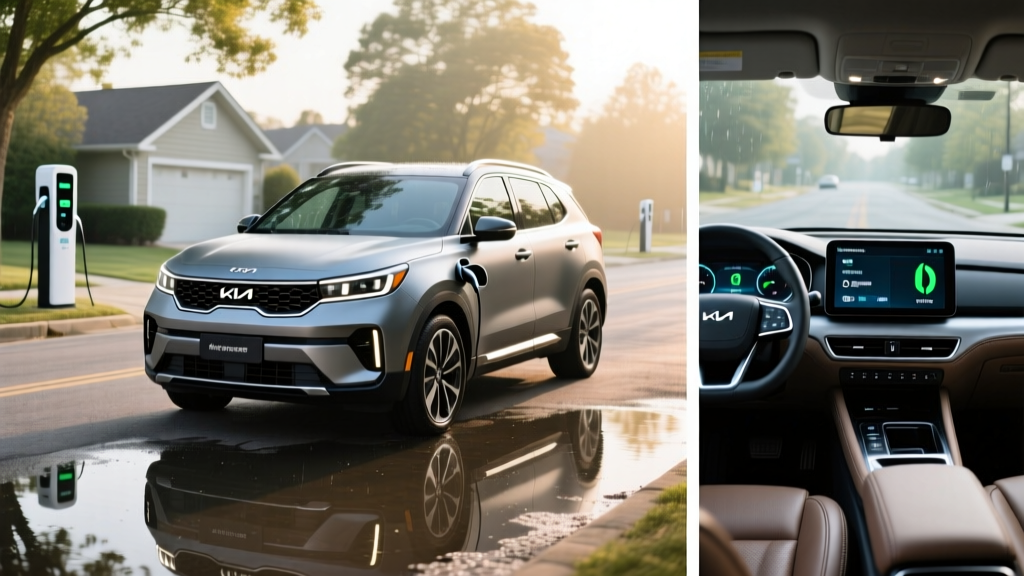
The 2026 Kia Sportage Plug-in Hybrid occupies a narrow but increasingly popular lane: a compact SUV that handles most daily commutes on electricity alone while eliminating range anxiety for road trips. With an EPA-estimated 34 miles of electric-only range and a combined 43 MPG once the battery depletes, it targets buyers who want EV-like commuting without committing to a full battery-electric vehicle. The powertrain pairs a 1.6-liter turbocharged four-cylinder with a 97-hp electric motor for a combined 261 horsepower — enough to feel confident merging onto highways or climbing grades fully loaded.
Starting at approximately $39,990 (including destination), the Sportage PHEV undercuts rivals like the Toyota RAV4 Prime on price while offering comparable electric range. The critical question for buyers: does it qualify for federal tax credits, and how do real-world numbers compare to the EPA sticker? This guide breaks down every figure that matters.
HEV vs. PHEV: Understanding the Sportage Lineup
Kia sells the Sportage in three powertrain flavors for 2026: a conventional gas model, a standard hybrid (HEV), and the plug-in hybrid (PHEV) covered here. The distinction between HEV and PHEV is the single most important concept for buyers comparing these trims.
Conventional Hybrid (HEV) — Sportage Hybrid
- How it charges: Regenerative braking and the gasoline engine recharge the small battery. You never plug it in.
- Battery size: ~1.49 kWh (small buffer for assist)
- Electric-only driving: Minimal — typically under 1 mile at low speeds
- Fuel economy advantage: Consistent MPG improvement over gas-only, especially in city driving
- Tax credit: Not eligible for the federal §30D plug-in vehicle credit
Plug-in Hybrid (PHEV) — Sportage PHEV
- How it charges: Plug into a wall outlet (Level 1) or a 240V home charger (Level 2) to fill a larger battery. The engine also recharges on the go.
- Battery size: 13.8 kWh usable capacity
- Electric-only driving: 34 miles EPA-estimated — enough for most round-trip commutes
- Fuel economy advantage: Near-zero gasoline use on short commutes; 43 MPG combined after battery depletion
- Tax credit: May qualify for partial or full §30D credit depending on battery sourcing and buyer income
If your daily driving stays under 30 miles round-trip and you have access to home or workplace charging, the PHEV lets you drive almost entirely on electricity on weekdays while keeping a gas tank for weekend road trips. If you can't charge at home, the HEV still delivers strong MPG without any change to your routine.
Fuel Economy and Electric Range: The Numbers
The EPA rates the 2026 Kia Sportage PHEV at 84 MPGe combined when operating in charge-depleting (electric + gas) mode and 43 MPG combined once the battery is depleted and the vehicle runs as a conventional hybrid. Here is the full breakdown:
| Mode | City | Highway | Combined |
|---|---|---|---|
| Charge-Depleting (EV + Gas) | — | — | 84 MPGe |
| Charge-Sustaining (Hybrid Only) | 38 MPG | 40 MPG | 43 MPG (est.) |
Source: fueleconomy.gov — verify trim-specific figures before purchase.
Real-World Range Expectations
EPA electric-only range: 34 miles
Expect in practice: 28–32 miles in mixed suburban/highway driving at 65–75°F. In cold weather (below 35°F), expect 22–27 miles due to cabin heating demands and reduced battery efficiency. Summer highway driving at sustained 75+ mph may yield 26–29 miles before the engine engages.
Total combined range: Approximately 430 miles (34 electric + ~396 on the 11.4-gallon fuel tank at 43 MPG combined).
The Sportage PHEV's 34-mile electric range is competitive. The Toyota RAV4 Prime offers 42 miles but starts roughly $4,000 higher. The Hyundai Tucson PHEV (its platform sibling) matches at 33 miles. For a 20-mile round-trip commute, the Sportage PHEV will complete most weekdays without burning a drop of gasoline — provided you plug in overnight.
Powertrain and Performance Specs
| Specification | 2026 Kia Sportage PHEV |
|---|---|
| Engine | 1.6L turbocharged 4-cylinder (177 hp, 195 lb-ft) |
| Electric Motor | 97 hp (72 kW), 195 lb-ft |
| Combined Output | 261 hp, 258 lb-ft |
| Transmission | 6-speed automatic |
| Drivetrain | All-wheel drive (standard) |
| 0-60 mph | ~7.4 seconds |
| Battery (Usable) | 13.8 kWh lithium-ion polymer |
| Electric-Only Range | 34 miles (EPA) |
| EV Top Speed | ~87 mph |
| Towing Capacity | 2,000 lbs |
| Cargo Volume | 30.7 cu ft (rear seats up) / 63.4 cu ft (folded) |
The 261-hp combined output puts the Sportage PHEV ahead of the standard Sportage Hybrid (226 hp) and makes it one of the quicker vehicles in the compact PHEV SUV segment. The instant torque from the electric motor fills in the low-end gap that turbocharged engines sometimes exhibit, resulting in responsive acceleration from stops. All-wheel drive is standard across all PHEV trims — the rear axle receives torque through the drivetrain rather than a dedicated rear motor.
Charging: What You Need to Know
The 2026 Sportage PHEV uses a J1772 connector for AC charging and does not support DC fast charging — a limitation common to most PHEVs in this class due to the smaller battery size. Here is what charging looks like in practice:
| Charging Level | Power (kW) | 0–100% Time | Where |
|---|---|---|---|
| Level 1 (120V household outlet) | ~1.4 kW | ~10–11 hours | Any standard outlet |
| Level 2 (240V home charger) | ~7.2 kW | ~2 hours (full charge) | Home garage, workplace |
| DC Fast Charging | Not supported | N/A | N/A |
For a 13.8 kWh battery, a Level 2 home charger is the practical sweet spot. A full charge in roughly two hours means you can plug in when you get home at 6 PM and have a full battery by 8 PM — or top up during a workday if your employer offers Level 2 access. Level 1 charging overnight will also replenish the battery fully if your daily electric consumption stays under 30 miles, though it takes longer.
A critical distinction: kW (kilowatts) measures the rate of charging power, while kWh (kilowatt-hours) measures the battery's total energy capacity. Think of kW as the flow rate of a hose and kWh as the size of the bucket. The Sportage PHEV's 13.8 kWh battery is roughly one-sixth the size of a typical full EV battery, which is why DC fast charging is neither necessary nor cost-effective to include.
Pricing, Trims, and Tax Credit Eligibility
The 2026 Kia Sportage PHEV is available in two trims:
- X-Line: Starting at ~$39,990 (including destination). Includes heated front seats, synthetic leather upholstery, dual 12.3-inch displays, wireless Apple CarPlay/Android Auto, and Kia's full suite of driver-assistance features.
- X-Line Prestige: Starting at ~$44,590. Adds ventilated front seats, heated rear seats, head-up display, Harman Kardon premium audio, Highway Driving Assist 2, and a panoramic sunroof.
Federal Tax Credit (§30D) Eligibility
The Sportage PHEV may qualify for a partial or full federal plug-in vehicle tax credit under IRS §30D, but eligibility depends on several conditions that change frequently. As of the 2026 tax year, the requirements include:
- MSRP cap: SUVs must have an MSRP at or below $80,000 (both trims qualify)
- Buyer income cap: Modified AGI must not exceed $150,000 (single), $225,000 (head of household), or $300,000 (joint)
- Battery sourcing: Critical minerals and battery components must meet phased-in domestic-content thresholds — this requirement has tightened annually since 2024, and some PHEVs have lost partial or full credit eligibility as a result
- Point-of-sale transfer: If eligible, the credit can be applied at the dealership as a down-payment reduction rather than claimed on your tax return
- North American assembly: Final assembly must occur in North America (the Sportage PHEV for the US market is assembled in West Point, Georgia)
Always verify current eligibility on IRS.gov and consult a tax professional. Battery-sourcing rules shift with supply-chain changes, and a vehicle's credit status can change mid-year.
If the Sportage PHEV qualifies for even a partial credit (historically $3,750 or $7,500 depending on sourcing compliance), the effective price drops meaningfully. At the full $7,500 credit, the X-Line trim effectively starts near $32,490 — competitive with well-equipped gas-only compact SUVs once fuel savings are factored in.
Real-World Ownership: MPG, Reliability, and Warranty
Real-World MPG vs. EPA Estimates
Hybrids and PHEVs often exceed their EPA city estimates in real-world stop-and-go driving, where regenerative braking recaptures the most energy. Owners who drive predominantly in city and suburban conditions at moderate speeds frequently report 45–48 MPG in charge-sustaining mode. Highway driving at sustained 75+ mph typically yields 37–40 MPG as aerodynamic drag reduces efficiency — the same pattern seen across the hybrid segment.
The combined 43 MPG figure is a reasonable expectation for mixed driving after the battery depletes. If your commute stays within the 34-mile electric window, your actual gasoline consumption could drop to near zero on weekdays, with the engine running only on longer weekend trips.
Reliability and Battery Longevity
Kia's Hybrid/PHEV Battery Warranty
- Coverage: 10 years / 100,000 miles (whichever comes first)
- What's covered: Battery capacity loss beyond a defined threshold (typically 70% of original capacity), defects in hybrid system components including the electric motor, inverter, and onboard charger
- Transferable: Yes, to subsequent owners (varies by state — confirm with your dealer)
- Out-of-pocket replacement cost: Estimated $3,500–$5,500 for the high-voltage battery pack if out of warranty, based on current PHEV battery pricing for this capacity class
Kia's 10-year/100,000-mile warranty is among the strongest in the segment, matching Hyundai's coverage and exceeding Toyota's 8-year/100,000-mile hybrid battery warranty.
Lithium-ion battery degradation in PHEVs tends to be modest over the first 5–8 years, typically losing 5–10% of original capacity under normal use. The 13.8 kWh battery in the Sportage PHEV is relatively small and operates within a conservative state-of-charge window managed by the vehicle's thermal management system — this buffer protects long-term health. Real-world data from earlier Kia PHEV models (Niro, Sorento PHEV) suggests owners retain 90%+ of electric range through year five.
Who Should Choose the Sportage PHEV?
Choose the 2026 Kia Sportage PHEV if:
- Your daily round-trip commute is under 35 miles and you can charge at home or work
- You want electric commuting but regularly take road trips exceeding 200 miles where charging infrastructure is uncertain
- You live in a region with extreme cold where full EV range loss (20–40%) is a concern
- You want AWD and strong acceleration (261 hp) in a compact SUV under $45,000
- You may qualify for the §30D tax credit, bringing the effective price below $33,000
Choose a full EV (like the Kia EV6 or Hyundai Ioniq 5) instead if:
- You have reliable home Level 2 charging and rarely drive more than 250 miles in a day
- You want to eliminate gasoline entirely — no oil changes, no fuel costs, minimal drivetrain maintenance
- You drive more than 15,000 miles annually and want the lowest per-mile energy cost (electricity at $0.04–0.06/mile vs. gasoline at $0.12–0.16/mile)
Choose the Sportage HEV (standard hybrid) instead if:
- You cannot charge at home or work — an apartment without charging access, for example
- You want hybrid fuel savings without any change to your fueling routine
- You want a lower starting price (~$32,000) and don't need electric-only driving
Pros
- 34-mile electric range covers most daily commutes
- 261 hp provides confident acceleration for a compact PHEV
- 10-year/100,000-mile battery warranty
- Standard AWD across all PHEV trims
- Competitive pricing vs. RAV4 Prime
- North American assembly (Georgia) supports §30D eligibility
Cons
- No DC fast charging (common for PHEVs but limits public charging utility)
- Electric range drops to ~22–27 miles in cold weather
- §30D credit eligibility uncertain due to battery-sourcing rules
- Cargo space slightly reduced vs. gas Sportage (battery under floor)
- 6-speed automatic feels less refined than competitors' CVTs or DCTs in some conditions
Frequently Asked Questions
How many MPG does the 2026 Kia Sportage PHEV get?
The EPA rates it at 84 MPGe combined in charge-depleting mode and approximately 43 MPG combined in charge-sustaining (hybrid-only) mode. Real-world city driving often exceeds the EPA estimate, while sustained highway driving at 75+ mph typically returns 37–40 MPG.
How far can the Sportage PHEV go on electric only?
The EPA-estimated electric-only range is 34 miles. In real-world conditions, expect 28–32 miles in moderate temperatures with mixed driving, and 22–27 miles in freezing weather or sustained highway speeds. Total combined range (electric + gasoline) is approximately 430 miles.
Does the Sportage PHEV qualify for a federal tax credit?
It may qualify for a partial or full §30D credit (up to $7,500) depending on battery-sourcing compliance, your income, and current IRS rules. The MSRP is under the $80,000 SUV cap, and assembly occurs in Georgia. However, critical-mineral and battery-component sourcing requirements have tightened annually. Check fueleconomy.gov and the IRS clean vehicle credits page for the latest status before purchasing.
Is the hybrid battery reliable, and what does replacement cost?
Kia covers the PHEV battery for 10 years or 100,000 miles. Historical data from Kia's hybrid lineup shows modest degradation (5–10% over five years). Out-of-warranty replacement is estimated at $3,500–$5,500 for a battery in this capacity class — though most owners will never need one within the warranty period.
Do I need a home charger for the Sportage PHEV?
You don't need one — the vehicle operates as a conventional hybrid if you never plug it in. However, to access the 34-mile electric range (the primary reason to choose the PHEV over the cheaper HEV), you should plan to plug in nightly. A standard 120V outlet provides enough charge overnight for most commutes. A 240V Level 2 charger reduces full-charge time to about two hours.
Hybrid vs. PHEV vs. full EV — which should I choose?
Choose a conventional hybrid (HEV) if you can't charge at home and want fuel savings without behavioral change. Choose a PHEV if you can charge at home, commute under 35 miles daily, but need gas-engine range for road trips. Choose a full EV if you have home charging, drive under 250 miles daily, and want to eliminate gasoline entirely with the lowest per-mile energy cost.
Specifications reflect 2026 model-year data available at publication. Pricing, tax credit eligibility, and equipment may vary by trim and market. Confirm all figures with your local Kia dealer and Kia.com before purchasing.