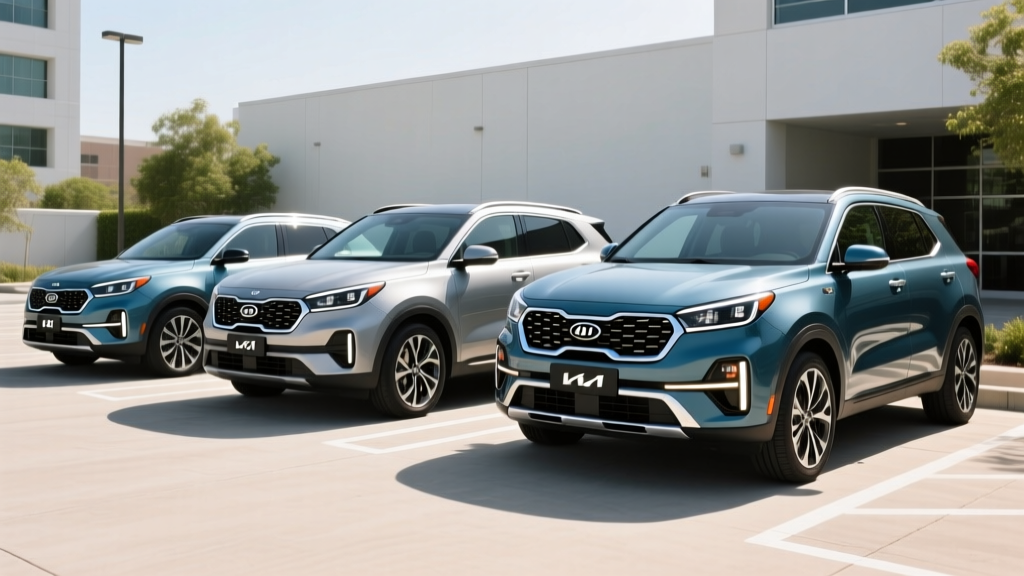
The Kia Sportage occupies a rare space in the compact crossover segment: it offers both a conventional hybrid (HEV) and a plug-in hybrid (PHEV) alongside its gas-only sibling. For buyers weighing electrification without committing to a full battery-electric vehicle, the Sportage lineup presents a genuine decision tree. This guide breaks down every 2026 Kia Sportage hybrid trim — powertrain specs, EPA fuel economy, pricing, tax credit eligibility, and the real-world ownership factors that spec sheets don't reveal.
HEV vs PHEV: Understanding the Two Sportage Hybrids
Conventional Hybrid (HEV)
The Sportage HEV pairs a 1.6-liter turbocharged four-cylinder with a 47.7 kW electric motor and a small 1.49 kWh lithium-ion battery. It never needs to be plugged in — the battery recharges through regenerative braking and the engine. Think of it as a more efficient gas car that drives exactly like one.
Plug-In Hybrid (PHEV)
The Sportage PHEV uses a larger 72.6 kW electric motor and a 13.8 kWh battery pack. It delivers a meaningful electric-only driving range before the gas engine engages. You plug it in to maximize that EV range — but if you forget or skip charging, it simply operates as a conventional hybrid.
The distinction matters enormously for your daily routine, fuel costs, and tax credit eligibility. Let's look at the numbers.
2026 Kia Sportage Hybrid Trim Lineup and Pricing
| Trim | Type | Combined HP | EPA Combined MPG/MPGe | EV Range (PHEV) | MSRP |
|---|---|---|---|---|---|
| LX (HEV) | HEV | 232 hp | 43 MPG combined | N/A | $31,090 |
| EX (HEV) | HEV | 232 hp | 43 MPG combined (FWD) / 38 MPG (AWD) | N/A | $33,590 |
| SX-Prestige (HEV) | HEV | 232 hp | 38 MPG combined (AWD) | N/A | $37,490 |
| X-Line (PHEV) | PHEV | 268 hp | 84 MPGe / 35 MPG gas-only | 34 miles | $40,590 |
| X-Line Prestige (PHEV) | PHEV | 268 hp | 84 MPGe / 35 MPG gas-only | 34 miles | $44,490 |
Source: fueleconomy.gov and Kia America press materials. Prices exclude destination charge (~$1,390).
A few things jump out from this table. First, the HEV trims with front-wheel drive achieve notably better EPA numbers than AWD variants — a 5 MPG combined gap that compounds over years of ownership. Second, the PHEV commands roughly a $7,000–$9,000 premium over the base HEV, which you'll need to offset through fuel savings and tax incentives to justify.
Fuel Economy Deep Dive: EPA vs Real-World MPG
| Trim / Drivetrain | City | Highway | Combined | Real-World Expectation |
|---|---|---|---|---|
| HEV FWD | 42 | 44 | 43 | 38–46 (city-favorable) |
| HEV AWD | 38 | 38 | 38 | 34–41 |
| PHEV (charge-sustaining / gas-only) | 36 | 35 | 35 | 31–37 |
Why Hybrids Often Beat EPA in the City
Hybrid powertrains recover energy during braking and low-speed driving — precisely the conditions that tank a conventional car's city MPG. In stop-and-go urban traffic, the Sportage HEV's electric motor handles initial acceleration, the engine shuts off at stops, and regen captures braking energy. Many owners report exceeding EPA city estimates by 2–4 MPG on urban-heavy commutes.
Highway driving tells the opposite story. At sustained 70–80 mph speeds, the engine does most of the work, and the hybrid system's advantage narrows. Expect real-world highway numbers to land 2–3 MPG below the EPA sticker, especially with roof rails, cargo, or headwinds. Cold weather further reduces efficiency — battery performance drops and cabin heating demands engine runtime, typically costing 3–5 MPG in winter months.
Sportage PHEV: Electric-Only Range and Charging
The Sportage PHEV's 13.8 kWh battery delivers an EPA-rated 34 miles of electric-only range. For context, the average American one-way commute is roughly 16 miles according to FHWA data — meaning many PHEV owners can complete daily round-trip commutes entirely on electricity, with the gas engine reserved for longer trips and weekends.
When the battery depletes, the PHEV seamlessly transitions to hybrid mode, delivering 35 MPG combined as a conventional hybrid. Total combined range (electric + gas tank) exceeds 430 miles.
Charging the PHEV
| Charging Method | Power | Time (0–100%) | Availability |
|---|---|---|---|
| Level 1 (120V household outlet) | ~1.4 kW | ~9–10 hours | Any standard outlet |
| Level 2 (240V home/public) | 7.2 kW | ~2 hours | Home wallbox or public L2 stations |
| DC Fast Charging | Not supported | N/A | N/A |
The Sportage PHEV uses a standard J1772 connector for Level 1 and Level 2 AC charging. Critically, it does not support DC fast charging — a common limitation among PHEVs. This isn't a practical problem: a 13.8 kWh battery fills quickly on Level 2 (roughly two hours), and overnight Level 1 charging works for most daily needs. But it means you cannot top up rapidly on a road trip.
Powertrain and Performance Specifications
Both hybrid systems share Kia's 1.6-liter turbocharged inline-four as their foundation, but the electric augmentation differs substantially:
| Specification | HEV | PHEV |
|---|---|---|
| Engine | 1.6L turbo I-4 | 1.6L turbo I-4 |
| Engine Output | 178 hp / 195 lb-ft | 178 hp / 195 lb-ft |
| Electric Motor | 47.7 kW (64 hp) | 72.6 kW (97 hp) |
| Combined System Output | 232 hp / 258 lb-ft | 268 hp / 258 lb-ft |
| Transmission | 6-speed automatic | 6-speed automatic |
| Drivetrain | FWD or AWD | AWD standard |
| 0–60 mph (est.) | ~7.4 sec | ~6.7 sec |
| Towing Capacity | 2,000 lbs | 2,000 lbs |
| Battery Capacity | 1.49 kWh | 13.8 kWh |
The PHEV's stronger electric motor gives it a meaningful acceleration advantage and a more EV-like feel in daily driving. The HEV is no slouch — 232 hp in a compact crossover is competitive — but the PHEV's instant electric torque makes it noticeably quicker off the line and more refined at low speeds.
Tax Credits and Incentives: What You Can Actually Claim
Federal §30D Tax Credit — PHEV Eligibility
The Sportage PHEV may qualify for a partial federal tax credit under IRS §30D, but eligibility depends on several factors that change frequently:
- Battery sourcing and critical minerals requirements — the vehicle must meet thresholds for North American battery component manufacturing and critical mineral sourcing. Kia's supply chain compliance varies by model year.
- MSRP cap — SUVs must be priced at or below $80,000. All Sportage PHEV trims clear this threshold.
- Buyer income cap — modified adjusted gross income must not exceed $150,000 (single), $225,000 (head of household), or $300,000 (joint filing).
- Point-of-sale transfer — as of 2024, eligible buyers can transfer the credit to the dealer for an immediate price reduction rather than waiting for tax filing.
HEV trims do not qualify for the §30D federal EV credit. Conventional hybrids are not eligible under current IRS rules.
Always verify current eligibility at irs.gov and consult a tax professional before purchasing.
Some states and utilities offer additional rebates for PHEVs — California's CVRP program, Colorado's state credit, and various utility company incentives can stack on top of federal credits. Check your state energy office and local utility for current programs.
Battery Warranty, Reliability, and Long-Term Costs
Kia Hybrid Battery Warranty
Kia covers the Sportage hybrid battery (both HEV and PHEV) with a 10-year / 100,000-mile warranty — one of the longest in the industry. This covers defects and capacity loss below a defined threshold (typically 70% state of charge retention). The broader hybrid system components carry the same coverage.
For comparison, the vehicle's basic warranty is 5 years / 60,000 miles, and the powertrain warranty is 10 years / 100,000 miles.
Real-World Reliability
Kia's hybrid powertrain has proven durable in the Sportage and its platform-mate, the Hyundai Tucson Hybrid. The 1.6T engine and 6-speed automatic are conventional components with established service histories. The most common owner-reported issues involve infotainment software and minor electrical gremlins rather than hybrid-specific failures.
Battery Replacement Cost
Should the hybrid battery require replacement outside of warranty coverage, expect the following approximate costs:
- HEV battery (1.49 kWh): $2,000–$3,500 (parts and labor)
- PHEV battery (13.8 kWh): $5,000–$8,000 (parts and labor)
These figures are based on current dealer pricing and independent hybrid repair shops. In practice, hybrid battery failures before 150,000 miles are uncommon — most degradation manifests as gradual capacity loss rather than sudden failure. The PHEV's larger battery may lose 10–15% of its original EV range over 8–10 years, reducing that 34-mile electric range to roughly 28–30 miles.
Who Should Choose the Sportage HEV, PHEV, or a Full EV?
Choose the Sportage HEV if:
- You want better fuel economy without changing your fueling habits
- You lack access to home or workplace charging
- Your budget is under $38,000
- You drive mostly city miles where hybrid efficiency shines (expect 40+ MPG real-world)
- You want the lowest-complexity path to better fuel economy
Choose the Sportage PHEV if:
- You can install a Level 2 charger at home or have reliable workplace charging
- Your daily round-trip commute is under 35 miles
- You want EV-like daily driving with gas-engine flexibility for road trips
- You qualify for the federal tax credit (which can close the price gap with HEV trims)
- You're not ready to commit to a full EV but want to reduce gas consumption significantly
Choose a Full EV (like the Kia EV6 or Hyundai Ioniq 5) if:
- You have reliable home Level 2 charging
- You want to eliminate gas purchases entirely
- Your daily driving is under 250 miles and you're comfortable planning road-trip charging
- You want maximum federal tax credit eligibility ($7,500 for qualifying vehicles and buyers)
- You prioritize lower long-term maintenance costs (no oil changes, fewer moving parts)
Pros and Cons at a Glance
Pros
- HEV achieves up to 43 MPG combined — class-leading for a turbocharged compact SUV
- PHEV offers 34 miles EV range — enough for most daily commutes
- 10-year / 100,000-mile hybrid battery warranty
- 268 hp PHEV is genuinely quick for the segment
- AWD available or standard across all hybrid trims
- Spacious interior with 39.6 cu ft cargo volume behind rear seats
- Strong safety ratings (IIHS Top Safety Pick eligible)
Cons
- AWD HEV drops to 38 MPG combined — a meaningful penalty vs FWD
- PHEV does not support DC fast charging
- PHEV premium of $7,000+ over base HEV requires years of fuel savings to recoup
- HEV trims do not qualify for any federal tax credit
- Turbocharged engine requires premium fuel for maximum output (regular is acceptable with slight power reduction)
- Infotainment system can be laggy compared to rivals
Frequently Asked Questions
How many MPG does the Kia Sportage Hybrid get?
The 2026 Sportage HEV with front-wheel drive achieves an EPA-rated 42 city / 44 highway / 43 combined MPG. AWD models drop to 38 combined. In real-world city-heavy driving, many owners report 40–46 MPG thanks to the hybrid system's regenerative braking advantage in stop-and-go traffic. Highway-heavy driving typically yields 35–40 MPG.
How far can the Sportage PHEV go on electric only?
The EPA rates the Sportage PHEV at 34 miles of electric-only range. Real-world results vary: gentle city driving in mild weather can stretch this to 36–38 miles, while highway speeds, cold temperatures, and aggressive acceleration may reduce it to 26–30 miles. Once the battery depletes, the vehicle operates as a conventional hybrid at 35 MPG combined.
Does the Kia Sportage Hybrid qualify for a tax credit?
The Sportage PHEV may qualify for a partial or full federal §30D tax credit (up to $7,500), depending on battery sourcing compliance, buyer income limits, and MSRP caps. The conventional HEV trims do not qualify for any federal EV tax credit. State and utility incentives may apply to both — check irs.gov and your state energy office for current eligibility.
Is the Sportage Hybrid reliable, and what does battery replacement cost?
Kia's hybrid system has a strong reliability track record across the Sportage and Tucson platforms. The hybrid battery is warrantied for 10 years / 100,000 miles. Out-of-warranty replacement runs approximately $2,000–$3,500 for the HEV battery and $5,000–$8,000 for the larger PHEV battery. Most hybrid batteries last 150,000+ miles with gradual capacity loss rather than sudden failure.
Do I need to plug in the Sportage Hybrid?
Only the PHEV version benefits from plugging in. The conventional HEV never needs to be plugged in — it charges its small battery through regenerative braking and the gasoline engine. If you buy the PHEV but don't plug it in regularly, it will still function as a hybrid at 35 MPG, but you'll miss the primary benefit of the larger battery and electric-only driving.
How long does it take to charge the Sportage PHEV?
On a standard 120V household outlet (Level 1), a full charge takes roughly 9–10 hours. On a 240V Level 2 charger (home wallbox or public station), it takes approximately 2 hours. The Sportage PHEV does not support DC fast charging.
Which Sportage hybrid trim offers the best value?
For most buyers, the EX HEV ($33,590) hits the sweet spot: it includes AWD availability, a strong feature set (dual 12.3-inch displays, heated front seats, smart cruise control), and achieves 43 MPG in FWD form. The PHEV makes financial sense primarily if you qualify for the federal tax credit, have home charging, and your commute fits within the 34-mile EV range — conditions that can bring the effective price close to the HEV while dramatically cutting fuel costs.
Fuel economy data sourced from fueleconomy.gov. Tax credit information per IRS §30D guidelines. Safety ratings from IIHS and NHTSA. All pricing and specifications reflect 2026 model year as published by Kia America and are subject to change.