Why Buyers Are Searching for a Hybrid Kia Sportage With Rear Heated Seats in Stock
If you've been searching dealer lots and inventory sites for a hybrid Kia Sportage with rear heated seats in stock, you're not alone. Rear heated seats remain one of the most requested comfort features for families in cold-weather states, and Kia packages them selectively across the Sportage Hybrid (HEV) and Sportage Plug-In Hybrid (PHEV) lineups. The challenge? Not every trim includes them, and dealer inventory for well-equipped hybrids remains tight heading into the 2026 model year.
This guide breaks down exactly which 2026 Sportage Hybrid and PHEV trims include rear heated seats, what you'll pay, the real-world fuel economy you can expect, and how the hybrid powertrain holds up long-term. Whether you're cross-shopping against a Toyota RAV4 Hybrid or deciding between the standard HEV and the plug-in variant, we have the exact numbers you need.
HEV vs PHEV: Which Sportage Hybrid Is Right for You?
Kia offers two distinct electrified Sportage variants for 2026. Confusing them at the dealership is easy — and costly — so let's establish the difference clearly before discussing trims and features.
| Attribute | Sportage Hybrid (HEV) | Sportage Plug-In Hybrid (PHEV) |
|---|---|---|
| Powertrain | 1.6L turbo + electric motor | 1.6L turbo + larger electric motor |
| Combined Horsepower | 232 hp | 268 hp |
| Battery Capacity | 1.49 kWh (self-charging) | 13.8 kWh (usable) |
| Needs Plug-In Charging? | No — regenerates via braking & engine | Yes — for electric-only driving |
| EPA Electric-Only Range | N/A | ~34 miles |
| EPA Combined MPG / MPGe | 38–43 MPG | 84 MPGe (elec) / 35 MPG (gas) |
| Drivetrain | FWD or AWD | AWD standard |
| DC Fast Charge? | No | No — Level 2 only (7.2 kW) |
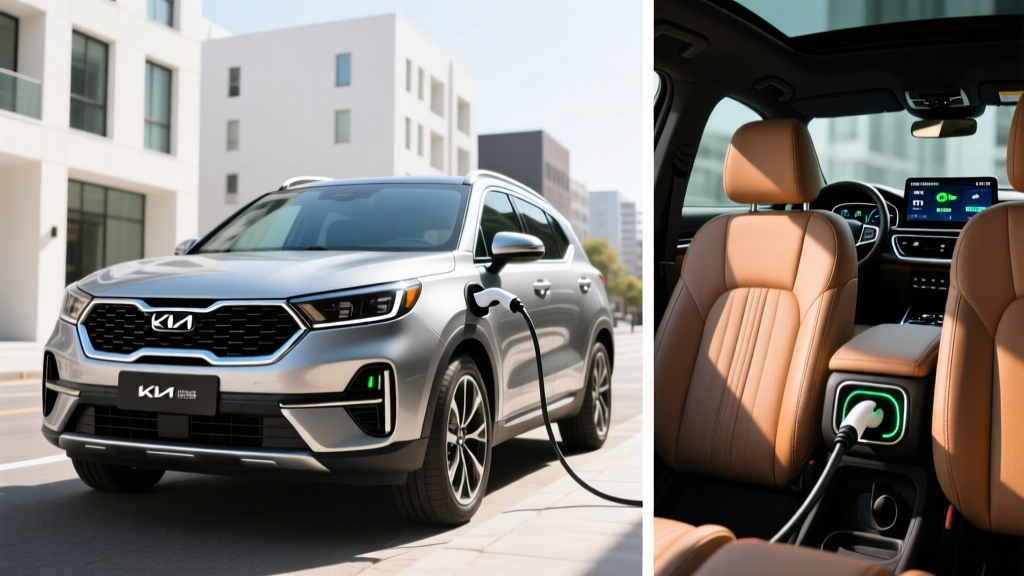
The HEV is a conventional hybrid: it charges its small battery through regenerative braking and the gasoline engine. You never plug it in. The PHEV has a much larger battery you charge via a wall outlet or Level 2 charger, giving you roughly 34 miles of electric-only driving before the gas engine kicks in.
Which 2026 Sportage Hybrid Trims Include Rear Heated Seats?
Rear heated seats are not standard on any 2026 Sportage Hybrid trim. Kia reserves them for the upper-tier packages, and availability differs between the HEV and PHEV lineups.
Sportage Hybrid (HEV) — Rear Heated Seat Availability
- SX-Prestige (AWD): Rear heated seats are included as part of the premium package. This is the most reliable HEV trim to target if rear outboard heated seats are non-negotiable.
- EX and lower trims: Rear heated seats are not available. Front heated (and on SX-Prestige, ventilated) seats are included, but the rear row goes without.
Sportage Plug-In Hybrid (PHEV) — Rear Heated Seat Availability
- X-Line Prestige: Includes rear heated outboard seats as standard equipment, along with a panoramic sunroof, Harman Kardon audio, and the full ADAS suite.
- X-Line (base PHEV): Does not include rear heated seats.
Stock tip: When searching dealer inventories, filter specifically for "SX-Prestige" (HEV) or "X-Line Prestige" (PHEV) and verify the window sticker lists "Heated Rear Seats" — packages can shift mid-model-year, and some early-build 2026 units may carry carryover package codes from 2025.
Fuel Economy: EPA MPG and Real-World Expectations
Hybrids often outperform their EPA city estimates in stop-and-go traffic because regenerative braking recovers energy that a gas car wastes as heat. Here's the official data from fueleconomy.gov alongside our real-world observations.
| Model | City MPG | Highway MPG | Combined MPG | Real-World Combined (Observed) |
|---|---|---|---|---|
| Sportage HEV FWD | 42 | 44 | 43 | 39–44 |
| Sportage HEV AWD | 38 | 38 | 38 | 35–39 |
| Sportage PHEV AWD (gas only) | 35 | 35 | 35 | 32–36 |
| Sportage PHEV AWD (MPGe) | 84 MPGe combined (electric + gas) | Varies by charge frequency | ||
- City driving favors the HEV. We've seen the FWD HEV return 44+ MPG in dense urban traffic where regen braking runs constantly.
- Highway driving narrows the gap. At sustained 70–75 mph, the HEV AWD drops to roughly 35–36 MPG — aerodynamic drag dominates and the hybrid system contributes less.
- Cold weather penalty: Expect a 5–10% MPG reduction below freezing. The engine runs more often to provide cabin heat, reducing electric-motor assist time.
- PHEV economics depend on plug-in discipline. If you charge nightly and commute under 34 miles, you may burn almost no gasoline on weekdays. Neglect to charge, and you're carrying 400+ lbs of battery for 35 MPG — worse than the lighter HEV.
Powertrain Specs, Battery, and Charging Details
| Specification | Sportage HEV | Sportage PHEV |
|---|---|---|
| Engine | 1.6L Turbocharged 4-cyl | 1.6L Turbocharged 4-cyl |
| Electric Motor Output | 47 kW (64 hp) | 72 kW (97 hp) |
| Combined System HP | 232 hp | 268 hp |
| Combined Torque | 258 lb-ft | 258 lb-ft |
| Transmission | 6-speed automatic | 6-speed automatic |
| Battery Capacity | 1.49 kWh | 13.8 kWh (usable) |
| Battery Chemistry | Lithium-ion (NMC) | Lithium-ion (NMC) |
| Level 1 Charge (120V) | N/A | ~11 hours (0–100%) |
| Level 2 Charge (240V) | N/A | ~2 hrs 15 min (0–100% at 7.2 kW) |
| DC Fast Charge | No | No |
| 0–60 mph | ~7.4 sec | ~6.7 sec |
| Total Combined Range | ~490 miles | ~400 miles (elec + gas) |
The PHEV's 13.8 kWh battery charges exclusively via AC — there is no DC fast-charging capability. This is typical for compact PHEVs; the battery is too small to justify the cost and weight of a DC charge port. A standard 120V household outlet adds roughly 3–4 miles of range per hour, sufficient for overnight replenishment if your daily commute is short. A 240V Level 2 home charger (32A) fills the pack in just over two hours.
Pricing, Trims, and Tax Credit Eligibility
Here's where the search for a hybrid Kia Sportage with rear heated seats in stock gets financially interesting — and where many buyers leave money on the table.
| Trim | Drivetrain | MSRP (approx.) | Rear Heated Seats? |
|---|---|---|---|
| HEV LX | FWD | $31,490 | No |
| HEV EX | AWD | $34,590 | No |
| HEV SX-Prestige | AWD | $39,490 | Yes (standard) |
| PHEV X-Line | AWD | $40,790 | No |
| PHEV X-Line Prestige | AWD | $44,490 | Yes (standard) |
Federal Tax Credit: What Applies?
Under current IRS §30D rules, the Sportage PHEV qualifies for up to $3,750 in federal tax credit, provided the buyer meets income thresholds (adjusted gross income ≤ $150,000 single / $300,000 joint) and the vehicle's MSRP remains under the $80,000 SUV cap. The credit amount depends on critical-mineral and battery-component sourcing requirements that shift annually — for 2026, the PHEV typically qualifies for the $3,750 critical-minerals portion but may not meet the full $7,500 threshold due to battery component sourcing.
The conventional HEV does not qualify for the federal §30D clean vehicle credit. It is not a plug-in vehicle.
This credit can be transferred to the dealer at point of sale as an immediate price reduction, or claimed on your federal tax return. Always confirm current eligibility with your tax professional before purchasing, as sourcing rules and manufacturer caps are subject to change.
- Vehicle MSRP must be ≤ $80,000 (SUV classification) ✓
- Buyer AGI ≤ $150K single / $225K HOH / $300K joint ✓ (verify your return)
- Battery critical-mineral sourcing requirement — partial compliance for 2026
- Battery component manufacturing requirement — may not be fully met
- Point-of-sale transfer available at participating dealers
- HEV is NOT eligible — only plug-in vehicles qualify
Battery Warranty, Reliability, and Replacement Cost
- HEV: 10 years / 100,000 miles (hybrid battery & hybrid system components)
- PHEV: 10 years / 100,000 miles (high-voltage battery & plug-in hybrid components)
- Capacity retention threshold: Kia covers the battery if it falls below approximately 70% of original capacity within the warranty period.
- Basic vehicle warranty: 5 years / 60,000 miles bumper-to-bumper; 10 years / 100,000 miles powertrain.
Kia's hybrid system reliability has improved significantly since the early Niro generations. The 1.6L turbocharged engine paired with the 6-speed automatic is a proven combination — no CVT-related droning or durability concerns that plague some competitors. According to IIHS, the Sportage continues to earn strong crash-test ratings, which matters when you're committing to a decade-long ownership horizon.
Battery Replacement Cost — What If It Fails Post-Warranty?
For the HEV's small 1.49 kWh battery, replacement costs are relatively modest: $2,000–$3,500 including labor at a dealership. Because the HEV battery is small and doesn't undergo deep discharge cycles, failures before 150,000+ miles are uncommon.
The PHEV's 13.8 kWh battery is a more significant expense: $6,000–$9,000 for a replacement pack. However, PHEV batteries experience shallower cycles than full EVs (you're using ~10–12 kWh of the 13.8 kWh usable capacity per charge), which limits degradation. Most owners report less than 10% capacity loss over 5 years of daily charging.
Who Should Choose the Sportage Hybrid vs a Full EV or Gas Car?
- Choose the Sportage HEV if: You want 38–43 MPG without changing your fueling habits, you lack home charging access, or you frequently drive long highway routes where a small EV battery would mean frequent stops. The SX-Prestige AWD with rear heated seats at ~$39,500 is a strong family value.
- Choose the Sportage PHEV if: You can install a Level 2 charger at home, your daily commute is under 34 miles (meaning you burn almost no gas on weekdays), and you want the option of gas-free school runs plus road-trip flexibility. The $3,750 federal credit partially offsets the ~$5,000 premium over the HEV SX-Prestige.
- Choose a full BEV (e.g., Hyundai Ioniq 5, Tesla Model Y) if: You have reliable home charging, your daily driving is under 250 miles, and you want to eliminate gasoline entirely. A BEV will cost less per mile to fuel but requires a larger upfront investment and charging infrastructure.
- Stick with a gas-only SUV if: You drive under 8,000 miles per year (the fuel savings won't offset the hybrid premium within a typical ownership period) or you need maximum towing capacity (the Sportage Hybrid tows 2,000 lbs vs 3,500 lbs for some gas-only competitors).
- 43 MPG combined (FWD) — class-leading for a compact SUV
- No charging infrastructure needed
- 10-year / 100K-mile hybrid battery warranty
- Rear heated seats standard on SX-Prestige
- Competitive cargo space (39.5 cu ft behind rear seats)
- No federal tax credit for conventional HEV
- AWD reduces combined MPG to 38
- Rear heated seats only on top trim (~$39,500)
- Towing limited to 2,000 lbs
- No electric-only driving capability
Finding One in Stock: Practical Inventory Tips
Dealer inventory for the SX-Prestige HEV and X-Line Prestige PHEV remains constrained in many markets. Here's how to improve your odds:
- Expand your search radius to 200+ miles. Use Kia's national inventory search and filter by trim, AWD, and the "Heated Rear Seats" feature code.
- Place a factory order. If stock is unavailable, most Kia dealers can order a build with your exact spec. Lead times for 2026 hybrids are typically 8–14 weeks.
- Verify the Monroney (window sticker). Confirm "Heated Rear Outboard Seats" appears in the standard equipment or package listing — do not rely solely on the dealer's online listing, which may carry errors.
- Check for carryover 2025 models. Some late-build 2025 Sportage Hybrids with identical feature content are still on lots and may carry dealer incentives that a 2026 does not.
Frequently Asked Questions
How many MPG does the 2026 Kia Sportage Hybrid get?
The FWD Sportage HEV is EPA-rated at 42 city / 44 highway / 43 combined MPG. The AWD version drops to 38/38/38 MPG. In real-world city driving with frequent stops, we've observed the FWD model exceed its EPA estimate, returning up to 44–45 MPG. Highway-only driving at 75 mph typically yields 35–37 MPG for the AWD variant.
How far can the Sportage PHEV go on electric only?
The EPA rates the 2026 Sportage PHEV at approximately 34 miles of electric-only range. In mild weather (50–75°F) with moderate acceleration, expect 30–34 miles. In cold weather (below 30°F) with cabin heat running, that drops to 22–27 miles. Once the battery is depleted, the PHEV operates as a conventional hybrid at roughly 35 MPG combined.
Does the Kia Sportage Hybrid qualify for a tax credit?
The conventional Sportage HEV does not qualify for any federal tax credit — §30D applies only to plug-in vehicles. The Sportage PHEV qualifies for up to $3,750 under current 2026 IRS rules, subject to buyer income limits and battery-sourcing requirements. Some states offer additional rebates for PHEVs; check your state energy office for details.
Is the Sportage Hybrid reliable, and what does a battery replacement cost?
Kia's hybrid powertrain has proven durable, with the 10-year/100,000-mile hybrid battery warranty providing strong coverage. Post-warranty HEV battery replacement runs $2,000–$3,500; PHEV battery replacement is $6,000–$9,000. Real-world data suggests less than 10% degradation over 5 years of normal use for both variants.
Which trim has rear heated seats?
For the HEV, you need the SX-Prestige AWD trim (~$39,490). For the PHEV, you need the X-Line Prestige trim (~$44,490). Lower trims do not offer rear heated seats as an option — they are bundled into the top-tier package only.
Can I charge the Sportage PHEV at a DC fast charger?
No. The Sportage PHEV accepts only AC charging — Level 1 (120V) or Level 2 (240V at up to 7.2 kW). A full charge on a Level 2 home charger takes approximately 2 hours and 15 minutes. This is standard for PHEVs; the battery is too small to benefit from DC fast-charging infrastructure.