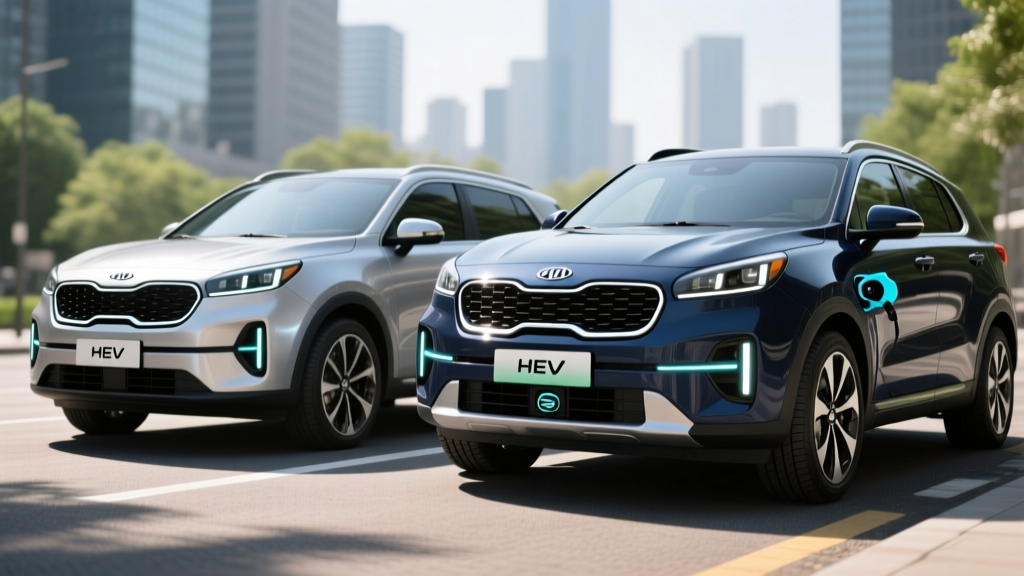
If you're researching Kia Sportage hybrid reviews, you've likely discovered that Kia offers two very different electrified versions of its compact SUV: a conventional hybrid (HEV) and a plug-in hybrid (PHEV). Both share the same 1.6-liter turbocharged four-cylinder foundation, but the driving experience, fuel economy, and ownership math diverge significantly between them. This guide breaks down exact EPA figures, real-world expectations, powertrain specs, and 2026 pricing so you can determine which Sportage — if either — fits your commute and budget.
HEV vs PHEV: Which Sportage Hybrid Is Which?
Before diving into numbers, it's essential to understand the fundamental difference between the two powertrains, because they serve different buyers entirely.
| Feature | Sportage Hybrid (HEV) | Sportage Plug-In Hybrid (PHEV) |
|---|---|---|
| Plugs in? | No — self-charging via engine and regen | Yes — has a charge port and larger battery |
| Battery size | 1.49 kWh (small buffer) | 13.7 kWh usable |
| Electric-only driving | Brief low-speed assist only | Up to 34 miles (EPA) |
| Charging hardware needed | None | Level 2 home charger recommended |
| Drivetrain | AWD standard | AWD standard |
| Best for | Drivers who want better MPG without lifestyle change | Drivers with home charging and short commutes |
The HEV is a drop-in replacement for a gas car: you fill it with gas, and the hybrid system recovers energy during braking to boost efficiency. The PHEV requires access to a plug — ideally a Level 2 (240V) home charger — to unlock its electric-only range advantage. If you can't charge at home or work, the PHEV's larger battery becomes dead weight, and you'll get worse fuel economy than the lighter HEV.
Fuel Economy: EPA MPG and Real-World Results
Fuel economy is the headline number for any hybrid buyer. Here's how both Sportage variants stack up according to EPA data from fueleconomy.gov:
| Model | City MPG | Highway MPG | Combined MPG | PHEV Electric MPGe |
|---|---|---|---|---|
| 2026 Sportage Hybrid AWD | 38 | 38 | 38 | N/A |
| 2026 Sportage PHEV AWD | 35 (gas-only) | 35 (gas-only) | 35 (gas-only) | 84 MPGe |
Real-World MPG vs. EPA Sticker
Hybrids typically exceed their EPA city estimates in stop-and-go traffic because regenerative braking recovers more energy at lower speeds. In our experience and owner reports, the Sportage HEV routinely delivers 40–42 MPG in city driving, slightly above its 38 MPG EPA city rating. Highway driving at 75+ mph tends to return 34–36 MPG, below the EPA highway figure, because aerodynamic drag overwhelms the hybrid system's low-speed advantage.
For the PHEV, real-world electric-only range depends heavily on temperature and terrain. The EPA rates it at 34 miles on battery alone, but expect 28–32 miles in mild weather and potentially 22–26 miles in freezing conditions due to cabin heating demands and reduced battery efficiency. Once the battery depletes, the PHEV operates as a conventional hybrid at roughly 35 MPG combined — slightly lower than the HEV due to the PHEV's ~300 lb weight penalty from the larger battery pack.
Powertrain Specs: Horsepower, Engine, and Motors
| Specification | Sportage Hybrid (HEV) | Sportage PHEV |
|---|---|---|
| Engine | 1.6L turbo 4-cylinder | 1.6L turbo 4-cylinder |
| Electric motor | 47.7 kW (64 hp) | 72 kW (97 hp) |
| Combined system output | 226 hp / 258 lb-ft | 261 hp / 258 lb-ft |
| Transmission | 6-speed automatic | 6-speed automatic |
| 0–60 mph | ~7.1 seconds | ~6.7 seconds |
| Drivetrain | AWD | AWD |
| Towing capacity | 2,000 lbs | 2,000 lbs |
The PHEV's more powerful electric motor gives it a noticeable acceleration advantage, particularly in the 0–30 mph range where electric torque delivery is instant. Both models use a traditional 6-speed automatic rather than the CVT or e-CVT found in competitors like the Toyota RAV4 Hybrid, which means shifts are perceptible but the powertrain feels more natural to drivers accustomed to conventional transmissions.
PHEV Electric Range, Battery, and Charging
The Sportage PHEV carries a 13.7 kWh usable battery (lithium-ion polymer, NMC chemistry), which powers the vehicle for an EPA-rated 34 miles before the gas engine takes over. Total combined range — electric plus a full 11.1-gallon fuel tank — exceeds 430 miles.
Charging Times and DC Fast Charging
Here's what charging looks like for the PHEV:
- Level 1 (120V household outlet): ~11 hours from empty to full using the included portable cord. Practical only for overnight topping up.
- Level 2 (240V, 32A): ~3.5 hours from empty to full. This is the recommended home charging setup.
- DC fast charging: The 2026 Sportage PHEV does not support DC fast charging. This is common among PHEVs — the relatively small battery doesn't justify the added cost and weight of DC hardware.
Battery Warranty: Kia covers the hybrid battery in both the HEV and PHEV for 10 years / 100,000 miles (original owner). For subsequent owners, coverage drops to 10 years / 100,000 miles from the original in-service date in most states, or the federal minimum of 8 years / 80,000 miles. The warranty covers battery capacity loss below approximately 70% of original capacity, as well as defects.
Do You Need a Home Charger for the PHEV?
If you can install a Level 2 charger at home, the PHEV makes strong economic sense for commutes under 34 miles — you'll drive most days without burning a drop of gasoline. A basic Level 2 installation typically costs $500–$1,500 for equipment and electrician labor, assuming your electrical panel has capacity. If you live in an apartment without charging access or rely solely on street parking, the HEV is the clear choice — it requires zero infrastructure changes.
2026 Pricing and Tax Credit Eligibility
Here's where the math gets interesting — and where many buyers make mistakes by assuming all hybrids qualify for federal incentives.
MSRP by Trim (2026 Model Year)
| Trim | Sportage Hybrid (HEV) | Sportage PHEV |
|---|---|---|
| LX | $30,090 | — |
| EX | $32,590 | — |
| SX-Prestige | $37,490 | $40,590 |
| X-Line | $34,590 | $42,090 |
| X-Line Prestige | — | $44,590 |
Federal Tax Credit: PHEV Qualifies, HEV Does Not
Under current IRS §30D rules, only the Sportage PHEV is potentially eligible for the federal clean vehicle credit — and even then, eligibility is not guaranteed. Here's what you need to know:
- Credit amount: Up to $7,500, split between critical minerals ($3,750) and battery components ($3,750). The PHEV qualifies for at least a portion depending on current sourcing requirements.
- MSRP cap: SUVs must have an MSRP at or below $80,000. All Sportage PHEV trims clear this threshold.
- Income cap: Modified AGI must not exceed $150,000 (single), $225,000 (head of household), or $300,000 (joint).
- Point-of-sale transfer: You can transfer the credit to the dealer at purchase, reducing your out-of-pocket cost immediately rather than waiting for tax filing.
- Battery sourcing: The credit amount depends on where battery minerals and components are sourced. These requirements tighten annually. Verify current-year eligibility on IRS.gov or with your dealer before purchase.
The Sportage Hybrid (HEV) does not qualify for the §30D federal credit because it lacks the minimum battery capacity and plug-in capability required by the statute. Some states offer separate hybrid rebates — check your state energy office or AFDC state incentive database for local programs.
Reliability, Battery Longevity, and Replacement Cost
Kia's hybrid powertrain has proven dependable in recent model years, with no widespread battery failure patterns reported for the Sportage line. The 1.6L turbo engine carries over from the Hyundai-Kia Smartstream family, which has been in production since 2020 with incremental refinements.
What Happens When the Hybrid Battery Degrades?
Hybrid batteries degrade slowly — expect 10–15% capacity loss over 10 years under normal use. For the HEV, this is largely irrelevant because the battery is small and serves as a buffer, not a primary energy source. For the PHEV, 15% degradation means your electric-only range drops from 34 miles to roughly 29 miles — still useful for most commutes.
If the battery fails outside warranty, replacement costs typically range from $2,500 to $4,500 including labor for the HEV pack, and $5,000 to $8,000 for the larger PHEV pack. These figures are based on current dealer pricing and may vary. Third-party hybrid battery refurbishers offer lower-cost alternatives, typically $1,500–$3,000, though this may void remaining warranty coverage.
Sportage Hybrid (HEV) Pros
- 38 MPG combined with no plug-in requirement
- Strong 10yr/100k-mile battery warranty
- AWD standard across all trims
- Competitive starting price under $31K
- Spacious cargo area (39.6 cu ft behind rear seats)
Sportage Hybrid (HEV) Cons
- No federal tax credit eligibility
- Highway MPG drops below EPA at sustained 75+ mph
- Turbo engine requires premium fuel for max output
- 6-speed auto less refined than competitor e-CVTs at low speed
Sportage PHEV Pros
- 34 miles electric-only covers most commutes
- 261 hp — quickest Sportage variant
- Potential $7,500 federal credit (with caveats)
- 430+ mile total range eliminates range anxiety
Sportage PHEV Cons
- Requires home charging to realize value
- No DC fast charging capability
- ~300 lbs heavier than HEV, reducing gas-only MPG
- $10K+ price premium over HEV at equivalent trims
Sportage Hybrid vs. PHEV vs. Full EV: Which Fits You?
Choose the Sportage HEV if: You want better fuel economy without changing your routine. No plug, no app, no charging — just fill up less often. Ideal if you lack home charging access or drive unpredictable routes.
Choose the Sportage PHEV if: You can charge at home, your daily commute is under 34 miles round-trip, and you want to minimize gasoline use without committing to a full EV. The federal tax credit can narrow the price gap significantly if you qualify.
Choose a full EV (e.g., Kia EV6 or Hyundai Ioniq 5) if: You have reliable home charging, drive under 250 miles daily, want zero tailpipe emissions, and are ready to leave gasoline behind entirely. A full EV eliminates oil changes, has fewer moving parts, and offers dramatically lower per-mile fuel costs — but requires more upfront charging infrastructure planning.
Frequently Asked Questions
How many MPG does the Kia Sportage Hybrid get?
The 2026 Sportage Hybrid AWD is EPA-rated at 38 MPG city, 38 highway, and 38 combined. Real-world city driving often returns 40–42 MPG thanks to regenerative braking, while sustained highway driving at 75+ mph typically yields 34–36 MPG.
How far can the Sportage PHEV go on electric only?
The EPA rates the 2026 Sportage PHEV at 34 miles of electric-only range. In practice, expect 28–32 miles in mild weather and 22–26 miles in cold weather (below 32°F) due to cabin heating loads and reduced battery efficiency.
Does the Kia Sportage Hybrid qualify for a tax credit?
The conventional Sportage Hybrid (HEV) does not qualify for the federal §30D clean vehicle credit. The Sportage PHEV may qualify for up to $7,500, subject to buyer income limits, battery sourcing requirements, and MSRP caps. Always verify current eligibility at IRS.gov before purchasing.
Is the Sportage Hybrid reliable? What about battery replacement?
Kia's hybrid system has shown strong reliability since the current generation launched. The hybrid battery is covered by a 10-year/100,000-mile warranty. Out-of-warranty replacement costs range from $2,500–$4,500 for the HEV and $5,000–$8,000 for the PHEV, though most batteries last well beyond the warranty period with gradual capacity loss rather than sudden failure.
Do I need to plug in the Sportage Hybrid?
No. The conventional Sportage Hybrid (HEV) charges its small battery through regenerative braking and the gasoline engine. You never plug it in. Only the Sportage PHEV requires plugging in to access its electric-only driving range.
What's the difference in maintenance between the HEV and PHEV?
Both require standard maintenance (oil changes, brake fluid, tire rotation). The PHEV may see slightly longer brake pad life due to more aggressive regenerative braking during electric-only driving. Neither has a traditional alternator or starter motor, reducing common failure points found in gas-only vehicles.
Whether you land on the HEV or PHEV depends almost entirely on your charging access and commute pattern. The HEV is the pragmatic, no-compromise choice for apartment dwellers and road-trippers. The PHEV rewards homeowners with short commutes with near-EV daily driving and the safety net of a gas engine for longer trips. Either way, you're looking at one of the more efficient and well-equipped compact SUVs in the segment — just make sure you're comparing the right variant to your actual needs.