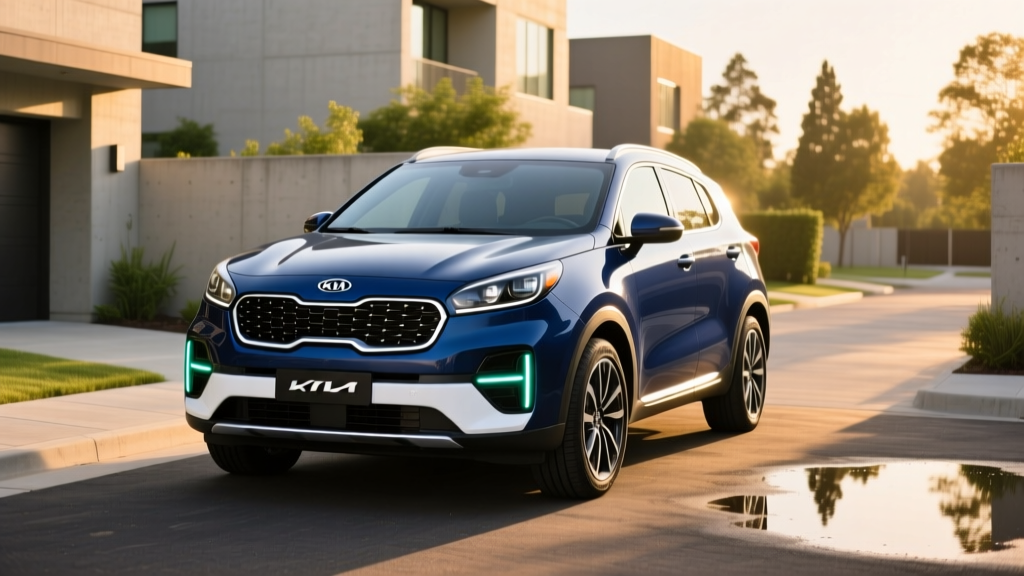
The 2026 Kia Sportage Hybrid SX Prestige sits at the top of Kia's compact hybrid crossover lineup, blending premium features with a powertrain that squeezes serious efficiency out of every gallon. For buyers who want electrified savings without plugging in, this conventional hybrid (HEV) delivers strong city mileage, standard all-wheel drive, and a tech-laden cabin — all without the charging infrastructure demands of a full EV or plug-in hybrid.
We've broken down every number that matters: EPA fuel economy, real-world MPG expectations, powertrain output, pricing, warranty coverage, and how the Sportage Hybrid stacks up against its PHEV sibling and full-electric alternatives. If you're cross-shopping the RAV4 Hybrid, Tucson Hybrid, or CR-V Hybrid, this is the spec-driven deep dive you need.
2026 Kia Sportage Hybrid SX Prestige: Core Specifications
| Specification | Detail |
|---|---|
| Powertrain | 1.6L turbocharged 4-cylinder + electric motor (HEV) |
| Combined Horsepower | 232 HP |
| Combined Torque | 258 lb-ft |
| Transmission | 6-speed automatic |
| Drivetrain | AWD (standard on SX Prestige) |
| EPA Fuel Economy (City/Hwy/Combined) | 38 / 38 / 38 MPG (AWD) |
| Battery Type | Lithium-ion polymer (~1.5 kWh, self-charging HEV) |
| Plug-In Required? | No — regenerative braking and engine recharge the battery |
| 0-60 MPH | ~7.4 seconds (estimated) |
| Cargo Volume (behind rear seats) | 39.5 cu ft |
| Base MSRP (SX Prestige AWD) | ~$40,590 (2026 estimate, incl. destination) |
| Federal Tax Credit (§30D) | Not eligible — conventional HEVs do not qualify |
| Hybrid Battery Warranty | 10 years / 100,000 miles |
| Powertrain Warranty | 10 years / 100,000 miles |
Fuel Economy: EPA Ratings vs. Real-World MPG
The 2026 Sportage Hybrid AWD carries an EPA rating of 38 MPG city, 38 MPG highway, and 38 MPG combined, according to fueleconomy.gov. The front-wheel-drive variant achieves slightly higher figures at approximately 42/44/43 MPG, but the SX Prestige trim comes exclusively with AWD.
In mixed driving, owners of the current-generation Sportage Hybrid consistently report 35–40 MPG combined. City-heavy routes with frequent stops tend to push mileage toward the high 30s or low 40s — hybrids thrive in stop-and-go traffic where regenerative braking recaptures energy. Sustained highway driving at 75+ MPH typically drops efficiency to 33–36 MPG due to increased aerodynamic drag and reduced regenerative opportunities.
In cold weather (below 30°F), expect a 5–10% reduction in fuel economy as the engine runs more frequently to maintain cabin heat and battery temperature.
| Driving Scenario | Expected MPG (AWD) |
|---|---|
| City (stop-and-go, under 40 MPH) | 38–42 MPG |
| Highway (65–75 MPH, flat terrain) | 33–36 MPG |
| Mixed Commute (50/50 city/highway) | 36–39 MPG |
| Cold Weather (below 30°F, mixed) | 32–36 MPG |
| Mountain/Towing | 26–30 MPG |
HEV vs. PHEV: Understanding the Sportage Hybrid Lineup
Kia offers the Sportage in three powertrain flavors for 2026: a conventional gas model, the Sportage Hybrid (HEV), and the Sportage Plug-In Hybrid (PHEV). The distinction matters enormously for your wallet and daily routine.
Sportage Hybrid (HEV)
- No plug-in required — the battery charges via regenerative braking and the engine
- ~1.5 kWh battery (small, lightweight)
- 38 MPG combined (AWD)
- Total range: ~500+ miles per tank
- No electric-only driving beyond very low-speed crawling
- No federal tax credit eligibility
Sportage Plug-In Hybrid (PHEV)
- Plugs in to charge — Level 1 (120V) or Level 2 (240V)
- ~13.8 kWh battery (larger, heavier)
- 34 miles electric-only range (EPA)
- 84 MPGe combined (electric + gas)
- 435 miles total range (electric + gas tank)
- May qualify for partial federal/state credits (check IRS §30D rules)
Bottom line: The HEV is the simpler, lower-cost choice for drivers who want better fuel economy without changing their habits. The PHEV makes sense if you have home charging access, a short commute (under 34 miles round-trip), and want to drive mostly on electricity on weekdays while keeping gas-engine range for road trips.
Powertrain Deep Dive: 232 HP from a Turbo Hybrid
The Sportage Hybrid pairs a 1.6-liter turbocharged gasoline direct-injection (T-GDI) four-cylinder with a 47.7 kW (64 HP) electric motor integrated into the transmission housing. Combined system output is 232 horsepower and 258 lb-ft of torque, routed through a conventional 6-speed automatic transmission rather than the CVT found in many competitors.
This matters for driving feel. The 6-speed delivers predictable, stepped gear changes that feel more natural than the rubber-band sensation of a CVT under hard acceleration. The turbo engine provides strong low-end pull, and the electric motor fills in torque gaps during gear shifts. The result is a 0-60 MPH time in the mid-7-second range — brisk for a compact hybrid crossover and noticeably quicker than the Toyota RAV4 Hybrid's ~7.6 seconds.
The AWD system uses an electrically controlled coupling to send torque rearward when slip is detected or when the system anticipates traction needs. It's not a dedicated rear motor setup (that's the PHEV), but it handles rain, snow, and light off-road duty competently.
SX Prestige Trim: What You Get at the Top
The SX Prestige is the range-topping Sportage Hybrid trim, and for 2026 it carries a premium over the mid-level EX and X-Line trims. Here's what justifies the price bump:
- Panoramic curved display: Dual 12.3-inch screens (instrument cluster + infotainment) in a single curved housing
- Harman Kardon premium audio: 8-speaker system with external amplifier
- Ventilated front seats and heated rear seats
- Leather-trimmed upholstery with driver seat memory
- Head-up display (HUD): Windshield-projected speed and navigation
- Highway Driving Assist 2 (HDA-2): Adaptive cruise with stop-and-go, lane centering, and curve speed reduction — a robust SAE Level 2 driver-assistance suite
- Remote Smart Parking Assist: Move the vehicle in/out of tight spots using the key fob
- Surround View Monitor with 360-degree camera
- Wireless Apple CarPlay / Android Auto
- LED projection headlights with dynamic bending light
The SX Prestige positions the Sportage Hybrid as a near-luxury compact crossover at a mainstream price. Competitors like the RAV4 Hybrid Limited and Tucson Hybrid Limited offer similar feature sets, but Kia's warranty coverage (detailed below) and cabin design give it a distinct edge in perceived value.
Battery Warranty, Reliability, and Replacement Cost
Reliability outlook: Kia's hybrid powertrain has been in production since the Niro's 2017 debut, and the 1.6L T-GDI hybrid system is now in its second generation within the Sportage. Early-model-year issues tend to center on software and infotainment rather than powertrain durability. The conventional 6-speed automatic avoids the long-term reliability questions that some buyers associate with CVTs.
Battery replacement cost: If the hybrid battery fails outside warranty, replacement typically runs $2,000–$4,000 including labor for a compact hybrid pack of this size (~1.5 kWh). This is far less than a full EV battery replacement because the pack is small. For context, the battery in a conventional hybrid is roughly the size of a large car battery and doesn't face the same degradation pressure as a full EV pack because it operates within a narrow state-of-charge window (typically 40–80% SoC), which dramatically extends cycle life.
Most hybrid batteries outlast the vehicle itself. Taxi fleets running Hyundai/Kia hybrid systems have logged 200,000+ miles on original battery packs with minimal degradation.
Pricing, Tax Credits, and Ownership Economics
The 2026 Kia Sportage Hybrid SX Prestige AWD carries an estimated MSRP of ~$40,590 including destination charges. This positions it between the RAV4 Hybrid Limited (~$41,500) and the Tucson Hybrid Limited (~$40,200).
If you want federal credit eligibility within the Sportage lineup, you'd need to step up to the Sportage PHEV — though even then, eligibility depends on current-year battery sourcing requirements, MSRP caps ($80,000 for SUVs), and buyer income limits ($300K joint / $150K single). Always verify current rules at irs.gov before purchasing.
Some states and utilities offer rebates for conventional hybrids — check your local energy provider and state environmental agency for programs in your area.
5-year fuel cost comparison (15,000 miles/year, $3.50/gallon average):
| Vehicle | MPG Combined | Annual Fuel Cost | 5-Year Fuel Cost |
|---|---|---|---|
| Sportage Hybrid AWD | 38 MPG | $1,382 | $6,908 |
| Sportage Gas AWD (2.5L) | 26 MPG | $2,019 | $10,096 |
| RAV4 Hybrid AWD | 39 MPG | $1,346 | $6,731 |
| Tucson Hybrid AWD | 38 MPG | $1,382 | $6,908 |
| CR-V Hybrid AWD | 40 MPG | $1,313 | $6,563 |
Over five years, the Sportage Hybrid saves approximately $3,188 in fuel compared to its gas-only sibling. That savings essentially covers the hybrid powertrain premium over a base gas model, making the HEV the economically rational choice for most buyers keeping the vehicle 5+ years.
Who Should Choose the Sportage Hybrid (and Who Shouldn't)
Choose the Sportage Hybrid If:
- You want 35-40 MPG without plugging in or changing habits
- You lack access to home or workplace charging
- Your daily commute exceeds 40 miles (PHEV electric range wouldn't cover it)
- You take regular road trips and want 500+ mile range without planning charging stops
- You want strong warranty coverage (10yr/100K mi powertrain + battery)
- You value premium features at a mainstream price point
Look Elsewhere If:
- You want electric-only daily driving — consider the Sportage PHEV or a full BEV like the Ioniq 5
- You want federal tax credit eligibility — HEVs don't qualify
- Payload and towing are priorities — the hybrid's battery weight slightly reduces payload vs. gas models (1,653 lb towing capacity)
- You want the absolute lowest fuel cost — a full EV at $0.04/mile (home charging) beats $0.09/mile (hybrid at 38 MPG)
- You prefer a CVT's seamless low-speed feel over stepped gear changes
Frequently Asked Questions
How many MPG does the 2026 Kia Sportage Hybrid SX Prestige get?
The AWD SX Prestige is EPA-rated at 38 MPG city, 38 MPG highway, and 38 MPG combined. Real-world results typically range from 35–42 MPG depending on driving conditions, with city-heavy routes yielding the best numbers thanks to regenerative braking.
Does the Sportage Hybrid need to be plugged in?
No. The Sportage Hybrid is a conventional HEV — it charges its small lithium-ion battery through regenerative braking and the gasoline engine. You fuel it like any other car at a gas station. If you want plug-in capability, look at the Sportage PHEV instead.
How far can the Sportage PHEV go on electric only?
The 2026 Sportage Plug-In Hybrid offers an EPA-estimated 34 miles of electric-only range. That's enough for many commuters to handle daily driving on electricity alone before the gas engine kicks in. Total combined range (electric + gas) reaches approximately 435 miles.
Is the hybrid battery reliable, and what does replacement cost?
Kia's hybrid battery packs have a strong reliability record, and the 10-year/100,000-mile warranty provides extensive coverage. Out-of-pocket replacement (rare before 150K+ miles) typically costs $2,000–$4,000 — far less than EV battery replacement due to the small ~1.5 kWh pack size.
Does the 2026 Sportage Hybrid qualify for any tax credit?
The conventional Sportage Hybrid (HEV) does not qualify for the federal §30D Clean Vehicle Credit, which requires plug-in capability and minimum battery capacity. The Sportage PHEV may qualify depending on current-year IRS rules regarding battery sourcing, MSRP caps, and buyer income. Consult a tax professional and check IRS guidance before relying on credit eligibility.
How does the Sportage Hybrid compare to the RAV4 Hybrid?
The RAV4 Hybrid AWD achieves 39 MPG combined (1 MPG better) and offers slightly more cargo space (37.5 cu ft behind rear seats with the spare vs. 39.5 cu ft for the Kia). However, the Sportage Hybrid delivers more horsepower (232 vs. 219), a more premium cabin at the top trim, and Kia's longer 10-year powertrain warranty vs. Toyota's 5-year/60,000-mile coverage. The Sportage SX Prestige also undercuts the RAV4 Limited Hybrid on price while offering comparable or better feature content.