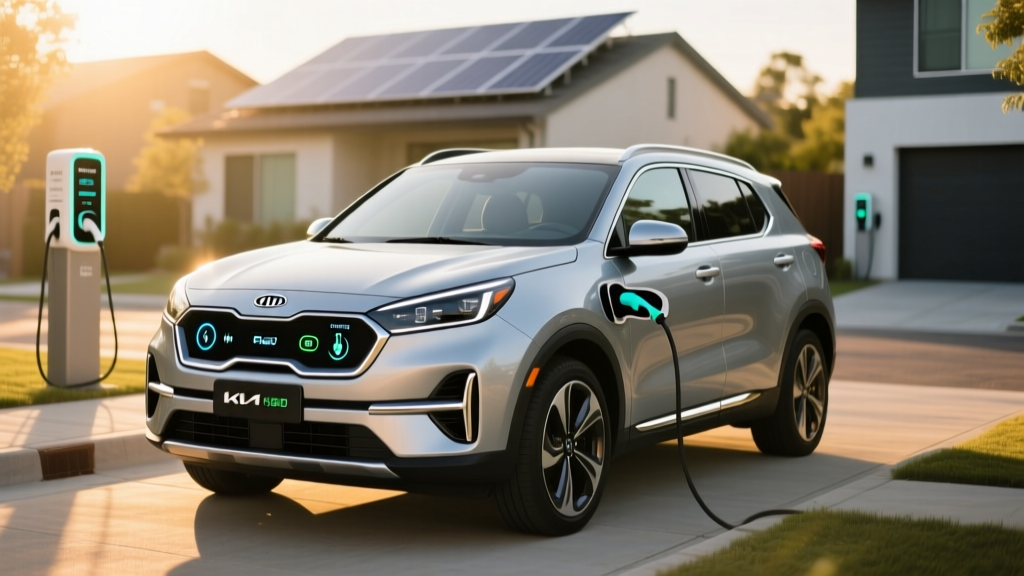
The 2026 Kia Sportage Hybrid lineup offers two distinct electrified paths for compact-SUV buyers who aren't ready to commit to a full battery-electric vehicle. The conventional Sportage Hybrid (HEV) delivers strong city MPG without ever plugging in, while the Sportage Plug-in Hybrid (PHEV) adds roughly 34 miles of electric-only commuting capability. Both share the same turbocharged 1.6-liter powertrain architecture, but their efficiency profiles, pricing, and ownership experiences diverge significantly. Here's the data-driven breakdown.
2026 Kia Sportage Hybrid vs. PHEV: What's the Difference?
Before comparing specs, it's essential to understand the fundamental distinction between these two powertrains — Kia sells them as separate models, and they serve different use cases.
Conventional Hybrid (HEV)
- How it works: A small battery (typically ~1.5 kWh) recharges through regenerative braking and the gasoline engine. You never plug it in.
- Best for: Drivers without home charging access who want better fuel economy with zero behavior change.
- Key advantage: Seamless ownership — just fill up with gas and go, with 38 MPG combined.
Plug-in Hybrid (PHEV)
- How it works: A larger 13.8 kWh battery provides an EPA-estimated 34 miles of electric-only driving before the gas engine engages. You plug it in to recharge.
- Best for: Drivers with home Level 2 charging who commute under 35 miles round-trip and want EV-like daily driving with gas backup for road trips.
- Key advantage: Near-zero fuel use on short commutes; 430+ miles total range when the battery depletes.
Neither requires you to sacrifice the cargo space or ground clearance that makes the Sportage practical. The PHEV's larger battery sits under the rear seat and cargo floor, resulting in only minor cargo-volume trade-offs compared to the HEV.
Fuel Economy and Electric-Only Range
Fuel economy is the headline number for any hybrid purchase. Here's what the EPA rates the 2026 Sportage lineup at, alongside real-world expectations based on owner data and testing patterns.
| Model | City MPG | Highway MPG | Combined MPG | PHEV Electric Range | PHEV Total Range |
|---|---|---|---|---|---|
| Sportage Hybrid FWD | 42 | 44 | 43 | — | ~430 mi |
| Sportage Hybrid AWD | 38 | 38 | 38 | — | ~410 mi |
| Sportage PHEV AWD | 36 (gas-only) | 35 (gas-only) | 35 (gas-only) / 84 MPGe | 34 mi | ~430 mi |
Source: EPA Fuel Economy
Real-World MPG vs. EPA Sticker
Hybrids consistently outperform their EPA ratings in city driving because regenerative braking recaptures energy during stop-and-go traffic. Expect the Sportage Hybrid FWD to achieve 44–48 MPG in urban commuting during mild weather. Highway driving is a different story: at sustained 75+ mph speeds, the electric motor contributes less, and aerodynamic drag dominates. Real-world highway MPG typically drops to 35–38 MPG for the FWD model.
Cold weather reduces hybrid efficiency by roughly 10–15% due to increased engine idling (for cabin heat) and reduced battery performance. In sub-30°F conditions, plan on 33–36 MPG combined for the FWD HEV.
For the PHEV, the 34-mile electric-only range assumes moderate temperatures and speeds under 65 mph. In winter, expect that range to contract to roughly 26–30 miles as the battery loses efficiency and cabin heating draws additional power. The gasoline engine may also engage sooner in cold weather to provide heat.
Powertrain Specs: Horsepower, Engine, and Motors
| Specification | Sportage Hybrid (HEV) | Sportage PHEV |
|---|---|---|
| Engine | 1.6L turbocharged 4-cylinder | 1.6L turbocharged 4-cylinder |
| Electric Motor | 47.7 kW (64 hp) | 72 kW (97 hp) |
| Combined System Output | 232 hp / 258 lb-ft torque | 268 hp / 258 lb-ft torque |
| Transmission | 6-speed automatic | 6-speed automatic |
| Drivetrain | FWD or AWD | AWD standard |
| 0–60 mph (est.) | ~7.7 sec | ~7.2 sec |
| Towing Capacity | 2,000 lbs | 2,000 lbs |
The PHEV's larger electric motor gives it a 36-horsepower advantage and slightly quicker acceleration, though neither variant is a performance SUV. The 6-speed automatic is a deliberate choice over a CVT — it delivers more natural shift feel, though it sacrifices a marginal amount of efficiency versus the continuously variable transmissions used by Toyota and Honda hybrids.
PHEV Battery, Charging, and Electric-Only Capability
The 2026 Sportage PHEV uses a 13.8 kWh lithium-ion polymer battery (NMC chemistry). Of that, roughly 11.5 kWh is usable — the remainder is buffer to protect long-term battery health.
| Charging Method | Power | Full Charge Time (0–100%) |
|---|---|---|
| Level 1 (120V household outlet) | ~1.4 kW | ~10 hours |
| Level 2 (240V home charger) | ~7.2 kW | ~2 hours |
| DC Fast Charging | Not supported | — |
Critical note: The Sportage PHEV does not support DC fast charging. This is common among PHEVs — the battery is small enough that Level 2 charging replenishes it quickly. A 2-hour Level 2 session is practical for overnight home charging or topping up during a workday if your workplace offers Level 2 stations.
The PHEV uses a standard J1772 connector for Level 1 and Level 2 AC charging. No adapter is needed for any North American public Level 2 station.
Pricing, Trims, and Tax Credit Eligibility
Kia prices the 2026 Sportage Hybrid across three trims, with the PHEV offered in two. All prices below are base MSRP before destination charges (~$1,375).
| Model / Trim | MSRP | Drivetrain |
|---|---|---|
| Sportage Hybrid LX | $29,990 | FWD |
| Sportage Hybrid EX | $32,590 | FWD or AWD (+$1,800) |
| Sportage Hybrid SX-Prestige | $36,590 | AWD |
| Sportage PHEV X-Line | $39,990 | AWD |
| Sportage PHEV X-Line Prestige | $43,390 | AWD |
Federal Tax Credit: Does the Sportage Hybrid or PHEV Qualify?
Conventional Hybrid (HEV): The Sportage Hybrid does not qualify for the federal §30D clean vehicle tax credit. That credit applies only to plug-in vehicles with a battery capacity of at least 7 kWh. Conventional hybrids are ineligible regardless of efficiency.
Sportage PHEV: The PHEV's 13.8 kWh battery exceeds the 7 kWh threshold, making it potentially eligible for up to $7,500 under the §30D credit. However, eligibility depends on multiple factors that change annually:
- MSRP cap: SUVs must have an MSRP at or below $80,000 (all Sportage PHEV trims qualify).
- Buyer income cap: Modified AGI must not exceed $150,000 (single), $225,000 (head of household), or $300,000 (joint).
- Battery sourcing: Critical minerals and battery components must meet phased-in domestic-content and free-trade-agreement thresholds per IRS §30D rules. Kia's supply chain compliance for 2026 model-year vehicles should be verified at purchase — ask the dealer for the IRS-sourced manufacturer certification letter.
- Point-of-sale transfer: You can transfer the credit to the dealer at purchase for an immediate price reduction, rather than waiting to claim it on your tax return.
Always consult a tax professional and verify current-year eligibility at irs.gov before purchasing.
Battery Warranty, Reliability, and Replacement Costs
Battery longevity is the top concern for hybrid buyers, and Kia addresses it with one of the strongest warranties in the industry.
Kia Hybrid/PHEV Battery Warranty
- Hybrid battery: 10 years / 100,000 miles (whichever comes first)
- Hybrid system components: 10 years / 100,000 miles (inverter, motor, onboard charger)
- Limited vehicle warranty: 5 years / 60,000 miles bumper-to-bumper
- Powertrain warranty: 10 years / 100,000 miles
The hybrid battery warranty covers capacity loss below a manufacturer-defined threshold (typically ~70% state of health) as well as outright failure.
Real-World Hybrid Battery Reliability
Modern lithium-ion hybrid batteries rarely require replacement within the warranty period. Hyundai-Kia's hybrid systems have demonstrated strong reliability in long-term fleet data, with most batteries retaining 85–90% capacity at 100,000 miles. The PHEV's larger battery experiences shallower charge-discharge cycles during electric-only driving, which reduces degradation stress compared to a full EV's deeper cycling.
If replacement is needed out of warranty, expect the following approximate costs:
- HEV battery pack: $2,000–$3,500 (parts + labor)
- PHEV battery pack: $4,500–$7,000 (parts + labor, larger pack)
These figures are estimates based on current dealer pricing and may vary by region. Third-party hybrid battery refurbishment services can reduce costs by 30–40%.
Who Should Buy the Sportage Hybrid vs. a Full EV or Gas SUV?
Choose the Sportage Hybrid (HEV) if:
- You don't have access to home or workplace charging.
- You want 38–43 MPG combined without changing any habits.
- Your budget is under $37,000 and you don't want to wait for tax-credit paperwork.
- You regularly drive in extreme cold where EV range loss is a concern.
Choose the Sportage PHEV if:
- You have Level 2 home charging and a commute under 35 miles round-trip.
- You want EV-like daily driving but need gas-engine flexibility for road trips.
- You qualify for the §30D tax credit, bringing the effective price closer to the HEV SX-Prestige.
- You want the strongest acceleration in the Sportage lineup (268 hp).
Choose a Full EV (like the Kia EV6 or Hyundai Ioniq 5) if:
- You have reliable home Level 2 charging and access to DC fast chargers for road trips.
- Your daily driving is under 250 miles and you want zero tailpipe emissions.
- You want the lowest per-mile fuel cost (~$0.04–$0.06/mile on home electricity vs. ~$0.10–$0.14/mile for the HEV at 38 MPG and $3.50/gallon gas).
- You want to eliminate oil changes and engine maintenance entirely.
Pros and Cons
Pros
- Strong city MPG — HEV FWD achieves 42 city, often exceeded in real-world stop-and-go
- PHEV offers 34 miles electric-only, covering most daily commutes without gasoline
- 10-year / 100,000-mile hybrid battery warranty — best-in-class coverage
- 268 hp in PHEV trim makes it the quickest Sportage variant
- AWD available across the lineup for all-weather buyers
- Spacious cargo area and rear seat for the compact-SUV segment
- No range anxiety — gas engine provides 410+ miles of total range
Cons
- PHEV does not support DC fast charging — Level 2 only
- AWD Hybrid drops to 38 MPG combined, narrowing the advantage over efficient gas SUVs
- PHEV starts near $40,000 — expensive before tax-credit offset
- HEV is ineligible for federal §30D tax credit
- 6-speed automatic feels less refined than competitors' CVTs at low-speed creep
- PHEV electric-only range contracts to ~26–30 miles in freezing temperatures
- Regenerative braking is mild — no true one-pedal driving mode
Frequently Asked Questions
How many MPG does the 2026 Kia Sportage Hybrid get?
The FWD Sportage Hybrid achieves an EPA-estimated 42 city / 44 highway / 43 combined MPG. The AWD version drops to 38 city / 38 highway / 38 combined. In real-world city driving, expect the FWD model to return 44–48 MPG thanks to regenerative braking. Highway driving at 75+ mph typically yields 35–38 MPG.
How far can the Sportage PHEV go on electric only?
The EPA rates the 2026 Sportage PHEV at 34 miles of electric-only range. Real-world results depend on temperature and speed: expect 30–34 miles in mild weather at moderate speeds, and 26–30 miles in freezing temperatures. Once the battery depletes, the gas engine provides an additional ~400 miles of range.
Does the 2026 Sportage Hybrid qualify for any tax credit?
The conventional Sportage Hybrid (HEV) does not qualify for the federal §30D clean vehicle credit — it applies only to plug-in vehicles. The Sportage PHEV may qualify for up to $7,500, subject to buyer income limits, MSRP caps, and battery-sourcing requirements. Verify eligibility at irs.gov and with a tax professional before purchase. Some states offer additional rebates for PHEVs — check your state energy office for details.
Is the Kia Sportage Hybrid reliable, and what does battery replacement cost?
Kia's hybrid powertrain has demonstrated strong reliability, with the 10-year/100,000-mile hybrid battery warranty providing substantial protection. Out-of-warranty battery replacement costs approximately $2,000–$3,500 for the HEV and $4,500–$7,000 for the PHEV. Most hybrid batteries retain 85–90% capacity at 100,000 miles based on fleet data, making replacement uncommon within the warranty period.
Do I need to plug in the Sportage Hybrid?
No. The conventional Sportage Hybrid (HEV) never needs to be plugged in — its small battery recharges through regenerative braking and the gasoline engine. Only the Sportage PHEV requires plugging in to access its 34-mile electric-only range. If you don't plug in the PHEV, it still functions as a conventional hybrid, but you lose the efficiency and cost benefits that justify its higher price.
How does the Sportage Hybrid compare to the Toyota RAV4 Hybrid?
The 2026 Toyota RAV4 Hybrid achieves an EPA-estimated 41 city / 38 highway / 40 combined MPG with AWD standard, compared to the Sportage Hybrid AWD at 38/38/38. The RAV4 Hybrid holds a slight highway and combined MPG advantage. However, the Sportage PHEV offers 34 miles of electric-only range versus the RAV4 Prime's 42 miles — the RAV4 Prime leads in electric range but starts at a significantly higher MSRP (~$44,500 vs. the Sportage PHEV's ~$39,990). Interior space, tech features, and warranty coverage (Kia's 10-year vs. Toyota's 8-year hybrid battery warranty) may sway the decision depending on your priorities.