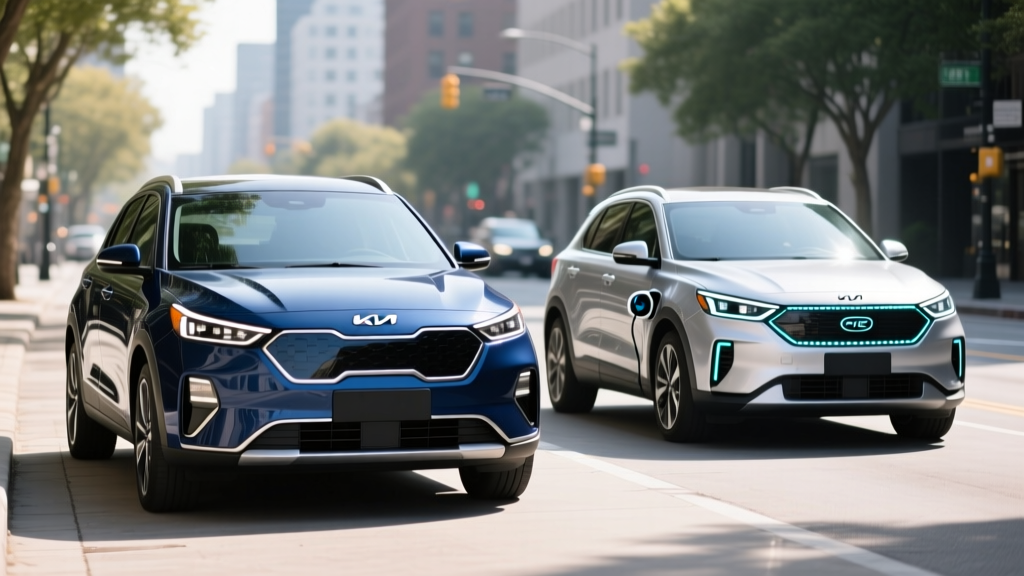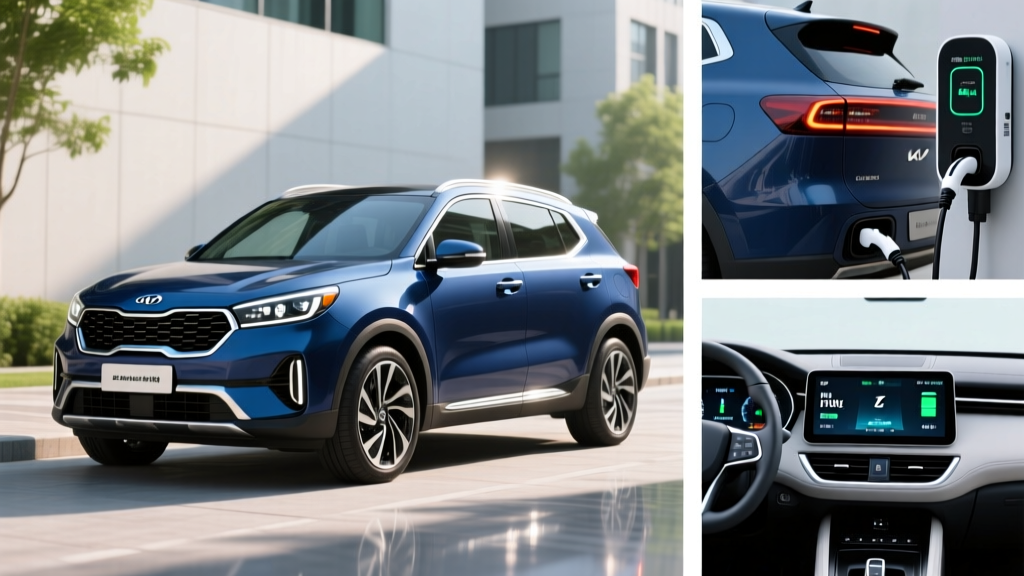
Quick Verdict: Two Flavors of Electrified Sportage
The 2025 Kia Sportage arrives in two electrified variants that serve very different buyers: the Sportage Hybrid (HEV) for drivers who want better fuel economy with zero behavior change, and the Sportage Plug-In Hybrid (PHEV) for those with short commutes and access to a charging outlet. Both share a 1.6-liter turbocharged four-cylinder paired with electric motors, but their battery sizes, range profiles, and pricing diverge significantly. This guide breaks down exactly what each version delivers — with real-world numbers, not just EPA stickers.
The conventional hybrid (HEV) charges its small battery through regenerative braking and the engine. You never plug it in. The plug-in hybrid (PHEV) carries a much larger battery you charge from a wall outlet or public station, enabling pure electric driving before the gas engine kicks in.
Powertrain and Performance Specs
| Specification | Sportage Hybrid (HEV) | Sportage PHEV |
|---|---|---|
| Engine | 1.6L turbo I4 + electric motor | 1.6L turbo I4 + electric motor |
| Combined Horsepower | 226 hp | 261 hp |
| Combined Torque | 258 lb-ft | 258 lb-ft |
| Transmission | 6-speed automatic | 6-speed automatic |
| Battery Capacity | ~1.49 kWh (self-charging) | 13.8 kWh usable |
| Drivetrain | AWD standard | AWD standard |
| 0-60 mph (est.) | ~7.5 sec | ~7.0 sec |
| Towing Capacity | 2,000 lbs | 2,000 lbs |
The PHEV's extra 35 horsepower comes from a more powerful electric motor integrated into the drivetrain. In practice, both feel responsive off the line thanks to instant electric torque — the HEV is no slouch in daily driving, while the PHEV pulls noticeably harder when you floor it from a stop in electric mode.
Fuel Economy: EPA Numbers and Real-World MPG
| Metric | HEV AWD | PHEV AWD (gas mode) |
|---|---|---|
| EPA City | 38 MPG | 36 MPG |
| EPA Highway | 38 MPG | 35 MPG |
| EPA Combined | 38 MPG | 35 MPG |
| PHEV Electric-Only Range | N/A | 34 miles (EPA) |
| PHEV Total Combined Range | ~470 miles | ~430 miles (gas + electric) |
| PHEV MPGe (electric mode) | N/A | 84 MPGe |
Source: fueleconomy.gov
Hybrids tend to meet or exceed EPA city estimates because stop-and-go traffic maximizes regenerative braking. On mixed suburban routes, owners report 39-42 MPG in the HEV. However, sustained highway driving at 75+ MPH drops the HEV to roughly 33-35 MPG — hybrids lose their city advantage at high constant speeds. The PHEV, once the battery is depleted, behaves like a slightly less efficient hybrid due to the extra battery weight, so plan for 32-34 MPG highway on long road trips after the electric range is used up.
PHEV Charging: Battery, Speed, and Practicality
The Sportage PHEV's 13.8 kWh battery is designed for overnight home charging, not DC fast charging — a deliberate trade-off that keeps cost and weight manageable.
| Charging Method | Power | Full Charge Time | Notes |
|---|---|---|---|
| Level 1 (120V outlet) | ~1.4 kW | ~10-11 hours | Adequate for overnight |
| Level 2 (240V home/public) | ~7.2 kW | ~2 hours | Recommended for daily use |
| DC Fast Charge | Not supported | N/A | No CCS/CHAdeMO port |
The lack of DC fast charging is common for PHEVs in this segment — the battery is small enough that Level 2 fully replenishes it quickly. If you install a 240V Level 2 home charger (typically $500-$1,200 installed), you'll wake up to a full battery every morning. On a standard 120V household outlet, a full charge takes overnight but still covers most commutes if you plug in when you get home.
Understanding MPGe: MPGe (miles per gallon equivalent) measures how far the PHEV travels on electricity alone, converting electrical energy to a gasoline-equivalent figure. The 84 MPGe rating means electric-mode driving uses energy equivalent to 84 MPG — dramatically cheaper per mile than gasoline. At $0.14/kWh (national average), the electric-only portion costs roughly $0.04 per mile versus ~$0.12-0.15 per mile on gas.
Pricing, Trims, and Tax Credit Eligibility
As of the 2025 model year, here's where the Sportage lineup lands:
| Trim | Powertrain | MSRP (approx.) |
|---|---|---|
| LX | HEV | $30,090 |
| EX | HEV | $33,590 |
| SX-Prestige | HEV | $37,490 |
| X-Line | PHEV | $40,590 |
| X-Line Prestige | PHEV | $44,090 |
The Sportage PHEV may qualify for a partial or full federal clean vehicle credit under IRS §30D, subject to these constraints:
- MSRP cap: SUVs/vans must be under $80,000 — all Sportage PHEV trims qualify.
- Buyer income limits: Modified AGI ≤ $150,000 (single) / $300,000 (joint). Check your tax situation.
- Battery sourcing requirements: Critical minerals and battery component rules phase in annually. Kia's supply chain has adapted, but exact credit amounts ($3,750 or $7,500) depend on current-year sourcing compliance — verify at purchase.
- Point-of-sale transfer: Eligible buyers can transfer the credit to the dealer at purchase for an immediate price reduction.
The conventional HEV does NOT qualify for the federal §30D credit — it lacks the minimum 4 kWh battery and plug-in capability required. Some states offer separate hybrid rebates; check your local energy agency.
Reliability, Battery Warranty, and Replacement Costs
Kia covers the hybrid battery and hybrid system components for 10 years / 100,000 miles on both the HEV and PHEV. This is among the longest hybrid warranties in the industry and exceeds Toyota's standard 8-year/100,000-mile coverage. The powertrain (engine, transmission) is also covered for 10 years/100,000 miles.
How long will the battery actually last? Modern lithium-ion hybrid batteries rarely need full replacement within the warranty period. Kia's hybrid system uses a relatively small, conservatively managed battery pack that avoids the deep charge/discharge cycles that accelerate degradation. Based on industry data from similar Hyundai/Kia hybrid platforms, expect 12-15+ years of usable battery life before capacity drops meaningfully.
Replacement cost if out of warranty: A hybrid battery replacement for the Sportage HEV runs approximately $2,500-$4,000 (parts and labor). The PHEV's larger 13.8 kWh pack would cost significantly more — likely $5,000-$8,000 — though this is speculative until more units age out of warranty. For context, most hybrid owners sell or trade the vehicle before battery replacement becomes necessary.
Kia's long-term reliability has improved substantially. The Sportage earned recognition from IIHS for safety performance, and the hybrid powertrain has proven durable across the Hyundai/Kia platform family. Consumer Reports and J.D. Power data place Kia in the mid-to-upper tier for hybrid reliability.
Who Should Choose Which Sportage — HEV, PHEV, or Full EV?
- Choose the HEV if: You drive 10,000-15,000 miles/year in mixed city/highway conditions, have no home charging access, and want a straightforward upgrade from a gas-only SUV without changing any habits. The ~$30K starting price and 38 MPG combined deliver strong value.
- Choose the PHEV if: Your daily commute is under 30 miles round-trip, you have access to a 120V or 240V outlet at home, and you want electric-only daily driving with gas-engine flexibility for road trips. The $7,500 potential tax credit narrows the price gap significantly.
- Choose a full EV (e.g., Kia EV6) if: You drive under 300 miles between charges most days, have reliable home Level 2 charging, want zero tailpipe emissions, and are ready to commit to electric-only driving. EVs have lower maintenance costs and stronger long-term efficiency but require charging infrastructure confidence.
- No plug-in required — works like a normal car
- 38 MPG combined beats most compact SUVs by 10+ MPG
- AWD standard across all trims
- Strong 10yr/100k-mile warranty
- Competitive starting price at ~$30K
- No federal tax credit eligibility
- Highway MPG drops to ~33-35 at 75+ MPH
- No electric-only driving mode
- Less power than PHEV (226 vs 261 hp)
- 34 miles electric-only covers most commutes
- Up to $7,500 federal tax credit potential
- 261 hp — most powerful Sportage variant
- Gas engine eliminates range anxiety on road trips
- 84 MPGe in electric mode = very low per-mile cost
- ~$10K more expensive than HEV base
- No DC fast charging
- Requires home outlet access for full value
- Heavier than HEV (lower MPG once battery depleted)
- Tax credit eligibility depends on sourcing rules
Frequently Asked Questions
How many MPG does the 2025 Kia Sportage Hybrid get?
The EPA rates the Sportage Hybrid AWD at 38 MPG city / 38 MPG highway / 38 MPG combined. In real-world driving, expect 39-42 MPG in city and suburban conditions, dropping to 33-35 MPG at sustained highway speeds above 75 MPH. The PHEV, when running on gasoline after battery depletion, achieves approximately 35 MPG combined.
How far can the Sportage PHEV go on electric only?
The EPA rates the Sportage PHEV at 34 miles of electric-only range. Real-world results vary: gentle city driving in mild weather can stretch this to 36-38 miles, while aggressive acceleration, cold weather (below 40°F), or highway speeds may reduce it to 26-30 miles. For most commuters with a sub-30-mile round trip, this covers daily driving entirely on electricity.
Does the 2025 Sportage Hybrid qualify for any tax credit?
The conventional HEV does not qualify for the federal §30D clean vehicle credit — it lacks plug-in capability. The PHEV may qualify for up to $7,500 depending on current-year battery sourcing compliance, your income level (≤$150K single / ≤$300K joint), and the vehicle's MSRP (all trims are under the $80K SUV cap). Always verify eligibility with your tax professional and the dealer at point of sale. See IRS §30D rules.
Is the Sportage Hybrid reliable, and what does battery replacement cost?
Kia's hybrid powertrain has proven reliable across multiple model years, and the company backs it with a 10-year/100,000-mile hybrid battery warranty — one of the best in the industry. Out-of-warranty hybrid battery replacement runs approximately $2,500-$4,000 for the HEV and an estimated $5,000-$8,000 for the PHEV's larger pack. Most owners trade the vehicle before replacement becomes necessary.
Should I get the HEV or PHEV version?
If you lack home charging access or drive mostly highway miles, the HEV delivers excellent efficiency without infrastructure needs. If you have a home outlet, a commute under 34 miles, and want to minimize fuel costs (and potentially claim the federal tax credit), the PHEV pays off — especially when the credit brings the effective price closer to the HEV. For drivers ready to go fully electric with home Level 2 charging, consider the Kia EV6 as an alternative.