Quick Verdict: Two Hybrids, Very Different Missions
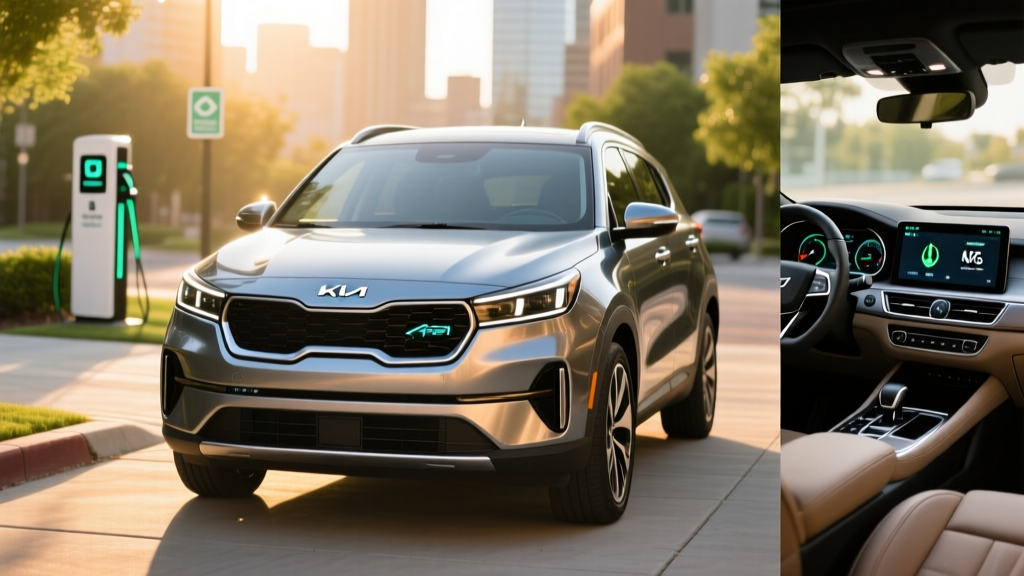
The 2024 Kia Sportage is one of the few compact SUVs sold in three distinct powertrains: a conventional hybrid (HEV), a plug-in hybrid (PHEV), and a gasoline-only model. For buyers weighing fuel savings against purchase price and charging logistics, the HEV and PHEV variants are where the math gets interesting. The HEV delivers up to 43 MPG combined with zero lifestyle change — no plug, no range anxiety, no charging apps. The PHEV adds 34 miles of electric-only range for commuters who can charge at home, but demands a ~$8,000 premium over the HEV. Here's exactly what each variant delivers, what it costs, and who should buy which.
A conventional hybrid (HEV) uses a small battery (typically ~1.5 kWh) charged entirely by the engine and regenerative braking. You never plug it in. A plug-in hybrid (PHEV) carries a much larger battery (13.8 kWh in the Sportage) that you charge from a wall outlet or charger, enabling electric-only driving before the gas engine takes over. Confusing these two is the most common mistake hybrid shoppers make — their pricing, fuel economy, and daily usability differ enormously.
2024 Kia Sportage Hybrid (HEV): Specs and EPA MPG
| Spec | FWD | AWD |
|---|---|---|
| EPA City MPG | 42 | 38 |
| EPA Highway MPG | 44 | 38 |
| EPA Combined MPG | 43 | 38 |
| Combined Horsepower | 227 hp | 227 hp |
| Engine | 1.6L turbo I4 + electric motor | 1.6L turbo I4 + electric motor |
| Transmission | 6-speed automatic | 6-speed automatic |
| Hybrid Battery | ~1.49 kWh lithium-ion | ~1.49 kWh lithium-ion |
| 0–60 mph (est.) | ~7.5 sec | ~7.7 sec |
| Base MSRP (LX) | $28,590 | $29,990 |
| Cargo Volume | 39.5 cu ft (rear seats up) | 39.5 cu ft (rear seats up) |
Source: EPA Fuel Economy, Kia America specifications.
Real-World MPG vs EPA Sticker
Kia's 1.6-liter turbocharged hybrid powertrain pairs a 178-hp gasoline engine with a 44-kW (59-hp) electric motor integrated into the transmission housing, producing a combined 227 hp and 258 lb-ft of torque. The FWD model's 43 MPG combined is class-leading — it beats the Toyota RAV4 Hybrid (39 combined) and Honda CR-V Hybrid (40 combined).
In real-world driving, conventional hybrids like the Sportage HEV often exceed their EPA city rating because regenerative braking recovers more energy in stop-and-go traffic. Owners reporting on Fuelly and similar tracking platforms frequently log 40–46 MPG in mixed city driving with the FWD model. Highway-only driving at 75+ mph tends to drop to 36–39 MPG for FWD and 34–37 MPG for AWD, as the electric motor contributes less at sustained high speed and aerodynamic drag dominates. In cold weather (below 30°F), expect a 5–10% reduction as the engine runs more frequently for cabin heat and battery warmup.
2024 Kia Sportage PHEV: Electric Range, Charging, and MPG
| Spec | AWD (standard) |
|---|---|
| EPA Electric-Only Range | 34 miles |
| EPA MPGe (EV mode) | 84 MPGe |
| EPA Combined MPG (gas only) | 35 MPG |
| Total Combined Range | ~430 miles |
| Combined Horsepower | 261 hp |
| PHEV Battery Capacity | 13.8 kWh (lithium-ion polymer) |
| Level 1 Charge Time (120V) | ~11 hours (full) |
| Level 2 Charge Time (240V) | ~3 hours 25 min (full) |
| DC Fast Charging | Not supported |
| Onboard Charger | 7.2 kW |
| 0–60 mph (est.) | ~6.7 sec |
| Base MSRP (X-Line) | $39,090 |
Source: EPA Fuel Economy, Kia America press kit.
Electric-Only Range in Practice
The EPA rates the Sportage PHEV at 34 miles of all-electric driving. That figure holds up reasonably well in moderate temperatures (50–80°F) on suburban routes under 50 mph, where owners report 30–35 actual miles. Highway driving at 70+ mph cuts electric range to roughly 22–26 miles due to higher energy demand. In freezing weather with cabin heating active, expect 20–25 miles of electric range — the battery's usable capacity shrinks and the gasoline engine engages sooner to provide heat.
MPGe (miles per gallon equivalent) measures how far the PHEV travels on the electricity stored in its battery, converted to the energy equivalent of one gallon of gasoline. The 84 MPGe rating means that while running on electricity, the Sportage PHEV uses energy at a rate equivalent to an 84-MPG vehicle. Once the battery is depleted, the 1.6L turbo engine takes over and delivers 35 MPG combined — still respectable for an AWD compact SUV, though lower than the HEV due to the added battery weight.
Charging the PHEV: What You Need
The Sportage PHEV uses a standard J1772 connector for AC charging. It does not support DC fast charging — this is typical for PHEVs, whose smaller batteries don't justify the cost and weight of DC hardware. At home on a standard 120V outlet (Level 1), a full charge takes about 11 hours, which works for overnight replenishment if you drive less than the 34-mile electric range daily. A 240V Level 2 home charger cuts that to roughly 3.5 hours, meaning you can top up during a work-from-home afternoon or between errands.
For the PHEV to make financial sense, you need reliable access to Level 1 or Level 2 charging — ideally at home. If you can't charge regularly, you're carrying 300+ pounds of battery you never use, and the HEV becomes the smarter buy.
HEV vs PHEV: Which Sportage Hybrid Fits Your Life?
Choose the HEV If…
- You can't charge at home (apartment, street parking)
- Your commute exceeds 34 miles each way
- You want maximum MPG with zero behavior change
- Budget is a priority — the HEV starts ~$10,500 less than the PHEV
- You do mostly highway driving (hybrids shine in city, PHEVs shine in stop-and-go EV mode)
Choose the PHEV If…
- You can install a Level 2 charger at home
- Your daily round-trip commute is under 34 miles
- You want EV-like daily driving with gas-engine road-trip freedom
- You qualify for the federal tax credit (see below)
- You value the extra 34 hp (261 vs 227) and quicker acceleration
HEV: Best for drivers who want better fuel economy with no plug, no apps, no infrastructure. You drive it exactly like a gas car. Ideal if you lack home charging.
PHEV: Best for households with home charging and a predictable short commute who still want a gas engine for weekend road trips. The bridge between gas and electric.
Full EV (BEV): Best if you have home charging, drive under 250 miles daily, and want zero tailpipe emissions and minimal maintenance. Higher upfront cost, lowest running cost.
Pricing, Trims, and Federal Tax Credit Eligibility
Sportage HEV Pricing (2024 Model Year)
- LX FWD: $28,590
- LX AWD: $29,990
- EX AWD: $32,090
- SX-Prestige AWD: $36,090
Sportage PHEV Pricing (2024 Model Year, AWD standard)
- X-Line: $39,090
- X-Line Prestige: $42,590
Does the 2024 Sportage Hybrid Qualify for a Tax Credit?
The Sportage HEV (conventional hybrid) does not qualify for the federal §30D clean vehicle credit. That credit applies only to plug-in vehicles (PHEVs and BEVs) with sufficient battery capacity.
The Sportage PHEV has a 13.8 kWh battery, which meets the §30D minimum of 7 kWh. However, eligibility under current IRS rules depends on several factors that change frequently:
- MSRP cap: SUVs must have an MSRP at or below $80,000 — both PHEV trims qualify.
- Buyer income cap: Modified AGI must not exceed $150,000 (single), $225,000 (head of household), or $300,000 (joint).
- Battery sourcing: Critical minerals and battery components must meet phased-in sourcing requirements from the U.S. or free-trade-agreement countries. Kia manufactures the Sportage in Georgia, but battery-cell sourcing determines credit eligibility — and this requirement has tightened annually through 2024–2025.
- Point-of-sale transfer: As of 2024, eligible buyers can transfer the credit to the dealer at purchase, reducing the purchase price directly rather than waiting for a tax refund.
Important: The partial credit amount (up to $3,750 if only one of the two sourcing requirements is met, or up to $7,500 if both are met) depends on the specific battery-cell supply chain for the build date of your vehicle. Always verify eligibility with your dealer and a tax professional before purchase, as these rules have shifted multiple times since the Inflation Reduction Act took effect.
Reliability, Battery Warranty, and Replacement Costs
Kia covers the Sportage hybrid battery (both HEV and PHEV) for 10 years or 100,000 miles, whichever comes first. This applies to the original owner; for subsequent owners, coverage typically drops to 10 years/100,000 miles from the original in-service date in most states (California and states adopting CARB emissions standards may offer longer coverage). The warranty covers defects and capacity loss below a threshold (typically ~70% of original capacity, though exact thresholds vary by model year — confirm with your dealer).
The standard vehicle warranty is 5 years/60,000 miles bumper-to-bumper and 10 years/100,000 miles powertrain.
How Long Will the Hybrid Battery Last?
Kia's hybrid batteries use lithium-ion polymer cells with active thermal management. Based on data from Hyundai/Kia hybrid platforms now in their second decade on the road (the Optima Hybrid launched in 2011), widespread battery failures before 150,000 miles have been rare. The HEV's small ~1.49 kWh battery experiences shallow charge-discharge cycles (it never fully depletes or fully charges), which is gentle on cell chemistry. The PHEV's 13.8 kWh pack sees deeper cycles but benefits from a larger buffer — the vehicle never uses 100% of the pack's capacity, preserving longevity.
Realistic expectation: both batteries should last the life of the vehicle under normal use. If replacement is needed outside warranty, estimated costs are:
- HEV battery replacement: $2,000–$3,500 (small pack, simpler replacement)
- PHEV battery replacement: $5,000–$8,000 (larger pack, more complex integration)
These are estimates based on current Hyundai/Kia hybrid service pricing and may vary by region and model year. Third-party refurbishment options may reduce cost.
Overall Reliability
The Sportage nameplate has average-to-above-average reliability ratings. The hybrid powertrain adds complexity (electric motor, inverter, high-voltage wiring) but eliminates others (the 6-speed automatic is a proven conventional design, not a CVT). The IIHS gave the 2024 Sportage strong crash-test scores. J.D. Power and Consumer Reports have rated recent Sportage models as average in predicted reliability, with the hybrid system itself generating fewer complaints than infotainment and build-quality items.
Pros and Cons at a Glance
✓ Pros
- Class-leading 43 MPG combined (HEV FWD)
- PHEV offers 34 miles of EV range — enough for most commutes
- 10-year/100,000-mile hybrid battery warranty
- Spacious cabin with 39.5 cu ft cargo volume
- Standard AWD on PHEV; strong 261 hp output
- No plug-in needed for HEV — zero lifestyle change
✗ Cons
- AWD drops HEV fuel economy to 38 combined (5 MPG penalty)
- PHEV requires home charging to justify the ~$10,500 premium
- PHEV does not support DC fast charging
- Federal tax credit for PHEV uncertain due to battery-sourcing rules
- 6-speed auto is smooth but less efficient than a CVT at steady highway speed
- PHEV cargo space slightly reduced vs HEV due to larger battery
Frequently Asked Questions
How many MPG does the 2024 Kia Sportage Hybrid get?
The FWD Sportage HEV achieves an EPA-rated 42 city / 44 highway / 43 combined MPG. The AWD version drops to 38/38/38. In real-world city driving, many owners report matching or slightly exceeding the EPA city figure thanks to regenerative braking. Highway-only driving at high speeds typically yields 36–39 MPG for FWD.
How far can the Sportage PHEV go on electric power alone?
The EPA rates it at 34 miles of all-electric range. Real-world results vary: expect 30–35 miles in moderate suburban driving, 22–26 miles at highway speeds, and 20–25 miles in freezing temperatures. Once the battery is depleted, the gasoline engine delivers 35 MPG combined.
Does the 2024 Sportage Hybrid qualify for any tax credit?
The conventional HEV does not qualify for any federal EV tax credit. The PHEV may qualify for up to $7,500 under IRS §30D, but eligibility depends on your income, the vehicle's battery-component and critical-mineral sourcing (which has tightened annually), and the MSRP cap ($80,000 for SUVs — both PHEV trims qualify). Always verify with the IRS and your tax professional before purchasing, as rules change frequently.
Is the Kia Sportage Hybrid reliable, and what does battery replacement cost?
Kia's hybrid system has proven durable over more than a decade of deployment across the Hyundai/Kia lineup. The hybrid battery is warrantied for 10 years/100,000 miles. Out-of-pocket replacement, if ever needed, runs roughly $2,000–$3,500 for the HEV and $5,000–$8,000 for the PHEV. Most owners will never need a replacement.
Do I need to plug in the Sportage HEV?
No. The conventional hybrid charges its small battery entirely through regenerative braking and the gasoline engine. You fuel it like any other gas car. Only the PHEV variant requires (or benefits from) plugging in.
Can the Sportage PHEV DC fast charge?
No. The PHEV supports Level 1 (120V, ~11 hours) and Level 2 (240V, ~3.5 hours) AC charging only via its J1772 port. This is standard for PHEVs — the 13.8 kWh battery is small enough that overnight Level 2 charging fully replenishes it, and DC fast-charging hardware would add cost and weight without meaningful benefit.