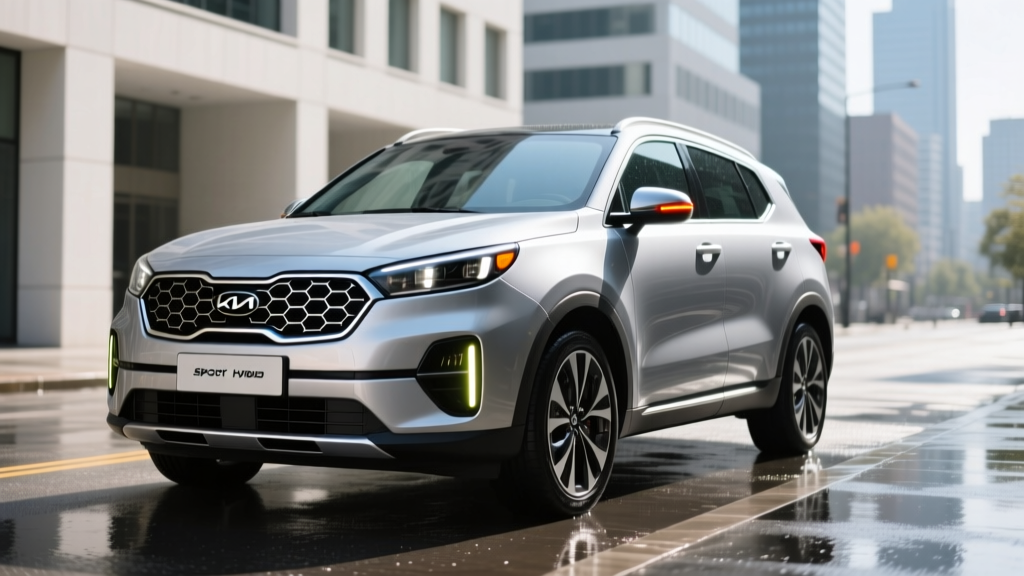
The 2023 Kia Sportage Hybrid: Two Electrified Paths
Kia's fifth-generation Sportage arrived for the 2023 model year with a fully redesigned platform and two electrified variants alongside the conventional gas model: a standard hybrid (HEV) and a plug-in hybrid (PHEV). Both share a 1.6-liter turbocharged four-cylinder paired with an electric motor, but their battery sizes, electric-only capabilities, and pricing diverge significantly. If you're cross-shopping the Kia Sportage Hybrid 2023 lineup, understanding the HEV-vs-PHEV split is the single most important decision you'll make before stepping into a dealership.
This guide breaks down the exact EPA figures, real-world efficiency expectations, battery warranty coverage, and tax-credit eligibility for both powertrains — the data points that actually matter once the brochure gloss wears off.
HEV vs PHEV: Which Sportage Hybrid Are You Looking At?
| Attribute | Sportage Hybrid (HEV) | Sportage Plug-In Hybrid (PHEV) |
|---|---|---|
| Powertrain | 1.6L turbo + 44 kW motor | 1.6L turbo + 72 kW motor |
| Combined Horsepower | 226 hp | 261 hp |
| Battery Capacity | 1.49 kWh (nominal) | 13.8 kWh (usable) |
| Plug-In Required? | No — self-charging via regen & engine | Yes — plug in for electric-only range |
| Electric-Only Range | N/A (EV assist only) | 34 miles (EPA) |
| Drivetrain | AWD standard | AWD standard |
| Transmission | 6-speed automatic | 6-speed automatic |
| DC Fast Charging | N/A | No — Level 2 AC only |
| Starting MSRP (2023) | $28,590 (LX) | $38,690 (X-Line) |
The conventional HEV never needs to be plugged in. It recovers energy through regenerative braking and uses its small battery to assist the gas engine during acceleration, enable brief low-speed electric creep, and improve stop-start efficiency. Think of it as a significantly more efficient gas car.
The PHEV carries a much larger 13.8 kWh battery that enables genuine electric-only driving for daily commutes. Plug it in overnight on a standard 120V outlet or a 240V Level 2 charger, and you can complete most errands without burning a drop of fuel. Once the battery depletes, it reverts to hybrid mode and operates much like the HEV.
Fuel Economy: EPA Numbers and Real-World MPG
| Model | City MPG | Highway MPG | Combined MPG | Combined Range |
|---|---|---|---|---|
| Sportage HEV (AWD) | 38 | 38 | 38 | ~521 miles |
| Sportage PHEV (AWD) — charge-depleting | 84 MPGe (combined gas + electric) | ~430 miles total | ||
| Sportage PHEV (AWD) — hybrid-only mode | 35 | 34 | 35 | ~396 miles (gas only) |
Source: EPA fueleconomy.gov
Real-World MPG: What to Actually Expect
The HEV's 38 MPG combined is a legitimate everyday figure. In city-heavy driving, owners frequently report 39–41 MPG because hybrids recapture the most energy during stop-and-go traffic where regenerative braking is maximized. Highway-only trips at 75+ MPH tend to drop efficiency to 34–36 MPG, since aerodynamic drag dominates and the engine carries the full load without electric assist regaining energy.
For the PHEV, the 84 MPGe figure applies only when you're actively drawing from a charged battery. Once that 34-mile electric buffer is exhausted, you're operating a ~4,000-lb hybrid SUV at 35 MPG combined — still excellent, but not the triple-digit MPGe that marketing materials sometimes imply. The real-world advantage of the PHEV is entirely dependent on your commute length and charging discipline.
PHEV Charging: What You Need to Know
The Sportage PHEV uses a 13.8 kWh lithium-ion polymer battery pack. Here's the charging reality:
| Charging Level | Power | 0–100% Time | Notes |
|---|---|---|---|
| Level 1 (120V household) | ~1.4 kW | ~10.5 hours | Works for overnight top-ups from partial depletion |
| Level 2 (240V, 32A) | ~7.2 kW (onboard charger limit) | ~2 hours | Recommended for daily full charges |
| DC Fast Charge | N/A | N/A | Sportage PHEV does NOT support DC fast charging |
The onboard charger is capped at 7.2 kW, meaning even a 48-amp Level 2 home charger won't push power any faster. A standard 240V/32A circuit — the same used by most home EV charging setups — fills the pack in roughly two hours, which is practical for topping up midday if you have workplace or home access.
The absence of DC fast charging is standard for PHEVs in this segment. The battery is small enough that Level 2 adequately serves the use case. Just don't expect to pull into an Electrify America station and add range in 15 minutes.
Powertrain and Performance
Both variants use Kia's Smartstream 1.6-liter turbocharged GDI four-cylinder, but the electric motor output differs:
| Spec | HEV | PHEV |
|---|---|---|
| Engine Output | 178 hp / 195 lb-ft | 178 hp / 195 lb-ft |
| Electric Motor | 44 kW (59 hp) | 72 kW (97 hp) |
| Combined System Output | 226 hp / 258 lb-ft | 261 hp / 258 lb-ft |
| 0–60 MPH (est.) | ~7.6 sec | ~6.7 sec |
| Curb Weight | ~3,845 lbs | ~4,150 lbs |
| Towing Capacity | 2,000 lbs | 2,000 lbs |
The PHEV's larger motor gives it a noticeable acceleration advantage, particularly in electric-only mode where torque delivery is instant. The HEV is no slouch — 226 hp in a compact SUV is competitive with turbocharged gas rivals — but the PHEV's 261 hp makes highway merging and passing genuinely effortless.
The six-speed automatic transmission is a deliberate choice over the CVTs found in the Toyota RAV4 Hybrid and Honda CR-V Hybrid. It delivers more natural shift feel and avoids the rubber-band drone that CVTs produce under hard acceleration. The trade-off is marginally less seamless power delivery at low speeds, though most drivers won't notice.
Battery Warranty, Reliability, and Replacement Cost
• HEV: 8 years / 100,000 miles (hybrid battery & components)
• PHEV: 10 years / 100,000 miles (high-voltage battery & PHEV-specific components)
• Powertrain: 10 years / 100,000 miles (both models)
• Basic: 5 years / 60,000 miles
Capacity retention threshold: Kia warrants the hybrid/PHEV battery against defects and abnormal capacity loss. If the battery falls below approximately 70% state of health within the warranty period, Kia will repair or replace it at no cost.
Kia's warranty coverage is among the most generous in the compact SUV segment. The PHEV's 10-year/100,000-mile high-voltage battery warranty provides long-term peace of mind that addresses the top concern hybrid buyers cite in surveys.
Is the Sportage Hybrid Reliable?
The 2023 Sportage is a first-year redesign, which historically carries slightly higher risk for early-production issues. However, Kia's turbocharged 1.6T Smartstream engine and hybrid powertrain components have been in the Kia/Hyundai lineup since 2011 (in various iterations), so the core technology is not unproven. The IIHS awarded the 2023 Sportage (gas and hybrid variants) strong crash-test performance.
Should the hybrid battery need replacement outside warranty, expect a cost between $3,500 and $5,500 for the HEV pack and $6,000 to $9,000 for the PHEV's larger 13.8 kWh pack, including labor. These figures are based on dealer parts pricing and independent hybrid-shop estimates as of 2025. Refurbished or aftermarket packs may reduce costs by 30–40%.
Pricing, Trims, and Tax Credit Eligibility
| Trim | Model | 2023 MSRP | Key Features |
|---|---|---|---|
| LX | HEV | $28,590 | 8" touchscreen, wireless CarPlay/Android Auto, Smart Cruise Control |
| EX | HEV | $31,090 | 12.3" digital cluster, heated front seats, power liftgate |
| SX-Prestige | HEV | $36,090 | Panoramic sunroof, leather, Harman Kardon audio, Highway Driving Assist |
| X-Line | PHEV | $38,690 | Unique styling, 34-mi EV range, synthetic leather |
| X-Line Prestige | PHEV | $41,490 | Full premium package, HUD, surround-view monitor |
Does the 2023 Sportage Hybrid Qualify for a Federal Tax Credit?
Here's where the HEV and PHEV diverge sharply on incentives:
- Sportage HEV (conventional hybrid): Does NOT qualify for the federal §30D clean vehicle credit. Conventional hybrids without plug-in capability are ineligible.
- Sportage PHEV: May qualify for up to $7,500 under IRS §30D, but eligibility depends on multiple conditions that shift frequently.
For the PHEV, the §30D credit requirements include:
- MSRP cap: SUVs must be under $80,000 — the Sportage PHEV clears this easily at ~$39K–$42K.
- Buyer income cap: Modified AGI must not exceed $150,000 (single) or $300,000 (joint).
- Battery sourcing: Critical minerals and battery components must meet phased-in domestic/free-trade sourcing percentages that tighten annually. Kia manufactures the Sportage in Georgia, but battery cell sourcing determines credit eligibility.
- Point-of-sale transfer: As of 2024, eligible buyers can transfer the credit to the dealer for an immediate price reduction rather than waiting for a tax refund.
Always verify current eligibility on IRS.gov before purchasing, as battery-sourcing rules change and can disqualify a previously eligible vehicle mid-year. Consult a tax professional for your specific situation.
Sportage Hybrid vs. the Competition
The 2023 Sportage HEV competes directly with the Toyota RAV4 Hybrid (40 MPG combined, ~$31,000 starting) and Honda CR-V Hybrid (37 MPG combined FWD, ~$34,000). The Sportage's 38 MPG sits between them, but its interior volume — 41.3 cubic feet of cargo space behind the second row — beats the RAV4's 37.5 cu ft. The cabin design with its dual 12.3-inch screens also reads as more modern than the RAV4's aging infotainment layout.
On the PHEV side, the Sportage's 34-mile electric range trails the Toyota RAV4 Prime's 42 miles and the Hyundai Tucson PHEV's 33 miles (essentially tied, as both share a platform). However, the Sportage PHEV's interior refinement and Kia's warranty edge make it competitive for buyers prioritizing cabin quality and long-term coverage.
✓ Pros
- Competitive 38 MPG combined (HEV) with strong real-world city results
- Industry-leading 10yr/100k battery warranty (PHEV)
- Spacious interior — 41.3 cu ft cargo, 41" rear legroom
- Standard AWD on all hybrid trims
- 6-speed automatic avoids CVT drone
- PHEV offers genuine 34-mile EV commute capability
✗ Cons
- PHEV does not support DC fast charging
- First-year redesign — long-term reliability TBD
- HEV ineligible for federal tax credit
- Highway MPG drops to 34–36 for HEV at sustained speed
- PHEV pricing starts $10K above HEV — payback period is long
- No spare tire on PHEV (tire-inflation kit only)
Who Should Choose the Sportage Hybrid, PHEV, or a Full EV?
Decision Framework
Choose the Sportage HEV if:
- You cannot charge at home (apartment, street parking, no garage)
- You want maximum simplicity — no plugs, no charging apps, no range management
- Your annual mileage is high (15K+ miles/year) and you want 500+ mile total range
- Your budget tops out around $30K–$36K
Choose the Sportage PHEV if:
- Your daily commute is under 30 miles round-trip and you can charge at home overnight
- You want EV-like daily driving but need gas flexibility for road trips
- You qualify for the §30D credit, effectively reducing the price gap vs. the HEV
- You value the extra 35 hp from the larger electric motor
Choose a full EV (e.g., Hyundai Ioniq 5, Tesla Model Y) if:
- You have reliable home Level 2 charging
- Your road trips are infrequent or you're comfortable planning DC fast-charge stops
- You want zero tailpipe emissions and minimal maintenance (no oil changes, no engine)
- You want to maximize federal and state incentives
The honest math for most buyers: if you cannot install a Level 2 charger at home, the PHEV premium is difficult to justify. You'll rarely charge, the battery sits partially depleted, and you're carrying 300 extra pounds of battery mass for nothing. The HEV is the rational pick for charging-limited households.
Frequently Asked Questions
How many MPG does the 2023 Kia Sportage Hybrid get?
The Sportage HEV is EPA-rated at 38 MPG city, 38 highway, and 38 combined. In real-world city driving, owners commonly see 39–41 MPG thanks to aggressive regenerative braking. Highway-only trips at 75+ MPH typically yield 34–36 MPG.
How far can the Sportage PHEV go on electric only?
The EPA rates the Sportage PHEV at 34 miles of electric-only range. Real-world results vary: expect 28–30 miles in cold weather, 26–28 miles at sustained highway speeds, and up to 36 miles in mild conditions with mixed city driving.
Does the Sportage Hybrid need to be plugged in?
No. The conventional Sportage HEV charges its small 1.49 kWh battery through regenerative braking and the gas engine. You never plug it in. Only the PHEV variant requires (and benefits from) plug-in charging.
Is the 2023 Sportage Hybrid reliable?
The 2023 model is a first-year redesign, which carries some early-production risk. However, Kia's hybrid powertrain components have been in production since 2011 across multiple models. The 10-year/100,000-mile hybrid battery warranty (PHEV) and 8-year/100,000-mile coverage (HEV) provide substantial protection. IIHS crash-test ratings are strong.
What does a hybrid battery replacement cost?
Outside of warranty, expect $3,500–$5,500 for the HEV battery pack and $6,000–$9,000 for the PHEV's larger 13.8 kWh pack, including dealer labor. Refurbished packs may reduce costs by 30–40%. Given Kia's generous warranty terms, most original owners will never face this expense.
Does the 2023 Sportage Hybrid qualify for any tax credit?
The conventional HEV does not qualify for the federal §30D credit. The PHEV may qualify for up to $7,500, subject to buyer income limits ($150K single / $300K joint), MSRP caps (under $80K for SUVs — the Sportage clears this), and battery-sourcing requirements that change periodically. Always verify on IRS.gov before purchasing.
How long does it take to charge the Sportage PHEV?
On a 240V Level 2 charger, approximately 2 hours for a full charge. On a standard 120V household outlet, roughly 10.5 hours. The PHEV does not support DC fast charging.
Should I buy the HEV or PHEV?
If your daily driving is under 30 miles and you can charge at home, the PHEV lets you drive electric most days while keeping gas flexibility. If you can't charge at home or regularly exceed 30 miles daily, the HEV delivers excellent efficiency with zero lifestyle change — and costs $10,000 less to start.