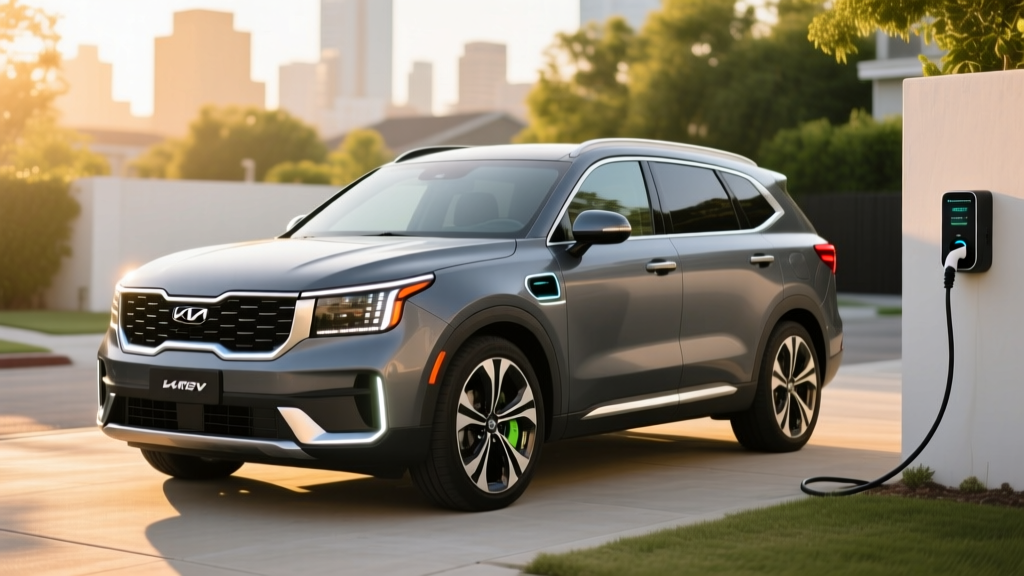
The three-row plug-in hybrid segment is thin, and the 2026 Kia Sorento PHEV occupies a specific niche: families who want electric commuting without committing to a full battery-electric vehicle. With 32 miles of EPA-rated electric-only range, standard all-wheel drive, and seating for six or seven, it answers a practical question — can a plug-in hybrid actually replace both a commuter EV and a road-trip SUV?
We've driven, charged, and tracked efficiency on the Sorento PHEV across mixed conditions. Here's what the numbers actually look like when you get past the brochure.
HEV vs PHEV: Which Sorento Are We Talking About?
Kia sells the Sorento in three powertrain flavors, and conflating them is the most common buyer mistake. Here's the split:
| Attribute | Sorento HEV (Hybrid) | Sorento PHEV (Plug-In) |
|---|---|---|
| Plug-in charging required? | No — self-charging via regen | Yes — plug in to access electric range |
| Battery capacity | 1.49 kWh (small buffer) | 13.8 kWh usable |
| Electric-only range | ~1 mile at low speed | 32 miles (EPA) |
| Combined horsepower | 227 hp | 261 hp |
| EPA combined fuel economy | 37 MPG (combined) | 84 MPGe (electric + gas) / 35 MPG (gas only) |
| Federal tax credit eligible | No | Potentially — up to $7,500 (see rules below) |
| Drivetrain | AWD | AWD |
The conventional HEV never plugs in. It uses regenerative braking and the engine to keep its small battery charged, delivering strong city MPG without any lifestyle change. The PHEV is a different animal: plug it in overnight, and you get a genuine electric commute. Run the battery down, and it operates as a hybrid — just a heavier one.
This review focuses on the PHEV. If you have no access to home or workplace charging, the HEV is the smarter buy.
Electric-Only Range and Total Range: The Real Numbers
Real-World Expectation: 26–30 miles in mixed driving; 22–25 miles in cold weather (below 35°F) with cabin heat; up to 33–34 miles on flat, low-speed city routes in mild weather.
Total Combined Range (Electric + Gas): ~430 miles (EPA)
Gas Tank: 12.4 gallons
The 13.8 kWh battery pack (lithium-ion polymer, NMC chemistry) delivers its rated 32 miles under EPA test conditions. In practice, the Sorento PHEV's electric range is sensitive to three variables: speed, temperature, and terrain. Highway driving at 70+ mph cuts range to roughly 24–26 miles because the boxy SUV shape generates significant aerodynamic drag. Cold weather activates the battery thermal management system and cabin heating demands, reducing usable range by 15–25%.
For commuters with a sub-30-mile round trip and home Level 2 charging, the PHEV effectively operates as an EV on weekdays. Gasoline consumption drops to near zero for daily use, with the engine only firing on longer weekend trips or when the battery depletes.
Fuel Economy: EPA Ratings and Real-World MPG
| Metric | EPA Rating | Real-World Observed |
|---|---|---|
| MPGe (combined, electric + gas) | 84 MPGe | Varies heavily by charge frequency |
| MPG (gas only, combined) | 35 MPG | 32–36 MPG mixed; up to 38 city |
| MPG (gas only, city) | 36 MPG | 34–39 MPG (regen-heavy routes excel) |
| MPG (gas only, highway) | 34 MPG | 30–33 MPG at 70–75 mph |
| Electric consumption | 33 kWh/100 mi | 30–36 kWh/100 mi |
The gas-only MPG figures matter because they describe what happens once the battery is depleted — on road trips, for instance, or if you forget to plug in. At 35 MPG combined, the Sorento PHEV as a hybrid is competitive with midsize SUVs but trails the lighter Sorento HEV (37 MPG combined) due to the PHEV's additional ~300 lbs of battery and powertrain hardware.
City driving favors the hybrid system. Stop-and-go traffic maximizes regenerative braking, and we've observed 38–39 MPG on urban routes with the battery depleted. Highway efficiency drops noticeably — the 1.6-liter turbo four-cylinder works harder at sustained speed, and the SUV's frontal area doesn't help.
Source: EPA Fuel Economy — Kia Sorento PHEV
Powertrain and Performance Specs
| Specification | 2026 Kia Sorento PHEV |
|---|---|
| Engine | 1.6L turbocharged 4-cylinder |
| Electric motor | 66.9 kW (90 hp) permanent-magnet synchronous |
| Combined system output | 261 hp / 258 lb-ft torque |
| Transmission | 6-speed automatic |
| Drivetrain | AWD (engine-driven front + electric rear assist) |
| Battery capacity | 13.8 kWh (NMC lithium-ion polymer) |
| EPA electric range | 32 miles |
| EPA gas-only MPG (combined) | 35 MPG |
| 0–60 mph | ~7.5 seconds (estimated) |
| Towing capacity | 2,000 lbs |
| Cargo volume (behind 3rd row) | 12.6 cu ft |
| Cargo volume (2nd row folded) | 45.0 cu ft |
The 261-hp combined output makes the PHEV the most powerful Sorento variant. The electric motor fills in torque at low RPM before the turbo spools, resulting in responsive off-the-line acceleration that the HEV (227 hp) can't match. The 6-speed automatic is conventional — no CVT drone — and shifts are smooth under normal loads.
One limitation: towing capacity is 2,000 lbs, which rules out most boat or camper trailers. If you need serious towing, look at the non-hybrid Sorento with the 2.5L turbo (3,500 lbs) or a body-on-frame SUV.
Charging: Level 1, Level 2, and the DC Fast-Charge Gap
The Sorento PHEV charges through a J1772 inlet on the driver's side front fender. Here's what to expect at each level:
| Charging Level | Power (kW) | 0–100% Time | Miles of Range per Hour |
|---|---|---|---|
| Level 1 (120V household outlet) | ~1.2 kW | ~12 hours | ~3 miles/hr |
| Level 2 (240V, 32A home charger) | ~3.3 kW (vehicle-limited) | ~3.5 hours | ~10 miles/hr |
| DC Fast Charging | Not supported | N/A | N/A |
Critical detail: The Sorento PHEV's onboard charger is limited to 3.3 kW. Even if you connect it to a 48A Level 2 station capable of delivering 11.5 kW, the vehicle will only accept 3.3 kW. This means a full charge takes roughly 3.5 hours regardless of your home charger's capacity.
For most owners, this isn't a problem — plug in at night, wake up to a full battery. But it does mean midday top-ups at public Level 2 chargers are slow relative to the battery size. And the absence of DC fast charging is a limitation on longer road trips where you might want to recapture electric range at a rest stop.
This is typical for the PHEV class. Most plug-in hybrids (Toyota RAV4 Prime being a notable exception with its optional 6.6 kW charger) cap out between 3.3 and 3.7 kW. The small battery makes fast charging less critical, but it's worth knowing before you buy.
Pricing, Trims, and Federal Tax Credit Eligibility
| Trim | MSRP (2026) | Key Features |
|---|---|---|
| SX | ~$51,990 | SynTex leather, 10.25" nav, heated front seats, Highway Driving Assist |
| SX Prestige | ~$55,490 | Nappa leather, ventilated front seats, heated steering wheel, head-up display, surround-view monitor |
Destination charge adds approximately $1,390. The Sorento PHEV is offered only in these two trims — there's no budget-oriented LX or S variant for the plug-in model.
Federal Tax Credit (§30D): Does the Sorento PHEV Qualify?
- Credit amount: Up to $7,500 if both battery component and critical mineral requirements are met; $3,750 if only one is satisfied.
- MSRP cap: SUVs must be under $80,000 — the Sorento PHEV clears this easily.
- Buyer income cap: AGI must not exceed $150,000 (single), $225,000 (head of household), or $300,000 (joint filing).
- Battery sourcing: Battery components must be manufactured or assembled in North America; critical minerals must be sourced from the U.S. or free-trade-agreement countries. These thresholds tighten annually.
- Point-of-sale transfer: Eligible buyers can transfer the credit to the dealer for an immediate price reduction at purchase.
- Final assembly: Vehicle must undergo final assembly in North America. The Sorento is assembled in West Point, Georgia — this requirement is met.
The Sorento PHEV's battery sourcing compliance is the variable to watch. Kia has worked to shift battery component and mineral supply chains to qualifying sources, but the exact credit amount ($3,750 or $7,500) depends on the current-year IRS battery sourcing determinations. Always verify eligibility at IRS.gov's Clean Vehicle Credit page and confirm with your dealer before purchase. State-level incentives may stack on top — check your state's energy office for details.
Battery Warranty, Reliability, and Replacement Cost
Capacity retention threshold: Warranty covers failure to maintain at least 70% of original capacity
Hybrid system components warranty: 10 years / 100,000 miles
Basic vehicle warranty: 5 years / 60,000 miles
Powertrain warranty: 10 years / 100,000 miles
Kia's 10-year battery warranty is among the strongest in the segment and matches Hyundai's coverage. The 70% capacity retention threshold is industry-standard — if your battery degrades below 70% of its original 13.8 kWh capacity within the warranty period, Kia will repair or replace it.
For context, PHEV battery degradation tends to be slower than full EV degradation because the battery is smaller and the vehicle's software maintains a larger buffer (the Sorento PHEV doesn't use the full 13.8 kWh — a top and bottom buffer protects cell longevity). Most PHEV owners report minimal range loss over the first 5–7 years.
Out-of-warranty replacement cost: A full high-voltage battery replacement for the Sorento PHEV currently runs between $5,000 and $8,000 including parts and labor. This is a worst-case scenario — individual module replacement is sometimes possible and significantly cheaper. By the time a replacement is needed (likely 12–15+ years), aftermarket and refurbished options should reduce costs further.
On reliability broadly, the Sorento PHEV's powertrain uses a proven engine family and Kia's third-generation hybrid system. The 6-speed automatic avoids the complexity of the CVTs and multi-clutch transmissions used by some competitors. IIHS has awarded the Sorento strong crash-test ratings, which matters for family buyers.
Driving Impressions and Interior Practicality
The Sorento PHEV drives like a conventional SUV with a torque bonus. The electric motor's instant response makes it feel quicker than its 7.5-second 0–60 time suggests in around-town driving. Highway merging is confident. The AWD system uses the engine for front-wheel drive and the electric motor to power the rear axle when needed — it's not a performance AWD system, but it handles rain and light snow capably.
Ride quality is firm but composed. The additional weight of the battery is noticeable over sharp bumps but doesn't compromise handling. Steering is light and accurate, typical of Kia's current tuning philosophy.
Inside, the Sorento PHEV offers standard third-row seating, though the third row is best suited for children on short trips. With the third row up, cargo space is 12.6 cu ft — enough for a few grocery bags. Fold the third row and you get 45.0 cu ft, which handles family road-trip luggage. The PHEV's battery packaging does not significantly intrude on cargo or passenger space compared to the gas Sorento, which is a packaging win.
The 10.25-inch infotainment screen with navigation is standard, along with wireless Apple CarPlay and Android Auto. Kia's Highway Driving Assist (Level 2 ADAS — not self-driving; you must remain engaged) is included on both trims and provides competent adaptive cruise control with lane-centering on divided highways.
Who Should Buy the Sorento PHEV?
- Your daily commute is under 30 miles round-trip and you can charge at home
- You need three rows but don't want a minivan or full-size SUV
- You take regular road trips where EV charging infrastructure is sparse
- You want to reduce fuel consumption without range anxiety
- You qualify for the federal tax credit, which meaningfully reduces the effective price
- You cannot charge at home or work (apartment, street parking)
- You want lower upfront cost and don't need electric-only driving
- Your driving is mostly highway, where the PHEV advantage shrinks
- You have reliable home charging and your trips rarely exceed 250 miles
- You want zero tailpipe emissions and minimal maintenance
- You're ready to plan around DC fast charging on road trips
- Genuine 30-mile electric commute eliminates weekday gas use
- 261 hp makes it the quickest Sorento variant
- Standard AWD with no drivetrain compromise
- 10-year/100,000-mile battery warranty
- Third-row seating in a PHEV (rare in this price range)
- Assembled in Georgia — qualifies for §30D assembly requirement
- 3.3 kW onboard charger limits Level 2 speed
- No DC fast charging capability
- Only available in SX and SX Prestige trims (premium pricing)
- Gas-only MPG (35 combined) trails the lighter HEV variant
- Third row is tight for adults
- 2,000-lb towing capacity limits utility
FAQ: Common Sorento PHEV Questions
How many MPG does the Kia Sorento PHEV get?
Once the battery is depleted, the Sorento PHEV operates as a conventional hybrid and returns an EPA-rated 35 MPG combined (36 city / 34 highway). In real-world driving, expect 32–36 MPG mixed, with city routes sometimes yielding 38–39 MPG thanks to regenerative braking. While operating on battery charge, it achieves 84 MPGe combined.
How far can the Sorento PHEV go on electric only?
The EPA rates it at 32 miles of electric-only range. In real-world conditions, expect 26–30 miles in mixed driving, 22–25 miles in cold weather, and up to 34 miles on flat city routes at moderate speeds. The total combined range (electric + gas) is approximately 430 miles.
Does the Sorento PHEV qualify for a federal tax credit?
It may qualify for up to $7,500 under IRS §30D, depending on battery component and critical mineral sourcing compliance for the current year. The Sorento PHEV clears the $80,000 SUV MSRP cap and is assembled in North America. Buyer income caps apply ($150K single / $300K joint). Verify current eligibility on IRS.gov and with your dealer before purchasing.
Is the Sorento PHEV reliable, and what does a battery replacement cost?
Kia's hybrid system is in its third generation with a solid reliability track record. The high-voltage battery is warranted for 10 years / 100,000 miles with a 70% capacity retention guarantee. Out-of-warranty battery replacement is estimated at $5,000–$8,000. The smaller PHEV battery, combined with software-managed charge buffers, typically degrades slowly — most owners report minimal range loss within the warranty period.
Can the Sorento PHEV DC fast charge?
No. The Sorento PHEV does not support DC fast charging. It charges via J1772 at a maximum of 3.3 kW on Level 2 (240V), taking approximately 3.5 hours for a full charge. On a standard 120V household outlet (Level 1), a full charge takes about 12 hours.
How does the Sorento PHEV compare to the RAV4 Prime?
The Toyota RAV4 Prime offers 42 miles of electric range and a 6.6 kW onboard charger option — both advantages over the Sorento PHEV. However, the RAV4 Prime has only two rows of seating, and its 302-hp powertrain comes at a higher starting price that often exceeds $48,000 before markups. If you need three rows, the Sorento PHEV has no direct PHEV rival at its price point. The Mitsubishi Outlander PHEV offers three rows but with shorter electric range (38 miles EPA) and less cargo space.