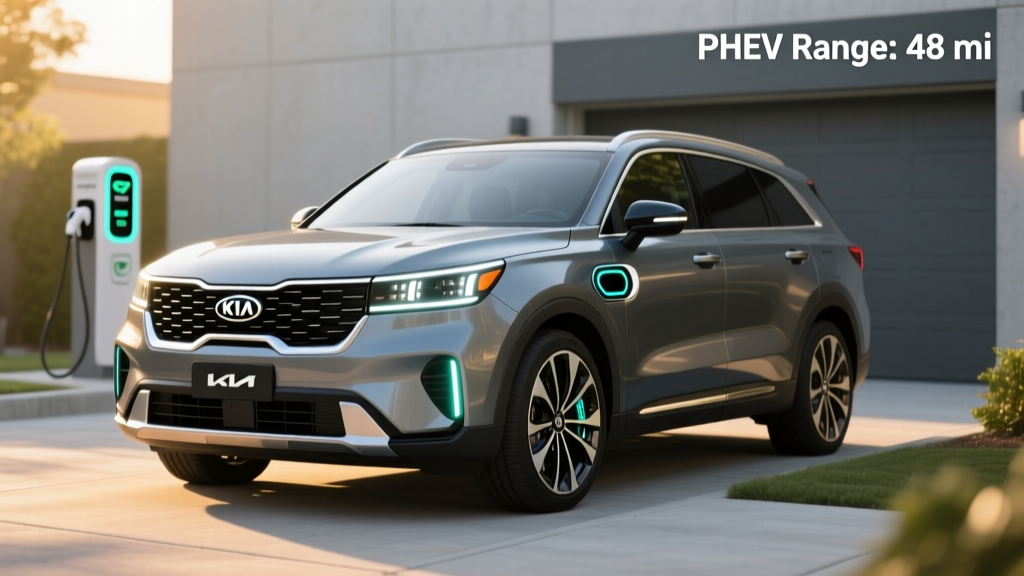
If you need three-row family space but aren't ready to commit to a full battery-electric vehicle, the Kia Sorento occupies a rare middle ground: it's one of the few mainstream SUVs sold simultaneously as a conventional hybrid (HEV) and a plug-in hybrid (PHEV). The question buyers actually need answered isn't whether it has three rows — it's what the real-world Sorento Hybrid MPG looks like once you leave the EPA sticker behind, and whether the PHEV's electric-only range justifies its price premium.
We've broken down both powertrains with exact numbers, real-world efficiency expectations, battery longevity data, and the tax-credit math that determines which version actually saves you money.
HEV vs PHEV: Two Very Different Sorentos
Before comparing MPG figures, the structural difference between the two Sorento electrified models matters because it dictates how you'll use the vehicle daily.
Kia Sorento Hybrid (HEV)
- No plug required. The 1.5 kWh battery recharges through regenerative braking and the gasoline engine.
- Electric assist only. The electric motor supplements the turbo engine; you cannot drive on electricity alone for meaningful distances.
- Lower MSRP, no home charging infrastructure needed.
Kia Sorento Plug-In Hybrid (PHEV)
- Plugs in. The 13.8 kWh battery charges via Level 1 (120V) or Level 2 (240V) — no DC fast charging.
- Genuine electric-only driving. EPA-rated 32 miles on battery alone before the gas engine engages.
- Higher MSRP, eligible for federal tax credit (with caveats).
Conflating these two is the most common mistake in Sorento research. They share a badge and a body, but the ownership experience diverges sharply.
2026 Sorento Hybrid MPG: EPA Numbers and Real-World Reality
| Model | City MPG | Highway MPG | Combined MPG | Source |
|---|---|---|---|---|
| Sorento Hybrid (HEV) FWD | 36 | 33 | 34 | EPA / fueleconomy.gov |
| Sorento Hybrid (HEV) AWD | 34 | 31 | 32 | EPA / fueleconomy.gov |
| Sorento PHEV AWD (charge-sustaining) | 34 | 33 | 33 | EPA / fueleconomy.gov |
Several patterns emerge from these numbers:
The HEV actually beats the PHEV in charge-sustaining mode. Once the PHEV's battery is depleted, it operates as a heavier hybrid (the 13.8 kWh pack adds roughly 250 lbs over the HEV's 1.5 kWh pack). You lose about 1-2 MPG combined. If you rarely plug in, the PHEV is a worse hybrid than the HEV — a critical consideration for apartment dwellers without charging access.
Real-world city MPG often exceeds the EPA sticker on the HEV. Hyundai/Kia's turbo-hybrid system recaptures aggressive amounts of energy in stop-and-go traffic. Owners routinely report 37-39 MPG in urban commuting during mild weather. Highway driving is where hybrids lose their advantage — sustained 70-80 mph cruising relies primarily on the gasoline engine, and expect 30-31 MPG with AWD on a flat interstate.
Cold weather penalty is real but modest. In sub-30°F conditions, expect a 5-8% drop in combined MPG for the HEV. The engine runs more frequently to provide cabin heat and maintain battery temperature. This is far less severe than the 20-30% range loss a full EV experiences in winter, but it's measurable over a tank.
Sorento PHEV Electric-Only Range: The 32-Mile Question
EPA Electric-Only Range: 32 miles
Real-World Expectation: 26-30 miles in mixed driving; 22-25 miles in cold weather or sustained highway speeds above 65 mph.
Total Combined Range (electric + gas): ~440 miles with a full tank and full battery.
The 13.8 kWh battery pack delivers 32 miles of EPA-rated electric driving, which covers the average American's one-way commute (U.S. Census data shows the median is roughly 26 miles round-trip). If your daily driving stays under 30 miles and you charge nightly on a Level 2 home charger, you could go months between fill-ups.
Charging specifics:
- Battery capacity: 13.8 kWh usable
- Level 1 (120V standard outlet): ~11 hours for a full charge — functional for overnight if you arrive home early
- Level 2 (240V, 3.3 kW onboard charger): ~3 hours 45 minutes from empty to full
- DC fast charging: Not supported. The Sorento PHEV uses a J1772 connector for AC charging only.
The 3.3 kW onboard charger is the limiting factor here. Even on a 48-amp Level 2 home charger capable of delivering 11.5 kW, the Sorento PHEV will only draw 3.3 kW. This is adequate for overnight replenishment but means you can't take advantage of faster public Level 2 stations to top up mid-day in any meaningful way.
Powertrain and Performance Specs
| Specification | Sorento HEV | Sorento PHEV |
|---|---|---|
| Engine | 1.6L Turbo GDI 4-cyl | 1.6L Turbo GDI 4-cyl |
| Engine HP / Torque | 178 hp / 195 lb-ft | 178 hp / 195 lb-ft |
| Electric Motor | 47.7 kW (64 hp) | 72 kW (97 hp) |
| Combined System Output | 227 hp / 258 lb-ft | 261 hp / 258 lb-ft |
| Transmission | 6-speed automatic | 6-speed automatic |
| Drivetrain | FWD or AWD | AWD standard |
| Battery Capacity | 1.5 kWh | 13.8 kWh |
| 0-60 mph (est.) | ~7.8 sec | ~7.0 sec |
| Towing Capacity | 2,000 lbs | 2,000 lbs |
| Cargo (behind 3rd row) | 12.6 cu ft | 12.6 cu ft |
The PHEV's larger motor provides noticeably stronger off-the-line acceleration and more confident highway merging, even though 0-60 times aren't sports-car territory. The 6-speed automatic (rather than a CVT) gives both models a more natural driving feel, though it sacrifices a fraction of the efficiency that Toyota's e-CVT achieves in the Highlander Hybrid.
Pricing and Federal Tax Credit Eligibility
| Trim | MSRP (2026 est.) | Drivetrain |
|---|---|---|
| Sorento Hybrid LX | $39,490 | FWD |
| Sorento Hybrid EX | $42,590 | AWD |
| Sorento Hybrid SX Prestige | $46,290 | AWD |
| Sorento PHEV EX | $51,590 | AWD |
| Sorento PHEV SX Prestige | $55,590 | AWD |
Federal tax credit — the PHEV qualifies, the HEV does not.
Under current IRS §30D rules, the Sorento PHEV may qualify for up to $7,500 in federal tax credit, subject to these requirements:
- MSRP cap: SUVs must be under $80,000 — both PHEV trims clear this easily
- Buyer income cap: $150,000 single / $225,000 head of household / $300,000 joint (modified AGI)
- Battery sourcing: Critical minerals and battery component requirements phase in annually; verify current-year compliance on the IRS qualified vehicles list
- Point-of-sale transfer: As of 2024, you can transfer the credit to the dealer at purchase for an immediate price reduction rather than waiting to claim it on your tax return
- VIN verification: The dealer must report the VIN to the IRS at time of sale
Important: The conventional Sorento HEV does NOT qualify for the §30D federal credit. The battery is too small (1.5 kWh) to meet the minimum 7 kWh requirement for plug-in vehicles. Some states offer separate hybrid incentives — check your state energy office for specifics.
This creates an interesting price crossover. The PHEV EX at $51,590, after the full $7,500 credit, effectively costs $44,090 — only about $1,500 more than the HEV EX AWD at $42,590. If you qualify for the full credit and can charge at home, the PHEV becomes the stronger financial play. If you don't qualify (income above the cap) or can't charge at home, the HEV is the clear winner.
Battery Longevity, Warranty, and Replacement Costs
Kia Hybrid/PHEV Battery Warranty
- Coverage: 10 years / 100,000 miles (whichever comes first)
- Capacity threshold: Kia warrants the battery against defects and excessive capacity loss; industry standard defines "excessive" as dropping below 70% of original capacity
- Transferability: The 10-year/100,000-mile powertrain warranty is not transferable to second owners — it drops to 5 years/60,000 miles upon resale (the 5-year/60,000-mile basic warranty is transferable)
- Hybrid system components: The motor, inverter, and related electronics share the 10-year/100,000-mile coverage
Is the Sorento Hybrid reliable? Kia's 1.6L turbo-hybrid powertrain has been in service since the 2022 model year across the Sorento and Sportage lineups. Early models had scattered reports of transmission shudder and software-related hesitation, largely addressed through ECU updates by the 2024 model year. The hybrid system itself — motor, inverter, battery — has proven robust. Hyundai/Kia's hybrid architecture is simpler than Toyota's planetary-gear e-CVT, which has its own reliability advantages in long-term simplicity.
Battery replacement cost: If the high-voltage battery requires replacement out of warranty, expect $3,500 to $5,500 for the HEV's smaller pack and $7,000 to $9,500 for the PHEV's 13.8 kWh pack (parts and labor). These are dealer-installed OEM replacement figures. Independent hybrid shops may offer refurbished packs at 30-40% less. For context, hybrid battery failure before 150,000 miles remains uncommon — most failures occur in high-heat climates (Arizona, Texas) after 10+ years of service.
Who Should Buy the Sorento Hybrid vs. a Full EV or Gas SUV?
Choose the Sorento HEV if:
- You lack access to home or workplace charging (apartment, street parking)
- You want hybrid efficiency without changing any habits — just gas up and go
- Your budget is under $45,000 and you don't qualify for the federal PHEV credit
- You drive mostly city miles where the hybrid system shines (37+ real-world MPG)
Choose the Sorento PHEV if:
- You have a garage or driveway with access to a 120V or 240V outlet
- Your daily round-trip commute is under 30 miles (you'll rarely use gas)
- You qualify for the full $7,500 federal tax credit, bringing the effective price close to the HEV
- You want EV-like daily driving with the gas engine as a road-trip safety net
Choose a full EV (like the Kia EV9) if:
- You have reliable Level 2 home charging and your daily driving is under 250 miles
- You want zero tailpipe emissions and minimal maintenance (no oil changes, no transmission fluid)
- You don't need a third row often, or you're willing to pay $55,000+ for the EV9's three-row layout
Stick with a gas-only SUV if:
- You drive under 8,000 miles per year (the hybrid premium won't pay back in fuel savings)
- You regularly tow over 3,500 lbs (the Sorento Hybrid tops out at 2,000 lbs)
How the Sorento Hybrid Compares to Rivals
The Sorento's direct three-row hybrid competition is limited. The Toyota Highlander Hybrid delivers a superior 35 MPG combined (AWD) and a proven planetary-gear system, but it starts around $42,000 and offers no PHEV variant. The Toyota Grand Highlander Hybrid provides more third-row space at 34 MPG combined but commands a $45,000+ starting price with long wait times.
The Mitsubishi Outlander PHEV offers 38 miles of electric range and standard AWD at a similar price point, but it's smaller — two rows standard, with a cramped optional third row that the Sorento matches in usability. If three-row space is non-negotiable and you want a plug, the Sorento PHEV is effectively without a direct rival at its price point.
Sorento HEV — Pros
- 34 MPG combined EPA; 37+ real-world city
- No charging infrastructure required
- Competitive pricing from $39,490
- 10-year/100,000-mile hybrid warranty
- Usable third row for children
Sorento HEV — Cons
- No federal tax credit eligibility
- 2,000-lb towing limit (below many gas V6 rivals)
- Third row is tight for adults on long trips
- FWD base model limits bad-weather confidence
Sorento PHEV — Pros
- 32 miles electric-only covers most commutes
- Up to $7,500 federal tax credit (if eligible)
- 261 hp combined — strongest Sorento powertrain
- AWD standard, strong regenerative braking
- ~440 miles total range eliminates range anxiety
Sorento PHEV — Cons
- Only 3.3 kW onboard charger — slow Level 2 fills
- No DC fast charging capability
- $51,590 starting MSRP before credit
- Heavier than HEV — worse MPG when battery is depleted
- Cold weather cuts electric range to ~22-25 miles
Frequently Asked Questions
How many MPG does the Kia Sorento Hybrid actually get?
The EPA rates the FWD Sorento Hybrid at 36 city / 33 highway / 34 combined. The AWD version drops slightly to 34/31/32. In real-world city driving with moderate temperatures, expect 37-39 MPG. Highway cruising at 75+ mph yields 29-31 MPG with AWD. Cold weather reduces combined figures by 5-8%.
How far can the Sorento PHEV go on electric power alone?
The EPA rates it at 32 miles of electric-only range. Real-world results vary: 28-30 miles in mild city driving, 22-25 miles in cold weather or sustained highway speeds. Once the battery depletes, the gasoline engine takes over seamlessly and the vehicle operates as a conventional hybrid at roughly 33 MPG combined.
Does the Sorento Hybrid qualify for any tax credit?
The conventional Sorento HEV does not qualify for the federal §30D tax credit — its battery is below the 7 kWh minimum. The Sorento PHEV may qualify for up to $7,500, depending on your income, the vehicle's battery sourcing compliance, and current-year IRS rules. Always verify eligibility on the IRS qualified vehicles list before purchasing. Some states offer additional rebates for both HEVs and PHEVs.
Is the Sorento Hybrid reliable, and what does a battery replacement cost?
Kia's hybrid system has proven reliable since its 2022 introduction, with the 10-year/100,000-mile hybrid component warranty providing strong coverage. Out-of-warranty battery replacement runs $3,500-$5,500 for the HEV and $7,000-$9,500 for the PHEV. Premature hybrid battery failure is uncommon before 150,000 miles in most climates.
Can I charge the Sorento PHEV at a public fast charger?
No. The Sorento PHEV does not support DC fast charging. It charges via J1772 at up to 3.3 kW on Level 2 (240V), taking about 3 hours 45 minutes for a full charge. On a standard 120V household outlet (Level 1), a full charge takes approximately 11 hours. This makes home overnight charging the primary use case.
How does Sorento Hybrid MPG compare to the Toyota Highlander Hybrid?
The Toyota Highlander Hybrid AWD achieves 35 MPG combined (36 city / 35 highway) per the EPA — slightly better than the Sorento HEV AWD's 32 combined. However, the Highlander Hybrid starts roughly $3,000 higher, offers no PHEV option, and its third row is comparably sized. The Sorento's advantage is the PHEV variant and lower entry price.
Should I get the HEV or the PHEV?
If you can charge at home and qualify for the $7,500 federal credit, the PHEV's effective price drops close to the HEV's, and you gain 32 miles of daily electric driving. If you can't charge at home, don't qualify for the credit, or drive mostly long highway trips where the electric range provides minimal benefit, the HEV is the smarter buy — it's a better hybrid when you never plug in.