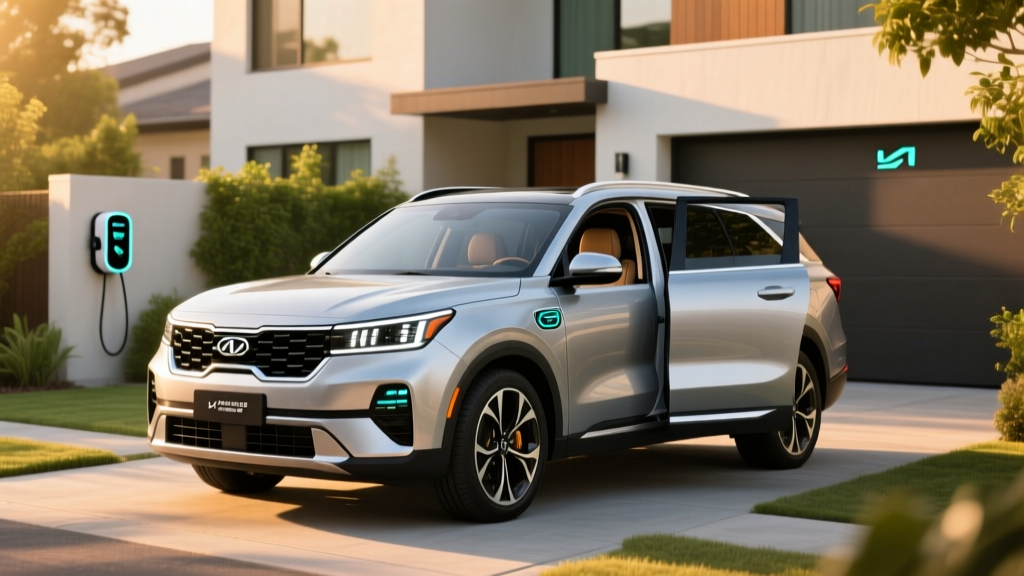
Three-row SUVs that don't guzzle gas are a short list, and the 2025 Kia Sorento Hybrid occupies a specific niche: it's one of the few midsize crossovers offering both a conventional hybrid (HEV) and a plug-in hybrid (PHEV) under one roof. If you're cross-shopping the Toyota Highlander Hybrid, Honda Pilot, or Ford Explorer Hybrid, the Sorento's dual-powertrain strategy and sub-$40,000 starting price demand attention. But the real question is whether its EPA-rated efficiency holds up outside the laboratory, and whether the PHEV variant justifies its premium.
I've broken down every spec that matters — from real-world MPG behavior to battery warranty coverage — so you can decide which Sorento electrified model, if either, fits your driving pattern.
HEV vs PHEV: Which Sorento Hybrid Are We Talking About?
Kia sells two distinct electrified Sorento models for 2025, and confusing them is the single most common buyer mistake. Here's the fundamental split:
Sorento Hybrid (HEV)
- No plug required. The battery recharges via regenerative braking and the gasoline engine.
- 1.6L turbo + electric motor producing 245 combined horsepower.
- EPA: 34 MPG combined (36 city / 33 highway) for FWD; 34 combined for AWD.
- Starting MSRP: ~$38,390 (S trim, FWD).
- No federal tax credit. HEVs do not qualify under IRS §30D.
Sorento Plug-In Hybrid (PHEV)
- Plugs in to charge. A larger 13.8 kWh battery enables electric-only driving.
- 1.6L turbo + more powerful electric motor producing 261 combined horsepower.
- EPA: 32 miles electric-only range, then 33 MPG combined as a hybrid.
- Starting MSRP: ~$50,290 (SX trim, AWD standard).
- No federal §30D tax credit for 2025 — battery sourcing rules disqualify it.
The HEV is a fuel-sipper that requires zero lifestyle change. The PHEV rewards owners who can charge at home or work with a daily commute under ~30 miles, effectively turning weekday driving into electric-only operation while preserving a 420+ mile total range for road trips.
Fuel Economy: EPA Ratings vs Real-World MPG
Hybrid efficiency isn't a single number — it shifts dramatically based on driving conditions. Here's the official EPA data from fueleconomy.gov alongside what owners and testers actually report:
| Model | City | Highway | Combined | Real-World Observed |
|---|---|---|---|---|
| Sorento HEV FWD | 36 MPG | 33 MPG | 34 MPG | 30–35 MPG |
| Sorento HEV AWD | 35 MPG | 32 MPG | 34 MPG | 29–33 MPG |
| Sorento PHEV AWD (hybrid mode) | 34 MPG | 33 MPG | 33 MPG | 30–33 MPG |
| Sorento PHEV AWD (electric) | 79 MPGe combined / 32 mi range | 25–30 mi real-world | ||
What the EPA sticker doesn't tell you: Hybrids like the Sorento HEV often exceed their EPA city rating in stop-and-go traffic because regenerative braking recaptures energy that a gas car wastes as heat. On the highway, where regen opportunities are fewer and aerodynamic drag dominates, expect MPG to drop 2–4 points below the combined rating. In winter conditions (below 35°F), plan for a 10–15% efficiency reduction across both HEV and PHEV models due to cold-start enrichment and cabin heating demands.
For the PHEV, the 32-mile electric-only EPA range assumes moderate temperatures and mixed driving. In real-world testing, expect 25–28 miles in summer and as low as 20–22 miles in freezing weather before the gas engine engages. That's still enough to cover the average American's one-way commute (~16 miles per the FHWA) on electricity alone.
Powertrain Specs: What's Under the Hood
| Specification | Sorento HEV | Sorento PHEV |
|---|---|---|
| Engine | 1.6L Turbo GDI 4-cyl | 1.6L Turbo GDI 4-cyl |
| Electric Motor | 44.2 kW (59 hp) | 72.0 kW (97 hp) |
| Combined Horsepower | 245 hp | 261 hp |
| Combined Torque | 271 lb-ft | 271 lb-ft |
| Transmission | 6-speed automatic | 6-speed automatic |
| Drivetrain | FWD or AWD | AWD (standard) |
| Battery Capacity | 1.49 kWh (lithium-ion) | 13.8 kWh (lithium-ion polymer) |
| 0–60 mph | ~7.7 sec | ~7.5 sec |
| Towing Capacity | 2,000 lbs | 2,000 lbs |
The PHEV's larger electric motor gives it noticeably stronger low-speed acceleration — useful for merging and city driving where electric torque is instantaneous. Both models use a conventional 6-speed automatic rather than the CVT or e-CVT found in the Toyota Highlander Hybrid, which some drivers prefer for its more natural shift feel, though it sacrifices a fraction of efficiency.
PHEV Charging: Times, Levels, and the DC Fast-Charge Question
If you're considering the PHEV, understanding charge times is essential. The Sorento PHEV uses a J1772 connector (the standard AC plug for non-Tesla EVs in North America).
| Charging Level | Power | Time (0–100%) | Where |
|---|---|---|---|
| Level 1 (120V household) | ~1.4 kW | ~10 hours | Any standard outlet |
| Level 2 (240V home/public) | ~3.3 kW (onboard limit) | ~3 hours 45 min | Home wallbox, public AC stations |
| DC Fast Charge | N/A — not supported | N/A | N/A |
No DC fast charging. The Sorento PHEV cannot use DC fast chargers (like Electrify America or EVgo stalls). Its 3.3 kW onboard charger limits AC charging speed. For most PHEV owners this isn't a practical problem — you plug in overnight at home and wake up to a full battery. But it means road-trip "top-ups" at DC stations aren't possible.
A Level 2 home charger (240V, 32A circuit) costs roughly $500–$1,200 installed depending on panel proximity. Given the PHEV's small battery, even a basic 120V outlet can replenish the pack overnight, making the Sorento PHEV one of the easiest electrified vehicles to "fuel" at home without electrical upgrades.
Pricing, Trims, and Tax Credit Reality
Here's where the math gets specific. Pricing reflects 2025 MSRP before destination charges:
| Model / Trim | MSRP | Federal Tax Credit | Effective Price |
|---|---|---|---|
| Sorento HEV S (FWD) | $38,390 | $0 | $38,390 |
| Sorento HEV EX (AWD) | $42,090 | $0 | $42,090 |
| Sorento PHEV SX (AWD) | $50,290 | $0* | $50,290 |
| Sorento PHEV SX Prestige (AWD) | $54,790 | $0* | $54,790 |
*As of 2025, the Sorento PHEV does not qualify for the IRS §30D clean vehicle credit because its battery components and critical minerals do not meet the sourcing thresholds established by the Inflation Reduction Act. The conventional HEV has never qualified, as §30D requires plug-in capability with a minimum battery capacity of 7 kWh.
Some states offer their own hybrid or PHEV rebates — California's CVRP, for example, has historically offered rebates for PHEVs, though funding and eligibility change frequently. Check your state energy office or AFDC's state incentive database for current programs.
Battery Longevity, Warranty, and Replacement Costs
Kia Hybrid Battery Warranty
- HEV: 10 years / 100,000 miles (whichever comes first)
- PHEV: 10 years / 100,000 miles (whichever comes first)
- Coverage: Defects and capacity loss below approximately 70% of original capacity
- Transferable: Yes, to subsequent owners (strengthens resale value)
Hybrid battery anxiety is understandable but largely overblown for modern systems. The Sorento HEV's 1.49 kWh battery is tiny and rarely cycles deeply — it buffers charge to avoid the extreme states that accelerate degradation. Toyota and Hyundai/Kia hybrid packs from the 2010s onward routinely exceed 150,000 miles without replacement.
If you do face an out-of-warranty replacement, expect:
- HEV battery: $2,000–$3,500 (small pack, simpler chemistry)
- PHEV battery: $5,000–$8,000 (larger 13.8 kWh pack, more complex)
These are ballpark figures; dealer quotes vary by region. Third-party hybrid battery rebuilders sometimes offer refurbished packs for 40–60% less. The 10-year warranty provides substantial peace of mind — Kia's coverage is among the longest in the industry, matched only by Hyundai and Genesis.
Who Should Buy the Sorento Hybrid — And Who Shouldn't
Choose the Sorento HEV if:
- You want better MPG without plugging in or changing habits
- You drive 12,000–18,000 miles/year and want fuel savings without a price premium exceeding $10K
- You need three rows but don't want minivan bulk
- You live in an apartment or lack home charging access
Choose the Sorento PHEV if:
- Your daily round-trip commute is under ~30 miles and you can charge at home
- You want near-EV operating costs on weekdays with gas flexibility for weekend trips
- You value the extra 16 hp and stronger electric acceleration
- You can absorb the ~$12,000 premium over the HEV and recoup it through fuel savings over 5–7 years
Choose a full EV instead if:
- You have reliable home Level 2 charging and your trips rarely exceed 250 miles
- You want to eliminate oil changes, spark plugs, and transmission fluid entirely
- You qualify for the $7,500 federal credit on a competing EV (e.g., Tesla Model Y, Hyundai Ioniq 5)
Sorento HEV Pros
- 34 MPG combined — excellent for a 3-row SUV
- No charging infrastructure needed
- Strong 10-year/100K powertrain + battery warranty
- Lower entry price than any PHEV competitor in class
- Smooth, quiet hybrid operation in city driving
Sorento HEV Cons
- No federal tax credit
- Third row is tight for adults on long trips
- Highway MPG drops noticeably above 70 mph
- AWD system adds weight, reducing efficiency slightly
- No DC fast charging (PHEV only, and it lacks it too)
Frequently Asked Questions
How many MPG does the 2025 Kia Sorento Hybrid get?
The Sorento HEV achieves an EPA-rated 36 city / 33 highway / 34 combined MPG in FWD configuration. AWD models rate at 35/32/34. In real-world driving, expect 30–35 MPG combined depending on conditions — city driving often yields higher numbers than the EPA city estimate thanks to regenerative braking, while sustained highway speeds above 70 mph will push you toward 28–30 MPG.
How far can the Sorento PHEV go on electric only?
The EPA rates the Sorento PHEV at 32 miles of electric-only range. In practice, expect 25–30 miles in warm weather and 20–24 miles in cold weather (below freezing). Once the battery depletes, the PHEV operates as a conventional hybrid at 33 MPG combined, giving a total system range exceeding 420 miles.
Does the 2025 Sorento Hybrid or PHEV qualify for a tax credit?
No. The conventional HEV does not meet the minimum 7 kWh battery requirement for the IRS §30D credit. The PHEV has sufficient battery capacity (13.8 kWh) but fails the battery component and critical mineral sourcing requirements as of 2025. Some state-level incentives may apply — check the AFDC state incentive tool for your area.
Is the Kia Sorento Hybrid reliable?
Kia's hybrid powertrain has demonstrated strong reliability in recent model years. The 1.6L turbo engine is shared across Hyundai/Kia products and is well-proven. The hybrid system uses a conventional automatic transmission rather than a complex e-CVT, reducing potential failure points. Kia's 10-year/100,000-mile hybrid battery warranty provides long-term coverage. J.D. Power and Consumer Reports have rated recent Sorento hybrid models at or above average for the midsize SUV segment.
What does it cost to replace the hybrid battery?
Out-of-warranty replacement runs approximately $2,000–$3,500 for the HEV's small 1.49 kWh pack and $5,000–$8,000 for the PHEV's 13.8 kWh pack. However, with Kia's 10-year/100,000-mile warranty and the proven longevity of modern lithium-ion hybrid packs, most owners will never face this expense. Many hybrid batteries from the 2010s are still in service at 150,000+ miles.
Can I tow with the Sorento Hybrid?
Yes. Both the HEV and PHEV are rated to tow up to 2,000 pounds when properly equipped — sufficient for a small utility trailer, a pair of jet skis, or a light pop-up camper. This is lower than the gas-only Sorento's 3,500-pound rating, so if heavy towing is a priority, the hybrid may not be the right fit.
Hybrid vs PHEV vs full EV — which should I choose?
If you can't charge at home, the HEV is the clear choice — zero infrastructure needed. If you can charge at home and your commute is under 30 miles round-trip, the PHEV gives you EV-like daily costs with gas-car flexibility. If you have home charging, rarely drive more than 250 miles in a day, and want to maximize fuel savings and qualify for federal credits, a full EV like the Hyundai Ioniq 5 or Tesla Model Y may be a better long-term bet. The Sorento's advantage is offering three rows — a segment where full EV options remain limited and expensive.