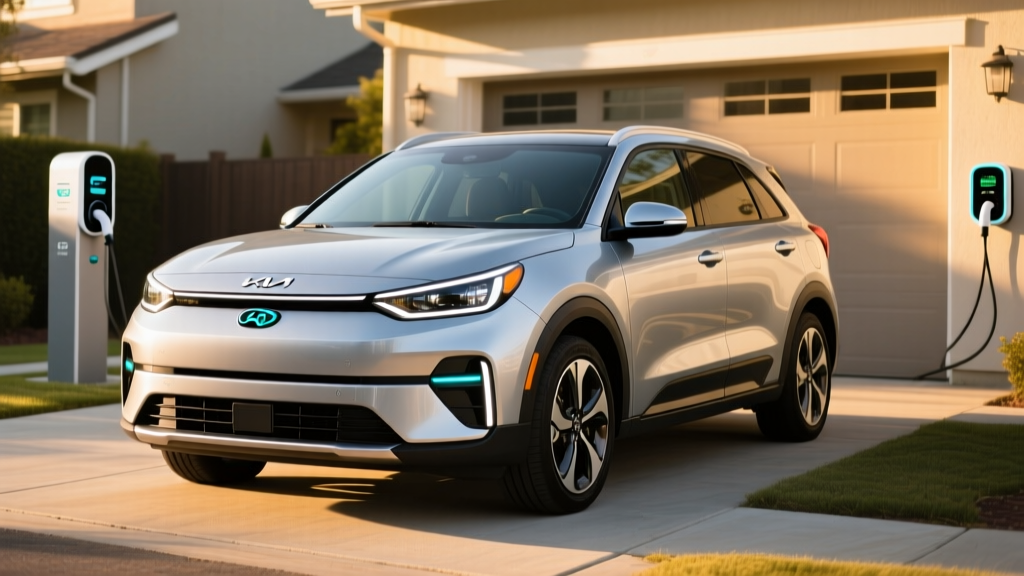
If you want electric commuting without the range anxiety of a full EV, the Kia Niro Plug-In Hybrid (PHEV) occupies a pragmatic middle ground. This 2026 Kia Niro Plug-In Hybrid review breaks down the exact numbers — electric-only range, combined MPG, charging times, powertrain output, and total cost of ownership — so you can decide whether this compact crossover fits your daily driving pattern better than a conventional hybrid, a full battery-electric vehicle, or a gas-only alternative.
Quick Verdict: Who the Niro PHEV Is For
The 2026 Kia Niro PHEV is best suited for drivers who commute 25–35 miles round-trip, have access to home Level 2 charging, and still want the flexibility for longer road trips without planning around DC fast-charging stations. With an EPA-rated 33 miles of electric-only range and 48 MPG combined once the battery depletes, it effectively functions as an EV during the workweek and a highly efficient hybrid on weekends. Starting MSRP lands around $34,390 before destination, and it currently qualifies for a portion of the federal §30D clean vehicle credit — though eligibility depends on your income, the vehicle's MSRP cap, and battery-mineral sourcing requirements that shift year to year.
| Spec | 2026 Kia Niro PHEV |
|---|---|
| Electric-Only Range (EPA) | 33 miles |
| Total Combined Range | ~430 miles |
| MPGe (Electric + Gas) | 108 MPGe |
| Gas-Only MPG (Combined) | 48 MPG (53 city / 45 hwy) |
| Battery Capacity | 11.1 kWh (usable ~9.0 kWh, NMC lithium-ion) |
| Combined Horsepower | 180 hp / 195 lb-ft torque |
| Engine | 1.6L GDI 4-cyl + 62 kW permanent-magnet motor |
| Transmission | 6-speed dual-clutch automatic (DCT) |
| Level 2 Charge Time (0–100%) | ~2 hours 45 minutes at 7.2 kW |
| DC Fast Charging | Not available |
| 0–60 mph | ~7.2 seconds |
| Cargo Volume | 19.4 cu ft (rear seats up) / 51.3 cu ft (folded) |
| Base MSRP | $34,390 (LX) / $37,090 (EX) / $40,090 (SX Touring) |
| Battery Warranty | 10 years / 100,000 miles |
| Powertrain Warranty | 10 years / 100,000 miles |
Electric-Only Range and Efficiency: What the EPA Says vs. Reality
The EPA rates the 2026 Niro PHEV at 33 miles of electric-only range and 108 MPGe when operating in EV mode. According to fueleconomy.gov, the combined gas-only fuel economy after the battery is depleted is 48 MPG — broken down as 53 MPG city and 45 MPG highway.
The Niro PHEV's 11.1 kWh battery pack (approximately 9.0 kWh usable, with a buffer to protect longevity) uses NMC (nickel-manganese-cobalt) lithium-ion chemistry. This chemistry offers higher energy density than LFP, which is important in a PHEV where packaging space is limited, but it benefits from not being regularly charged to 100% or deeply discharged — though Kia's battery management system handles most of this automatically.
HEV vs. PHEV: Which Niro Should You Choose?
Kia sells the Niro in three powertrain variants: the conventional Niro Hybrid (HEV), the Niro Plug-In Hybrid (PHEV), and the all-electric Niro EV. The HEV and PHEV share a similar 1.6L engine, but their use cases diverge sharply.
Niro Hybrid (HEV)
- No plug required — regenerative braking charges a small 1.56 kWh battery
- EPA: 53 city / 54 hwy / 53 combined MPG
- No electric-only driving beyond very low-speed creep
- Lower MSRP (~$27,090 base)
- No federal tax credit
- Best for: apartment dwellers, no home charging access
Niro Plug-In Hybrid (PHEV)
- Plug in to unlock 33 miles of EV range
- EPA: 108 MPGe (EV mode) / 48 MPG combined (gas mode)
- Genuine zero-emission commuting for most daily drives
- Higher MSRP (~$34,390 base) but potential tax credit
- Qualifies for partial or full §30D federal credit (eligibility varies)
- Best for: home-charging owners with sub-35-mile commutes
The math is straightforward: if you can charge at home and your round-trip commute falls within 33 miles, you will burn almost no gasoline on weekdays. Over a year of 12,000 miles with 70% of driving within electric range, a Niro PHEV owner might use fewer than 60 gallons of gas — compared to roughly 226 gallons for a 53 MPG HEV covering the same distance.
Charging the Niro PHEV: Level 1, Level 2, and What You Need at Home
Unlike full EVs, the Niro PHEV does not support DC fast charging. That is typical for plug-in hybrids — the battery is too small to benefit from high-power DC infrastructure, and the added hardware cost wouldn't justify the minimal time savings. Here is what charging looks like in practice:
| Charging Level | Power | Time (0–100%) | Practical Use |
|---|---|---|---|
| Level 1 (120V household outlet) | ~1.4 kW | ~7 hours | Overnight top-up if no Level 2 available |
| Level 2 (240V, 32A home charger) | 7.2 kW | ~2 hours 45 min | Full charge overnight; recommended setup |
| DC Fast Charge | N/A | N/A | Not supported on Niro PHEV |
A Level 2 home charger is strongly recommended. The included Level 1 cord will replenish the battery overnight in most cases, but a 240V Level 2 station ensures a full battery every morning even if you arrive home nearly depleted. Installation costs for a Level 2 home setup typically range from $500 to $1,800 depending on panel proximity, conduit runs, and local permit requirements — a licensed electrician should evaluate your panel capacity before quoting.
Powertrain and Driving Impressions
The Niro PHEV pairs a 1.6-liter gasoline direct-injection 4-cylinder engine (producing 104 hp on its own) with a 62 kW (83 hp) permanent-magnet synchronous electric motor integrated into the 6-speed dual-clutch transmission. Combined output is 180 horsepower and 195 lb-ft of torque.
The dual-clutch transmission is a notable differentiator. Most competitors in this segment — the Toyota RAV4 Prime, for example — use a continuously variable transmission (CVT). Kia's DCT delivers more direct, gear-based acceleration that feels natural rather than the rubber-band sensation some CVTs produce. The 0–60 mph time of approximately 7.2 seconds is brisk for a compact crossover and makes highway merging effortless.
Driving modes include EV-only (default on startup), Hybrid (HEV), and a driver-selectable Sport mode that blends engine and motor output more aggressively. Regenerative braking is adjustable via steering-wheel paddles, though the Niro PHEV does not offer true one-pedal driving the way a full EV does — it will coast to a near-stop but not hold the vehicle stationary without brake application.
Pricing, Trims, and Federal Tax Credit Eligibility
The 2026 Kia Niro PHEV is offered in three trims:
- LX: ~$34,390 MSRP — 8-inch display, wireless Apple CarPlay/Android Auto, heated front seats, Smart Cruise Control, Highway Driving Assist
- EX: ~$37,090 MSRP — 10.25-inch dual displays, power driver seat, smart power liftgate, LED headlights
- SX Touring: ~$40,090 MSRP — Harman Kardon audio, ventilated front seats, heated steering wheel, highway driving assist with navigation-based curve slowdown
§30D Federal Tax Credit — Key Requirements (2026 Rules)
Under IRS §30D, the Niro PHEV may qualify for up to $7,500 in federal tax credits, broken into two halves:
- $3,750 — Battery Components: Battery components must be manufactured or assembled in North America (percentage thresholds increase annually).
- $3,750 — Critical Minerals: A specified percentage of critical minerals must be sourced from the U.S. or a free-trade-agreement partner.
- MSRP Cap: PHEV SUVs/crossovers must have an MSRP ≤ $80,000. All Niro PHEV trims qualify.
- Income Cap: Modified AGI must not exceed $150,000 (single) / $225,000 (head of household) / $300,000 (joint).
- Point-of-Sale Transfer: As of 2024, eligible buyers can transfer the credit to the dealer at purchase, receiving it as an immediate price reduction rather than a tax-time credit.
Important: Battery sourcing requirements tighten each year. Confirm current eligibility on the IRS clean vehicle credit page or with your tax professional before purchase. Kia's assembly location and battery supply chain determine whether the Niro PHEV qualifies for the full $7,500, half ($3,750), or none in the current tax year.
Reliability, Battery Longevity, and Replacement Costs
Kia backs the Niro PHEV's high-voltage battery with a 10-year / 100,000-mile warranty, matching the coverage on the hybrid powertrain. This is among the best in the segment — Toyota's hybrid battery warranty is now 10 years / 150,000 miles, slightly longer on mileage, but Kia's decade of coverage provides substantial peace of mind.
Kia's hybrid and PHEV lineup has shown strong reliability in industry surveys. The Niro platform, now in its second generation (introduced for the 2023 model year), uses proven powertrain components shared across the Hyundai-Kia family. The NHTSA has not issued major recalls specific to the Niro PHEV's high-voltage system as of early 2026. IIHS has historically rated the Niro favorably in crashworthiness testing, though you should verify the current model year's rating directly.
Real-World Ownership Costs: Niro PHEV vs. HEV vs. EV
Here is a simplified 5-year cost comparison assuming 12,000 miles/year, $3.50/gallon gas, and $0.14/kWh home electricity:
| Cost Factor (5 yr) | Niro PHEV | Niro HEV | Niro EV |
|---|---|---|---|
| Fuel / Electricity | ~$1,800 | ~$4,500 | ~$2,500 |
| Maintenance (est.) | ~$2,200 | ~$2,800 | ~$1,200 |
| Purchase Premium over HEV | +$7,300 | Baseline | +$12,000 |
| Potential Tax Credit | Up to $7,500 | $0 | Up to $7,500 |
| Net 5-yr Advantage vs HEV | ~Break-even to slight savings | — | Higher upfront, lower operating |
The PHEV's economics shine when the federal tax credit applies, effectively erasing the purchase premium over the HEV. Without the credit, the HEV remains the more cost-effective choice for drivers who cannot charge at home or whose commutes exceed the electric range regularly.
Decision Framework: Which Powertrain Fits You?
Choose the Niro PHEV if: You have home Level 2 charging, your daily driving is under 35 miles, you take road trips where EV charging infrastructure is sparse, and you qualify for the §30D credit.
Choose the Niro HEV if: You rent or live in a condo without charging access, you want the lowest purchase price, or your daily mileage regularly exceeds 40+ miles.
Choose the Niro EV if: You want zero tailpipe emissions, your daily driving is under 200 miles, you have reliable home and/or workplace charging, and you want the lowest per-mile operating cost and minimal maintenance.
Pros and Cons at a Glance
Pros
- 33-mile EV range covers most commutes emissions-free
- 48 MPG gas mode eliminates range anxiety on road trips
- Dual-clutch transmission feels sportier than typical hybrid CVTs
- 10-year / 100,000-mile battery and powertrain warranty
- Compact crossover footprint with practical cargo space
- Strong standard ADAS suite (Smart Cruise, Highway Driving Assist)
- Eligible for partial or full §30D federal tax credit
Cons
- No DC fast charging — public charging is Level 2 only
- Electric range drops notably in cold weather (~22–26 mi)
- SX Touring trim pushes past $40,000 before options
- Rear-seat legroom is adequate but not class-leading
- Requires home charging access to maximize value proposition
- All-wheel drive not available (FWD only)
Frequently Asked Questions
How many MPG does the Kia Niro Plug-In Hybrid get?
The 2026 Kia Niro PHEV achieves an EPA-rated 108 MPGe in combined electric-and-gas operation. Once the battery is depleted and it operates as a conventional hybrid, it delivers 48 MPG combined — 53 MPG in city driving and 45 MPG on the highway. Real-world city driving often matches or slightly exceeds the EPA city figure because regenerative braking recaptures energy in stop-and-go traffic.
How far can the Niro PHEV go on electric power alone?
The EPA rates the Niro PHEV at 33 miles of electric-only range. In warm-weather, low-speed city driving you may achieve 30–32 miles; in freezing temperatures or sustained highway driving, expect 22–27 miles. The gasoline engine seamlessly engages once the battery is depleted, so there is no risk of being stranded.
Does the Kia Niro PHEV qualify for a federal tax credit?
The Niro PHEV may qualify for up to $7,500 under the IRS §30D clean vehicle credit, split into a $3,750 battery-component portion and a $3,750 critical-minerals portion. Your eligibility depends on your modified adjusted gross income (≤$150K single / ≤$300K joint), the vehicle's MSRP (≤$80,000 for SUVs — all Niro trims qualify), and current-year battery sourcing rules. Check the IRS clean vehicle credit page for the latest sourcing-compliance list before purchasing.
Is the Niro PHEV reliable? What does battery replacement cost?
Kia's 10-year / 100,000-mile battery warranty is a strong signal of confidence. PHEV batteries experience less stress than full-EV batteries because daily cycling involves a smaller portion of total capacity. Out-of-warranty replacement, should it be needed after 12–15 years, typically costs $4,000–$6,500 including labor. Most owners report gradual range reduction rather than sudden failure.
Can I charge the Niro PHEV at a public DC fast charger?
No. The Niro PHEV does not have a DC fast-charging port. It charges via a standard J1772 connector at Level 1 (120V) or Level 2 (240V) speeds. This is standard for plug-in hybrids — the 11.1 kWh battery is too small to justify DC fast-charging hardware. A full Level 2 charge takes approximately 2 hours and 45 minutes.
Should I buy the Niro PHEV or a full EV like the Niro EV?
If you have reliable home charging and your daily driving rarely exceeds 200 miles, the Niro EV (EPA range ~239 miles) offers lower running costs, zero tailpipe emissions, and near-zero maintenance. Choose the Niro PHEV if you regularly take trips beyond comfortable EV charging range, live in an area with sparse public charging infrastructure, or simply want the security blanket of a gasoline engine for long drives.