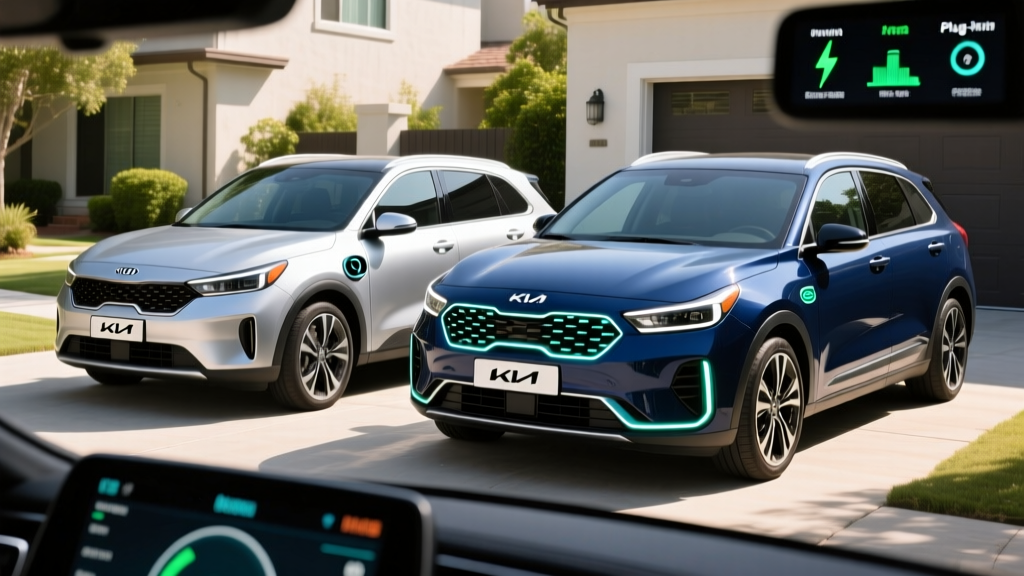
If you're searching for a Kia Niro hybrid plug in solution — or weighing the conventional hybrid against it — you're looking at one of the most practical electrified crossovers on the market. The 2026 Kia Niro comes in two distinct flavors: the Niro Hybrid (HEV) that never needs a plug, and the Niro Plug-In Hybrid (PHEV) that offers genuine electric-only commuting with a gas engine backup. Both share the same crossover body, but their powertrains, fuel economy, and ownership economics diverge significantly.
We've broken down every spec that matters — EPA MPG, electric range, battery size, charging time, pricing, and federal tax credit eligibility — so you can decide which Niro fits your driving pattern.
HEV vs PHEV: Understanding the Two Kia Niro Powertrains
Before comparing numbers, it's essential to understand what separates these two vehicles. A conventional hybrid (HEV) uses a small battery charged entirely by regenerative braking and the gas engine. You never plug it in. A plug-in hybrid (PHEV) carries a larger battery that you charge from a wall outlet or charging station, enabling electric-only driving for a set distance before the gas engine takes over.
| Feature | 2026 Niro Hybrid (HEV) | 2026 Niro Plug-In Hybrid (PHEV) |
|---|---|---|
| Plug-in required? | No — self-charging | Yes — for electric-only range |
| Battery capacity | 1.56 kWh | 11.1 kWh |
| Electric-only range | N/A (EV assist only) | 33 miles (EPA) |
| Total range | ~590 miles | ~430 miles (electric + gas) |
| Combined horsepower | 139 hp | 180 hp |
| EPA combined MPG / MPGe | 53 MPG | 108 MPGe (electric) / 48 MPG (gas) |
| DC fast charging | N/A | No — AC only |
| Starting MSRP | ~$28,590 | ~$35,790 |
The HEV is the simpler ownership play: fill up with gas and drive. The PHEV rewards drivers who can charge at home or work with dramatically lower fuel consumption on short commutes, while still offering a gas engine for road trips.
Fuel Economy: EPA MPG and Real-World Results
2026 Kia Niro Hybrid (HEV)
| Driving Cycle | EPA Estimate | Real-World Expectation |
|---|---|---|
| City | 53 MPG | 54–58 MPG (hybrids excel in stop-and-go) |
| Highway | 52 MPG | 47–50 MPG (aerodynamic drag reduces regen benefit) |
| Combined | 53 MPG | 50–55 MPG |
According to fueleconomy.gov, the Niro Hybrid achieves 53 MPG combined. In real-world driving, hybrids typically beat their EPA city estimates because regenerative braking recovers energy that gas cars waste as heat. Highway driving is the opposite — sustained speeds reduce the regen advantage, so expect 47–50 MPG on long freeway commutes. Cold weather can drop these figures by 5–10% due to reduced battery efficiency and cabin heating demands.
2026 Kia Niro Plug-In Hybrid (PHEV)
| Driving Cycle | EPA Estimate | Real-World Expectation |
|---|---|---|
| Electric-only (MPGe) | 108 MPGe | 95–110 MPGe (temperature dependent) |
| Electric-only range | 33 miles | 28–35 miles (shorter in cold/heat) |
| Gas-only combined MPG | 48 MPG | 44–50 MPG |
| Total range | ~430 miles | ~400–450 miles |
The PHEV's 33-mile electric-only range covers the average American's one-way commute with margin, per EPA data. If your daily round trip is under 30 miles and you charge nightly, you may go weeks without visiting a gas station. Once the battery depletes, the 1.6L engine kicks in and delivers a still-respectable 48 MPG combined.
Powertrain and Performance Specs
| Specification | Niro HEV | Niro PHEV |
|---|---|---|
| Engine | 1.6L GDI 4-cylinder | 1.6L GDI 4-cylinder |
| Engine output | 104 hp / 111 lb-ft | 104 hp / 111 lb-ft |
| Electric motor | 43 hp (32 kW) | 83 hp (62 kW) |
| Combined system output | 139 hp / 195 lb-ft | 180 hp / 195 lb-ft |
| Transmission | 6-speed dual-clutch (DCT) | 6-speed dual-clutch (DCT) |
| Drivetrain | Front-wheel drive | Front-wheel drive |
| 0–60 mph | ~9.8 seconds | ~7.4 seconds |
| Cargo volume (rear seats up) | 22.8 cu ft | 19.4 cu ft |
The PHEV's larger electric motor gives it a meaningful performance advantage: 180 combined horsepower and a 0–60 time roughly 2.4 seconds quicker than the HEV. That extra power is noticeable during highway merging and passing. The trade-off is slightly reduced cargo space — the PHEV's larger battery pack sits beneath the rear floor, shaving about 3.4 cubic feet.
Charging the Niro Plug-In Hybrid: What to Expect
The Niro PHEV's 11.1 kWh lithium-ion battery charges exclusively via AC power. There is no DC fast charging capability — a common limitation among plug-in hybrids, since their smaller batteries don't justify the cost and weight of DC hardware.
| Charging Method | Power | Time (0–100%) | Notes |
|---|---|---|---|
| Level 1 (120V household outlet) | ~1.4 kW | ~8 hours | Overnight on any standard outlet |
| Level 2 (240V home/public station) | ~3.3 kW (onboard charger limit) | ~2 hours 45 min | Requires Level 2 EVSE; limited by 3.3 kW onboard charger |
The onboard charger maxes out at 3.3 kW, so even if you plug into a 7.2 kW or 11.5 kW Level 2 station, the Niro PHEV will only draw 3.3 kW. This is perfectly adequate for overnight home charging — plug in when you get home and the battery is full well before morning. A standard 120V outlet works too, albeit slowly.
Preconditioning note: Unlike full EVs, the Niro PHEV does not actively precondition its battery for charging. In very cold weather (below 20°F), expect the electric-only range to drop to 22–26 miles as the battery's usable capacity temporarily shrinks and cabin heating draws additional power.
Pricing, Trims, and Federal Tax Credit Eligibility
2026 Kia Niro Hybrid Pricing
- LX: ~$28,590
- EX: ~$31,090
- SX Touring: ~$34,490
2026 Kia Niro Plug-In Hybrid Pricing
- EX: ~$35,790
- SX: ~$38,090
- X-Line: ~$39,490
Federal Tax Credit: Does the Niro Qualify?
Under the current IRS §30D Clean Vehicle Credit, the Niro Plug-In Hybrid may qualify for up to $3,750 — not the full $7,500. The reduced amount is because the PHEV must meet both critical minerals and battery component sourcing requirements, and the Niro's supply chain currently satisfies one of the two prongs (check current-year IRS guidance, as sourcing requirements tighten annually through 2030).
§30D eligibility requirements for the Niro PHEV:
- Vehicle MSRP must be ≤ $80,000 for SUVs/crossovers (Niro qualifies)
- Buyer modified AGI: ≤ $150,000 (single) / $225,000 (head of household) / $300,000 (joint)
- Battery capacity ≥ 7 kWh (Niro PHEV's 11.1 kWh qualifies)
- Vehicle must be assembled in North America (Niro PHEV is built in South Korea — this currently disqualifies it from the federal credit)
- Point-of-sale transfer available if all requirements are met
Important: The 2026 Niro PHEV is assembled in Hwaseong, South Korea. Under current §30D rules, North American final assembly is mandatory. This means the Niro PHEV does not qualify for the federal tax credit as of 2026. However, the Niro HEV never qualified for §30D regardless (conventional hybrids are excluded). Check with a tax professional and your state's incentive programs — some states (California, Colorado, New York) offer separate rebates for PHEVs that don't require domestic assembly.
Battery Warranty, Reliability, and Replacement Cost
Kia backs both Niro hybrid batteries with a 10-year/100,000-mile warranty — one of the longest in the industry. This covers the high-voltage traction battery against defects and capacity loss below approximately 70% of original capacity. For comparison, Toyota covers its hybrid batteries for 10 years/150,000 miles.
| Component | Warranty Coverage |
|---|---|
| Hybrid/PHEV battery | 10 years / 100,000 miles |
| Hybrid system components | 10 years / 100,000 miles |
| Basic vehicle | 5 years / 60,000 miles |
| Powertrain | 10 years / 100,000 miles |
Real-world reliability: Kia's hybrid powertrain has proven durable. The 1.6L GDI engine paired with the DCT transmission is shared across the Hyundai/Kia lineup (Ioniq, Sorento Hybrid) with millions of units on the road. The Niro's battery uses NMC (nickel-manganese-cobalt) chemistry, which offers good energy density. Degradation in PHEV batteries tends to be moderate — expect 85–92% capacity retention after 5 years of typical use, based on fleet data from similar Kia/Hyundai PHEV systems.
Battery replacement cost: If the high-voltage battery fails outside warranty, replacement runs approximately $3,000–$5,500 including parts and labor. The HEV's smaller 1.56 kWh battery is on the lower end of that range; the PHEV's 11.1 kWh pack is on the higher end. However, out-of-warranty hybrid battery failures remain rare — most units outlast the vehicle itself.
Who Should Buy the Niro Hybrid vs. the Plug-In vs. a Full EV?
Choose the Niro Hybrid (HEV) if:
- You can't charge at home or work (apartment, street parking)
- You want maximum simplicity — no plugs, no charging apps, no range planning
- Your budget is under $30,000 and you want 50+ MPG
- You drive a mix of city and highway with no predictable short-commute pattern
Choose the Niro Plug-In Hybrid (PHEV) if:
- You have access to a 120V or 240V outlet at home or work
- Your daily round-trip commute is 30 miles or less
- You want electric driving for errands but gas flexibility for road trips
- You want the performance boost (180 hp vs 139 hp)
Choose a full EV (like the Kia EV6 or Hyundai Ioniq 5) if:
- You have reliable Level 2 home charging
- Your daily driving is under 200 miles and you rarely exceed 250 miles between charge stops
- You want to eliminate oil changes, spark plugs, and transmission maintenance entirely
- You qualify for the full $7,500 federal tax credit on a qualifying EV
Niro Hybrid (HEV) Pros:
- 53 MPG combined — among the most efficient crossovers sold
- No charging infrastructure needed
- Low starting price ($28,590)
- 10-year/100,000-mile hybrid warranty
- Spacious 22.8 cu ft cargo area
Niro Hybrid (HEV) Cons:
- Slower acceleration (9.8s to 60 mph)
- No electric-only driving mode
- No federal tax credit eligibility
- FWD only — no AWD option
Niro Plug-In (PHEV) Pros:
- 33 miles electric-only covers most commutes
- 180 hp — noticeably quicker (7.4s to 60)
- 48 MPG even after battery is depleted
- 10-year/100,000-mile battery warranty
- Best of both worlds: electric daily, gas road trips
Niro Plug-In (PHEV) Cons:
- $7,200 price premium over HEV
- Reduced cargo space (19.4 cu ft)
- No DC fast charging
- Built in South Korea — currently no federal §30D credit
- 3.3 kW onboard charger limits Level 2 speed
Frequently Asked Questions
How many MPG does the Kia Niro Hybrid get?
The 2026 Kia Niro Hybrid achieves an EPA-estimated 53 MPG combined (53 city / 52 highway). In real-world city driving with frequent stops, many owners report 54–58 MPG thanks to aggressive regenerative braking. Highway-only driving typically yields 47–50 MPG.
How far can the Kia Niro Plug-In Hybrid go on electric only?
The 2026 Niro PHEV delivers an EPA-estimated 33 miles of electric-only range on a full charge. Real-world results vary: expect 28–35 miles in mild weather, dropping to 22–26 miles in sub-freezing temperatures when battery efficiency decreases and cabin heating draws additional energy.
Does the Kia Niro Plug-In Hybrid qualify for a federal tax credit?
As of 2026, the Niro PHEV does not qualify for the federal §30D Clean Vehicle Credit because it is assembled in South Korea, and the credit requires North American final assembly. The conventional Niro Hybrid is not eligible regardless, as §30D covers only plug-in vehicles with ≥ 7 kWh batteries. State-level incentives may still apply — check your state's energy or DMV website.
Is the Kia Niro Hybrid reliable, and what does battery replacement cost?
Kia's hybrid system has demonstrated strong reliability across multiple model years. The high-voltage battery is covered by a 10-year/100,000-mile warranty. Out-of-warranty replacement costs approximately $3,000–$5,500 depending on whether it's the HEV (smaller battery) or PHEV (larger battery). Battery failures within the first 150,000 miles are uncommon based on fleet and owner data.
Do I need to plug in the Kia Niro Hybrid?
No. The conventional Niro Hybrid (HEV) charges its 1.56 kWh battery through regenerative braking and the gas engine. You never plug it in. Only the Niro Plug-In Hybrid (PHEV) benefits from being plugged in — doing so unlocks the 33-mile electric-only range.
Can the Niro Plug-In Hybrid DC fast charge?
No. The Niro PHEV charges exclusively via AC power — either a standard 120V outlet (Level 1, ~8 hours) or a 240V Level 2 station (~2 hours 45 minutes). The onboard charger is limited to 3.3 kW, so higher-power Level 2 stations won't charge it any faster. This is typical for PHEVs with smaller battery packs.
Hybrid vs. PHEV vs. EV — which Kia should I buy?
If you lack home charging access, the Niro HEV is the clear choice — 53 MPG with zero behavior change. If you can charge at home and commute under 30 miles daily, the Niro PHEV lets you drive on electricity most days while keeping a gas engine for longer trips. If you have Level 2 home charging, rarely drive over 200 miles daily, and want zero tailpipe emissions plus lower maintenance, consider a full EV like the Kia EV6 (310-mile EPA range) — which does qualify for federal tax credits.