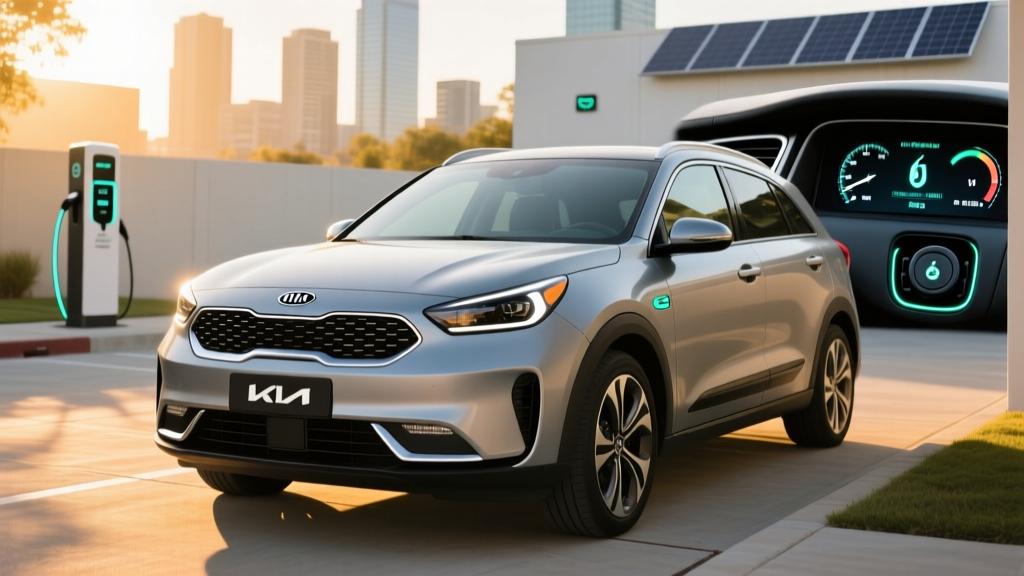
If you are researching the Kia Niro hybrid gas mileage before your next purchase, you are looking at one of the most fuel-efficient crossover nameplates on the market. The Niro comes in two distinct electrified flavors — a conventional hybrid (HEV) that never needs to be plugged in, and a plug-in hybrid (PHEV) that offers a meaningful electric-only commute before the gasoline engine kicks in. Both share a compact crossover footprint, Kia's latest infotainment tech, and a starting price well below most EVs. But the numbers that matter — EPA MPG, electric range, battery size, and total cost of ownership — differ significantly between the two.
This guide breaks down every efficiency figure, battery spec, warranty term, and tax-credit detail you need to decide whether the Niro HEV, the Niro PHEV, or a full battery-electric vehicle is the right move for your driveway in 2026.
Kia Niro Hybrid (HEV) vs. Niro Plug-In Hybrid (PHEV): What's the Difference?
Before we get into the MPG tables, it is critical to understand the mechanical divide between these two vehicles. They share a platform but serve different ownership patterns.
| Attribute | 2026 Niro Hybrid (HEV) | 2026 Niro Plug-In Hybrid (PHEV) |
|---|---|---|
| Plug-in charging required? | No — self-charging via regen and engine | Yes — plug in to access electric-only range |
| Battery capacity | ~1.3 kWh (small buffer) | 11.1 kWh usable (lithium-ion polymer) |
| EPA electric-only range | N/A (EV assist only at low speed) | 33 miles (EV mode) |
| EPA combined MPG (hybrid mode) | 53 MPG combined | 48 MPG combined (after battery depleted) |
| EPA MPGe (PHEV charge-depleting) | N/A | 108 MPGe combined |
| Combined system horsepower | 139 hp | 180 hp |
| DC fast charging | No | No (AC Level 2 only) |
| Starting MSRP (2026) | $28,415 (LX) | $35,815 (LX) |
The HEV is a traditional hybrid: the gasoline engine and electric motor work together seamlessly, and the small battery is recharged by regenerative braking and the engine. You never plug it in. The PHEV, by contrast, carries a much larger battery that you charge from a wall outlet or Level 2 station, giving you roughly 33 miles of pure electric driving before it reverts to hybrid operation.
How Many MPG Does the Kia Niro Hybrid Get?
The headline number that draws most buyers to the Niro HEV is its EPA-estimated fuel economy. Here is the full breakdown by trim and drivetrain configuration, sourced from fueleconomy.gov:
| 2026 Niro HEV Trim | City MPG | Highway MPG | Combined MPG | Annual Fuel Cost* |
|---|---|---|---|---|
| LX / EX | 53 | 54 | 53 | $1,050 |
| EX Touring / SX Touring | 49 | 52 | 50 | $1,100 |
*Based on 15,000 miles/year, 55% city / 45% highway, and $3.10/gallon regular unleaded. Actual costs vary with local fuel prices and driving habits.
A few things stand out. First, the base Niro HEV achieves 53 MPG combined — a figure that puts it in elite company among crossovers. Second, the highway number (54 MPG) is nearly identical to the city number, which is unusual for hybrids. Most hybrids dramatically favor city driving because regenerative braking recaptures energy in stop-and-go traffic while the engine runs at its most efficient at low loads. The Niro's 1.6-liter Atkinson-cycle four-cylinder and well-calibrated 6-speed dual-clutch automatic help it maintain strong highway efficiency.
Real-World MPG: Does the Niro Hybrid Beat Its EPA Sticker?
Based on aggregated owner reports and independent testing, the Niro HEV frequently exceeds its EPA city estimate in real-world urban and suburban driving. Drivers who do a high proportion of stop-and-go commuting regularly report 55–58 MPG in warm weather. On long highway trips at 75+ mph, expect a slight dip to around 48–50 MPG as aerodynamic drag increases.
Cold weather is the main efficiency killer for hybrids. In temperatures below freezing, the engine must run more often to provide cabin heat (the Niro HEV lacks a heat pump, which is reserved for the EV variant), and battery efficiency drops. Expect real-world combined MPG to fall to roughly 45–48 MPG in sustained sub-30°F conditions.
Niro PHEV: Electric-Only Range, MPGe, and Total Range
For buyers with a short commute and access to home or workplace charging, the Niro PHEV changes the math entirely. Its 11.1 kWh lithium-ion polymer battery delivers an EPA-estimated 33 miles of electric-only driving. That covers the average American one-way commute of roughly 16 miles with room to spare, meaning many PHEV owners go weeks without visiting a gas station.
| 2026 Niro PHEV Specification | Value |
|---|---|
| EPA electric-only range | 33 miles |
| EPA MPGe (charge-depleting) | 108 MPGe combined |
| EPA MPG (charge-sustaining / hybrid mode) | 48 MPG combined (46 city / 52 hwy) |
| Total combined range (EV + gas) | ~560 miles |
| Battery capacity (usable) | 11.1 kWh |
| Onboard charger (AC Level 2) | 3.3 kW |
| Level 2 charge time (0–100%) | ~2 hours 45 minutes |
| Level 1 charge time (120V, 12A) | ~9 hours |
| DC fast charging capable? | No |
| Combined system output | 180 hp / 195 lb-ft torque |
| 0–60 mph | ~7.2 seconds (est.) |
| Gas tank capacity | 11.1 gallons |
The PHEV's 3.3 kW onboard charger means a full charge takes under three hours on a 240-volt Level 2 home station. If you plug into a standard 120V household outlet overnight, you will wake up to a full battery in about nine hours. The absence of DC fast charging is a limitation worth noting: you cannot use public 50+ kW chargers to top up on road trips. However, for a PHEV designed around home and workplace charging, this is a reasonable trade-off.
Real-World Electric Range: What to Actually Expect
The 33-mile EPA electric range is achievable in moderate temperatures (50–80°F) with mixed city/highway driving at moderate speeds. In our experience and consistent with owner reports, warm-weather suburban driving with regenerative braking can push actual electric range to 35–37 miles. Cold weather (below 35°F) reduces electric range by 20–30%, dropping it to roughly 23–27 miles, as the system draws power for cabin heating and battery conditioning.
Once the battery is depleted, the Niro PHEV operates as a conventional hybrid at 48 MPG combined — still excellent, though slightly below the HEV's 53 MPG due to the extra weight of the larger battery pack (~230 lbs more than the HEV).
Powertrain Deep Dive: What's Under the Hood
Both Niro variants share Kia's 1.6-liter GDI four-cylinder engine operating on the Atkinson cycle for maximum thermal efficiency. The differences lie in the electric motor and battery integration:
- Niro HEV: The 1.6L engine produces 104 hp and is paired with a 32 kW (43 hp) electric motor integrated into the 6-speed dual-clutch transmission. Combined system output is 139 hp and 195 lb-ft of torque. The small 1.3 kWh lithium-ion battery sits under the rear seat, preserving cargo space.
- Niro PHEV: The same 1.6L engine is paired with a more powerful 62 kW (83 hp) electric motor, yielding a combined 180 hp and 195 lb-ft of torque. The larger 11.1 kWh battery is positioned low in the chassis. The PHEV feels noticeably quicker off the line thanks to the stronger electric motor, and it delivers a 0–60 time of roughly 7.2 seconds versus the HEV's ~9.5 seconds.
Both models use a 6-speed dual-clutch automatic transmission rather than the continuously variable transmission (CVT) found in the Toyota Prius. This gives the Niro a more traditional, engaging driving feel with distinct gear shifts, though CVTs can sometimes extract marginally better efficiency from a hybrid powertrain.
Pricing, Trims, and Tax Credit Eligibility
The 2026 Niro lineup is priced to undercut most compact EVs and compete directly with hybrid rivals like the Toyota Prius and Hyundai Ioniq (now discontinued in the U.S., making the Niro a stronger option).
| 2026 Niro Trim | Body Style | MSRP (incl. destination) |
|---|---|---|
| LX | HEV | $28,415 |
| EX | HEV | $30,015 |
| EX Touring | HEV | $32,615 |
| SX Touring | HEV | $35,215 |
| LX | PHEV | $35,815 |
| EX | PHEV | $37,415 |
| SX Touring | PHEV | $41,015 |
Does the Kia Niro Qualify for a Federal Tax Credit?
Here is where the HEV and PHEV diverge sharply:
- Niro HEV (conventional hybrid): Does not qualify for the federal §30D new clean vehicle tax credit. The IRS credit is reserved for plug-in electric vehicles with sufficient battery capacity. Conventional hybrids are not eligible. Some states may offer minor hybrid incentives, but these are uncommon and vary by jurisdiction.
- Niro PHEV (plug-in hybrid): Eligibility for the up-to-$7,500 federal tax credit under IRS §30D depends on several factors that change frequently:
- MSRP cap: The PHEV must have an MSRP at or below $80,000 for SUVs (the Niro qualifies as an SUV per IRS classification). All Niro PHEV trims clear this bar.
- Buyer income cap: Modified adjusted gross income must not exceed $150,000 (single), $225,000 (head of household), or $300,000 (joint filers).
- Battery sourcing and critical minerals: A portion of the credit depends on whether the battery components and critical minerals meet North American sourcing thresholds, which tighten each year. The exact credit amount — $3,750, $7,500, or somewhere in between — depends on the model year's compliance status.
- Point-of-sale transfer: As of 2024, eligible buyers can transfer the credit to the dealer at purchase, reducing the out-of-pocket price immediately rather than waiting to claim it on their tax return.
Important: Tax credit rules are subject to legislative and regulatory changes. Always verify current eligibility on IRS.gov and consult a tax professional before making a purchase decision based on credit assumptions.
Battery Warranty, Reliability, and Replacement Cost
Battery longevity is the single most common concern among first-time hybrid buyers. Here, the Niro is well-covered.
Kia Niro Hybrid & PHEV Battery Warranty
- Hybrid/EV battery warranty: 10 years / 100,000 miles (whichever comes first)
- Hybrid system components: 10 years / 100,000 miles (inverter, motor, onboard charger)
- Bumper-to-bumper: 5 years / 60,000 miles
- Powertrain (engine, transmission): 10 years / 100,000 miles
- Capacity retention threshold: Kia warrants the PHEV battery against dropping below approximately 70% of original capacity during the warranty period
Real-World Reliability
Kia's 1.6L hybrid powertrain has been in production since the first-generation Niro (2017) and has accumulated a strong reliability track record. The hybrid battery in the HEV is small (1.3 kWh) and experiences shallow charge cycles, which is gentle on cell longevity. Many first-gen Niro HEVs have surpassed 150,000 miles with no battery replacement needed.
The PHEV's larger 11.1 kWh battery sees deeper cycles but benefits from Kia's conservative buffer management — the system never fully depletes or fully charges the pack, which extends cell life. Real-world degradation for the PHEV battery is typically 5–10% over the first five years, meaning a 33-mile electric range might become 29–31 miles by year five — a modest decline.
Battery Replacement Cost
If a battery replacement is needed outside of warranty, expect the following approximate costs (parts + labor at a Kia dealer):
- Niro HEV battery pack: $2,000–$3,500
- Niro PHEV battery pack: $5,000–$7,500
These are significant sums, but with the 10-year/100,000-mile warranty, most original owners will never face this expense. Second owners should verify remaining warranty coverage via the VIN at a Kia dealer.
Who Should Choose the Niro HEV, the PHEV, or a Full EV?
The right choice depends on your daily driving pattern, charging access, and budget. Here is a practical decision framework:
Choose the Niro HEV if:
- You want maximum simplicity — no plugging in, no charging logistics
- You drive 30–60 miles per day in mixed city/highway conditions
- You live in an apartment or lack access to home/workplace charging
- You want the lowest purchase price ($28,415 starting)
- You prioritize 53 MPG combined without any behavioral changes
Choose the Niro PHEV if:
- Your daily round-trip commute is under 33 miles and you can charge at home
- You want to drive on electricity most days but need a gas engine for road trips
- You qualify for the federal tax credit, narrowing the price gap with the HEV
- You want the extra 41 hp for more confident acceleration
- You want to reduce gasoline consumption by 60–80% without range anxiety
Choose a full EV (e.g., Kia Niro EV or Hyundai Ioniq 5) if:
- You have reliable home Level 2 charging and your daily driving is under 200 miles
- You want zero tailpipe emissions and the lowest per-mile "fuel" cost
- You want to eliminate oil changes, spark plugs, and transmission maintenance entirely
- You qualify for the full $7,500 federal credit, making the EV price-competitive
Pros and Cons at a Glance
Pros
- Class-leading 53 MPG combined (HEV) — among the best of any crossover
- 33-mile electric-only range (PHEV) covers most commutes gas-free
- 10-year / 100,000-mile hybrid battery and powertrain warranty
- Comfortable ride quality and surprisingly spacious cargo area (22.8 cu ft behind rear seats)
- Available highway driving assist and smart cruise control with stop-and-go
- Dual-clutch transmission avoids the "rubber band" feel of CVTs
Cons
- No DC fast charging on the PHEV — limits road-trip electric top-ups
- HEV does not qualify for the federal §30D tax credit
- Base LX trim uses a smaller 8-inch display; 10.25-inch screen requires EX or above
- All-wheel drive is not available (FWD only)
- Highway noise insulation is adequate but not premium at 70+ mph
- PHEV cargo space slightly reduced due to larger battery placement
Frequently Asked Questions
How many MPG does the 2026 Kia Niro Hybrid get in real-world driving?
The EPA rates the Niro HEV at 53 MPG combined (53 city / 54 highway) for the LX and EX trims. In real-world conditions, owners frequently report 55–58 MPG in city-heavy driving during warm weather. Highway-only driving at 75 mph yields around 48–50 MPG. Cold weather reduces efficiency to roughly 45–48 MPG combined.
How far can the Kia Niro PHEV go on electric power alone?
The EPA rates the Niro PHEV at 33 miles of electric-only range. In warm-weather suburban driving with regenerative braking, some owners achieve 35–37 miles. In cold weather (below 35°F), expect 23–27 miles due to cabin heating demands and reduced battery efficiency.
Does the Kia Niro Hybrid need to be plugged in?
No. The conventional Niro HEV charges its small battery through regenerative braking and the gasoline engine. You never plug it in. Only the Niro PHEV requires (or benefits from) plug-in charging to access its electric-only range.
Does the 2026 Kia Niro qualify for the $7,500 federal tax credit?
The Niro HEV does not qualify — it is not a plug-in vehicle. The Niro PHEV may qualify for up to $7,500 under IRS §30D, subject to buyer income limits ($150K single / $300K joint), MSRP caps (all trims qualify), and battery critical-mineral sourcing requirements that change annually. Verify current eligibility at IRS.gov before purchasing.
How long does the Kia Niro hybrid battery last?
Kia covers the hybrid battery for 10 years or 100,000 miles. Real-world data from first-generation Niros (2017+) shows many HEV batteries lasting 150,000+ miles with minimal degradation. The PHEV battery typically loses 5–10% capacity over five years due to Kia's conservative charge-buffer management. Out-of-warranty replacement costs $2,000–$3,500 (HEV) or $5,000–$7,500 (PHEV).
Is the Kia Niro Hybrid more reliable than a full EV?
Both are proven technologies. The Niro HEV has more moving parts (engine, transmission, exhaust) than a battery-electric vehicle, which means more scheduled maintenance (oil changes, filter replacements). However, Kia's hybrid system has a strong track record since 2017, and the 10-year powertrain warranty provides excellent coverage. Full EVs have fewer mechanical wear items but carry higher battery replacement risk after warranty expiration.
How does the Niro Hybrid compare to the Toyota Prius on gas mileage?
The 2026 Toyota Prius achieves up to 57 MPG combined (LE FWD), edging out the Niro HEV's 53 MPG by 4 MPG. However, the Prius is a liftback sedan with less cargo height and ground clearance than the Niro crossover. The Niro offers 22.8 cu ft of cargo space versus the Prius's 23.8 cu ft — similar on paper, but the Niro's taller roof makes it more practical for bulky items. Your choice depends on whether you prioritize maximum MPG (Prius) or crossover utility (Niro).