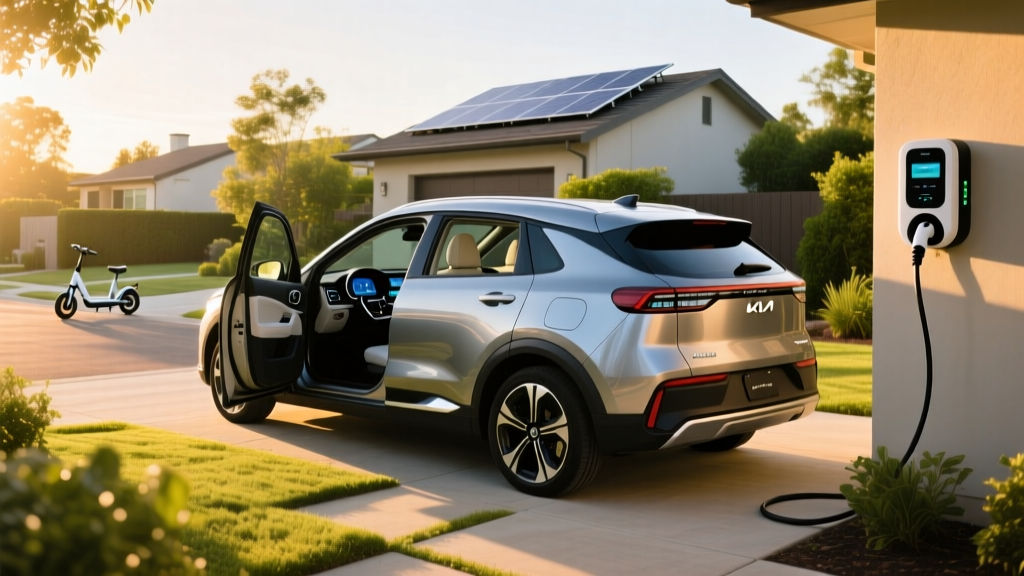
If you want electrified efficiency without ever plugging in, the 2025 Kia Niro Hybrid occupies a practical sweet spot: compact crossover utility, proven hybrid powertrain reliability, and fuel economy that routinely beats its EPA estimates in city driving. Now in its second generation (redesigned for 2023), the Niro Hybrid continues into 2025 with minor packaging updates and a starting price that undercuts most hybrid SUV competitors.
But Kia also sells the Niro Plug-In Hybrid (PHEV) alongside the conventional hybrid — and the two powertrains serve very different buyers. This guide breaks down exact MPG figures, real-world efficiency expectations, powertrain specs, battery longevity, and the tax-credit landscape so you can decide which Niro (if either) fits your driveway.
HEV vs PHEV: Which 2025 Kia Niro Is Which?
Before diving into numbers, let's eliminate the most common confusion. Kia sells two electrified Niro variants in the US, and they work fundamentally differently:
| Attribute | Niro Hybrid (HEV) | Niro Plug-In Hybrid (PHEV) |
|---|---|---|
| Plug in to charge? | No — charges via engine and regen braking | Yes — has a charge port (J1772/CCS) |
| Electric-only driving | Brief low-speed EV mode only | Up to 33 miles EPA on battery alone |
| Battery size | ~1.56 kWh (small, self-charging) | 11.1 kWh usable (lithium-ion polymer) |
| Combined system HP | 139 hp | 180 hp |
| EPA combined MPG / MPGe | 49–53 MPG | 48 MPG (gas) / 108 MPGe (electric) |
| Starting MSRP (2025) | ~$27,390 | ~$34,390 |
| Federal tax credit | None | Up to $3,902 (subject to §30D sourcing rules) |
The conventional Niro HEV is a true "gas and go" vehicle. Its small battery assists the gasoline engine and recovers energy during braking, but you never plug it in. The Niro PHEV, by contrast, offers meaningful electric-only commuting range and a larger battery you charge at home or at public Level 2 stations — but it also has a gas engine for longer trips, eliminating the range anxiety some buyers feel with full battery-electric vehicles.
Fuel Economy: EPA Ratings and Real-World MPG
The 2025 Niro Hybrid's headline number is its EPA-estimated fuel economy, which varies slightly by trim due to wheel size and equipment weight:
| Trim | City MPG | Highway MPG | Combined MPG |
|---|---|---|---|
| LX / EX (16" wheels) | 53 | 54 | 53 |
| SX / SX Touring (18" wheels) | 49 | 52 | 50 |
Source: EPA fueleconomy.gov
Those numbers are impressive for a crossover, but real-world results depend heavily on your driving mix. Here's what owners and testers consistently report:
- City driving: Hybrids shine in stop-and-go traffic, where regenerative braking recaptures energy and the electric motor handles low-speed propulsion. Expect 54–58 MPG in urban conditions — often beating the EPA city estimate.
- Highway driving: At sustained 70–80 mph speeds, the gasoline engine does most of the work. Real-world highway economy tends to land around 44–48 MPG, below the EPA highway sticker.
- Cold weather: Below 40°F, expect a 5–10% drop in fuel economy as the engine runs more frequently to generate cabin heat and warm the catalytic converter.
- Combined real-world: Most owners report 48–52 MPG in mixed driving over a full tank, closely tracking the EPA combined figure for the lower trims.
For the PHEV variant, the EPA rates it at 108 MPGe when operating on battery power and 48 MPG combined once the battery is depleted and the gas engine takes over. The 33-mile electric-only range covers many commutes entirely on electricity — meaning some PHEV owners burn almost no gasoline on weekdays.
Powertrain Deep Dive: What Moves the Niro Hybrid
The 2025 Niro Hybrid pairs a 1.6-liter four-cylinder gasoline engine (producing 104 hp and 111 lb-ft of torque) with a 32-kW permanent-magnet synchronous electric motor integrated into a 6-speed dual-clutch automatic transmission (DCT). Combined system output is 139 horsepower and 195 lb-ft of torque.
This is a parallel hybrid architecture — both the engine and the motor can drive the front wheels, and the DCT gives it a more direct, responsive feel than the continuously variable transmissions (CVTs) found in the Toyota Prius and RAV4 Hybrid. The trade-off is that you may notice occasional gear shifts, whereas a CVT delivers seamless (if droning) acceleration.
The Niro PHEV upgrades the electric motor to 62 kW (83 hp) and pairs it with a larger 11.1 kWh lithium-ion polymer battery pack, raising combined output to 180 horsepower and 195 lb-ft. The extra power makes the PHEV noticeably quicker — 0–60 mph in roughly 7.2 seconds versus the HEV's ~9.5-second sprint.
| Specification | Niro HEV | Niro PHEV |
|---|---|---|
| Engine | 1.6L I4 GDI | 1.6L I4 GDI |
| Electric motor | 32 kW (43 hp) | 62 kW (83 hp) |
| Combined HP | 139 hp | 180 hp |
| Combined torque | 195 lb-ft | 195 lb-ft |
| Transmission | 6-speed DCT | 6-speed DCT |
| Battery capacity | ~1.56 kWh | 11.1 kWh |
| Drivetrain | FWD | FWD |
| 0–60 mph | ~9.5 sec | ~7.2 sec |
| Towing capacity | Not rated | Not rated |
Niro PHEV Charging: Battery, Times, and the DC Fast-Charging Gap
If you're considering the PHEV, understanding its charging profile is essential. The 11.1 kWh battery charges as follows:
- Level 1 (120V household outlet): Approximately 9–10 hours for a full charge using the included portable cord. Adequate if you drive fewer than 30 miles daily and can plug in overnight.
- Level 2 (240V home or public station): Approximately 2 hours 45 minutes from empty to full at the PHEV's onboard charger rate of ~3.3 kW.
- DC fast charging: The Niro PHEV does not support DC fast charging. This is typical for PHEVs — their smaller batteries and lower-power onboard chargers make DC fast-charging hardware impractical. You'll rely entirely on Level 1 and Level 2 AC charging.
For context, a 3.3 kW charge rate means you add roughly 10–12 miles of electric range per hour of Level 2 charging. That's perfectly adequate for overnight replenishment but means you can't quickly top up at a public fast-charging station during a road trip. On longer drives, the gas engine seamlessly takes over once the battery is depleted.
Pricing, Trims, and Tax Credit Eligibility
The 2025 Niro Hybrid lineup starts at an accessible price point, with the PHEV commanding a significant premium justified by its electric range and higher output:
- Niro Hybrid LX: ~$27,390 MSRP
- Niro Hybrid EX: ~$29,790 MSRP
- Niro Hybrid SX Touring: ~$33,490 MSRP
- Niro Plug-In Hybrid EX: ~$34,390 MSRP
- Niro Plug-In Hybrid SX / SX Prestige: ~$36,090–$37,390 MSRP
Federal Tax Credit: The §30D Picture
The conventional Niro HEV does not qualify for the federal §30D clean vehicle tax credit — that credit applies only to plug-in electric vehicles (BEVs and PHEVs) meeting battery-sourcing and critical-minerals requirements.
The Niro PHEV may qualify for a partial federal tax credit. As of 2025, the PHEV is eligible for up to $3,902 under §30D, depending on whether it meets the critical-minerals and battery-component sourcing thresholds set by the IRS. This amount can be transferred to the dealer at point of sale as a purchase discount, or claimed on your tax return.
Key §30D eligibility requirements for the Niro PHEV (per IRS guidelines):
- Vehicle MSRP must not exceed $80,000 for SUVs (Niro PHEV qualifies)
- Buyer modified AGI must not exceed $150,000 (single) / $300,000 (joint)
- Battery must meet critical-minerals and component-sourcing phase-in thresholds
- Vehicle must be assembled in North America (Niro is assembled in South Korea — this may disqualify it depending on current-year interpretation of final-assembly rules for PHEVs)
Critical caveat: The Kia Niro is manufactured in South Korea. Under current §30D rules, vehicles must undergo final assembly in North America to qualify for the new-vehicle credit. This has historically disqualified the Niro PHEV from the federal credit. Always verify current eligibility on the IRS clean vehicle credit page or with a tax professional before counting on credit dollars in your purchase budget.
Battery Warranty, Reliability, and Replacement Costs
Kia Hybrid/PHEV Battery Warranty: 10 years / 100,000 miles (whichever comes first), covering defects and capacity loss below a specified threshold. The broader hybrid system (motor, inverter, control electronics) is also covered under the 10-year/100,000-mile powertrain warranty.
Kia's hybrid battery warranty is among the best in the industry, matched by Hyundai and Genesis but exceeding Toyota's 10-year/150,000-mile coverage only in the mileage dimension (Toyota actually goes further on miles in many states). For most original owners, the battery will remain under warranty for the entire period they own the vehicle.
On reliability, the second-generation Niro's 1.6L hybrid powertrain has proven durable since its 2023 introduction. Kia's hybrid DCT has been more reliable than early-generation units from other manufacturers, though some owners report occasional low-speed shift hesitation — a characteristic of DCTs rather than a defect. The Niro earned strong marks from Consumer Reports for predicted reliability in the hybrid category.
Battery Replacement Cost: What If It Fails Out of Warranty?
If you're a second owner or plan to keep the Niro well past 100,000 miles, out-of-warranty battery replacement is a legitimate concern:
- Niro HEV battery replacement: Estimated $2,000–$3,500 for the smaller ~1.56 kWh pack, including labor.
- Niro PHEV battery replacement: Estimated $5,000–$8,000 for the 11.1 kWh pack, including labor.
In practice, modern lithium-ion hybrid batteries rarely fail catastrophically. More common is gradual capacity loss (degradation) over 10–15 years. A PHEV battery that has degraded to 70–80% of original capacity still provides 23–26 miles of electric range — perfectly usable for most commutes. Complete failure requiring full replacement before 150,000 miles is uncommon based on industry data from first-generation Niro and Hyundai Ioniq PHEV batteries.
Niro Hybrid vs PHEV vs Full EV: Which Fits Your Life?
Choose the Niro HEV if:
- You don't have access to home or workplace charging
- You want maximum fuel economy with zero behavior change
- Your budget is under $30,000
- You drive mostly city and suburban miles
Choose the Niro PHEV if:
- You can install a Level 2 charger at home or have reliable workplace charging
- Your daily commute is under 30 miles round-trip
- You want electric commuting but need gas flexibility for road trips
- You value the extra 41 hp and quicker acceleration
Choose a full EV (like the Kia EV6 or Hyundai Ioniq 5) if:
- You have reliable home Level 2 charging
- Your daily driving is under 200 miles
- You want zero tailpipe emissions and minimal maintenance
- You're eligible for the full $7,500 federal EV tax credit
The Niro Hybrid makes the most sense for apartment dwellers, street-parkers, and anyone who simply wants to fill up at a gas station and drive. The PHEV is ideal for homeowners with a garage who want to experiment with electric commuting without committing to a full EV. And if you've already confirmed home charging access and your daily mileage is modest, a full EV like Kia's own EV6 will deliver lower per-mile energy costs and access to the full federal tax credit.
Pros and Cons at a Glance
Pros
- 53 MPG combined (HEV LX/EX) — among the most efficient crossovers sold
- Real-world city MPG often exceeds EPA estimates
- 10-year / 100,000-mile hybrid battery warranty
- Spacious cabin and cargo area for the compact segment (22.8 cu ft behind rear seats)
- Dual-clutch transmission feels more engaging than competitor CVTs
- Competitive starting price under $28,000
- PHEV offers usable 33-mile electric range for commuters
Cons
- HEV acceleration is leisurely (~9.5 sec to 60 mph)
- FWD only — no AWD option (competitors like RAV4 Hybrid offer AWD)
- Not assembled in North America — likely ineligible for federal tax credit
- PHEV lacks DC fast charging
- 18" wheel trims drop HEV fuel economy by ~3 MPG
- Road noise on highway is noticeable compared to some rivals
- Infotainment, while improved, still uses a resistive-touch climate panel
Frequently Asked Questions
How many MPG does the 2025 Kia Niro Hybrid actually get?
The EPA rates the Niro Hybrid LX and EX at 53 city / 54 highway / 53 combined MPG. Higher SX and SX Touring trims with 18-inch wheels are rated at 49/52/50 MPG. In real-world driving, expect 54–58 MPG in city traffic and 44–48 MPG on the highway. Most owners average 48–52 MPG combined.
How far can the Niro PHEV go on electric only?
The EPA rates the Niro PHEV at 33 miles of electric-only range. In mild weather with moderate speeds, some drivers squeeze out 35–37 miles. In cold weather or at highway speeds, expect 25–28 miles before the gas engine engages.
Does the 2025 Kia Niro Hybrid qualify for a tax credit?
The conventional Niro HEV does not qualify for any federal tax credit. The Niro PHEV is potentially eligible for up to $3,902 under §30D, but because it is assembled in South Korea, it likely fails the North American final-assembly requirement. Verify current status on the fueleconomy.gov tax credit page before purchasing.
Is the Kia Niro Hybrid reliable?
Yes. Kia's 1.6L hybrid powertrain has a strong reliability record since the 2023 redesign. The hybrid battery is covered by a 10-year/100,000-mile warranty. Independent reliability surveys from Consumer Reports rate the Niro Hybrid favorably within the compact hybrid SUV category.
What does it cost to replace the Niro Hybrid battery?
Out-of-warranty replacement runs approximately $2,000–$3,500 for the HEV and $5,000–$8,000 for the PHEV. However, catastrophic battery failure is rare — most hybrid batteries lose capacity gradually over 10–15 years and remain functional well past 150,000 miles.
Does the Niro Hybrid need to be plugged in?
No. The conventional Niro Hybrid (HEV) charges its battery through regenerative braking and the gasoline engine. You never plug it in. Only the Niro Plug-In Hybrid (PHEV) has a charge port and benefits from being plugged in.
Is AWD available on the 2025 Niro Hybrid?
No. Both the Niro HEV and PHEV are front-wheel drive only. If AWD is a priority, consider the Toyota RAV4 Hybrid (39 MPG combined, AWD standard) or the Hyundai Tucson Hybrid (37–38 MPG combined, AWD available).