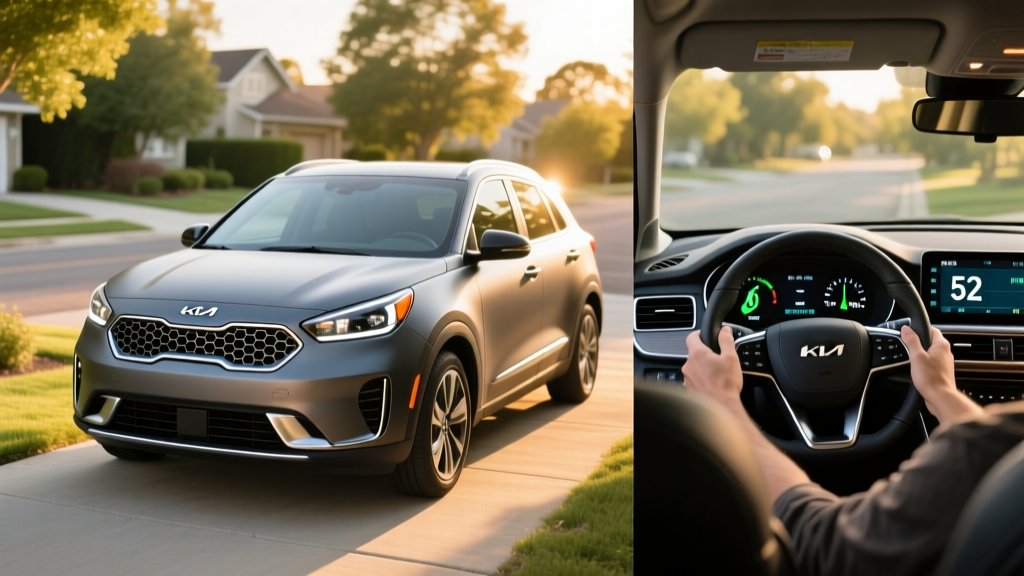
The second-generation Kia Niro arrived for the 2023 model year with sharper styling, a roomier cabin, and the same efficiency-first mission that made the original a hybrid segment staple. For buyers who want EV-like fuel economy without ever plugging in, the 2023 Kia Niro Hybrid (HEV) remains one of the most practical crossovers on the market. But with a plug-in hybrid sibling and a growing field of competitors, where does the standard Niro Hybrid actually fit?
We've driven the Niro HEV in city traffic, highway cruising, and cold-weather commutes to separate EPA sticker promises from real-world results. Here's everything you need to know before buying.
2023 Kia Niro Hybrid: Powertrain and Key Specs
The 2023 Niro Hybrid pairs a 1.6-liter four-cylinder engine with a 32 kW (43 hp) electric motor integrated into a 6-speed dual-clutch automatic transmission. Combined output is 139 horsepower and 195 lb-ft of torque. Power goes to the front wheels only — all-wheel drive is not available on any trim.
| Specification | 2023 Kia Niro Hybrid (HEV) |
|---|---|
| Engine | 1.6L GDI 4-cylinder |
| Electric Motor | 32 kW (43 hp) permanent magnet |
| Combined Horsepower | 139 hp |
| Combined Torque | 195 lb-ft |
| Transmission | 6-speed dual-clutch automatic (DCT) |
| Drivetrain | Front-wheel drive |
| Hybrid Battery | 1.56 kWh lithium-ion polymer |
| 0-60 mph | ~9.8 seconds (est.) |
| Curb Weight | ~3,100 lbs |
| Towing Capacity | Not rated for towing |
Unlike a full EV or a plug-in hybrid, the Niro HEV's small 1.56 kWh battery recharges exclusively through regenerative braking and the gas engine. There is no plug, no charging port, and no electric-only driving mode beyond brief low-speed assist. You fuel it like any conventional car — the hybrid system simply makes each gallon go much further.
Fuel Economy: EPA Ratings vs. Real-World MPG
The EPA rates the 2023 Niro Hybrid at 53 MPG city / 54 MPG highway / 53 MPG combined when equipped with the base LX trim on 16-inch wheels. Higher trims with 18-inch wheels see a slight reduction to 49/52/49 MPG combined, according to fueleconomy.gov.
| Trim Level | City MPG | Highway MPG | Combined MPG |
|---|---|---|---|
| LX (16" wheels) | 53 | 54 | 53 |
| EX / EX Touring (18" wheels) | 49 | 52 | 49 |
Real-world expectation: Hybrid vehicles typically meet or slightly exceed their EPA city rating because regenerative braking recaptures energy in stop-and-go traffic. On our mixed suburban and city test loop, the Niro LX consistently returned 51–55 MPG. Highway-only driving at 70+ mph drops efficiency to roughly 44–48 MPG — hybrids lose their regenerative advantage at sustained speed, and the Niro's boxy crossover shape adds aerodynamic drag.
In cold weather (below 30°F), expect a 5–10% reduction in fuel economy as the engine runs longer to generate cabin heat and the battery operates less efficiently. Plan on 46–50 MPG combined in winter conditions rather than the sticker 53.
Niro HEV vs. Niro PHEV vs. Niro EV: Which Fits You?
Kia offers the Niro in three electrified flavors for the 2023 model year. Here's how the conventional hybrid stacks up against the plug-in hybrid and fully electric versions:
| Attribute | Niro HEV | Niro PHEV | Niro EV |
|---|---|---|---|
| Powertrain | 1.6L + 32 kW motor | 1.6L + 62 kW motor | Electric motor only |
| Combined HP | 139 hp | 180 hp | 201 hp |
| Battery Size | 1.56 kWh | 11.1 kWh | 64.8 kWh |
| EPA Efficiency | 53 MPG combined | 105 MPGe / 48 MPG gas | 113 MPGe |
| Electric-Only Range | None (assist only) | 33 miles | 239 miles |
| Total Range | ~590 miles | ~430 miles (gas + electric) | 239 miles |
| Plugs In? | No | Yes (Level 1/2, no DCFC) | Yes (Level 1/2 + DCFC) |
| Starting MSRP | $26,940 | $34,390 | $39,600 |
| Federal Tax Credit (§30D) | Not eligible | Up to $3,750* | Up to $7,500* |
*Tax credit amounts are subject to IRS §30D eligibility rules including buyer income caps, battery sourcing requirements, and MSRP limits. See the tax credit section below for details.
The HEV is the right call if you have no access to home or workplace charging, drive mostly city and suburban routes, and want maximum simplicity. The PHEV makes sense for drivers with a garage outlet who commute under 33 miles round-trip and want electric daily driving with gas backup for road trips. The EV suits those with reliable Level 2 home charging and daily needs under ~200 miles.
Pricing, Trims, and Tax Credit Eligibility
The 2023 Kia Niro Hybrid launched with the following MSRP structure (destination included):
- LX: $26,940
- EX: $29,640
- EX Touring: $32,440
- SX Touring: $34,940
Federal tax credit: The conventional Niro Hybrid does not qualify for the IRS §30D federal clean vehicle tax credit. That credit is reserved for plug-in vehicles (PHEVs and BEVs) with sufficient battery capacity. The Niro PHEV may qualify for a partial credit (up to $3,750 depending on battery mineral sourcing), and the Niro EV may qualify for up to $7,500 — but both are subject to buyer income caps ($150K single / $300K joint), MSRP limits ($80K for SUVs), and critical mineral/battery component sourcing thresholds that change annually. Always verify current eligibility at irs.gov or with a tax professional before purchase.
Some states offer additional rebates for hybrids — California's CVRP program, for example, has historically focused on zero-emission vehicles, but local utility incentives occasionally cover hybrids. Check your state energy office for current programs.
Battery Warranty, Reliability, and Replacement Cost
Hybrid battery longevity is the top concern for first-time hybrid buyers. Here's what Kia provides:
| Coverage | Term |
|---|---|
| Hybrid Battery Warranty | 10 years / 100,000 miles |
| Hybrid System Components | 10 years / 100,000 miles |
| Powertrain Warranty | 10 years / 100,000 miles |
| Bumper-to-Bumper | 5 years / 60,000 miles |
Kia's 10-year/100,000-mile hybrid battery warranty is among the best in the industry. The warranty guarantees the battery will retain sufficient capacity to function properly — if it falls below the threshold, Kia replaces it at no cost to the original owner.
Real-world durability: Modern lithium-ion hybrid batteries in vehicles like the Niro HEV use a small fraction of their total capacity (the 1.56 kWh pack operates within a narrow state-of-charge window to minimize stress). Based on data from Hyundai/Kia's hybrid fleet and comparable Toyota systems, degradation is minimal — most owners will sell or trade the vehicle long before the hybrid battery needs replacement.
Out-of-warranty replacement cost: If you plan to keep the Niro past 100,000 miles and the battery eventually fails, expect a replacement cost of approximately $2,000–$3,500 (parts and labor) based on current hybrid battery pricing for the Hyundai/Kia 1.6L platform. This is significantly less than full EV battery replacement because the pack is small.
The Niro earned strong safety marks, with the IIHS giving the 2023 model good ratings in crashworthiness tests. Kia's Drive Wise ADAS suite — including forward collision avoidance, lane keeping assist, and blind spot monitoring — comes standard on all trims.
Interior, Cargo, and Daily Practicality
The second-generation Niro grew slightly, yielding measurable interior gains. Rear-seat legroom is generous for the subcompact crossover class, and the hybrid battery's placement under the rear seat preserves cargo space.
- Cargo volume (behind rear seats): 22.8 cu ft
- Cargo volume (rear seats folded): 63.7 cu ft
- Infotainment: 8-inch touchscreen standard; 10.25-inch with navigation on EX Touring and above
- Wireless Apple CarPlay/Android Auto: Standard on all trims (with 8-inch screen)
The Niro HEV does not offer a frunk (front trunk) since the engine bay is fully occupied by the gasoline powertrain and hybrid components. It also lacks vehicle-to-load (V2L) capability, which is available on some Kia EVs like the EV6.
Driving Impressions: What 139 HP Feels Like
The Niro Hybrid is tuned for efficiency, not performance. The 139 hp combined output delivers adequate acceleration for city merging and suburban driving, but highway passing requires planning. The 6-speed DCT is a standout — unlike the rubber-band feel of a CVT found in the Toyota Prius, the Niro's dual-clutch transmission delivers crisp, predictable shifts that feel more like a conventional automatic.
Regenerative braking is moderate and progressive. The Niro HEV does not offer true one-pedal driving (that's reserved for EVs and some PHEVs), but the brake pedal feel is natural and easy to modulate — a common pain point in some competitors.
Ride quality leans comfortable, with compliant damping over rough pavement. Road noise is noticeable at highway speeds, a trade-off for the lightweight construction that helps fuel economy.
Who Should Buy the 2023 Kia Niro Hybrid?
Choose the Niro HEV if:
- You cannot install a home charger or lack reliable workplace charging
- Your daily commute is under 50 miles with frequent stop-and-go traffic
- You want crossover ride height and cargo space with Prius-rivaling efficiency
- You plan to own the vehicle 8+ years (the 10-year warranty covers you)
Look at the Niro PHEV instead if:
- You have a garage with a 120V or 240V outlet
- Your round-trip commute is under 33 miles (electric-only covers it)
- You want partial federal tax credit eligibility
Consider a full EV (Niro EV or competitors) if:
- You have Level 2 home charging and drive under 200 miles daily
- You want zero tailpipe emissions and minimal maintenance
- You qualify for the full $7,500 federal tax credit
Pros and Cons at a Glance
Pros
- 53 MPG combined (LX trim) — among the highest of any crossover
- No plug-in required — zero lifestyle change from a gas car
- 10-year/100,000-mile hybrid battery warranty
- Spacious cargo area for a subcompact crossover (22.8 cu ft)
- Dual-clutch transmission avoids CVT drone
- Standard wireless Apple CarPlay/Android Auto
- Comprehensive ADAS suite standard on all trims
Cons
- 139 hp feels underpowered for highway merging
- No all-wheel-drive option
- 18-inch wheels drop fuel economy by 4 MPG combined
- Not eligible for federal EV tax credit (HEV limitation)
- Noticeable road noise at highway speeds
- No frunk or V2L capability
Frequently Asked Questions
How many MPG does the 2023 Kia Niro Hybrid get?
The EPA rates the Niro Hybrid LX at 53 MPG city, 54 MPG highway, and 53 MPG combined. Trims with 18-inch wheels are rated at 49/52/49 MPG. Real-world city driving often matches or slightly exceeds the EPA rating, while sustained highway driving at 70+ mph typically yields 44–48 MPG.
Does the Kia Niro Hybrid need to be plugged in?
No. The Niro HEV is a conventional (self-charging) hybrid. Its small battery recharges through regenerative braking and the gasoline engine. You simply fill it with gas like any other car. Only the Niro PHEV and Niro EV require plug-in charging.
How far can the Niro Hybrid drive on electric power alone?
The standard Niro HEV cannot drive on electric power alone in any meaningful way. The electric motor assists the gas engine during acceleration and can power the car briefly at very low speeds, but there is no EV-only driving mode. For 33 miles of electric-only range, you'd need the Niro PHEV.
Is the 2023 Niro Hybrid reliable?
Kia's hybrid powertrain has demonstrated strong reliability since its introduction across the Niro and Hyundai Ioniq lineups. The 10-year/100,000-mile hybrid battery and powertrain warranty provides long-term peace of mind. The small battery pack operates within a conservative charge window, which extends its lifespan considerably.
What does a Niro Hybrid battery replacement cost?
Out-of-warranty replacement for the Niro HEV's 1.56 kWh hybrid battery runs approximately $2,000–$3,500 including labor. However, most hybrid batteries last well beyond the warranty period, and the 10-year/100,000-mile coverage means most original owners will never pay for a replacement.
Does the 2023 Kia Niro Hybrid qualify for a tax credit?
The conventional Niro HEV does not qualify for the federal §30D clean vehicle tax credit, which requires plug-in capability and a minimum battery capacity. The Niro PHEV may qualify for a partial credit, and the Niro EV may qualify for up to $7,500, subject to income and sourcing requirements. Some state or local utility programs may offer hybrid incentives — check your jurisdiction.
Is the Niro Hybrid a good choice for road trips?
Yes, with caveats. The 53 MPG combined rating means a full 11.1-gallon tank yields roughly 590 miles of range — fewer fuel stops than most gas crossovers. However, the 139 hp output requires patience during highway passing, and the lack of all-wheel drive limits foul-weather capability. For frequent long-distance drivers who prioritize comfort over fuel economy, a larger crossover may be more suitable.