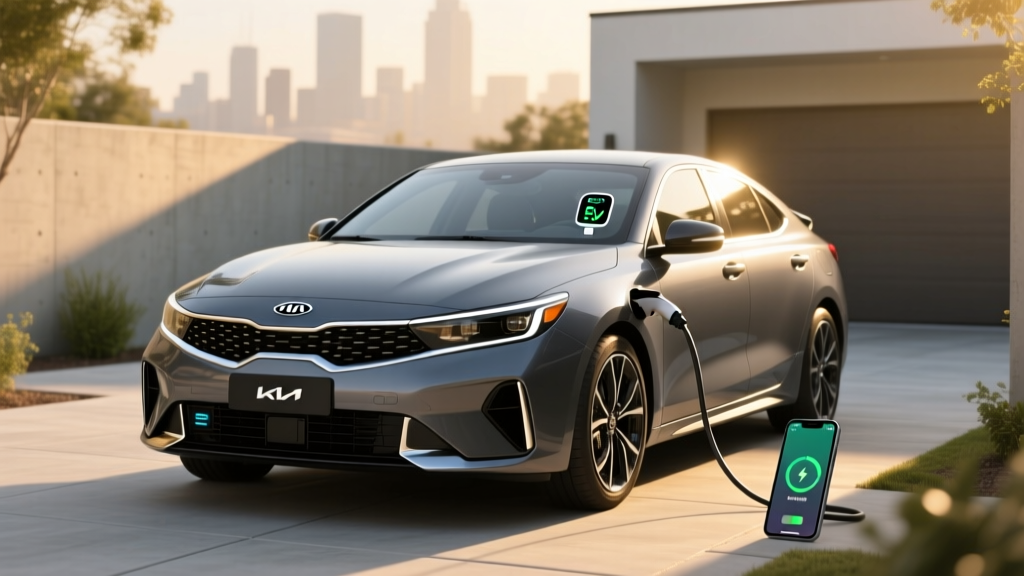
The Kia Forte is gone. In its place, the Kia K4 arrived for the 2025 model year as a sleek, slightly larger compact sedan — and it brought a hybrid variant to challenge the Toyota Corolla Hybrid and Honda Civic Hybrid head-on. For 2026, the Kia K4 Hybrid continues to slot into one of the most competitive segments in the market, promising strong fuel economy, modern tech, and Kia's generous warranty coverage at an accessible price point.
But how does it actually stack up once you move past the brochure? Below, we examine the K4 Hybrid's real-world efficiency, powertrain behavior, ownership costs, and where it fits among the growing field of electrified compact sedans — including whether a plug-in hybrid or full EV might serve you better.
HEV vs. PHEV: What the Kia K4 Hybrid Actually Is
The Kia K4 Hybrid is a conventional hybrid electric vehicle (HEV). It pairs a gasoline engine with a small electric motor and a compact battery pack that recharges through regenerative braking and the engine — no plug required. You fuel it like a normal car and never think about charging.
Quick Distinction: HEV vs. PHEV vs. BEV
| Type | Plug Required? | Electric-Only Range | Fueling | Typical Use Case |
|---|---|---|---|---|
| HEV (K4 Hybrid) | No | ~1 mi at low speed | Gasoline only | Max MPG without lifestyle change |
| PHEV | Yes | 25–45 mi | Gas + plug-in | Electric commute, gas road trips |
| BEV (Full EV) | Yes | 200–400+ mi | Electricity only | Home charging access, lowest running cost |
As of the 2026 model year, Kia does not offer a plug-in hybrid (PHEV) version of the K4. If you need electric-only commuting range, you'd need to look at a PHEV like the Toyota Prius Prime or consider a full EV like the Kia Niro EV or Hyundai Ioniq 6. The K4 Hybrid is purpose-built for buyers who want maximum fuel economy with zero change to their refueling habits.
EPA Fuel Economy and Real-World MPG
The 2026 Kia K4 Hybrid is rated by the EPA at 51 MPG city / 48 MPG highway / 50 MPG combined in its most efficient trim configuration, placing it squarely in the upper tier of the compact hybrid segment. These figures are competitive with the Toyota Corolla Hybrid (50 combined) and a meaningful step above the base Honda Civic Hybrid's combined rating.
| Metric | Kia K4 Hybrid | Toyota Corolla Hybrid | Honda Civic Hybrid |
|---|---|---|---|
| City MPG | 51 | 53 | 50 |
| Highway MPG | 48 | 46 | 47 |
| Combined MPG | 50 | 50 | 49 |
Source: fueleconomy.gov — EPA estimates. Actual mileage will vary.
Real-World MPG: What to Actually Expect
Hybrids tend to outperform their EPA city estimates in stop-and-go traffic because regenerative braking recovers energy that a gas car wastes as heat. In urban and suburban driving, owners of similar Kia/Hyundai hybrid powertrains routinely report 52–56 MPG in warm weather.
Highway driving is a different story. At sustained 75–80 mph speeds, the electric motor contributes less and aerodynamic drag dominates. Expect highway trips to yield 42–46 MPG in real-world conditions. Cold weather (below 35°F) reduces battery efficiency and forces the engine to run more frequently for cabin heat, knocking combined figures down to roughly 44–47 MPG until temperatures recover.
Powertrain Specs: Engine, Motor, and Combined Output
The K4 Hybrid uses a variant of Kia/Hyundai's well-proven hybrid architecture — the same family of powertrains found in the Niro Hybrid and Sonata Hybrid, tuned for the compact K4 platform.
| Specification | 2026 Kia K4 Hybrid |
|---|---|
| Engine | 1.6L 4-cylinder GDI |
| Electric Motor | Permanent-magnet synchronous |
| Combined Horsepower | ~140 hp |
| Combined Torque | ~195 lb-ft |
| Transmission | 6-speed dual-clutch automatic (DCT) |
| Drivetrain | Front-wheel drive |
| 0–60 mph (est.) | ~8.5 seconds |
| Hybrid Battery | ~1.6 kWh lithium-ion (HEV, non-pluggable) |
The 6-speed dual-clutch transmission is a deliberate choice over the continuously variable transmissions (CVTs) used by Toyota and Honda in their hybrids. The DCT delivers more natural-feeling acceleration with defined shift points, though it can occasionally hunt for gears at very low speeds — a trade-off most drivers will accept for the more engaging feel.
The ~140 hp combined output positions the K4 Hybrid as adequate rather than quick. It's a car optimized for efficiency first, with enough power for confident highway merging. If you want more performance, the non-hybrid K4 with its turbocharged engine option is the play — but you'll sacrifice roughly 15 MPG combined.
Pricing, Trims, and Tax Credit Eligibility
The 2026 Kia K4 Hybrid starts at an MSRP of approximately $27,500 for the base LXS Hybrid trim, with higher trims (EX, GT-Line Hybrid) climbing toward $31,000–$33,000 loaded with options. Destination charges add roughly $1,100.
Federal Tax Credit: What Applies
Here's where clarity matters. Under current IRS §30D rules, the $7,500 federal clean vehicle credit applies only to plug-in electric vehicles (BEVs and PHEVs) that meet battery sourcing, critical mineral, MSRP cap, and buyer income requirements.
- Federal §30D credit: Not eligible (HEV, not a plug-in vehicle)
- State hybrid incentives: Vary by jurisdiction — some states offer $500–$1,500 rebates for HEVs
- Employer/utility rebates: Occasionally available for high-efficiency vehicles — check locally
- Fuel savings as offset: At 50 MPG vs. a 30 MPG gas car, you save ~$600–$900/year in fuel at 12,000 miles driven
Battery Warranty, Reliability, and Replacement Costs
Hybrid battery longevity remains the single most cited concern among first-time hybrid buyers. It's worth addressing directly.
Kia backs the K4 Hybrid's battery pack and hybrid system components with a 10-year / 100,000-mile warranty — one of the longest in the industry. This covers the hybrid battery, electric motor, inverter, and related control modules against defects and abnormal capacity loss. The basic vehicle warranty is 5 years / 60,000 miles, and the powertrain warranty is 10 years / 100,000 miles.
| Coverage | Term |
|---|---|
| Basic Vehicle Warranty | 5 years / 60,000 miles |
| Powertrain Warranty | 10 years / 100,000 miles |
| Hybrid Battery & Components | 10 years / 100,000 miles |
| Roadside Assistance | 5 years / 60,000 miles |
Realistic Battery Lifespan and Replacement Cost
Modern lithium-ion hybrid batteries are engineered for the life of the vehicle. Toyota's hybrid battery packs — the longest track record in the market — routinely last 150,000–200,000+ miles before significant degradation. Kia's hybrid systems, which share engineering DNA with Hyundai's well-established hybrid lineup, are expected to follow a similar trajectory.
If a replacement is needed out of warranty, a hybrid battery pack for a compact car like the K4 typically costs between $2,000 and $3,500 for the part, plus $500–$800 in labor. Refurbished packs are often available for less. This is a fraction of the $10,000–$20,000+ replacement cost for a full EV battery — because the K4's HEV battery is small (~1.6 kWh) and relatively simple.
Reliability data for the K4 Hybrid specifically is still accumulating given the model's recent introduction. However, Kia's hybrid powertrain components have been in service across the Niro and Sonata Hybrid lineups for years, with generally favorable long-term results as tracked by sources like IIHS and consumer reliability surveys.
Who Should Buy the K4 Hybrid — and Who Shouldn't
The K4 Hybrid occupies a specific niche. It's not the right electrified vehicle for everyone, but for the right buyer, it's arguably the lowest-friction path to significantly lower fuel costs.
Pros
- 50+ MPG combined with zero behavior change
- No plug or home charger required
- 10-year/100,000-mi hybrid battery warranty
- 600-mile total range between fill-ups
- Competitive starting price (~$27,500)
- DCT feels more natural than a CVT
Cons
- No federal tax credit eligibility
- No electric-only commuting capability
- ~140 hp is adequate, not quick
- Highway MPG drops noticeably above 75 mph
- Cold weather reduces efficiency ~10%
- No PHEV or AWD variant available
Decision Framework: Is the K4 Hybrid Right for You?
Choose the K4 Hybrid if: You drive 12,000+ miles per year in mixed city/highway conditions, lack access to home or workplace charging, and want to cut fuel costs without changing your refueling routine.
Choose a PHEV (e.g., Prius Prime) if: You have home charging access, your daily commute is under 40 miles, and you want electric-only driving for errands while retaining gas flexibility for road trips.
Choose a full BEV (e.g., Tesla Model 3, Hyundai Ioniq 6) if: You can install a Level 2 home charger, your daily driving is under 250 miles, and you want the lowest per-mile energy cost plus federal tax credit eligibility.
How the K4 Hybrid Fits Into Kia's Electrified Lineup
Kia's 2026 lineup spans the full electrification spectrum. The K4 Hybrid sits at the entry point — the most affordable and least disruptive way to reduce fuel consumption. Moving up:
- Kia Niro Hybrid / PHEV / EV: A subcompact crossover with hybrid, plug-in hybrid (~33 mi electric), and full EV (~250 mi range) options
- Kia Sportage Hybrid / PHEV: A compact SUV with up to 43 MPG (HEV) or 34 mi electric range (PHEV)
- Kia EV6 / EV9: Dedicated battery-electric platforms with 230–310 mi range and DC fast charging up to 350 kW
The K4 Hybrid makes the most sense as a sedan buyer's gateway into electrification. If you need cargo versatility, the Niro or Sportage hybrids serve. If you're ready to go fully electric and have charging sorted, the EV6 is the stronger long-term financial play — especially with the §30D credit.
Frequently Asked Questions
How many MPG does the 2026 Kia K4 Hybrid get?
The EPA rates the K4 Hybrid at 51 MPG city, 48 MPG highway, and 50 MPG combined. In real-world driving, expect 52–56 MPG in city conditions, 42–46 MPG on the highway, and roughly 44–47 MPG in cold weather.
Does the Kia K4 Hybrid need to be plugged in?
No. The K4 Hybrid is a conventional HEV. Its small battery recharges through regenerative braking and the gasoline engine. You refuel only at gas stations, like any other car.
Is there a plug-in hybrid (PHEV) version of the Kia K4?
As of the 2026 model year, Kia does not offer a PHEV variant of the K4. If you want plug-in capability in the Kia lineup, consider the Niro PHEV (~33 mi electric range) or Sportage PHEV (~34 mi electric range).
Does the Kia K4 Hybrid qualify for a federal tax credit?
No. The federal §30D clean vehicle credit requires plug-in capability and a minimum 7 kWh battery. The K4 Hybrid, as a conventional HEV with a ~1.6 kWh battery, does not qualify. Check your state for possible hybrid-specific incentives.
How long will the K4 Hybrid battery last?
Kia covers the hybrid battery for 10 years / 100,000 miles. Based on industry data from similar hybrid systems, these batteries typically last 150,000–200,000+ miles before requiring replacement. Out-of-warranty replacement costs approximately $2,000–$3,500 plus labor.
Is the K4 Hybrid reliable?
The K4 Hybrid uses Kia/Hyundai's established hybrid powertrain architecture, which has been in production across multiple models for years. Long-term reliability data specific to the K4 is still building, but the underlying components have a solid track record. The 10-year powertrain and hybrid warranty provides additional peace of mind.
How does the K4 Hybrid compare to the Toyota Corolla Hybrid?
Both achieve approximately 50 MPG combined. The Corolla Hybrid edges ahead in city MPG (53 vs. 51) and offers available AWD, while the K4 Hybrid provides slightly more highway MPG (48 vs. 46), a more engaging DCT transmission, and a more upscale interior design. Pricing is closely matched.