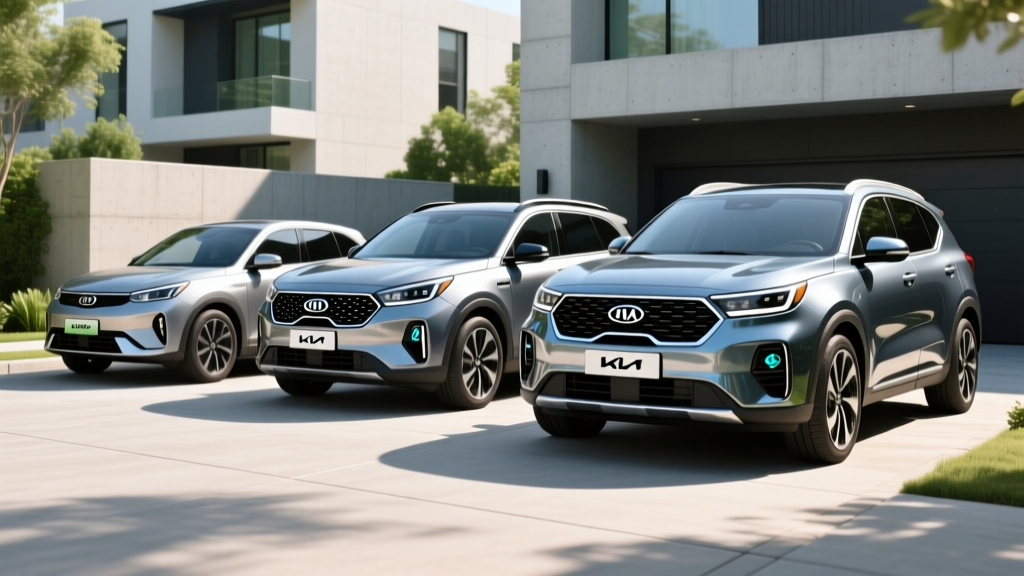
Shopping for a Kia hybrid SUV in 2026 means choosing among three distinct nameplates — the compact Niro, the midsize Sportage, and the three-row Sorento — each available as a conventional hybrid (HEV), a plug-in hybrid (PHEV), or both. The differences in fuel economy, electric-only range, pricing, and tax-credit eligibility are substantial enough that picking the wrong variant can cost you thousands in missed incentives or daily charging hassle.
This guide breaks down every current Kia hybrid SUV with exact EPA figures, real-world expectations, battery specs, warranty coverage, and who each model actually fits. No marketing fluff — just the numbers you need to decide.
HEV vs PHEV: What Kia Hybrid SUV Buyers Must Know First
Before comparing models, it is critical to understand the two hybrid architectures Kia uses. Confusing them is the single most common mistake buyers make.
| Feature | Conventional Hybrid (HEV) | Plug-In Hybrid (PHEV) |
|---|---|---|
| Plug in to charge? | No — regenerative braking & engine recharge the battery | Yes — plug in for electric-only driving |
| Battery size | ~1.3–1.6 kWh | ~13.8–18.1 kWh |
| Electric-only range | Less than 1 mile at low speed | 30–38 miles (EPA) |
| Fuel economy (after battery) | Excellent — engine + motor always active | Good — operates as HEV once battery depletes |
| Federal tax credit | None (not eligible under §30D) | Up to $7,500 (subject to income, MSRP caps, battery sourcing) |
| Home charging needed? | No | Strongly recommended (Level 2, ~2–3 hours) |
The trade-off is straightforward: HEVs are simpler and cheaper upfront with no charging logistics. PHEVs give you 30+ miles of gas-free commuting but cost more, require a plug, and add ~300–400 lbs of battery weight that slightly hurts highway fuel economy once the battery is depleted.
Kia Niro Hybrid & Plug-In Hybrid: MPG, Range, and Pricing
The Niro is Kia's smallest hybrid SUV — technically a subcompact crossover — and the most fuel-efficient vehicle Kia sells. It is available as both an HEV and a PHEV for the 2026 model year.
Niro HEV (Conventional Hybrid)
| Spec | Value |
|---|---|
| Powertrain | 1.6L 4-cyl + 47 kW electric motor |
| Combined horsepower | 139 hp |
| EPA MPG (city / hwy / combined) | 53 / 54 / 53 (FE trim); 53 / 45 / 49 (other trims) |
| Battery | ~1.3 kWh lithium-ion polymer |
| 0–60 mph | ~9.6 seconds |
| Starting MSRP | ~$28,390 (LX) |
| Federal tax credit | None |
Real-world MPG: The Niro HEV consistently matches or slightly exceeds its EPA city rating in stop-and-go driving because regenerative braking recaptures energy that a gas car wastes. Expect 50–55 MPG in mixed city commuting. Highway-heavy driving at 75+ mph drops efficiency to the mid-40s. Cold weather (below 30°F) reduces city MPG by roughly 5–8% due to engine warm-up cycles and reduced battery efficiency.
Niro PHEV (Plug-In Hybrid)
| Spec | Value |
|---|---|
| Powertrain | 1.6L 4-cyl + 62 kW electric motor |
| Combined horsepower | 180 hp |
| EPA electric-only range | 33 miles |
| Total combined range | ~430 miles |
| EPA MPG (charge-depleted, combined) | 48 MPG combined (54 city / 43 hwy) |
| MPGe (electric + gas combined) | 108 MPGe |
| Battery | 11.1 kWh usable (lithium-ion polymer) |
| Level 2 charge time (0–100%) | ~2 hours 45 minutes at 7.2 kW |
| DC fast charging | Not available |
| Starting MSRP | ~$35,590 (S) |
| Federal tax credit | Up to $7,500 (see eligibility below) |
Kia Sportage Hybrid & Plug-In Hybrid: MPG, Range, and Pricing
The Sportage sits in the heart of the compact SUV segment and offers the most powertrain variety in Kia's lineup: gas-only, HEV, and PHEV. The hybrid variants use a turbocharged 1.6-liter engine paired with an electric motor — a meaningful upgrade over the naturally aspirated Niro powertrain.
Sportage HEV
| Spec | Value |
|---|---|
| Powertrain | 1.6L turbo 4-cyl + 47.7 kW electric motor |
| Combined horsepower | 226 hp |
| EPA MPG (city / hwy / combined) | 42 / 44 / 43 (FWD); 38 / 38 / 38 (AWD) |
| Battery | ~1.49 kWh lithium-ion |
| 0–60 mph | ~7.7 seconds |
| Starting MSRP | ~$30,590 (LX) |
| Federal tax credit | None |
Real-world MPG: The Sportage HEV's city advantage is real — expect 40–44 MPG in urban commuting with frequent stops. The AWD system's mechanical drag lowers highway efficiency noticeably; owners report 35–38 MPG on sustained highway trips at 70–75 mph. This is a case where FWD delivers a significant efficiency edge if all-wheel drive is not essential for your climate.
Sportage PHEV
| Spec | Value |
|---|---|
| Powertrain | 1.6L turbo 4-cyl + 72 kW electric motor |
| Combined horsepower | 261 hp |
| EPA electric-only range | 34 miles |
| Total combined range | ~430 miles |
| EPA MPG (charge-depleted, combined) | 35 MPG combined (36 city / 34 hwy) |
| MPGe (electric + gas combined) | 84 MPGe |
| Battery | 13.8 kWh usable (lithium-ion polymer) |
| Level 2 charge time (0–100%) | ~2 hours at 7.2 kW |
| DC fast charging | Not available |
| Drivetrain | AWD standard |
| Starting MSRP | ~$40,490 (X-Line) |
| Federal tax credit | Up to $7,500 (see eligibility below) |
The Sportage PHEV comes exclusively with all-wheel drive, which explains its lower charge-depleted MPG compared to the FWD Niro PHEV. The trade-off is 261 hp and genuine all-weather capability — a legitimate advantage for buyers in snow-belt states.
Kia Sorento Hybrid & Plug-In Hybrid: Three-Row MPG, Range, and Pricing
The Sorento is the only three-row hybrid SUV Kia offers, filling a niche that very few competitors occupy (the Toyota Highlander Hybrid is the closest rival). Both HEV and PHEV variants seat up to six passengers with second-row captain's chairs.
Sorento HEV
| Spec | Value |
|---|---|
| Powertrain | 1.6L turbo 4-cyl + 47.7 kW electric motor |
| Combined horsepower | 227 hp |
| EPA MPG (city / hwy / combined) | 36 / 35 / 35 (FWD); 34 / 34 / 34 (AWD) |
| Battery | ~1.49 kWh lithium-ion |
| 0–60 mph | ~8.0 seconds |
| Starting MSRP | ~$38,590 (S) |
| Federal tax credit | None |
Real-world MPG: Expect 33–36 MPG combined in typical mixed driving. The Sorento's larger mass (4,100+ lbs) means the hybrid system works harder, and the city MPG advantage over a conventional gas Sorento is roughly 8–10 MPG rather than the 15+ MPG gap you see in lighter vehicles. For a three-row SUV, 35 MPG is still exceptional.
Sorento PHEV
| Spec | Value |
|---|---|
| Powertrain | 1.6L turbo 4-cyl + 72 kW electric motor |
| Combined horsepower | 261 hp |
| EPA electric-only range | 32 miles |
| Total combined range | ~440 miles |
| EPA MPG (charge-depleted, combined) | 33 MPG combined (33 city / 33 hwy) |
| MPGe (electric + gas combined) | 79 MPGe |
| Battery | 13.8 kWh usable (lithium-ion polymer) |
| Level 2 charge time (0–100%) | ~2 hours 15 minutes at 7.2 kW |
| DC fast charging | Not available |
| Drivetrain | AWD standard |
| Starting MSRP | ~$51,090 (SX) |
| Federal tax credit | Up to $7,500 (see eligibility below) |
Federal Tax Credit Eligibility for Kia PHEV SUVs
Only the PHEV variants qualify for the federal §30D Clean Vehicle Credit. The HEV models do not qualify for any federal purchase incentive. Here is the current eligibility framework per IRS guidelines:
- Maximum credit: Up to $7,500 for new PHEVs meeting all requirements
- MSRP cap: SUVs/vans/pickups must be under $80,000 MSRP — all Kia PHEV SUVs clear this
- Buyer income cap: Modified AGI must not exceed $150,000 (single), $225,000 (head of household), or $300,000 (joint)
- Battery sourcing: Critical minerals and battery components must meet phased-in domestic/free-trade sourcing requirements — percentages increase annually; verify current-year compliance on the DOE/EPA fueleconomy.gov tax credit page
- Point-of-sale transfer: As of 2024+, you can transfer the credit to the dealer at purchase, reducing your out-of-pocket cost immediately rather than waiting for tax filing
- Final assembly: Vehicle must undergo final assembly in North America — Kia's Georgia plant (West Point) assembles the Sportage and Sorento, but verify VIN-specific eligibility at purchase
Important caveat: Battery sourcing requirements tighten each year. A Kia PHEV that qualified for the full $7,500 in 2024 may qualify for a reduced amount or none in 2026 depending on supply-chain shifts. Always confirm the specific vehicle's credit amount with your dealer and cross-reference the IRS credit lookup tool before signing.
Battery Warranty, Reliability, and Replacement Costs
Kia Hybrid & PHEV Battery Warranty Coverage
| Component | Warranty |
|---|---|
| Hybrid battery (HEV & PHEV) | 10 years / 100,000 miles |
| Hybrid system components (inverter, motor) | 10 years / 100,000 miles |
| Basic vehicle warranty | 5 years / 60,000 miles |
| Powertrain warranty | 10 years / 100,000 miles |
The hybrid battery warranty guarantees that Kia will repair or replace the battery if its capacity falls below approximately 70% of original capacity during the warranty period. Note: warranty is typically non-transferable to second owners (drops to 5yr/60,000mi upon resale), which affects used-market value.
Reliability data: Kia's 1.6L turbo hybrid powertrain has been in production since 2020 across multiple Hyundai/Kia models. Large-scale failure data is limited, but the hybrid-specific components (motor, inverter, battery) have proven robust across the Hyundai-Kia group. The conventional hybrid system is simpler than the PHEV (smaller battery, no plug-in hardware), which statistically means fewer failure points over 10+ years.
Battery replacement cost: If a hybrid battery needs replacement out of warranty, expect $2,500–$4,000 for an HEV battery pack and $5,000–$8,000 for a PHEV pack, based on current parts pricing. However, complete pack failure is rare — individual cell or module replacement is often possible at lower cost. Most hybrid batteries outlast the vehicle itself with proper thermal management, which Kia's liquid-cooled system provides.
Which Kia Hybrid SUV Fits You? HEV vs PHEV vs Full EV
Choose a Kia HEV if:
- You cannot install a home charger (apartment, street parking, no garage)
- Your daily driving is unpredictable — some days 10 miles, some days 300
- You want maximum simplicity with no charging habits to build
- You prioritize the lowest purchase price
Choose a Kia PHEV if:
- You have reliable Level 2 home charging and a commute under 35 miles round-trip
- You want gas-free daily driving but need the flexibility for longer road trips without charging stops
- You qualify for the §30D federal tax credit (income + sourcing requirements met)
- You live in a state with additional PHEV incentives (check your state energy office)
Choose a full BEV (e.g., Kia EV6 or EV9) if:
- You have home charging and your longest regular trip is under 250 miles (or you're comfortable with DC fast-charging stops)
- You want the lowest per-mile fuel cost and minimal maintenance (no oil changes, no engine)
- You want maximum federal and state incentives
- You are ready to learn charging logistics for road trips
The PHEV is the sweet spot for buyers who want electric commuting but are not ready to commit to a full EV — especially in areas with limited public DC fast-charging infrastructure. The HEV is the pragmatic choice for buyers without home charging access who still want a 30–40% fuel-cost reduction over a gas-only SUV.
Side-by-Side Comparison: All 2026 Kia Hybrid SUVs
| Model | Type | HP | EPA Combined MPG / MPGe | EV Range | Starting MSRP | Tax Credit |
|---|---|---|---|---|---|---|
| Niro | HEV | 139 | 53 MPG (FE) | N/A | $28,390 | None |
| Niro | PHEV | 180 | 108 MPGe / 48 MPG | 33 mi | $35,590 | Up to $7,500 |
| Sportage | HEV | 226 | 43 MPG (FWD) | N/A | $30,590 | None |
| Sportage | PHEV | 261 | 84 MPGe / 35 MPG | 34 mi | $40,490 | Up to $7,500 |
| Sorento | HEV | 227 | 35 MPG (FWD) | N/A | $38,590 | None |
| Sorento | PHEV | 261 | 79 MPGe / 33 MPG | 32 mi | $51,090 | Up to $7,500 |
Pros and Cons: Kia Hybrid SUV Lineup
Pros
- Best-in-class fuel economy in their segments (Niro HEV at 53 MPG leads all non-PHEV crossovers)
- 10-year/100,000-mile hybrid battery and powertrain warranty exceeds most competitors
- PHEV variants offer 32–34 miles of electric range — enough for most commutes gas-free
- Sportage and Sorento assembled in Georgia, supporting §30D final-assembly requirement
- Conventional hybrids require zero behavior change — no plug, no app, no range management
- Strong cargo utility: Niro offers 22.8 cu ft behind rear seats; Sorento seats six with third row
Cons
- No Kia PHEV offers DC fast charging — all limited to ~7.2 kW Level 2 AC charging
- PHEV charge-depleted highway MPG drops noticeably, especially with AWD (Sportage/Sorento)
- Niro is subcompact — rear seat and cargo space tighter than Sportage
- Sorento PHEV starts above $51,000 — expensive for a compact three-row SUV
- Tax credit eligibility for PHEVs depends on evolving battery-sourcing rules — not guaranteed at full $7,500
- Hybrid powertrains are less refined than Kia's pure EVs (EV6, EV9) in terms of acceleration smoothness and cabin quietness
Frequently Asked Questions About Kia Hybrid SUVs
How many MPG does the Kia Niro hybrid get in real-world driving?
The EPA rates the Niro HEV at 53 MPG combined on the FE trim. In real-world mixed driving, owners consistently report 48–55 MPG depending on conditions. City-heavy routes with frequent stops maximize regenerative braking and push you toward the upper end. Sustained 75-mph highway driving and cold weather pull it down to the mid-40s. It is one of the most efficient non-plug-in vehicles sold in the US, per fueleconomy.gov.
How far can a Kia Sportage PHEV go on electric only?
The EPA rates the Sportage PHEV at 34 miles of electric-only range. Real-world results vary: expect 30–35 miles in mild weather at moderate speeds, 22–26 miles at sustained highway speeds, and 20–24 miles in freezing temperatures with the heater running. Once the battery depletes, the vehicle operates as a conventional hybrid at approximately 35 MPG combined.
Do Kia hybrid SUVs need to be plugged in?
Only the PHEV variants (Niro PHEV, Sportage PHEV, Sorento PHEV) benefit from being plugged in. Conventional hybrids (Niro HEV, Sportage HEV, Sorento HEV) never need to be plugged in — they recharge their small batteries through regenerative braking and the gasoline engine. You fuel them like a normal car and the hybrid system works automatically.
Is a Kia hybrid SUV reliable long-term?
Kia's hybrid powertrain components carry a 10-year/100,000-mile warranty, which is one of the longest in the industry. The 1.6L turbo hybrid system has been in use across Hyundai-Kia vehicles since 2020, and widespread battery or motor failures have not emerged as a pattern. The smaller HEV battery (~1.5 kWh) is under less stress than a full EV battery, contributing to longevity. Routine maintenance is minimal — no transmission fluid changes on the hybrid-specific 6-speed automatic, and brake pads last longer due to regenerative braking.
What does it cost to replace a Kia hybrid battery?
Out-of-warranty replacement for an HEV battery pack typically costs $2,500–$4,000 including labor. A PHEV battery pack runs $5,000–$8,000 due to its larger capacity. However, complete pack failures are uncommon — most degradation issues involve individual cells or modules that can be serviced at lower cost. Given Kia's 10-year/100,000-mile hybrid warranty, most original owners will never pay for a battery replacement.
Does the Kia Sportage Hybrid qualify for a federal tax credit?
The Sportage HEV (conventional hybrid) does not qualify for any federal tax credit. The Sportage PHEV may qualify for up to $7,500 under the §30D Clean Vehicle Credit, subject to your income level (under $300,000 joint AGI for SUVs), the vehicle's MSRP (under $80,000 — all Sportage PHEVs qualify), and current-year battery sourcing requirements. The credit can be transferred to the dealer at point of sale, reducing your purchase price directly. Always verify eligibility on the IRS website before committing to a purchase.
Hybrid vs PHEV vs EV — which Kia SUV should I buy?
If you lack home charging: choose an HEV. If you have home charging and a sub-35-mile commute but take occasional long road trips: choose a PHEV. If you have home charging, your longest regular trip is under 250 miles, and you want the lowest operating cost: consider a full EV like the Kia EV6 or EV9. The PHEV is the most versatile but also the most complex — it only makes financial sense if you actually plug it in daily and capture the tax credit.