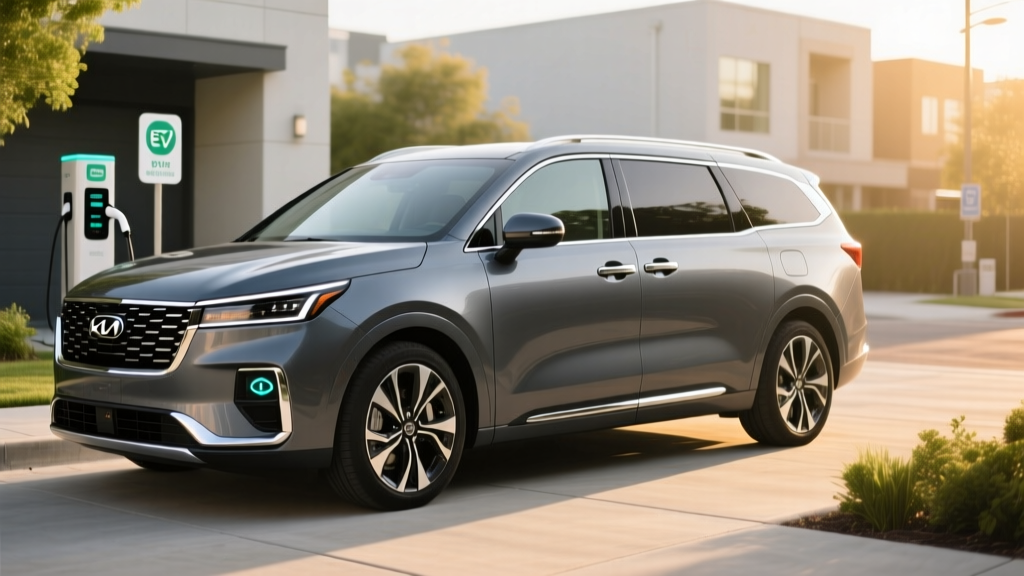
Quick Verdict: The 2026 Kia Carnival SX Hybrid (officially the Carnival Hybrid, with SX Prestige as the top trim) delivers an EPA-estimated 34 MPG combined — a massive improvement over the gas-only Carnival's 22 MPG combined — while retaining the minivan's signature 8-passenger seating and class-leading cargo space. It's a conventional hybrid (HEV), not a plug-in, meaning no charging required. For families who want minivan utility without the fuel bill of a traditional V6, the Carnival Hybrid is the most compelling option in its segment.
HEV vs PHEV: Understanding the Carnival Hybrid
Before diving into specs, it's critical to understand what the Carnival Hybrid is — and isn't. Kia offers the Carnival as a conventional hybrid (HEV), not a plug-in hybrid (PHEV). This distinction matters for buyers cross-shopping electrified minivans.
Conventional Hybrid (HEV)
- No plug-in charging required
- Small battery (~1.5-2 kWh) charged by regenerative braking and engine
- Electric motor assists gas engine; cannot drive on electric alone for extended distances
- Lower upfront cost; no home charging infrastructure needed
- This is the Carnival Hybrid
Plug-in Hybrid (PHEV)
- Requires plug-in charging (Level 1 or Level 2)
- Larger battery (typically 10-20 kWh) enabling 20-40 miles electric-only range
- Can drive on electric power alone for daily commutes
- Higher upfront cost; qualifies for federal tax credit if requirements met
- Not available for Carnival in the US market
The Carnival Hybrid operates like a gas minivan at the pump — you fill it with regular unleaded and drive. The hybrid system simply makes that fuel go significantly further, particularly in stop-and-go city driving where regenerative braking and electric motor assist shine.
Fuel Economy: EPA Ratings and Real-World MPG
| Metric | Carnival Hybrid (HEV) | Carnival Gas (3.5L V6) |
|---|---|---|
| EPA City | 34 MPG | 19 MPG |
| EPA Highway | 31 MPG | 26 MPG |
| EPA Combined | 34 MPG | 22 MPG |
| Fuel Tank Capacity | 16.9 gal | 16.9 gal |
| Total Range (est.) | ~575 miles | ~372 miles |
Source: fueleconomy.gov (EPA estimates for 2025-2026 model year Kia Carnival Hybrid)
Real-World MPG: What to Actually Expect
Hybrids typically exceed their EPA city ratings in real-world urban driving because regenerative braking recaptures energy that gas cars waste as heat. Based on owner reports and independent testing of the Carnival Hybrid's 1.6L turbo hybrid powertrain:
- City driving: Expect 33-36 MPG — the hybrid system thrives here, with frequent stops enabling maximum regen and electric motor assist
- Highway cruising: Expect 28-31 MPG — at sustained 70-80 mph speeds, the gas engine does most of the work, and aerodynamic drag on a minivan is substantial
- Cold weather penalty: Expect a 10-15% reduction in winter months (roughly 28-30 MPG combined) as the engine runs more frequently for cabin heat and the battery operates less efficiently at low temperatures
- Heavy cargo/towing: With 8 passengers and full cargo, expect 27-30 MPG combined — still far better than the gas Carnival under equivalent load
The Carnival Hybrid's combined EPA rating of 34 MPG is notably higher than the highway rating — unusual for gas cars but typical for hybrids. This reflects the powertrain's efficiency in mixed and urban driving cycles.
Powertrain Specs: 245 HP Turbo Hybrid System
| Specification | 2026 Carnival Hybrid |
|---|---|
| Engine | 1.6L Turbocharged 4-cylinder |
| Electric Motor | 47.7 kW (64 hp) permanent magnet |
| Combined System Output | 245 hp / 271 lb-ft torque |
| Transmission | 6-speed automatic |
| Drivetrain | Front-wheel drive |
| Hybrid Battery | ~1.5 kWh lithium-ion (HEV) |
| 0-60 mph (est.) | ~7.8 seconds |
| Towing Capacity | 3,500 lbs |
| Seating | 7 or 8 passengers |
The Carnival Hybrid pairs a 1.6-liter turbocharged inline-4 with an electric motor integrated into the transmission housing. Combined output of 245 horsepower actually exceeds the gas-only Carnival's 290-hp 3.5L V6 in real-world responsiveness — the electric motor's instant torque (available from 0 RPM) makes the hybrid feel quicker in city acceleration despite the lower peak horsepower figure.
The 6-speed automatic transmission is a conventional torque-converter design (not a CVT), which means familiar shift feel and none of the "rubber band" drone that some hybrid CVTs produce under hard acceleration.
Pricing: Trim Levels and Value
The 2026 Kia Carnival Hybrid is available across multiple trims, with the SX and SX Prestige representing the higher-end offerings most buyers research:
| Trim Level | MSRP (est.) | Key Features |
|---|---|---|
| LXS Hybrid | ~$41,000 | 8-passenger, power sliding doors, 12.3" display |
| EX Hybrid | ~$44,500 | Leatherette, heated front seats, power liftgate |
| SX Hybrid | ~$48,000 | Navigation, premium audio, Highway Driving Assist |
| SX Prestige Hybrid | ~$52,500 | VIP rear seats, Nappa leather, surround-view camera |
Note: Pricing is estimated for 2026 model year based on 2025 pricing trends. Confirm exact MSRP with Kia's official configurator at time of purchase.
Tax Credit Eligibility
The Carnival Hybrid is a conventional hybrid (HEV), not a plug-in hybrid or battery electric vehicle. As such, it does not qualify for the federal §30D Clean Vehicle Credit (up to $7,500), which requires plug-in capability and minimum battery capacity of 7 kWh. The Carnival Hybrid's ~1.5 kWh battery falls well below this threshold.
Some states offer separate incentives for conventional hybrids, though these have largely been phased out in favor of PHEV and BEV incentives. Check your state's energy office or department of environmental quality for current programs. There is no federal tax credit available for this vehicle.
Battery Warranty and Long-Term Reliability
Kia Hybrid Battery Warranty Coverage
- Hybrid Battery: 10 years / 100,000 miles (whichever comes first)
- Hybrid System Components: 10 years / 100,000 miles
- Limited Vehicle Warranty: 5 years / 60,000 miles bumper-to-bumper
- Powertrain Warranty: 10 years / 100,000 miles
Warranty applies to original owner; coverage may differ for subsequent owners. Verify current terms with Kia at purchase.
Hybrid Battery Lifespan: What to Expect
Kia's hybrid system uses a relatively small lithium-ion battery (~1.5 kWh) that operates within a conservative state-of-charge window — typically between 40-80% — to maximize longevity. Unlike EV batteries that cycle through large portions of their capacity daily, HEV batteries experience shallow charge/discharge cycles, which dramatically extends their lifespan.
Based on data from Kia's hybrid fleet (Sorento Hybrid, Sportage Hybrid, and now Carnival Hybrid) and industry-wide HEV battery performance:
- Expected lifespan: 150,000-200,000+ miles before significant degradation
- Degradation impact: Minimal — HEV batteries don't need to retain high capacity the way EV batteries do; even 20% degradation won't noticeably affect fuel economy
- Replacement cost (out of warranty): $2,000-$3,500 for the hybrid battery pack, plus labor
- Failure rate: Low — modern lithium-ion HEV batteries rarely fail catastrophically within the warranty period
The 10-year/100,000-mile hybrid battery warranty is among the best in the industry and provides strong protection against premature failure. Most owners will never need a hybrid battery replacement during typical ownership.
Carnival Hybrid vs. Competition: Where It Fits
The electrified minivan segment is small but growing. Here's how the Carnival Hybrid stacks up against its closest competitors:
| Model | Type | EPA Combined | Starting MSRP |
|---|---|---|---|
| Kia Carnival Hybrid | HEV | 34 MPG | ~$41,000 |
| Toyota Sienna | HEV | 36 MPG | ~$39,000 |
| Chrysler Pacifica Hybrid | PHEV | 30 MPG + 32 mi EV | ~$51,000 |
| Honda Odyssey | Gas only | 22 MPG | ~$39,000 |
The Toyota Sienna (hybrid-only since 2021) edges out the Carnival Hybrid by 2 MPG combined and offers available AWD, but the Carnival counters with more cargo space behind the third row, available 8-passenger seating (Sienna maxes at 8 but with less flexible second-row configurations), and Kia's longer warranty coverage.
The Chrysler Pacifica Hybrid is the only plug-in option, offering 32 miles of electric-only range for daily commutes. However, it costs ~$10,000 more than the Carnival Hybrid before any tax credit, and the Pacifica's third-row and cargo space are compromised by the larger PHEV battery packaging.
Who Should Choose the Carnival Hybrid?
✓ Ideal For
- Families driving 15,000+ miles/year who want to cut fuel costs without changing behavior
- Buyers without home charging access (apartment dwellers, street parking)
- Those who want minivan utility without the 18-22 MPG fuel bill of gas models
- Long-distance road trippers who need 550+ mile range between fill-ups
- Buyers prioritizing warranty coverage (10yr/100k mi powertrain + hybrid)
✗ Consider Alternatives If
- You have home charging and want to eliminate most gas use (consider Pacifica PHEV or a 3-row EV like the Kia EV9)
- You prioritize maximum fuel economy above all else (Sienna Hybrid gets 36 MPG)
- You need AWD for snow/ice (Sienna Hybrid offers AWD; Carnival Hybrid is FWD only)
- You want electric-only driving for short commutes (no PHEV Carnival exists)
Decision Framework: Hybrid vs PHEV vs EV
Choose the Carnival Hybrid (HEV) if: You want better fuel economy with zero lifestyle changes — no charging, no range planning, just fill up and go. You don't have reliable home charging access, or you frequently take long road trips where charging infrastructure is sparse.
Choose a PHEV minivan (Pacifica Hybrid) if: You have home Level 2 charging, your daily driving is under 30 miles, and you want to do most weekday driving on electricity while keeping gas capability for longer trips. You're willing to pay more upfront and manage charging routines.
Choose a 3-row EV (Kia EV9, Tesla Model X) if: You have reliable home charging, your daily range needs are within 250-300 miles, you want to eliminate gas entirely, and you're prepared for road-trip charging stops. EVs have lower operating costs but higher upfront prices and require charging infrastructure.
Frequently Asked Questions
How many MPG does the Kia Carnival SX Hybrid get?
The 2026 Kia Carnival Hybrid achieves an EPA-estimated 34 MPG city, 31 MPG highway, and 34 MPG combined. Real-world city driving often matches or slightly exceeds the EPA city rating (33-36 MPG), while highway driving at 75+ mph typically yields 28-31 MPG. Cold weather and heavy cargo loads reduce these figures by 10-15%.
Does the Carnival Hybrid need to be plugged in?
No. The Carnival Hybrid is a conventional hybrid (HEV), not a plug-in hybrid (PHEV). It charges its small battery through regenerative braking and the gas engine — you never plug it in. Just fill it with regular unleaded gasoline like any other car.
Does the Kia Carnival Hybrid qualify for a federal tax credit?
No. The federal §30D Clean Vehicle Credit (up to $7,500) requires plug-in capability and a minimum battery capacity of 7 kWh. The Carnival Hybrid's ~1.5 kWh battery and lack of plug-in charging make it ineligible. Some states may offer minor incentives for hybrids — check your state energy office. See IRS.gov for current federal credit rules.
Is the Carnival Hybrid reliable? What about battery replacement cost?
Kia's hybrid system has proven reliable across the Sorento and Sportage Hybrid lineups, and the Carnival uses the same proven 1.6T hybrid architecture. The hybrid battery is covered by a 10-year/100,000-mile warranty. Out-of-warranty replacement costs approximately $2,000-$3,500, though most HEV batteries last 150,000-200,000+ miles without significant issues.
How far can the Carnival Hybrid go on electric only?
The Carnival Hybrid cannot drive on electric power alone for meaningful distances. Unlike a PHEV, its small ~1.5 kWh battery and 47.7 kW motor are designed to assist the gas engine, not replace it. You may get brief electric-only operation at very low speeds (parking lots, stop-and-go traffic) for a few hundred yards, but the engine is always running or ready to engage. This is normal HEV behavior — the efficiency gains come from the electric motor reducing engine load, not from electric-only driving.
What's the difference between the Carnival SX Hybrid and SX Prestige Hybrid?
Both share the identical 245-hp hybrid powertrain and 34 MPG combined rating. The SX Prestige adds premium features: VIP second-row lounge seats with power recline and heated/ventilated cushions, Nappa leather seating, surround-view monitor, and additional luxury amenities. The hybrid system, fuel economy, and warranty coverage are identical across all trims.
Is the Carnival Hybrid slower than the gas V6 model?
The gas Carnival's 3.5L V6 produces 290 hp vs. the hybrid's 245 hp combined, but real-world acceleration is closer than the numbers suggest. The hybrid's electric motor delivers instant torque from 0 RPM, making it feel responsive in city driving. Estimated 0-60 mph is ~7.8 seconds for the hybrid vs. ~7.3 seconds for the V6 — a negligible difference in daily driving. The hybrid's advantage is fuel economy (34 vs 22 MPG combined), not straight-line speed.
Bottom Line: The 2026 Kia Carnival SX Hybrid delivers exactly what hybrid minivan buyers want: 50%+ better fuel economy than the gas model with no behavioral changes required. No charging, no range anxiety, no compromises in passenger or cargo space. At ~$48,000 for the SX trim, it's a compelling value for high-mileage families — especially when you factor in the 10-year/100,000-mile hybrid warranty and estimated annual fuel savings of $800-$1,200 vs. the gas Carnival.