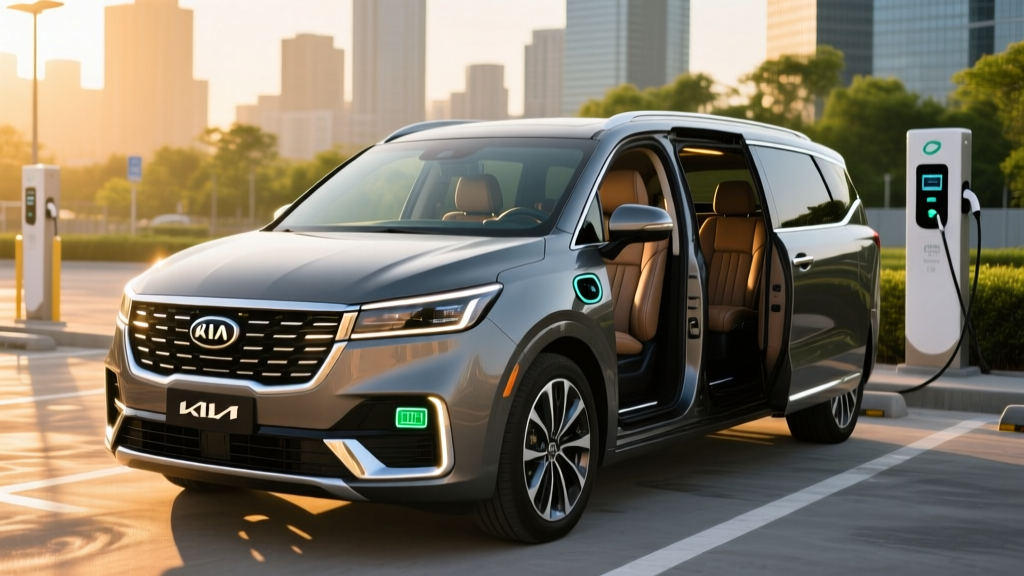
If you're researching the Kia Carnival Hybrid SX Prestige, you're likely weighing whether a hybrid minivan can deliver meaningful fuel savings without sacrificing the space, tech, and comfort that make the Carnival a top pick among three-row haulers. For 2026, the Carnival Hybrid pairs a turbocharged four-cylinder with an electric motor in a conventional hybrid (HEV) configuration — no plug required — and the SX Prestige sits near the top of the lineup with premium features that rival luxury SUVs at a fraction of the cost.
This guide covers everything data-minded buyers need: exact EPA MPG figures, real-world fuel economy expectations, powertrain specs, pricing, warranty coverage, tax credit eligibility, and whether the Carnival Hybrid is the right move versus a plug-in hybrid or a full battery-electric vehicle.
Kia Carnival Hybrid SX Prestige: Full Spec Sheet
| Attribute | 2026 Kia Carnival Hybrid SX Prestige |
|---|---|
| Powertrain | 1.6L turbo-4 + electric motor (HEV) |
| Combined Horsepower | 245 hp |
| Combined Torque | 271 lb-ft |
| Transmission | 6-speed automatic |
| Drivetrain | Front-wheel drive |
| EPA MPG (City / Hwy / Combined) | 34 / 31 / 33 |
| Fuel Tank Capacity | 16.9 gallons |
| Total Range | ~557 miles |
| 0–60 mph (est.) | ~7.8 seconds |
| Seating | 7 or 8 passengers |
| Cargo (behind 3rd row) | 41.1 cu ft |
| Cargo (max, seats folded) | 145.1 cu ft |
| Towing Capacity | 3,500 lbs |
| MSRP (SX Prestige) | ~$53,000 |
| Hybrid Battery Warranty | 10 years / 100,000 miles |
How Many MPG Does the Kia Carnival Hybrid Get?
The EPA rates the 2026 Kia Carnival Hybrid at 34 mpg city, 31 mpg highway, and 33 mpg combined across all trims including the SX Prestige. That's a substantial improvement over the gas-only Carnival, which returns an EPA-estimated 19/26/22 mpg — meaning the hybrid delivers roughly 50% better combined fuel economy.
| Model | City | Highway | Combined | Annual Fuel Cost* |
|---|---|---|---|---|
| Carnival Hybrid (all trims) | 34 mpg | 31 mpg | 33 mpg | ~$1,850 |
| Carnival Gas (V6) | 19 mpg | 26 mpg | 22 mpg | ~$2,775 |
| Toyota Sienna (Hybrid) | 36 mpg | 36 mpg | 36 mpg | ~$1,700 |
| Honda Odyssey (Gas V6) | 19 mpg | 28 mpg | 22 mpg | ~$2,775 |
*Based on 15,000 miles/year at $3.50/gallon regular unleaded. Source: fueleconomy.gov
HEV vs. PHEV vs. EV: Which Powertrain Fits You?
The Carnival Hybrid is a conventional hybrid (HEV) — it has no plug and requires no change to your fueling habits. You simply fill up at a gas station. This is a key distinction from plug-in hybrids and battery-electric vehicles, and it matters for your ownership experience.
| Factor | HEV (Carnival Hybrid) | PHEV (e.g., Chrysler Pacifica Hybrid) | Full EV (e.g., Kia EV9) |
|---|---|---|---|
| Plug-in charging needed? | No | Yes (for max savings) | Yes |
| Electric-only range | None (motor assists engine) | ~32 miles | 240–310+ miles |
| Home charging install | Not required | Level 2 recommended (~$500–$2,000) | Level 2 required (~$500–$2,500) |
| Fuel cost per mile | ~$0.11 | ~$0.05 (electric) / ~$0.12 (gas) | ~$0.04–$0.06 |
| Oil changes | Yes (every ~7,500 mi) | Yes (less frequent if mostly electric) | None |
| Federal tax credit | Not eligible (§30D is for PHEVs/EVs only) | Up to $7,500 (if eligible) | Up to $7,500 (if eligible) |
| Best for | No home charging access; road-trip heavy | Home charging + short commutes | Home charging + lower running costs |
Powertrain Deep Dive: 1.6L Turbo-Hybrid
The Carnival Hybrid uses Kia's turbocharged 1.6-liter four-cylinder engine paired with a 47.7 kW electric motor integrated into the 6-speed automatic transmission. The engine produces 180 hp on its own; combined system output is 245 horsepower and 271 lb-ft of torque. Torque delivery is strong from low RPMs thanks to the electric motor's instant response, which makes the Carnival Hybrid feel punchy in city driving and confident during highway merges.
Unlike the Toyota Sienna's naturally aspirated 2.5L hybrid system (245 hp combined via CVT), the Carnival uses a conventional stepped-gear automatic. The result is more familiar, linear acceleration without the "rubber-band" drone some drivers dislike in CVT-equipped hybrids. The trade-off is a marginally lower EPA combined rating (33 vs. 36 mpg for the Sienna).
The hybrid battery pack is a lithium-ion unit located under the second-row seats. Kia does not publish the exact kWh capacity for the HEV pack — conventional hybrid batteries are typically in the 1.0–2.0 kWh range, as they're designed for frequent small charge/discharge cycles rather than sustained electric-only driving.
SX Prestige Trim: What You Get for ~$53,000
The SX Prestige is the top-tier Carnival Hybrid trim, and its feature list reads like a luxury SUV:
- Nappa leather seating surfaces with heated and ventilated front and second-row seats
- Power-reclining second-row VIP lounge seats with relaxation mode
- 12.3-inch dual panoramic displays (instrument cluster + infotainment)
- Head-up display (HUD)
- Harman Kardon premium audio (12 speakers)
- Surround-view monitor with 3D perspective
- Highway Driving Assist 2 (HDA2) — adaptive cruise with stop-and-go, lane centering, and lane-change assist
- Remote Smart Parking Assist (move the van in/out of tight spots via key fob)
- Power sliding doors and power liftgate with smart open
- Digital Key 2 (use your smartphone as the key)
At approximately $53,000 MSRP (plus destination), the SX Prestige is a premium investment. For comparison, the base Carnival Hybrid LXE starts around $41,000, and the mid-tier EX sits near $46,000. The hybrid powertrain is standard on EX and above for 2026.
Battery Warranty, Reliability, and Replacement Cost
Kia's hybrid powertrain has proven reliable in real-world use. The 1.6L turbo-hybrid system is shared with other Kia/Hyundai models (Sorento Hybrid, Tucson Hybrid) that have been on the road since 2022, and widespread battery failure reports are rare. The conventional hybrid battery is smaller and cycles less deeply than a PHEV or EV battery, which generally translates to longer operational life.
If a hybrid battery replacement is needed out of warranty, expect a cost in the range of $2,000–$4,000 for the battery module, plus labor. This is significantly less than a full EV battery replacement ($8,000–$20,000+), and most hybrid owners never need one within the vehicle's typical lifespan. According to NHTSA data and owner forums, hybrid system failures before 100,000 miles are uncommon when routine maintenance is followed.
Tax Credits and Incentives: What the Carnival Hybrid Qualifies For
Because the Kia Carnival Hybrid is a conventional hybrid (HEV) and not a plug-in hybrid, it does not qualify for the federal §30D Clean Vehicle Credit (up to $7,500). That credit is reserved for plug-in electric vehicles — battery-electric vehicles (BEVs) and plug-in hybrids (PHEVs) — that meet battery sourcing, critical mineral, MSRP cap, and buyer income requirements per IRS guidelines.
- Federal §30D credit: Not eligible (HEV — no plug-in capability)
- State incentives: Some states offer rebates or reduced registration fees for hybrids. Check your state's energy or DMV website for current programs.
- Fuel savings as offset: At 33 mpg combined vs. 22 mpg for the gas Carnival, the hybrid saves roughly $925 per year in fuel costs (15,000 mi/yr at $3.50/gal). Over 5 years, that's approximately $4,600 — a meaningful offset even without a tax credit.
- Resale value: Hybrids currently command stronger resale values than gas-only counterparts, which partially offsets the lack of a tax incentive.
Carnival Hybrid vs. the Competition
| Spec | Kia Carnival Hybrid SX Prestige | Toyota Sienna XLE (Hybrid) | Chrysler Pacifica Hybrid (PHEV) |
|---|---|---|---|
| Powertrain | 1.6L turbo HEV | 2.5L 4-cyl HEV | 3.6L V6 PHEV |
| Combined HP | 245 hp | 245 hp | 260 hp |
| EPA Combined MPG | 33 mpg | 36 mpg | 30 mpg (gas) / 82 MPGe (elec) |
| Electric-Only Range | N/A | N/A | ~32 miles |
| Plug-In Required? | No | No | Yes (for max benefit) |
| Federal Tax Credit | None | None | Up to $7,500* |
| Starting MSRP (comparable trim) | ~$53,000 | ~$47,000 | ~$52,000 |
| Cargo (max) | 145.1 cu ft | 101.0 cu ft | 140.5 cu ft |
| Battery Warranty | 10 yr / 100k mi | 10 yr / 150k mi | 10 yr / 100k mi |
*Pacifica Hybrid credit eligibility depends on battery sourcing, MSRP caps, and buyer income per current IRS rules.
- You want maximum cargo space and premium features in a hybrid minivan
- You don't have access to home charging and don't want to plug in
- You value Kia's 10-year powertrain and hybrid battery warranty
- You prefer a turbo-hybrid with a conventional automatic over a CVT
- Maximum MPG (36 combined) is your top priority
- You want available AWD
- Cargo space needs are moderate
- You have home charging and a short commute (32 miles electric-only)
- You may qualify for the $7,500 federal tax credit, making effective cost competitive
- You want Stow 'n Go seating (not available on Carnival Hybrid due to battery placement)
Who Should Buy the Carnival Hybrid SX Prestige?
The Carnival Hybrid SX Prestige is best suited for families who:
- Drive 12,000–20,000 miles per year and want to reduce fuel costs without changing their refueling routine
- Need best-in-class cargo volume (145.1 cu ft) — the Carnival beats both the Sienna and Pacifica here
- Want luxury-adjacent features (VIP lounge seats, Harman Kardon audio, HUD) without paying luxury-brand prices
- Take frequent road trips where EV range limitations or charging infrastructure gaps remain a concern
- Plan to keep the vehicle long-term and value Kia's class-leading warranty coverage
It's not the best choice if you have home charging access, a short commute, and want to minimize your gasoline use as much as possible — a PHEV or full EV would better serve that goal.
- 33 mpg combined — 50% better than gas Carnival
- Class-leading cargo space (145.1 cu ft)
- Premium SX Prestige features rival luxury SUVs
- No plug-in charging required
- 10-year / 100,000-mile hybrid battery warranty
- Strong low-end torque from turbo + electric motor
- 3,500-lb towing capacity
- No federal tax credit (HEV, not PHEV/EV)
- FWD only — no AWD option (Sienna offers AWD)
- 33 mpg trails Sienna's 36 mpg combined
- SX Prestige price pushes past $53,000
- Second-row seats don't fold into floor (unlike Pacifica Stow 'n Go)
- Turbo engine requires premium fuel for maximum performance
Frequently Asked Questions
How many MPG does the Kia Carnival Hybrid SX Prestige get?
The EPA rates the 2026 Carnival Hybrid at 34 mpg city, 31 mpg highway, and 33 mpg combined. In real-world city driving with frequent stops, many owners report exceeding the EPA city figure, reaching 35–37 mpg thanks to regenerative braking. Highway-only driving at higher speeds typically yields 29–31 mpg.
Does the Kia Carnival Hybrid need to be plugged in?
No. The Carnival Hybrid is a conventional hybrid (HEV). Its small battery is charged entirely by the gasoline engine and regenerative braking. You never plug it in — just fill up at any gas station with regular unleaded fuel.
Is the Carnival Hybrid available as a plug-in hybrid (PHEV)?
As of the 2026 model year, Kia does not offer a Carnival PHEV in the United States. If you want a plug-in hybrid minivan, the Chrysler Pacifica Hybrid is currently the only PHEV option in the segment, offering approximately 32 miles of electric-only range.
Is the Kia Carnival Hybrid reliable?
Kia's 1.6L turbo-hybrid powertrain has been in production since 2022 and is shared across multiple Kia/Hyundai models. Major hybrid system failures are rare based on NHTSA complaint data and owner reports. The hybrid battery is covered by a 10-year / 100,000-mile warranty, and replacement costs (if ever needed out of warranty) are estimated at $2,000–$4,000 — far less than EV battery replacement.
Does the Carnival Hybrid qualify for any tax credit?
The Carnival Hybrid does not qualify for the federal §30D Clean Vehicle Credit because it is a conventional hybrid, not a plug-in vehicle. Some states may offer incentives for hybrid purchases — check your state energy office for details. The fuel savings alone (~$925/year vs. the gas Carnival) provide a meaningful financial offset over time.
How does the Carnival Hybrid compare to a full EV like the Kia EV9?
The Kia EV9 is a three-row electric SUV starting around $55,000 with up to 304 miles of EPA range. It qualifies for the federal tax credit (if eligible), has lower per-mile fuel costs, and requires no oil changes. However, it offers less cargo space, requires home charging installation, and may involve charging stops on long road trips. The Carnival Hybrid is the better choice for maximum space and road-trip flexibility; the EV9 is better for minimizing running costs and tailpipe emissions if you have reliable charging access.
What is the Carnival Hybrid's battery warranty?
Kia covers the hybrid battery for 10 years or 100,000 miles. In CARB-adopting states, hybrid system component coverage may extend further. This is one of the strongest hybrid warranties in the industry and provides long-term peace of mind for ownership.