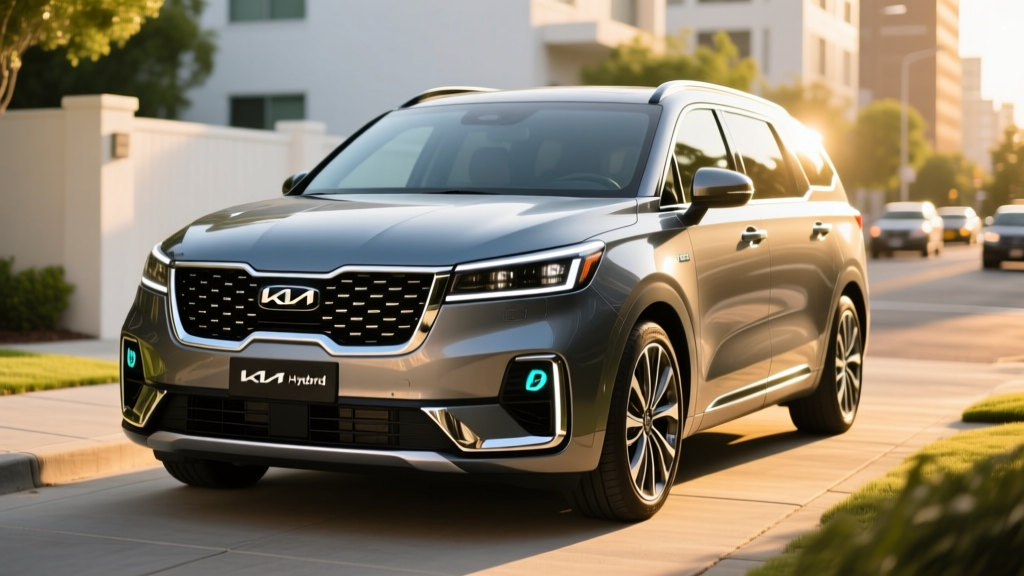
The 2026 Kia Carnival Hybrid is one of only two minivans in the U.S. market offering a conventional hybrid powertrain — no plug required — and its EPA-estimated 33 MPG combined is a headline figure for a vehicle with this much interior space. If you've been searching for Kia Carnival hybrid miles per gallon data, this guide covers the exact EPA breakdown, real-world expectations, powertrain details, and how the Carnival HEV stacks up against plug-in alternatives and full electric vehicles for family duty.
EPA Fuel Economy: The Official Numbers
The 2026 Kia Carnival Hybrid uses a 1.6-liter turbocharged four-cylinder engine paired with an electric motor and a 6-speed automatic transmission. Unlike the Chrysler Pacifica Hybrid (which is a plug-in hybrid), the Carnival Hybrid is a conventional HEV — it charges its small battery through regenerative braking and the gasoline engine. You never plug it in.
| Metric | EPA Estimate |
|---|---|
| City MPG | 34 MPG |
| Highway MPG | 31 MPG |
| Combined MPG | 33 MPG |
| Fuel Tank Capacity | 15.9 gallons |
| Total Driving Range | ~525 miles |
Source: fueleconomy.gov — 2026 Kia Carnival Hybrid. Figures apply across all trims (LXS, EX, SX, SX Prestige) since the powertrain is identical.
Real-World MPG vs. EPA Sticker
This city-highway split is the hallmark of a well-tuned hybrid system. The Carnival's electric motor handles low-speed crawling and initial acceleration, where gasoline engines are least efficient. Once you're at highway cruising speeds, the turbocharged 1.6L engine does most of the work alone, which is why highway MPG trails city MPG — the opposite of a conventional gas minivan.
For comparison, the gas-only 2026 Kia Carnival with its 3.5L V6 is rated at 19 city / 26 highway / 22 combined. The hybrid nearly doubles city fuel economy while offering comparable highway figures, making the HEV a clear winner for school-run and errand-heavy driving patterns.
Powertrain and Performance Specs
| Specification | 2026 Kia Carnival Hybrid |
|---|---|
| Engine | 1.6L turbocharged 4-cylinder |
| Electric Motor | 47 kW (63 hp) permanent-magnet synchronous |
| Combined System Output | 245 hp / 271 lb-ft torque |
| Transmission | 6-speed automatic |
| Drivetrain | Front-wheel drive (FWD only) |
| 0–60 mph (est.) | ~7.8 seconds |
| Towing Capacity | 3,500 lbs |
| Hybrid Battery | ~1.5 kWh lithium-ion (sealed, non-plug) |
| Cargo Volume (behind 3rd row) | 41.1 cu ft |
| Max Cargo Volume | 145.1 cu ft |
The 245 combined horsepower is sufficient for highway merging and loaded family road trips. The electric motor fills in the torque gap at low RPMs, so acceleration from a stop feels responsive despite the smaller displacement engine. The trade-off is that the hybrid is FWD-only — there is no AWD option on the Carnival Hybrid, unlike the Toyota Sienna (which offers AWD on its hybrid) or the Chrysler Pacifica.
HEV vs. PHEV vs. EV: Which Minivan Fits Your Family?
| Factor | Kia Carnival Hybrid (HEV) | Chrysler Pacifica Hybrid (PHEV) | Full EV (e.g., upcoming electric minivan) |
|---|---|---|---|
| Plug-in Required? | No | Yes (Level 2 recommended) | Yes (Level 2 + DC fast) |
| Electric-Only Range | None (EV assist only) | 32 miles (EPA) | 250–350+ miles |
| Combined MPG / MPGe | 33 MPG | 30 MPG (gas) / 82 MPGe (electric) | ~2.0 kWh/mi (est.) |
| Total Range | ~525 miles | ~460 miles (32 EV + 428 gas) | 250–350 miles |
| Home Charging Needed | No | Yes (120V works, 240V ideal) | Yes (240V strongly recommended) |
| Federal Tax Credit (§30D) | Not eligible | Up to $7,500 (subject to eligibility) | Up to $7,500 (subject to eligibility) |
| Best For | No home charging, long road trips | Home charging + short daily commutes | Home charging + shorter trips or 2-car household |
The Carnival Hybrid's biggest advantage is zero lifestyle change. You fuel it like any gas car, and the hybrid system silently improves your fuel economy. If you lack access to home or workplace charging, the HEV is the pragmatic choice. The Pacifica PHEV rewards plug-in access with 32 miles of electric-only driving — enough to cover most school runs and grocery trips without burning gas — but requires a Level 2 charger for convenient overnight top-ups.
Full-electric minivans remain extremely limited as of 2026. No mainstream three-row electric minivan is currently on sale in the U.S., though several have been announced. For families needing 7–8 seats and 500+ mile road-trip range today, the hybrid minivan segment (Carnival, Sienna, Pacifica) remains the practical answer.
Pricing, Trims, and Tax Credit Eligibility
| Trim | MSRP (2026) |
|---|---|
| LXS | $41,900 |
| EX | $44,500 |
| SX | $48,500 |
| SX Prestige | $52,900 |
Destination charge adds approximately $1,395.
The fuel savings partially offset the lack of a federal credit. At 33 MPG combined vs. 22 MPG for the gas Carnival, and assuming 15,000 miles/year at $3.40/gallon, the hybrid saves roughly $775 per year in fuel costs. Over a typical 7-year ownership period, that's approximately $5,400 in fuel savings — more than enough to justify the hybrid powertrain premium over the gas model.
Battery Warranty, Lifespan, and Replacement Cost
Kia's 1.5 kWh hybrid battery is far smaller than a full EV battery (which typically runs 60–100 kWh) and operates within a narrow state-of-charge window managed by the vehicle's battery management system. This shallow-cycling strategy significantly extends longevity. Real-world data from earlier Kia/Hyundai hybrid models (Niro, Sorento Hybrid) shows minimal degradation over 100,000+ miles — typically less than 10% capacity loss.
If replacement is ever needed outside warranty, a Kia Carnival Hybrid battery pack is estimated at $2,500–$4,000 including labor at a dealership, based on comparable Kia/Hyundai hybrid battery pricing. Independent hybrid battery specialists may offer refurbished units for $1,500–$2,500. For context, most hybrid batteries outlast the vehicle's useful life when properly maintained by the factory BMS.
Reliability and Ownership Costs
The Carnival Hybrid's powertrain is derived from the proven 1.6T hybrid system used in the Kia Sorento Hybrid and Hyundai Tucson Hybrid since 2022. This architecture has accumulated millions of real-world miles across the Hyundai-Kia fleet with few systemic issues. The 6-speed automatic transmission (rather than a CVT) is a reliability and drivability positive — CVTs in competitor hybrids draw frequent owner complaints about drone and long-term durability concerns.
The Insurance Institute for Highway Safety (IIHS) has tested the Carnival platform; check iihs.org for the most current 2026 rating. The National Highway Traffic Safety Administration (NHTSA) also publishes crash-test results at nhtsa.gov/ratings.
Insurance premiums for the Carnival Hybrid run 5–10% higher than the gas model due to the higher MSRP and hybrid-system repair costs, though this varies by carrier and driving record. Maintenance costs are lower than the gas V6: no timing belt (the 1.6T uses a chain), and regenerative braking extends brake pad life by 30–50%.
Pros, Cons, and the Verdict
Pros
- 33 MPG combined — best-in-class for a non-plug-in minivan
- No plug-in charging required; zero lifestyle change
- 10-year / 100,000-mile hybrid battery warranty
- 245 hp is responsive for a minivan; 6-speed auto avoids CVT drone
- Up to 145.1 cu ft cargo volume with seats folded
- 3,500-lb towing capacity
- ~$775/year fuel savings over gas Carnival
Cons
- No AWD option (FWD only)
- No federal tax credit (HEV, not PHEV/BEV)
- Highway MPG drops to ~28–30 at sustained 75+ mph speeds
- No electric-only driving mode for zero-emission neighborhood trips
- Premium trims push past $52,000
- Competitor Toyota Sienna offers AWD hybrid (though with slightly less cargo space)
Who Should Buy the Kia Carnival Hybrid?
Choose the Carnival Hybrid if: You need a 7–8 seat minivan, lack home charging access, take regular road trips beyond 300 miles, and want maximum fuel economy without plugging in. It's ideal for suburban families doing school runs, errands, and weekend trips who want a simple ownership experience.
Look at the Pacifica PHEV instead if: You have Level 2 home charging, your daily driving is under 30 miles, and you want electric-only commuting with gas-engine backup for longer trips. The $7,500 potential federal credit (if eligible) also narrows the price gap.
Consider a full EV when: A mainstream electric minivan becomes available with 300+ mile range, DC fast charging, and three rows — or if a two-vehicle household lets you pair an EV daily driver with a gas/hybrid road-trip car.
Frequently Asked Questions
How many MPG does the 2026 Kia Carnival Hybrid get?
The EPA rates the 2026 Kia Carnival Hybrid at 34 city / 31 highway / 33 combined MPG. Real-world city driving often yields 34–36 MPG thanks to regenerative braking, while sustained highway driving at 75+ mph typically returns 28–30 MPG.
Does the Kia Carnival Hybrid need to be plugged in?
No. The Carnival Hybrid is a conventional HEV (hybrid electric vehicle). Its small ~1.5 kWh battery is charged entirely by the gasoline engine and regenerative braking. You simply fill it with gasoline like any other car.
Is the Kia Carnival Hybrid reliable?
The 1.6T hybrid powertrain has been in production across Hyundai-Kia vehicles since 2022 with strong reliability data. Kia backs the hybrid battery and system with a 10-year / 100,000-mile warranty, which is among the best in the industry.
What does it cost to replace the Carnival Hybrid battery?
Outside of warranty, expect $2,500–$4,000 for a new OEM hybrid battery pack including dealer labor. Refurbished options from hybrid specialists may cost $1,500–$2,500. Most hybrid batteries last the life of the vehicle due to shallow-cycling battery management.
Does the Kia Carnival Hybrid qualify for a tax credit?
No. The federal §30D Clean Vehicle Credit applies only to plug-in vehicles (BEVs and PHEVs) meeting specific battery sourcing, MSRP, and buyer income requirements. The Carnival Hybrid is a conventional HEV and is not eligible. Check your state for any local hybrid incentives.
How does the Carnival Hybrid compare to the Toyota Sienna Hybrid?
The Toyota Sienna Hybrid is also a conventional HEV rated at 36 MPG combined (FWD) or 35 MPG (AWD). The Sienna offers available AWD, which the Carnival does not. However, the Carnival provides more maximum cargo volume (145.1 vs. 101.0 cu ft) and a more traditional minivan interior layout with available 8-passenger seating.
Can the Carnival Hybrid tow?
Yes. The 2026 Carnival Hybrid has a 3,500-lb towing capacity when properly equipped, sufficient for a small utility trailer, a pair of jet skis, or a lightweight pop-up camper.