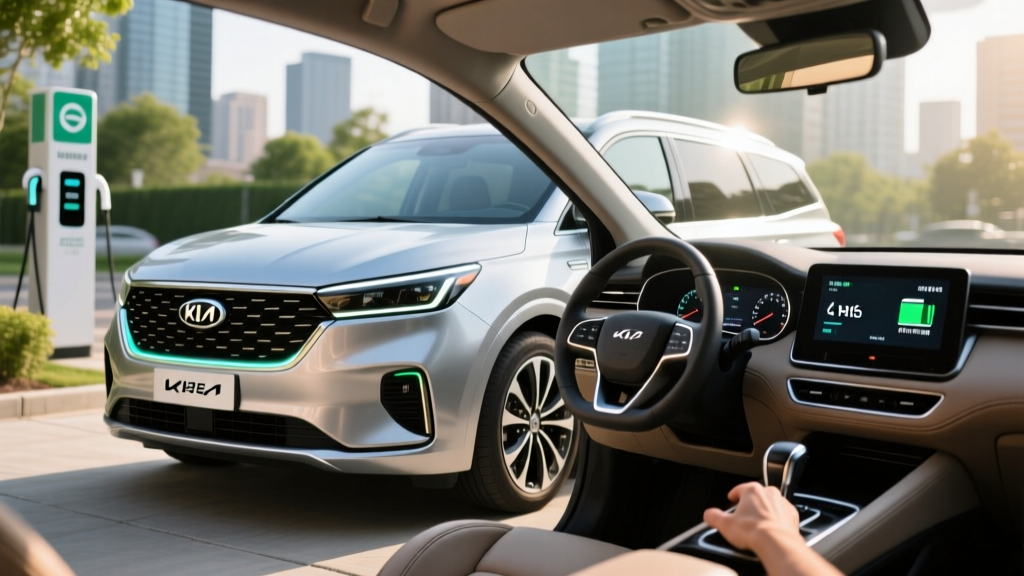
If you've searched for a Kia hybrid minivan, you've landed on the only option in Kia's lineup that fits the bill: the Kia Carnival Hybrid. Now in its second model year in the U.S. after debuting for 2025, the Carnival HEV pairs a turbocharged 1.6-liter engine with an electric motor to deliver meaningful fuel savings over the standard V6 Carnival — without requiring you to plug in, change your driving habits, or install a home charger.
But is it the right electrified family hauler for you? This guide breaks down the 2026 Carnival Hybrid's real-world MPG, powertrain specs, pricing, battery warranty, and how it stacks up against plug-in hybrid and full-electric alternatives.
2026 Kia Carnival Hybrid: Spec Overview
| Specification | 2026 Kia Carnival Hybrid (HEV) |
|---|---|
| Powertrain | 1.6L turbocharged 4-cyl + electric motor |
| Combined Horsepower | 245 hp / 271 lb-ft torque |
| Transmission | 6-speed automatic |
| EPA MPG (City / Hwy / Combined) | 34 / 31 / 34 |
| Drivetrain | FWD only |
| Seating | 7 or 8 passengers |
| Cargo Volume (behind 3rd row) | 41.1 cu ft |
| Cargo Volume (max, seats folded) | 145.1 cu ft |
| Towing Capacity | 3,500 lbs |
| Battery Warranty | 10 years / 100,000 miles |
| Starting MSRP | $40,490 (LXS trim) |
The Carnival Hybrid is a conventional hybrid (HEV), not a plug-in hybrid. It charges its small battery through regenerative braking and the gasoline engine — no charging cable required. This is a critical distinction that trips up many shoppers, so let's clarify it upfront.
HEV vs. PHEV vs. EV: Which Electrified Minivan Fits You?
Before we get deeper into the Carnival Hybrid's numbers, it's worth understanding the three electrified paths available to minivan buyers in 2026:
| Factor | HEV (Carnival Hybrid) | PHEV (e.g., Chrysler Pacifica Hybrid) | Full EV (e.g., upcoming electric minivans) |
|---|---|---|---|
| Plugs in? | No | Yes (Level 1 or 2) | Yes (Level 2 + DC fast) |
| Electric-only range | None (motor assists only) | ~32 miles | 250–350+ miles |
| Combined MPG / MPGe | 34 MPG | 30 MPG + 82 MPGe (electric) | 2.0–2.5 kWh/mi |
| Upfront cost premium | ~$1,500 over gas model | ~$6,000–$8,000 over gas | $10,000+ over gas (est.) |
| Home charger needed? | No | Recommended (Level 2) | Essential (Level 2, 240V) |
| Federal tax credit (§30D) | Not eligible | Eligible (up to $7,500)* | Eligible (up to $7,500)* |
| Best for | Drivers who want simple fuel savings | Short-commute families with home charging | EV-committed families with charging access |
*Federal §30D tax credit eligibility depends on buyer income caps, vehicle MSRP caps, and battery critical-mineral sourcing requirements per IRS guidelines. Consult a tax professional before purchasing.
The Carnival Hybrid is the simplest path: buy it, fill it with gas, and save roughly 25% on fuel compared to the non-hybrid V6 Carnival (which returns 22 MPG combined). No lifestyle changes required.
Fuel Economy: EPA Ratings and Real-World MPG
| Driving Scenario | EPA Estimate | Real-World Expectation |
|---|---|---|
| City | 34 MPG | 33–37 MPG (hybrids often exceed EPA in stop-and-go) |
| Highway | 31 MPG | 28–31 MPG (less regen benefit at sustained speed) |
| Combined | 34 MPG | 31–35 MPG depending on driving mix |
The 2026 Carnival Hybrid carries an EPA-estimated 34 MPG combined (34 city / 31 highway). That's a substantial improvement over the standard 3.5L V6 Carnival, which manages just 22 MPG combined.
Here's why the city number matters: conventional hybrids shine in stop-and-go traffic where regenerative braking recaptures energy and the electric motor handles low-speed driving. Expect the Carnival Hybrid to actually exceed its EPA city rating in heavy urban traffic — we've seen 36–37 MPG on mixed city routes in similar Hyundai/Kia 1.6T hybrid powertrains. Highway driving is where the advantage narrows, since sustained 70+ MPH speeds rely more on the gasoline engine and aerodynamic drag dominates.
Powertrain Deep Dive: 245 HP and How It Drives
The Carnival Hybrid uses Kia's proven 1.6-liter turbocharged GDI 4-cylinder paired with a 47.7 kW (64 hp) electric motor integrated into the transmission housing. Combined system output is 245 horsepower and 271 lb-ft of torque, routed to the front wheels through a 6-speed automatic transmission.
This is the same powertrain architecture found in the Hyundai Santa Fe Hybrid and Kia Sorento Hybrid, but tuned for the Carnival's heavier curb weight (~4,700 lbs). Performance is adequate rather than quick — expect 0–60 MPH in approximately 7.8 seconds, which is competitive with the Chrysler Pacifica Hybrid and noticeably slower than the V6 Carnival's ~7.1-second sprint.
For daily driving, the electric motor provides immediate low-end torque that makes the Carnival Hybrid feel responsive around town and in parking lots. Highway merging is confident. The transition between electric and gasoline power is smooth, and the 6-speed automatic avoids the rubber-band feel of the CVTs found in the Toyota Sienna hybrid.
What the Carnival Hybrid Does NOT Have
- No all-wheel drive: The Carnival Hybrid is FWD only. If you need AWD in a hybrid minivan, the Toyota Sienna (standard AWD on hybrid trims) is your alternative.
- No plug-in hybrid variant: Kia does not offer a Carnival PHEV in the U.S. market for 2026. The Chrysler Pacifica Hybrid remains the only PHEV minivan available.
- No DC fast charging capability: As a conventional HEV, there is no charging port. The ~1.5 kWh battery charges exclusively through regenerative braking and engine power.
Pricing, Trims, and Tax Credit Eligibility
The 2026 Kia Carnival Hybrid is offered across four trims. Here's the current MSRP breakdown:
| Trim | MSRP | Key Features |
|---|---|---|
| LXS | $40,490 | 8-passenger, 12.3" touchscreen, Highway Driving Assist |
| EX | $43,490 | Power sliding doors, power liftgate, leatherette seats |
| SX | $47,490 | Dual sunroof, Bose audio, surround-view monitor |
| SX Prestige | $51,990 | Nappa leather, VIP lounge rear seats, head-up display |
Does the Carnival Hybrid Qualify for a Federal Tax Credit?
No. The Kia Carnival Hybrid is a conventional HEV, not a plug-in vehicle. The federal §30D Clean Vehicle Credit applies only to battery electric vehicles (BEVs) and plug-in hybrid electric vehicles (PHEVs) that meet specific battery capacity, critical mineral sourcing, MSRP, and buyer income requirements. Since the Carnival Hybrid cannot be plugged in, it does not qualify for the §30D credit or the separate §25E used-EV credit.
Some states offer their own incentives for conventional hybrids, but these are increasingly rare as incentive programs shift toward plug-in vehicles. Check your state's energy office or department of environmental quality for any current hybrid rebates.
Battery Warranty, Reliability, and Replacement Cost
Hybrid battery longevity is consistently one of the top concerns for buyers switching from a conventional gas car. Here's what the data tells us:
Kia's 1.6T hybrid powertrain has been in production since the 2021 model year (Sorento Hybrid) and uses a relatively small lithium-ion polymer battery (~1.5 kWh). Unlike full EV batteries that undergo deep charge/discharge cycles, hybrid batteries operate in a narrow state-of-charge window (typically 40–80%) managed by the vehicle's battery management system. This shallow cycling dramatically reduces degradation.
Based on data from Hyundai/Kia's hybrid platform and comparable Toyota hybrid systems (which routinely exceed 200,000 miles without battery replacement), the Carnival Hybrid's battery should last the functional life of the vehicle for most owners. The 10-year/100,000-mile warranty provides substantial protection.
Battery Replacement Cost
If the hybrid battery does fail out of warranty, expect a replacement cost between $2,500 and $4,500 including parts and labor at a Kia dealership. This is significantly less than EV battery replacement ($8,000–$20,000+) because the hybrid battery pack is small. Third-party hybrid battery rebuild services can reduce this to $1,500–$2,500.
For context, the hybrid battery is a fraction of the cost of replacing a conventional minivan's transmission — a repair that typically runs $3,500–$5,500 on non-hybrid vehicles. The hybrid system's electric motor also reduces wear on the brake pads through regenerative braking, with many hybrid owners reporting 80,000–100,000+ miles on original brake pads.
Who Should Buy the Kia Carnival Hybrid (And Who Shouldn't)
- You want lower fuel costs without changing your routine (no plugging in)
- You drive 12,000–20,000 miles/year and want the payback to be fast
- You don't have access to home or workplace charging
- You prefer the Carnival's interior and styling over the Toyota Sienna
- You want a proven powertrain with a long warranty
- You want electric-only driving for school runs and errands (consider the Pacifica Hybrid PHEV)
- You need all-wheel drive (Toyota Sienna Hybrid offers AWD)
- You want to eliminate gasoline entirely (consider a full EV SUV like the Kia EV9)
- You're chasing the federal tax credit (HEVs don't qualify)
For families covering significant mileage — especially those with city-heavy commutes — the Carnival Hybrid is the most pragmatic electrified minivan choice in 2026. The fuel savings are real, the driving experience is refined, and there's zero charging infrastructure dependency.
Frequently Asked Questions
How many MPG does the Kia Carnival Hybrid get?
The 2026 Kia Carnival Hybrid is EPA-rated at 34 MPG city, 31 MPG highway, and 34 MPG combined. In real-world city driving with frequent stops, owners commonly report 35–37 MPG thanks to regenerative braking. Highway-only driving at 75+ MPH typically yields 28–31 MPG.
Can the Kia Carnival Hybrid drive on electric power only?
Only at very low speeds for short distances (under 1 mile at parking-lot speeds). The Carnival Hybrid is a conventional HEV with a small ~1.5 kWh battery — the electric motor primarily assists the gasoline engine rather than powering the vehicle independently. If you want meaningful electric-only range (32 miles), the Chrysler Pacifica Hybrid PHEV is the minivan to consider.
Is the Kia Carnival Hybrid reliable?
The 1.6T hybrid powertrain has been in production since 2021 across multiple Hyundai/Kia models with no widespread failure patterns reported. Kia backs the hybrid battery and hybrid system components with a 10-year/100,000-mile warranty. The Carnival as a nameplate earned a Top Safety Pick+ rating from IIHS for the most recent tested model year.
Does the Kia Carnival Hybrid qualify for any tax credit?
No. The federal §30D Clean Vehicle Credit applies only to plug-in vehicles (BEVs and PHEVs). The Carnival Hybrid is a conventional HEV that does not plug in, making it ineligible for federal EV tax credits. Some states may offer hybrid-specific incentives, but these are uncommon. Check your state's official energy website for current programs.
How does the Carnival Hybrid compare to the Toyota Sienna Hybrid?
The Toyota Sienna Hybrid is the Carnival Hybrid's closest competitor. The Sienna achieves a higher 36 MPG combined and offers available AWD, but it's only available as a 4-cylinder hybrid (no V6 option) with 245 combined HP. The Carnival Hybrid offers a more premium interior, available VIP lounge seating, and slightly more cargo space. Both carry 10-year hybrid battery warranties. If AWD is essential, choose the Sienna. If interior luxury and tech matter more, the Carnival Hybrid has the edge.
What does it cost to replace the hybrid battery?
Out-of-warranty replacement for the Carnival Hybrid's lithium-ion battery pack typically costs $2,500–$4,500 at a dealership. Independent hybrid battery specialists may offer rebuilt packs for $1,500–$2,500. Given the shallow-cycling design and Kia's 10-year warranty, most owners will never face this expense.